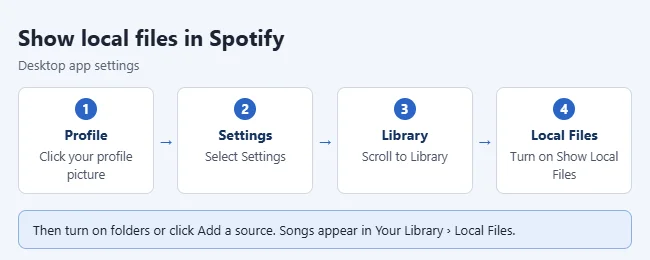
To show local files in the Spotify desktop app, click your profile picture, choose Settings, find Library, and turn on Show Local Files. Then pick the folders Spotify should read, and your songs appear under Local Files in Your Library.
These steps cover the current Spotify app for Windows and Mac, plus the Spotify app on iPhone and Android, where the switch is called Local audio files. They follow Spotify’s Local files help article and the Spotify Community’s Local Files FAQ.
What Local Files Are
A local file is a song stored on your own computer or phone instead of in Spotify’s catalog. It might be an MP3 you bought, a CD you ripped, or a recording you made. Spotify can play these files next to its own songs and let you add them to your playlists, but it never uploads them. The file stays where it is, and it only plays on the device where it’s stored.
That last point explains most problems people run into. Turning on the setting on your computer does nothing for your phone, and the reverse is also true. Each device needs the setting turned on and its own copy of the music.
Before You Start
- Update Spotify. Spotify’s first troubleshooting step is to make sure the app and your device are up to date. Older versions put this setting in a different place.
- Use the desktop or mobile app. Spotify’s instructions cover the installed apps on computers and phones. They don’t describe local files in the web player.
- Check your file types. The Community FAQ lists .mp3, .mp4, and .m4p as supported. It says .mp4 files that contain video and iTunes lossless (ALAC) .m4a files aren’t supported.
- Use music you own. The FAQ says files from unofficial sources aren’t permitted and are a likely reason a track won’t play.
How to Show Local Files on a Computer
These steps work in the Spotify app for Windows and Mac.
- Click your profile picture at the top of the Spotify window and select Settings. The Settings page opens.
- Scroll to the Library section.
- Turn on Show Local Files. A Show songs from list appears under the switch.
- Under Show songs from, turn on each folder you want Spotify to read, and turn off any you don’t. Spotify usually lists your Downloads and Music Library folders by default.
- To use a different folder, click Add a source, browse to the folder that holds your music, and select it. Make sure its switch is on.
- Go to Your Library and open Local Files.
The Local Files list shows every supported song in the folders you turned on. Click a song to play it. Spotify doesn’t copy anything, so new songs you save to one of those folders show up in Local Files the next time Spotify checks the folder.
Add local files to a playlist
Local Files works like a playlist of its own, but you can also mix your songs into any playlist you made. Spotify’s create playlists article lists two ways:
- Right-click a song in Local Files, or click the three dots next to it.
- Choose Add to Playlist and pick the playlist.
You can also drag a song from Local Files onto a playlist in the sidebar. To start a new playlist, press Ctrl + N on Windows or Cmd + N on a Mac. For more playlist tips, see how to create and download a Spotify playlist.
Keep your music easy to find
Spotify reads whole folders, so a little organization saves time later. Put your music in one or two dedicated folders and add those as sources, rather than turning on Downloads, which fills up with other files. If your music lives on an external drive, add the folder on that drive with Add a source. The songs only appear while the drive is connected.
How to Show Local Files on iPhone
On an iPhone, Spotify reads music from its own folder in the Files app. You turn on the setting first, then copy music into that folder.
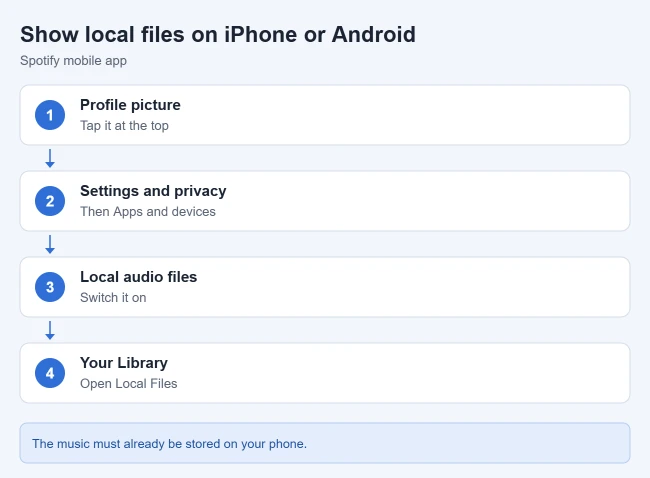
- Open Spotify and tap your profile picture at the top.
- Tap Settings and privacy, then tap Apps and devices.
- Switch Local audio files on.
- Go to Your Library and open Local Files.
Music saved in the Spotify folder on your iPhone appears in Local Files. If you haven’t added any yet, the list stays empty until you do. Spotify notes that you may need to allow access in your device settings.
Get music into the Spotify folder on iPhone
The Spotify folder lives at On My iPhone > Spotify in the Files app. Files stored in iCloud Drive don’t count, so move or copy the music into this folder.
- From the Files app: find the song in a browser’s downloads or a storage app’s folder, touch and hold it, and choose Copy or Move. Browse to On My iPhone, open the Spotify folder, and paste or move it there.
- From a Mac with a cable: connect the iPhone with a USB cable and open a Finder window. Select the iPhone in the sidebar, click the Files tab, and drag your songs onto Spotify. Apple’s Finder file sharing guide covers this method.
- From a Mac with Universal Clipboard: copy the file on your Mac, then paste it into the Spotify folder on your iPhone. Apple says both devices need the same Apple Account, Wi-Fi and Bluetooth turned on, and Handoff on.
- From a Windows PC: connect the iPhone with a USB cable and open the Apple Devices app. Click Files, select Spotify, click Add File, choose your songs, and click Add. Apple’s Apple Devices file sharing article has the details. Older setups that still use iTunes work the same way through its File Sharing section.
If the Spotify folder disappears from On My iPhone, Spotify says the Help file inside it was probably deleted. Close and reopen Spotify to bring the folder back.
How to Show Local Files on Android
- Open Spotify and tap your profile picture, then tap Settings and privacy.
- Tap Apps and devices, and under Other devices, switch Local audio files on.
- Go to Your Library and open Local Files.
- When Android asks, allow Spotify to access your music and media files. The wording of this prompt depends on your Android version.
Music files saved on your phone appear in Local Files. To get files onto the phone, Spotify suggests downloading them from an app such as Google Drive, or connecting the phone to a computer with a USB cable and copying them over. On a Windows PC, tap Allow or choose file transfer on the phone’s prompt, then drag the songs into the phone’s Music folder in File Explorer. A Mac needs an Android file transfer app for this.
If you tapped Don’t allow by mistake, open your phone’s Settings, go to Apps > Spotify > Permissions, and allow access to music and audio. Menu names can vary by phone maker.
How to Check That It Worked
- Local Files is listed in Your Library. If it’s missing, the setting is off on that device.
- The song count looks right. Compare a few songs in Local Files with the folder on your computer or phone.
- A song plays all the way through. Play one track, then add it to a playlist to make sure it behaves like any other song.
To undo the change, go back to the same setting and turn off Show Local Files on a computer or Local audio files on a phone. Local Files disappears from Your Library, and your music files stay where they are. Turning off one folder under Show songs from hides only that folder’s songs.
Local Files Not Showing or Playing?
Work through these in order. Most problems are solved by the first two.
- The setting is off on this device. Turn on Show Local Files or Local audio files on the device you’re using. Each computer and phone has its own setting.
- The folder isn’t turned on. On a computer, check that the folder holding the song is listed under Show songs from with its switch on. If you moved your music, add the new folder with Add a source.
- The file type isn’t supported. Spotify plays .mp3, .mp4, and .m4p files, per the Community FAQ. Video .mp4 files and iTunes lossless .m4a files won’t show up or won’t play. If you have FLAC files, the FAQ says updating your computer’s codec pack can help. Converting the file to MP3 with a music app you trust is the other option.
- The file is protected. Songs with copy protection (DRM, digital rights management) may not play. The FAQ suggests checking that the file isn’t protected. It also notes some protected tracks may play if QuickTime is installed on your computer.
- Spotify can’t reach the folder on a Mac. Open the Apple menu > System Settings > Privacy & Security > Files & Folders, find Spotify, and turn on the folders it needs, as Apple’s Files & Folders guide describes. Then quit and reopen Spotify.
- The song is grayed out. The file was usually moved, renamed, or deleted, or the drive it’s on is disconnected. Put it back in an active folder or reconnect the drive.
- It won’t play on a speaker or TV. The Community FAQ says local files can’t play through Spotify Connect, the feature that sends music to another device. Play the song on the device where it’s stored, or use a Bluetooth connection.
- It still doesn’t work. Spotify suggests updating the app and device, removing local files from any playlists, and repeating the setup steps. If that fails, do a clean reinstall. Back up anything you need first, because you’ll have to download your offline music and podcasts again afterward.
Frequently Asked Questions
Do I need Premium for local files?
Spotify’s local files help article doesn’t list Premium as a requirement for the steps above. If the setting is missing, update the app first.
Can I sync local files from my computer to my phone over Wi-Fi?
Spotify’s current instructions don’t use Wi-Fi syncing. Instead, each device plays music from its own storage, so copy the files onto your phone with one of the methods above. Some older guides describe a sync method; it isn’t part of Spotify’s current help article.
Do local files crossfade?
Yes, with a condition. Spotify says crossfade works between local files that use the same sample rate and the same channel count (mono or stereo). Albums that mix formats may switch without a fade. You can adjust crossfade with Spotify’s sound settings.
Where are my local files stored?
They stay exactly where you saved them. Spotify only reads the folders you turned on; it doesn’t move or upload your music. Deleting a song from the folder removes it from Local Files.
Can I use local files on more than one computer?
Yes, but each computer needs its own copy of the music and the setting turned on. A song you add on one computer won’t appear on another.
More Spotify how-tos: turn off shuffle, and if the desktop app lags, try changing the hardware acceleration setting in Spotify. If Spotify is filling up your phone, see how to clear the Spotify cache.

Matthew Burleigh is the founder, head writer, and editor of Solve Your Tech, which he launched in 2012. He has written technology tutorials since 2008 and worked in IT since 2003, including small-business support, IT management, and consulting. He holds Bachelor’s and Master’s degrees in Computer Science from Arizona State University.
Matthew writes practical guides for Windows, iPhone and iPad, Microsoft Office, Outlook, Google apps, and Android. Solve Your Tech’s guides are checked step by step against the device or app maker’s own documentation and tested on his own devices whenever he has the hardware or software, with clear steps, sources, and update dates.
Read more about Matthew and how Solve Your Tech writes and updates its guides, or report a correction.