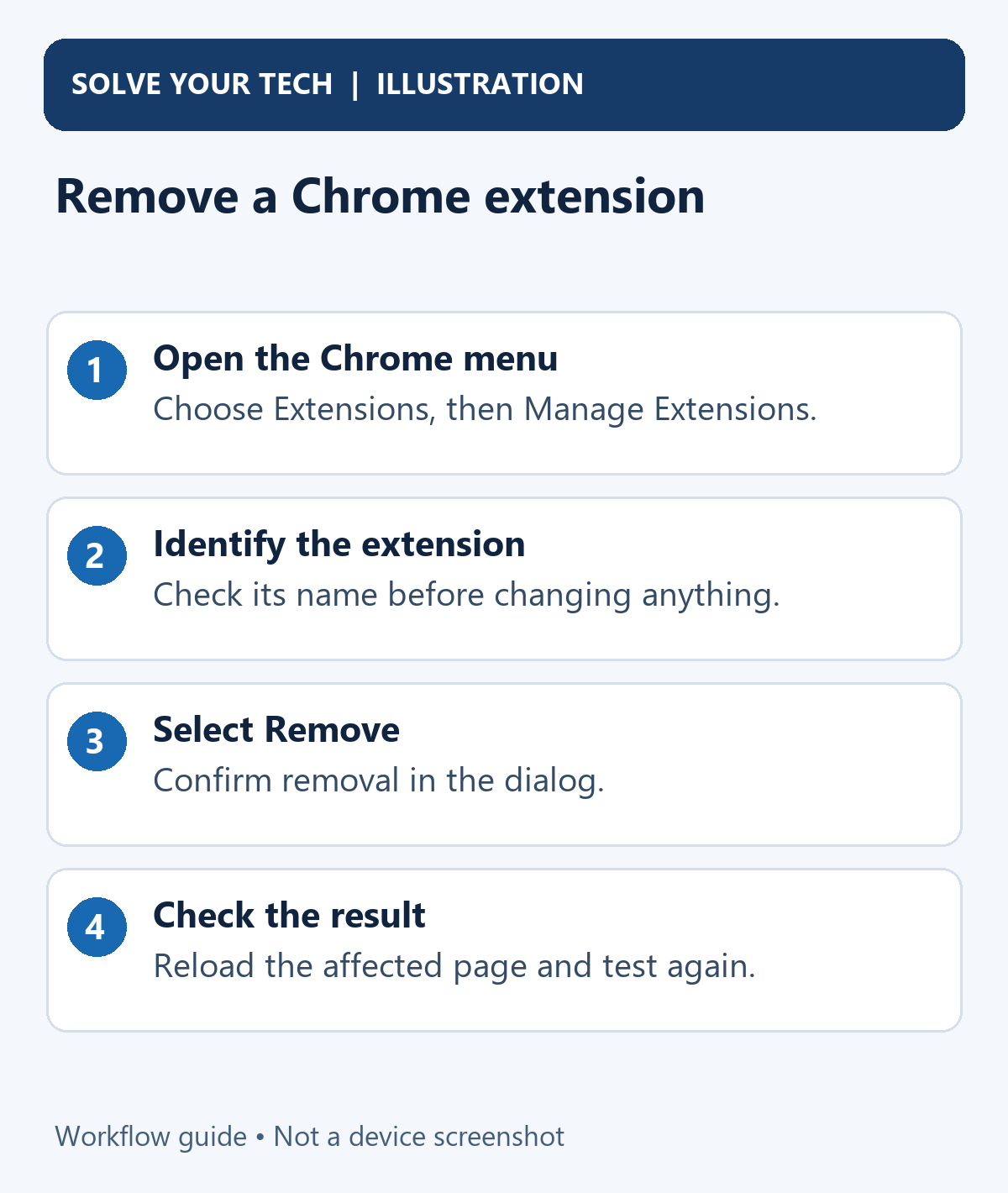
To remove a Chrome extension on your computer, open the three-dot menu > Extensions > Manage extensions, find the extension, and select Remove. Select Remove again to confirm. If its icon is visible beside the address bar, right-click that icon and choose Remove from Chrome.
These instructions cover desktop Google Chrome. An extension is an add-on that changes or adds browser features. Removing an extension is different from uninstalling Chrome, deleting a Chrome profile, or removing a website shortcut. If you want to remove an installed visual theme, use the Chrome theme reset in Appearance instead.
Choose Between Removing, Disabling, and Unpinning
Before you remove an extension you use for important work, check whether it stores settings or data that you need. For example, export important information using the extension’s own tools if its developer provides an export option. Reinstalling the extension does not guarantee recovery of its local settings. If the extension is a site blocker, removing it also removes its blocks, so see how to block a website on Chrome for other methods.
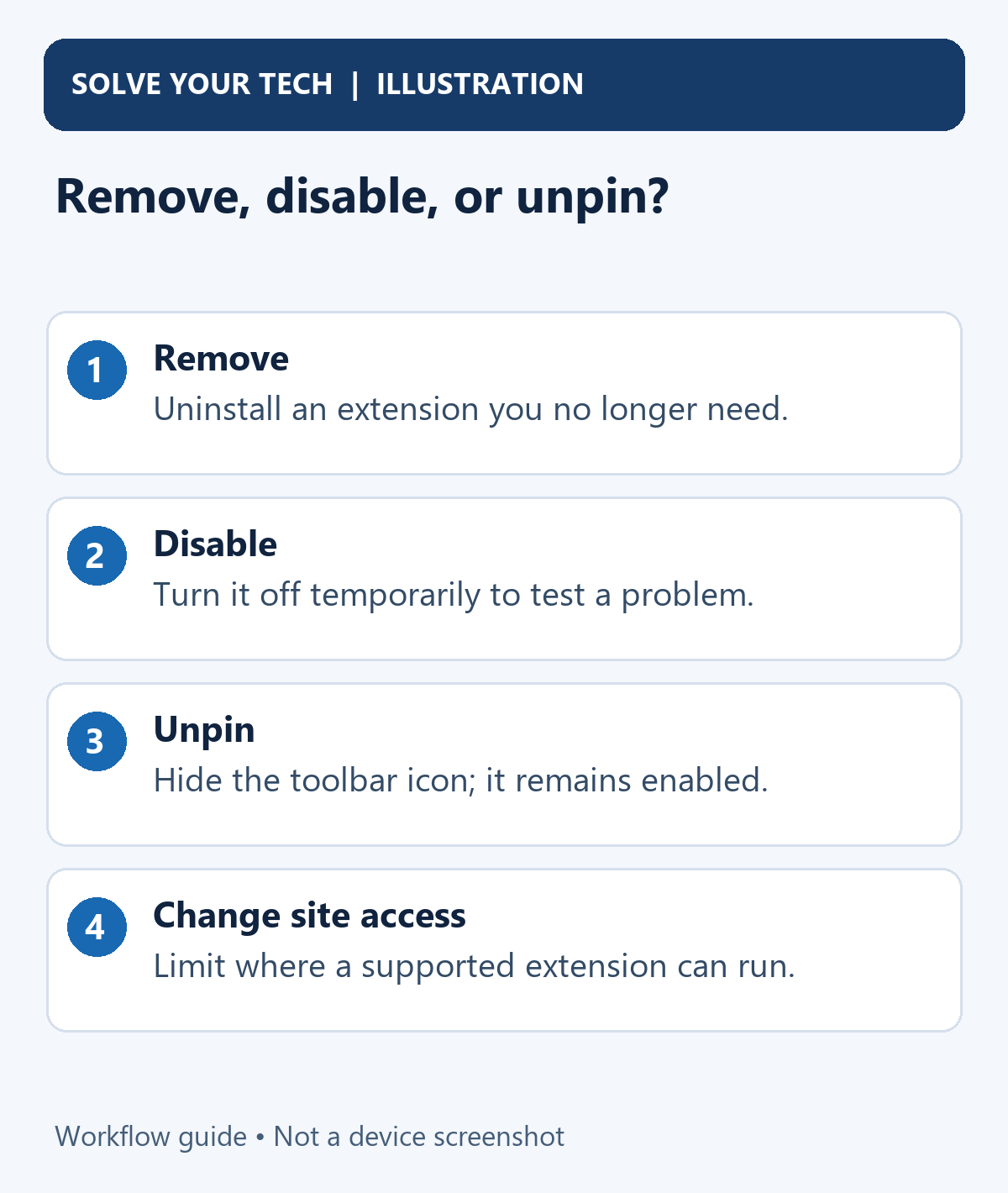
| Action | What changes | When it is useful |
|---|---|---|
| Remove | Uninstalls the extension from that Chrome profile | You no longer want the add-on |
| Turn its switch off | Leaves it installed but disables it | You want to test whether it causes a problem |
| Unpin | Hides its toolbar icon | You want less toolbar clutter while keeping the extension |
| Limit site access | Changes which permitted websites it can read or modify | You want to keep the extension with narrower access |
Unpinning does not uninstall an extension or stop it from working. Conversely, an extension without a visible toolbar icon can still be installed.
Remove an Extension From the Extensions Page
- Open Chrome on your computer. If you use multiple profiles, select the profile where the unwanted extension appears. Profiles can have different extension lists.
- Select the three-dot menu at the top right. This opens Chrome’s main menu.
- Choose Extensions > Manage extensions. Chrome displays the installed extensions as cards. Older screenshots may show More tools > Extensions instead.
- Locate the correct extension. Check its name and, if necessary, open Details to identify it. Avoid removing another extension just because its icon looks similar.
- Select Remove on that extension’s card. Chrome displays a confirmation.
- Select Remove again. The card disappears from the installed list. If the extension had a toolbar icon, that icon should disappear too.
- Reload the affected webpage if needed. A page opened before removal can still show interface elements that were already inserted into it. Check a newly loaded page before deciding that removal failed.
You can also type chrome://extensions/ into Chrome’s address bar and press Enter to open the installed extension list directly. Enter it in the browser’s address bar, rather than a search field inside a website.
Google’s extension management instructions describe the current menu route, removal confirmation, switches, and permissions.
Remove an Extension Using Its Toolbar Icon
- Find the extension’s own icon to the right of the address bar.
- Right-click the icon. On a Mac, use the equivalent secondary click if your pointing device is configured differently.
- Select Remove from Chrome.
- Confirm removal in the dialog that opens.
If you do not see the icon, use Manage extensions instead. The puzzle-piece Extensions button is Chrome’s menu for extensions; it is not one particular add-on that you should uninstall.
To hide an icon while keeping its extension, use Unpin instead. The extension remains available from the Extensions menu.
Disable an Extension for Troubleshooting
Open Manage extensions and turn off the switch on the extension’s card. The extension stays listed, so you can turn the switch back on later.
For a webpage problem, disable the extension, reload that webpage, and repeat the action that previously failed. If the problem stops, you have a useful lead. It does not prove that every other extension is working correctly.
When investigating an extension problem, check the Chrome version and apply available updates before comparing your menu with an older guide. Record the full version if the problem continues.
If several extensions may be involved, disable them and re-enable one at a time, checking the same webpage after each change. Keep notes on which switch you changed so you can restore extensions you still need.
For a performance problem, our Chrome Task Manager guide explains how to inspect Chrome processes. Removing an extension does not guarantee that a slow computer will become fast; tabs, websites, other programs, and available memory also matter.
Restrict Site Access Instead of Removing the Extension
If your concern is which websites an extension can access, open its Details page and review Site access. Depending on the extension’s permissions, Chrome offers access when you select the extension, on specific sites, or on all matching sites.
Choose the narrowest access that still supports the task you want the extension to perform. An extension that needs access to a particular website may stop working there if you remove that access.
Google notes that these controls apply to matching site permissions. They do not necessarily limit lower-level network changes made by VPN or proxy extensions. Site access is a permission setting, not a universal way to contain every extension feature.
Incognito access is separate. Where available, Details > Allow in incognito controls whether the extension is allowed in those windows. Disabling that permission does not uninstall the extension from normal browsing.
If Chrome Will Not Let You Remove It
The extension is installed by your organization
A work or school administrator can force-install an extension. Google confirms that users cannot remove force-installed items themselves. Ask the administrator to review it, and provide the extension name and the message shown on its card.
To check whether the browser is managed, look at the bottom of Chrome’s three-dot menu for Managed by your organization, or open chrome://management. A management message alone does not establish that the extension is malicious.
If this is your personal computer and you do not expect management, review the account and device administrator involved. Do not begin by deleting registry keys or Chrome profile folders based on an online removal shortcut. That changes more than the extension and can damage or override legitimate configuration.
Google’s managed-browser help explains the distinction, and its force-installation documentation explains why the normal Remove button can be unavailable.
The extension returns after removal
Record when it returns: immediately, after restarting Chrome, or after signing in. Check that you are viewing the same profile and look for a management notice or another installed program that supplies the extension.
On a personal device, check for unwanted software with your operating system’s trusted security tools. Google recommends an antivirus or anti-malware scan when suspicious software repeatedly changes extension files. Avoid downloading a “removal tool” from the same unexpected pop-up that prompted your concern.
For broader unwanted settings, our Chrome reset guide explains what a reset changes. Read those effects before proceeding. A reset is broader than removing one extension and is not a guaranteed fix for administrator-enforced settings.
Chrome says the extension is corrupted or unsupported
If you trust a corrupted extension and want to retain it, Google provides a Repair option. That serves a different purpose from Remove. If corruption repeats, investigate software that may be changing its files.
For an unsupported extension that Chrome disabled, removing it or finding a maintained alternative is preferable to treating its disabled state as a reason to bypass the warning. Review the replacement’s developer, purpose, and requested permissions before installing it.
Verify the Result and Restore an Extension if Needed
Reopen Manage extensions and confirm the removed card is absent. Then load a page where the extension previously appeared. For an extension that changed your start page or search engine, check those settings separately. Verify them after removal rather than assuming that every change has been undone.
If you removed the wrong extension, find its legitimate Chrome Web Store listing and reinstall it. Review the permissions again. Its developer’s account or synchronization features may restore some data, but local information is not guaranteed to return.
Common Questions
Will removal delete my bookmarks and passwords?
The extension’s Remove command is not Chrome’s profile deletion command. However, data held inside the extension itself can have different storage rules. Preserve important extension data before removal.
Can I remove an extension from the Chrome app on my phone?
This procedure manages desktop Chrome extensions. Google’s Add to Desktop option on a phone adds an extension for the desktop browser; it is not a phone extension manager. Do not follow Android instructions written for a different browser as though they describe ordinary Chrome.
Is switching it off enough?
Switching it off is useful for a reversible troubleshooting check. Remove it when you want it uninstalled. Hiding the toolbar icon accomplishes neither action.
Start with the extension’s name on Manage extensions. That gives you a clear way to choose the correct action and verify exactly which add-on changed.

Matthew Burleigh is the founder, head writer, and editor of Solve Your Tech, which he launched in 2012. He has written technology tutorials since 2008 and worked in IT since 2003, including small-business support, IT management, and consulting. He holds Bachelor’s and Master’s degrees in Computer Science from Arizona State University.
Matthew writes practical guides for Windows, iPhone and iPad, Microsoft Office, Outlook, Google apps, and Android. Solve Your Tech’s guides are tested on current devices or checked against official product documentation, with clear steps, sources, and update dates.
Read more about Matthew and how Solve Your Tech writes and updates its guides, or report a correction.