To record a phone call on an iPhone with iOS 18.1 or later, tap the More button during the call and select Call Recording. Everyone on the call hears an audio notice that it’s being recorded, and the recording is saved to a Call Recordings folder in Notes. For an in-person conversation, use the Voice Memos app.
This guide covers the iPhone’s built-in tools only: Call Recording in the Phone app and Voice Memos. It explains where recordings are saved, how to get a transcript, what to do if Call Recording is missing, and how to get clearer in-person recordings. Always get permission before you record someone.
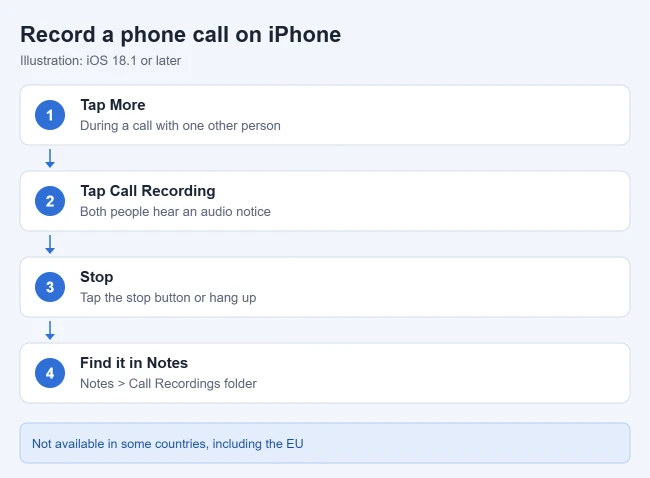
Record a Phone Call
- Make or answer a call in the Phone app. Call Recording works when you’re talking to one other person.
- Tap the More button. Result: more call options appear.
- Tap Call Recording. Result: both people hear an audio notice that the call is being recorded.
- To stop, tap the stop button or just hang up. Result: the recording is saved automatically. Tap View Saved Call to open it in Notes.
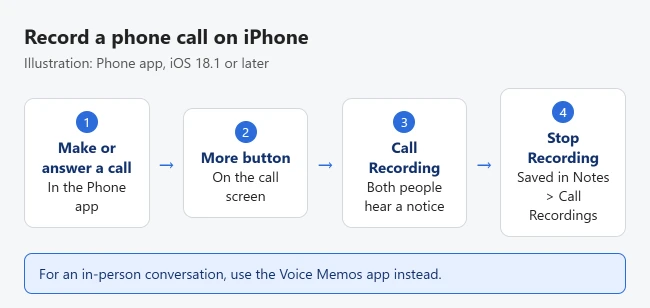
These steps follow Apple’s iPhone User Guide. Apple’s support video on call recording says it also works for FaceTime audio calls.
- Play it: open Notes, go to the Call Recordings folder, tap the note, then tap play.
- Transcript: in select regions and languages, a transcript appears in the note, with each speaker identified. It may take a moment. Apple advises checking a transcript’s accuracy before relying on it.
- Summary: on iPhones that support Apple Intelligence, you can tap Summary to read a short summary of the call.
- Save or share the audio: tap the recording, tap the More button, and choose Save Audio Files or Share Audio. You can also copy the transcript.
- Delete it: tap the More button, then Delete. Apple notes that deleting the audio also deletes the transcript.
If You Don’t See Call Recording
- Update your iPhone: you need iOS 18.1 or later. Go to Settings > General > Software Update.
- Check the setting: Call Recording is on by default, but it can be turned off. Go to Settings > Apps > Phone > Audio Call Recording and turn it on.
- Check your region: Apple says call recording isn’t available in the European Union and several other countries, including Russia, Saudi Arabia, South Africa, Turkey, and the United Arab Emirates. The full list is in Apple’s guide.
- Only two people: the option applies to calls with one other person, not conference calls.
Record an In-Person Conversation With Voice Memos
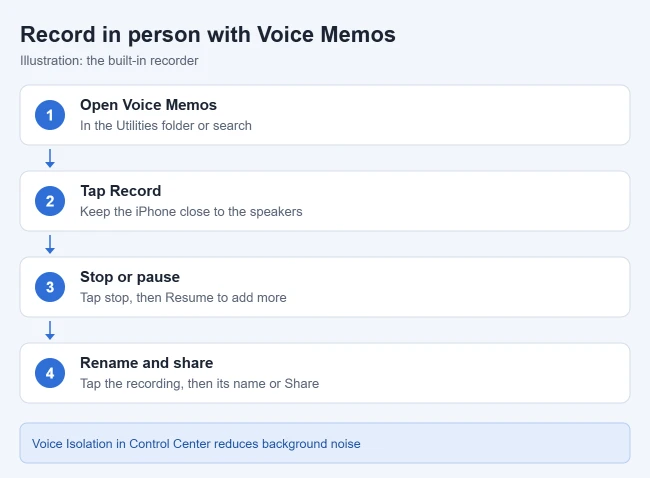
- Open Voice Memos. It’s in the Utilities folder, or search for it. Result: your list of recordings appears.
- Tap the red Record button. Result: the waveform moves and an orange dot shows the microphone is in use.
- Keep the iPhone close to the people speaking. Apple says moving the microphone closer or farther is how you adjust the level.
- Tap stop to pause, then Resume to keep recording in the same file, or Done to save.
- Tap the recording and then its name to rename it. It’s saved as New Recording or with your location name.
Apple’s Voice Memos guide also notes that you can use another app while recording, as long as it doesn’t play audio. To stop Voice Memos from naming recordings by place, see how to stop Voice Memos from naming recordings by location.
Get clearer recordings
- Reduce background noise: while Voice Memos is open, open Control Center, tap Voice Memos at the top, and choose Voice Isolation. Choose Wide Spectrum to keep room sound (not on every model).
- Recording mode: go to Settings > Apps > Voice Memos > Recording Mode and choose Mono, Stereo, or Spatial Audio, depending on your iPhone.
- Use a microphone: Voice Memos works with a supported headset or external microphone.
- Silence the tones: turn on Silent mode to mute the start and stop sounds.
For more Voice Memos tips, see how to record audio on iPhone.
Other Ways to Record a Call
- Google Voice: if you use a Google Voice number with a personal Google account, Google says you can record incoming calls with the dialpad after turning on Incoming call options in Voice settings at voice.google.com. Voice announces the recording to everyone on the call.
- Speakerphone and a second device: put the call on speaker and record it with Voice Memos on another phone, tablet, or computer. Tell the other person first.
- Recording apps: many App Store apps route calls through a conference line to record them. They often need a subscription, and how they handle your data varies, so read the privacy details before using one.
The built-in Call Recording is the simplest choice where it’s available, because it needs no extra app and announces itself automatically.
Get Permission First
Recording laws differ by state and country. Some places require everyone’s consent to record a conversation, including in-person talks. Tell people when you’re recording them, and check the rules where you live. This isn’t legal advice.
Frequently Asked Questions
Can I turn off the recording notice?
No. The notice is part of the feature, and Apple says both participants hear it.
Where are call recordings saved?
In the Call Recordings folder in the Notes app. If you sync Notes with iCloud, they should also appear on your other Apple devices signed in to the same account.
Can I record a conversation without an app?
Yes. Call Recording and Voice Memos are both built into the iPhone, so you don’t need to download anything.
How do I share a recording?
For a call recording, open the note, tap the recording, tap the More button, and choose Share Audio or Save Audio Files. In Voice Memos, tap the recording and then the Share button.
Want to send a recording to someone? See how to share a voice memo via text message.

Matthew Burleigh is the founder, head writer, and editor of Solve Your Tech, which he launched in 2012. He has written technology tutorials since 2008 and worked in IT since 2003, including small-business support, IT management, and consulting. He holds Bachelor’s and Master’s degrees in Computer Science from Arizona State University.
Matthew writes practical guides for Windows, iPhone and iPad, Microsoft Office, Outlook, Google apps, and Android. Solve Your Tech’s guides are tested on current devices or checked against official product documentation, with clear steps, sources, and update dates.
Read more about Matthew and how Solve Your Tech writes and updates its guides, or report a correction.