To publish a Google Sheet to the web as a PDF, open the spreadsheet, go to File > Share > Publish to web, choose PDF document (.pdf) in the format menu on the Link tab, and click Publish. Google gives you a public link that opens a PDF version of the sheet, and anyone with that link can view it without a Google account.
These steps are for Google Sheets in a web browser on a Windows PC, Mac, or Chromebook. The menu path matches Google’s guide to making Docs, Sheets, and Slides files public. The Google Sheets app on iPhone, iPad, and Android doesn’t offer Publish to web, so you’ll need a computer.
Before You Publish: Check for Private Data
Publishing makes the content public, so look over the sheet first. Google warns that anyone who can see a published chart can see the data behind it. Notes, helper columns, and old figures on the published tabs can end up in front of strangers too.
- Publish only the tab you need. If the rest of the file is working data, keep it unpublished.
- Don’t count on hidden rows or columns. Hiding is a display setting, not a privacy control, and the data is still in the sheet. Move sensitive data to a tab you don’t publish instead.
- Build a clean public tab if needed. The publish settings work by whole sheets, not by cell range. To share only some cells, add a new tab, point its cells at the data you want with simple formulas such as =Data!A1, and publish just that tab. Viewers see the values, not the formulas.
- Know that there’s no password. A published link has no password option. Anyone who has the link, or finds it on a page where you posted it, can open the PDF.
Publish a Google Sheet as a PDF
- Go to sheets.google.com on a computer and open the spreadsheet. You need to be the owner or an editor of the file.
- Click File in the menu bar under the file name. The File menu opens.
- Point to Share, then click Publish to web. The Publish to the web window opens with two tabs, Link and Embed. Stay on Link.
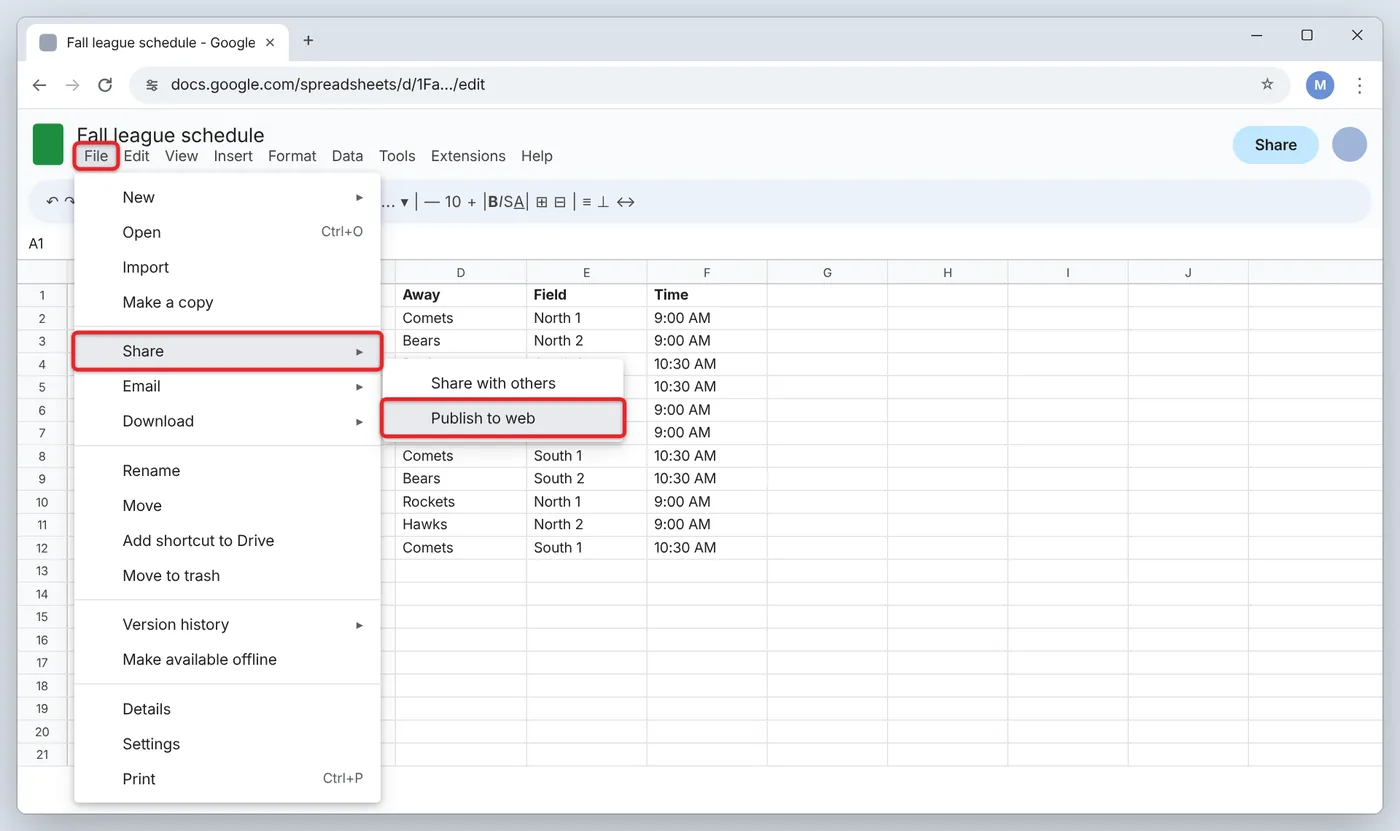
- Click the first dropdown menu, which says Entire document by default. Choose Entire document to publish every tab, or pick a single sheet by its tab name.
- Click the second dropdown menu, which says Web page by default, and choose PDF document (.pdf).
- Click Published content & settings at the bottom of the window to expand it. Check that Automatically republish when changes are made is turned on if you want the PDF to keep up with your edits. Uncheck it if you want the PDF to stay as it is right now.
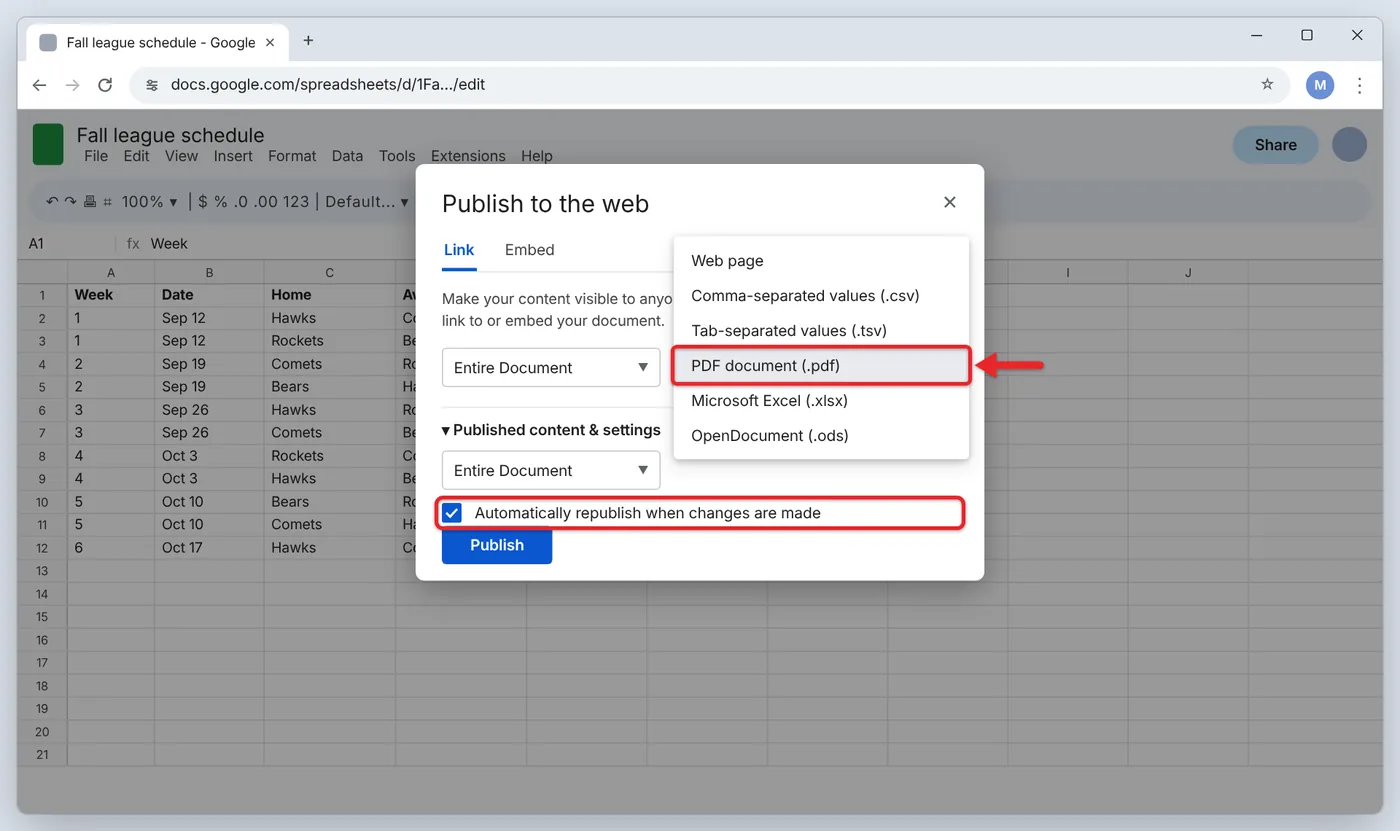
- Click Publish. A confirmation box asks if you’re sure you want to publish the selection.
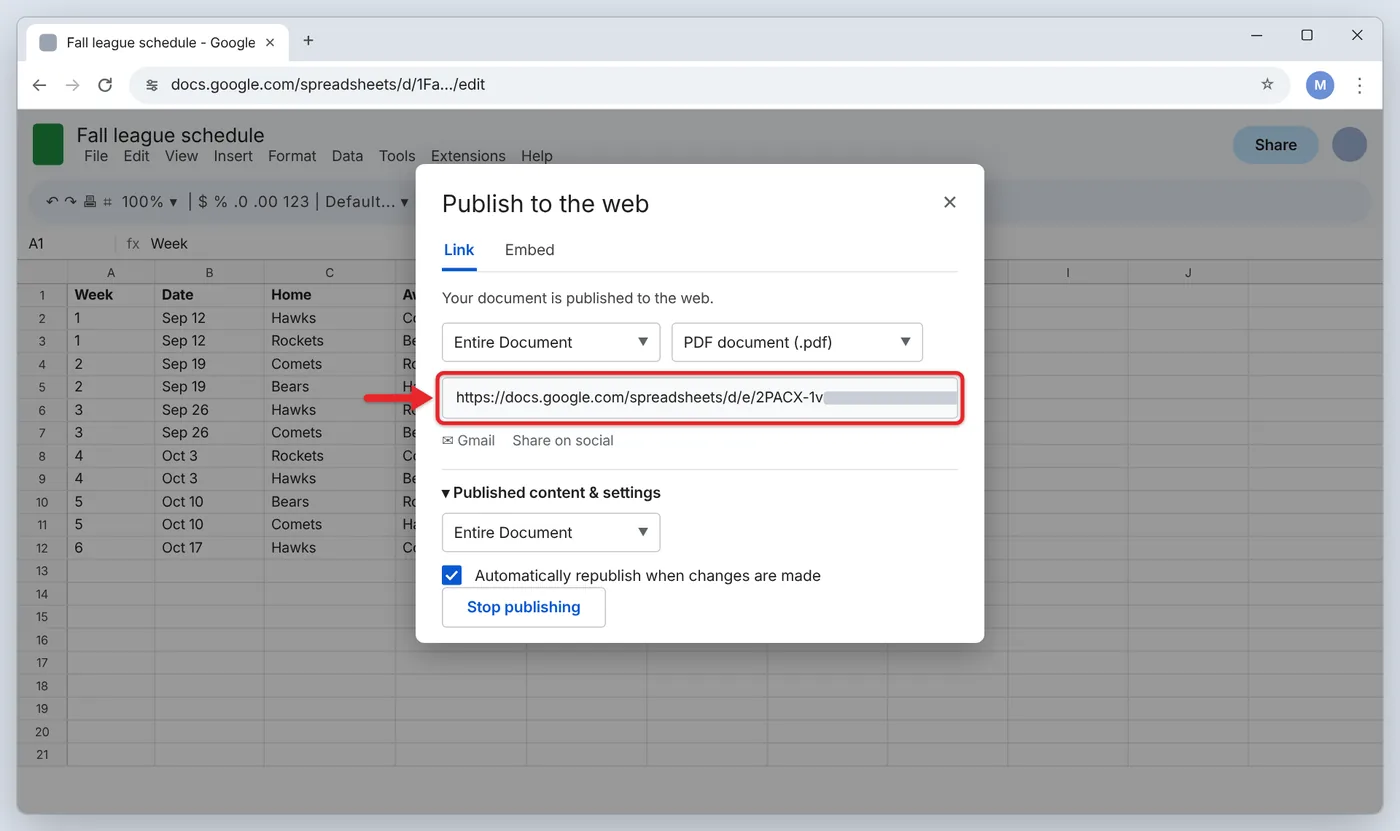
- Click OK. A link appears in the window.
- Click the link box, then press Ctrl + C (Windows or Chromebook) or Command + C (Mac) to copy it.
Check that it worked
Paste the link into a private or incognito browser window, where you aren’t signed in. You should see a PDF of the sheet, or your browser downloads it, depending on how your browser handles PDFs. This is exactly what a stranger sees, so it’s the best place to catch a tab or a number that shouldn’t be there.
With automatic republishing on, changes can take a few minutes to show up in the published version. Wait a bit and reload before you assume something is broken.
Tips for a cleaner PDF
The published PDF uses the spreadsheet’s content and formatting, but you don’t get the print-layout options you see when downloading. A few changes to the sheet itself make the PDF easier to read:
- Publish a single tab instead of the entire document, so readers don’t get pages of working data.
- Delete or move empty rows and columns at the edges of the data.
- Make column widths fit the content so text isn’t cut off. Double-click the right edge of a column letter to fit it to its contents.
- Put a title and an “updated” date in the top rows, so readers know what they’re looking at and how current it is.
- If you need exact paper size, margins, orientation, or a fit-to-page layout, download the PDF instead and share the file.
Change What’s Published or Stop Publishing
You can come back to the same window at any time.
- Open the spreadsheet and go to File > Share > Publish to web.
- Click Published content & settings.
- To change which tabs are public, use the dropdown under Published content & settings and check or uncheck sheets.
- To stop automatic updates, uncheck Automatically republish when changes are made.
- To take the PDF offline, click Stop publishing. This removes the file from the web, so the link stops working for everyone.
Stopping publishing doesn’t change who the spreadsheet is shared with. To remove people’s access to the file itself, change its sharing settings separately. If you publish again later, check that the link still works before you send it out, and update it anywhere you posted it if it changed. Anyone who already downloaded the PDF keeps their copy, so stopping publishing can’t pull back files people saved.
Google Sheets has three ways to get a spreadsheet in front of other people, and they’re easy to mix up:
- Publish to web creates a public, view-only link. When you pick PDF, the link opens a PDF of the sheet. The PDF can update itself when you edit the spreadsheet, so the link always points to the current numbers. Use this for a price list, schedule, or sign-up results you want to post on a website or send out once.
- Download as PDF (File > Download > PDF) saves a PDF file to your computer. It’s a snapshot that won’t change, and you can choose paper size, margins, and scaling first. For that method, read about converting a Google Sheet to PDF, Excel, or CSV.
- Share gives specific people, or anyone with the link, access to the live spreadsheet itself, including formulas and, if you allow it, editing. Here’s how to share or unshare a Google Sheets file.
Publishing doesn’t change your sharing settings. Viewers of the published PDF can’t see the spreadsheet itself or open its edit page unless you also share it with them.
| If you want to… | Use |
|---|---|
| Post one link that always shows the latest numbers | Publish to web as PDF |
| Send a fixed copy with a set page layout | Download as PDF |
| Let people work in the spreadsheet or see formulas | Share |
Other Formats You Can Publish
The same format dropdown in step 5 has other choices:
| Format | What the link gives viewers | Good for |
|---|---|---|
| Web page | A view-only page in the browser with no toolbar | Reading on any device |
| Comma-separated values (.csv) | A CSV file of one sheet | Importing data into another app |
| Tab-separated values (.tsv) | A TSV file of one sheet | Data that contains commas |
| PDF document (.pdf) | A PDF of the sheet or file | Printing or posting a fixed-looking copy |
| Microsoft Excel (.xlsx) | An Excel workbook | People who work in Excel |
| OpenDocument spreadsheet (.ods) | An ODS file | LibreOffice users |
CSV and TSV files hold only one sheet, so pick the tab you want in step 4 before choosing either one.
The Embed tab is different. It gives you HTML code that shows the spreadsheet as a live web page inside your own site, not a PDF. You can add extra settings to the embed code, such as a cell range or hiding the sheet tabs. If you run a WordPress site, read about embedding Google Sheets in WordPress.
If You Can’t Publish
- Publish to web is missing or grayed out. You may have view-only or comment access. Only owners and editors can publish. Ask the owner to publish it or to give you edit access. Owners can also stop editors from publishing by unchecking Editors can change permissions and share in the sharing settings.
- You see a message that publishing is turned off. On a work or school account, your Google Workspace administrator can block publishing. Contact your administrator.
- The file is in a shared drive. Shared drives have their own rules. A shared drive manager has to allow sharing with people outside the drive in Shared drive settings before files in it can be published.
- Viewers are asked to sign in. Work and school accounts may publish only to people in your organization or a group. Check the access option under Published content & settings. If it’s limited to your organization, people outside it can’t open the link.
- The PDF shows old data. Make sure Automatically republish when changes are made is checked, then wait a few minutes and reload. If it’s unchecked, the PDF stays frozen at the moment you published.
- The PDF has too many pages. You probably published the entire document. Go back to Published content & settings and publish only the tab you need.
- You’re on a phone or tablet. The Sheets app doesn’t have Publish to web. Open sheets.google.com on a computer.
Frequently Asked Questions
Can people see my formulas in a published PDF?
No. A published sheet shows values, cell formatting, and charts, but not formulas. People can still see every value on the published tabs, including any data used in charts.
Does the published PDF update when I change the spreadsheet?
Yes, if Automatically republish when changes are made is checked under Published content & settings. Changes can take a few minutes to appear. Uncheck the box if you want a fixed version.
Do viewers need a Google account to open the link?
Not if you published to everyone on the web, which is the setting for personal Google accounts. Work and school accounts may limit published files to people in the organization.
Is publishing the same as making the sheet public with “Anyone with the link”?
No. Publishing creates a separate, view-only version in the format you picked. Sharing with Anyone with the link opens the actual spreadsheet in Google Sheets, where viewers can see formulas and other tabs, and editors can make changes.
Can I publish just a range of cells as a PDF?
Not directly. The Link tab publishes the entire document or whole sheets. Put the cells you want on their own tab, as described above, and publish that tab.
How do I unpublish the PDF?
Go to File > Share > Publish to web, click Published content & settings, and click Stop publishing. The link stops working for anyone who tries to open it.
Next Step
Open your published link in a private window once more after your next edit to confirm the PDF picked up the change. If you’d rather send a file with a fixed page layout, you can convert a Google Sheet to PDF instead.

Matthew Burleigh is the founder, head writer, and editor of Solve Your Tech, which he launched in 2012. He has written technology tutorials since 2008 and worked in IT since 2003, including small-business support, IT management, and consulting. He holds Bachelor’s and Master’s degrees in Computer Science from Arizona State University.
Matthew writes practical guides for Windows, iPhone and iPad, Microsoft Office, Outlook, Google apps, and Android. Solve Your Tech’s guides are checked step by step against the device or app maker’s own documentation and tested on his own devices whenever he has the hardware or software, with clear steps, sources, and update dates.
Read more about Matthew and how Solve Your Tech writes and updates its guides, or report a correction.