To turn off AutoCorrect in Google Docs, open a document on a computer and click Tools > Preferences > Substitutions. Uncheck Automatic capitalization, Spelling corrections or Link detection to stop just those changes, or uncheck Automatic substitution to stop text replacements, then click OK.
These steps follow Google’s own help page, Manage Autocorrect in Google Docs. The sections below cover each setting separately, including smart quotes, plus how to reverse a single correction and what to check if a setting is not where you expect it.
Before You Start
- Use a computer. Google says you can only manage Autocorrect in Google Docs on a computer. You can’t do it in the Android, iPhone or iPad apps.
- Open any document first. The Tools menu only appears while a document is open in your web browser.
- Check your language. Autocorrect is available in English, French, German, Portuguese and Spanish.
- Know the terms. A substitution is a text swap, such as (c) becoming the copyright symbol. Smart quotes are the curved quotation marks and apostrophes that Docs uses in place of the straight ones on your keyboard.
How to Turn Off AutoCorrect in Google Docs
Use this route when you want Docs to stop changing what you type. Nothing here deletes text or affects what you’ve already written, and every box can be checked again later.
- On your computer, open a file in Google Docs.
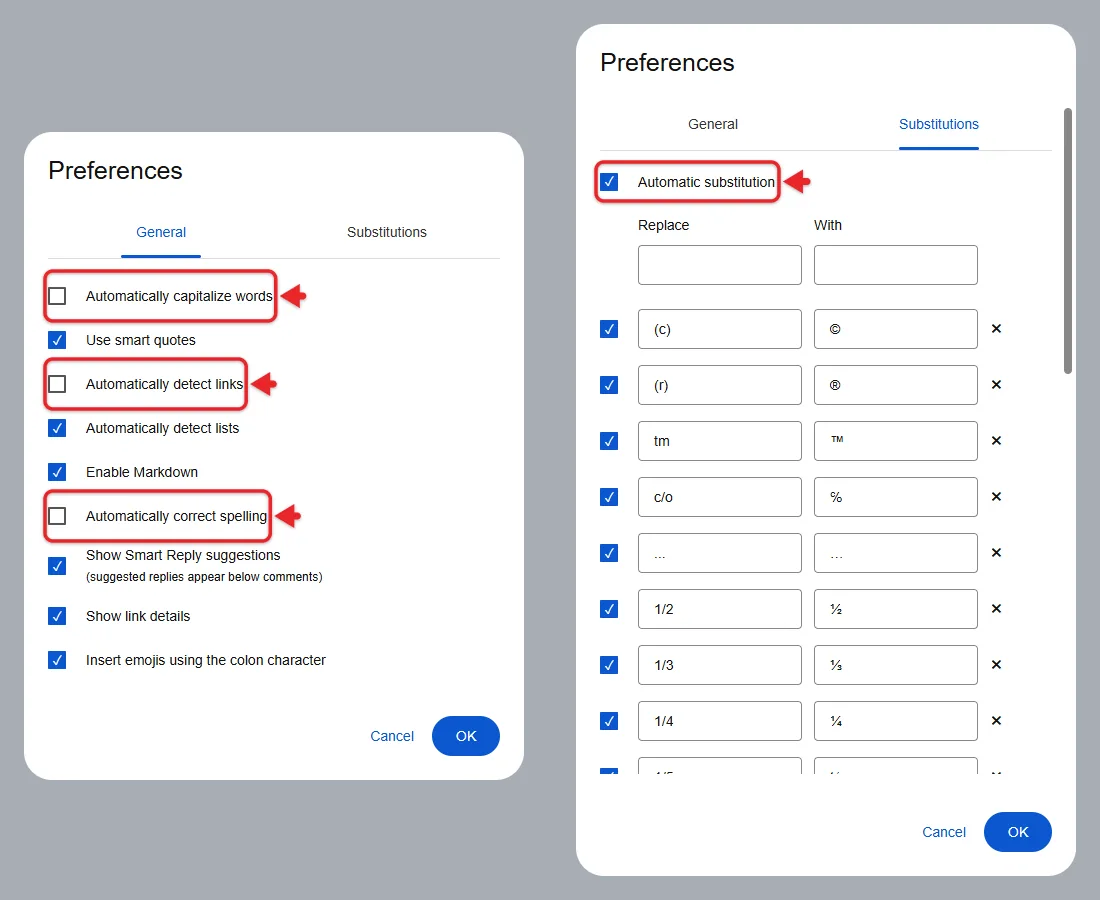
- Click Tools in the menu bar at the top of the document, then click Preferences. A small window opens with tabs at the top.
- Click the Substitutions tab. You’ll see checkboxes for the automatic corrections, followed by a list of text replacements.
- Uncheck the box next to each correction you want to stop: Automatic capitalization, Spelling corrections or Link detection.
- Optional: to turn off all automatic substitutions, uncheck the box next to Automatic substitution.
- Click OK. The window closes and the change is saved.
What Each Setting Controls
You don’t have to switch everything off. Pick the row that matches the change that is bothering you.
| What Docs keeps doing | Box to uncheck | Where to find it |
|---|---|---|
| Capitalizing words for you | Automatic capitalization | Tools > Preferences > Substitutions |
| Fixing spelling as you type | Spelling corrections | Tools > Preferences > Substitutions |
| Turning web addresses into links | Link detection | Tools > Preferences > Substitutions |
| Swapping typed text for symbols or other text | Automatic substitution, or the box next to one entry | Tools > Preferences > Substitutions |
| Curling quotation marks and apostrophes | Use smart quotes | Tools > Preferences > General |
| Turning asterisks or number signs into formatting | Enable Markdown | Tools > Preferences > General |
| Suggesting the rest of your sentence | Show Smart Compose suggestions | Tools > Preferences > General |
How to Turn Off One Text Replacement
If only one replacement gets in your way, you can switch off that entry and leave the rest working.
- Open a file in Google Docs on your computer.
- Click Tools > Preferences > Substitutions.
- Find the entry in the list.
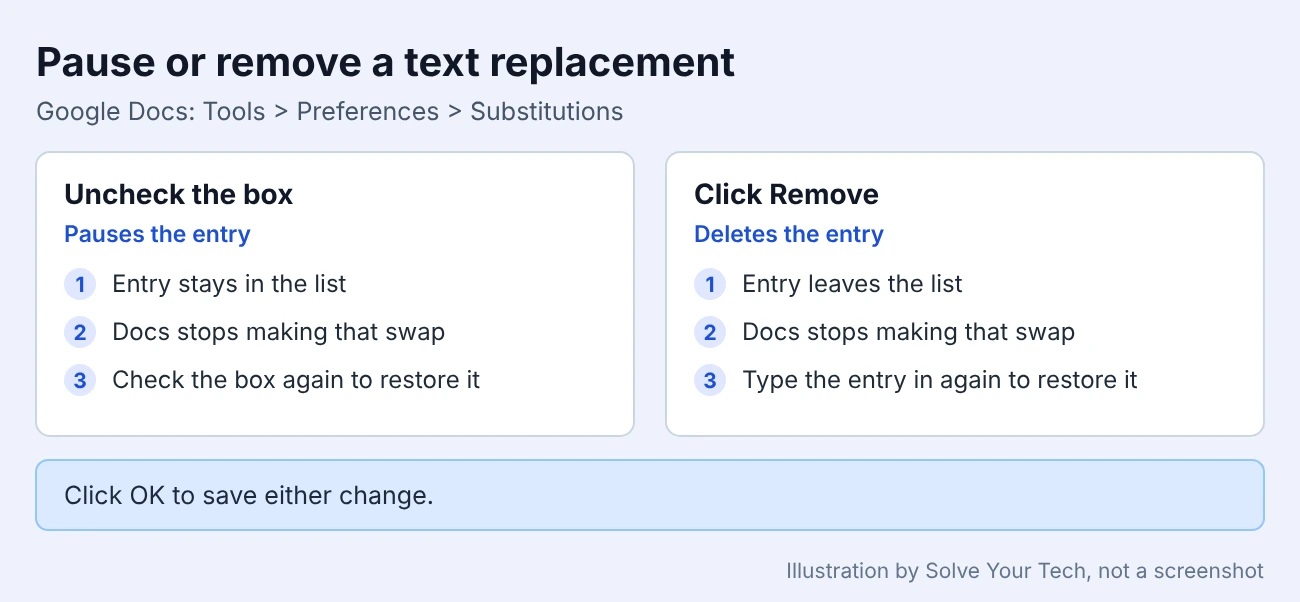
- To pause it, uncheck the box next to the word. To delete it from the list, click Remove next to the word.
- Click OK.
Unchecking is the safer choice if you might want the replacement back, because you only need to check the box again. A removed entry has to be typed in again.
If you added replacements to get letters like é or ñ, you can also type accent marks on your keyboard directly.
How to Turn Off Smart Quotes
The smart quotes option is on the General tab of the Preferences window, not the Substitutions tab. It’s labeled Use smart quotes.
- Open a file in Google Docs on your computer.
- Click Tools > Preferences. The window opens on the General tab.
- Uncheck Use smart quotes.
- Click OK.
After that, new quotation marks and apostrophes should stay straight. That matters most when you write code, formulas or commands in a document, because those usually need straight quotes.
Curved quotes that are already in the document are not converted. To change those, turn off smart quotes first, then use Edit > Find and replace: paste a curved quote into the Find box, type a straight one next to Replace with, and click Replace all. Repeat for each quote style. For more on that tool, read about using find and replace in Google Docs.
How to Stop Markdown and Smart Compose Changes
Two other features can look like AutoCorrect, but they have their own switches in the same Preferences window.
- Markdown. Markdown is a way to format text with symbols. When it is on, typing a number sign and a space at the start of a line creates a heading, and wrapping text in asterisks makes it italic or bold. To stop this, click Tools > Preferences and uncheck the box next to Enable Markdown. Google’s Use Markdown in Google Docs, Slides, & Drawings page explains the feature.
- Smart Compose. Smart Compose shows suggested words as you write. To stop it, click Tools > Preferences, click Show Smart Compose suggestions to clear it, and click OK. Google’s Smart Compose help page notes that it is offered to work and school accounts in certain languages, so you may not have this option at all.
Google Sheets has its own suggestion settings, and you can turn off autocomplete in Google Sheets there.
If Markdown already made some text bold or italic, select it and clear the formatting from that selection.
How to Undo a Single Correction
You may only need to reverse one change and leave AutoCorrect on.
- Click the word. After a word is fixed, you can click the word and then click Undo. According to Google, that permanently turns off the automatic correction for it.
- Use the keyboard. Press Ctrl + Z on Windows or a Chromebook, or Command + Z on a Mac, right after the change. That is the standard Undo shortcut in Docs.
- Teach Docs a spelling. If you want a word fixed the same way every time, right-click the word and click Always correct to followed by the suggested spelling.
How to Confirm It Worked or Turn It Back On
Test the change in the same document. Start a new line and type a sentence in lowercase to check capitalization, type a web address followed by a space to check link detection, or type a quotation mark to check smart quotes. If the text stays exactly as you typed it, the setting is off.
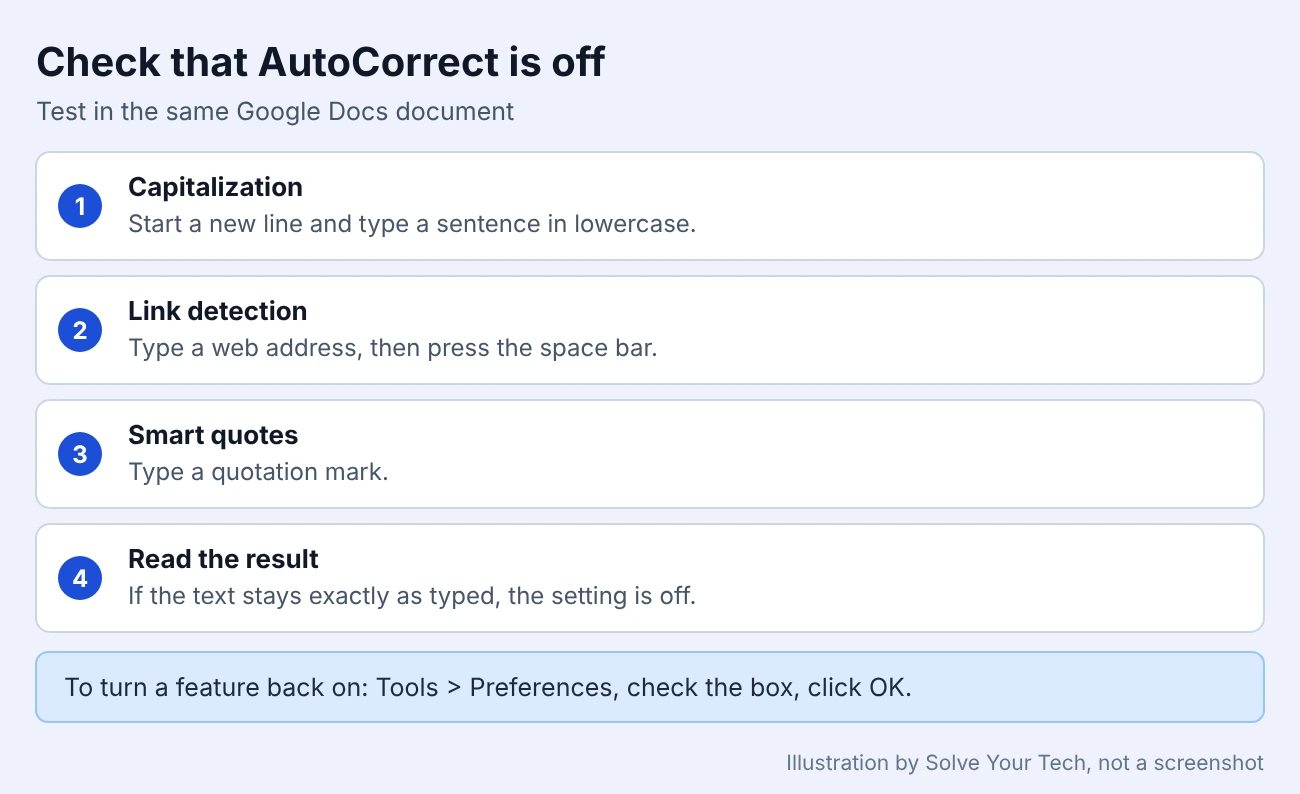
To turn a feature back on, return to Tools > Preferences, check the same box again, and click OK.
Troubleshooting
The Substitutions tab doesn’t show those checkboxes
Google’s current instructions place Automatic capitalization, Spelling corrections and Link detection on the Substitutions tab. Older guides describe similar boxes on the General tab with names such as Automatically correct spelling. If your Preferences window looks different, check both tabs for the closest matching label.
There is no Tools menu
You’re probably in the mobile app or in a compact view. Open the document in a web browser on a computer. If the menus are hidden, the Docs shortcut Ctrl + Shift + F shows them again.
Words are still being changed
Make sure you clicked OK rather than closing the window, then reload the page and test on a new line. If the change still happens, something outside Docs may be responsible, such as a browser extension or your device’s own keyboard correction.
Web addresses still become links when pasted
Link detection is described as an as-you-type correction. A link that is already in the document stays a link until you remove it. To change or take out an existing link, follow the steps to add, edit or remove a hyperlink in Google Docs.
Frequently Asked Questions
Can I turn off AutoCorrect in the Google Docs phone app?
No. Autocorrect in Google Docs can only be managed on a computer, not on Android, iPhone or iPad. On a phone, the keyboard app usually makes its own corrections, and those are controlled in the keyboard’s settings. With Google’s Gboard keyboard on Android, for example, the options are under Settings > Text correction, as described in Gboard Help.
Will turning off AutoCorrect remove the red spelling underlines?
No. Autocorrect changes text for you, while spell check only marks it. A misspelled word still gets a red line under it, and clicking the word shows a spelling suggestion. For the rest of the spelling tools, read about running spell check in Google Docs.
How do I stop Docs from flagging a name or term it doesn’t know?
Add it to your personal dictionary. Right-click the word that’s underlined in red and click Add to personal dictionary, or go to Tools > Spelling and grammar > Personal dictionary, enter the word and click Add.
Can I add my own text replacements instead of turning them off?
Yes. On the Substitutions tab, type what you’ll enter in the empty Replace box at the end of the list, type what Docs should insert in the With box, and click OK.
Does this work in languages other than English?
Autocorrect in Google Docs works in English, French, German, Portuguese and Spanish. In another language, you may not see the corrections in the first place.
Next Steps
Once AutoCorrect behaves the way you want, these guides cover related Docs settings:
- How to run spell check in Google Docs
- How to turn on dark mode in Google Docs
- How to make Google Docs read to you
If you also use Microsoft Word, you can turn on spell check in Word there.

Matthew Burleigh is the founder, head writer, and editor of Solve Your Tech, which he launched in 2012. He has written technology tutorials since 2008 and worked in IT since 2003, including small-business support, IT management, and consulting. He holds Bachelor’s and Master’s degrees in Computer Science from Arizona State University.
Matthew writes practical guides for Windows, iPhone and iPad, Microsoft Office, Outlook, Google apps, and Android. Solve Your Tech’s guides are checked step by step against the device or app maker’s own documentation and tested on his own devices whenever he has the hardware or software, with clear steps, sources, and update dates.
Read more about Matthew and how Solve Your Tech writes and updates its guides, or report a correction.