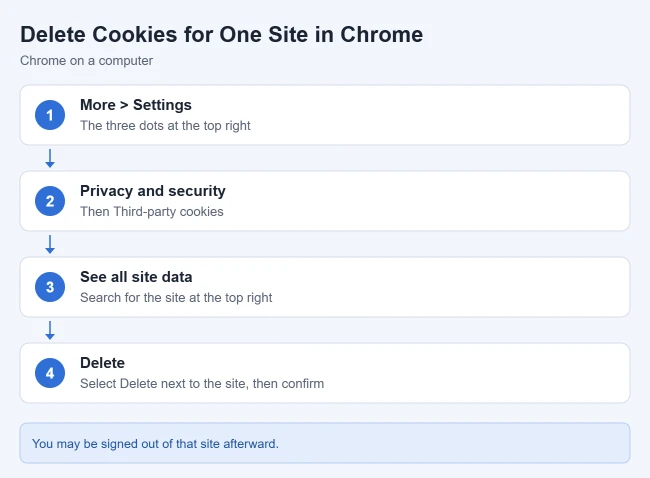
To delete the cookies for one website in Chrome on a computer, select More > Settings > Privacy and security > Third-party cookies > See all site data and permissions, search for the site, and select Delete next to it. Your cookies for every other site stay where they are, so you stay signed in everywhere else.
These steps are for current Chrome on Windows, Mac, ChromeOS, and Linux, with separate sections for Chrome on Android and iPhone. They follow Google’s Delete, allow, and manage cookies in Chrome help page.
What Happens When You Delete a Site’s Cookies
A cookie is a small file a website saves in your browser to remember you, such as the fact that you’re signed in or what’s in your cart. Deleting one site’s cookies makes that site treat you as a new visitor.
- You’ll probably be signed out of that site. Google warns that saved preferences for the site can be deleted too.
- Other sites aren’t touched. That’s the advantage over clearing everything.
- Saved passwords stay. Chrome stores passwords separately, so it can fill in your login when you sign back in.
- The cookies come back. The next time you visit, the site sets new ones. Deleting is a reset, not a block.
How to Delete Cookies for One Site in Chrome Settings
- Open Chrome on your computer.
- At the top right, select the three-dot More menu, then Settings. The Settings page opens in a new tab.
- Select Privacy and security in the left menu.
- Select Third-party cookies.
- Scroll down and select See all site data and permissions. A list of every site with stored data appears, with the amount of storage each one uses.
- Type the site’s name in the search box at the top right. The list filters as you type.
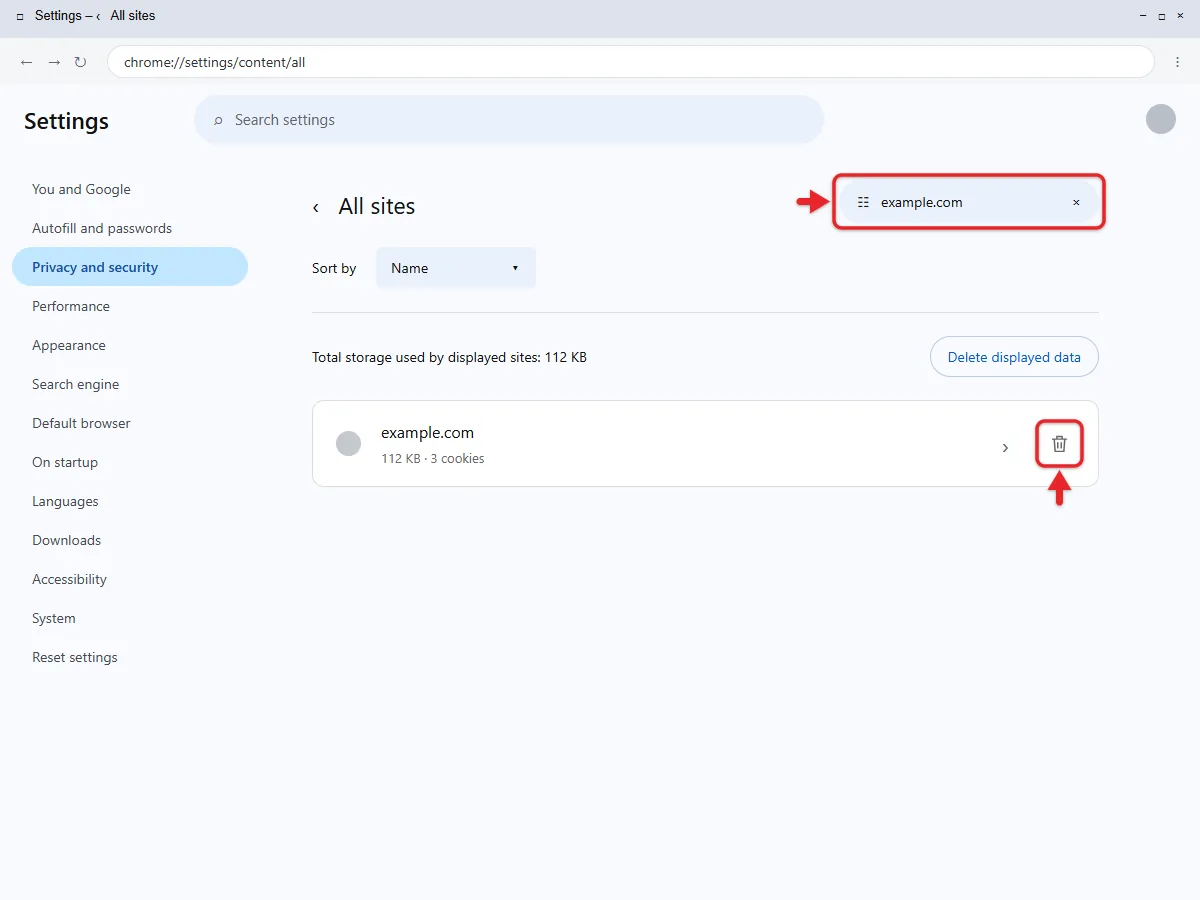
- Select the Delete (trash) icon to the right of the site.
- Read the confirmation box, which says what Chrome will remove, then select Delete.
The site disappears from the list. To check, open the site in a new tab: it should ask you to sign in again or show its cookie banner. To jump straight to this list next time, type chrome://settings/content/all in the address bar and press Enter.
Chrome groups sites by their main domain, so one entry such as example.com can also cover subdomains like shop.example.com. Deleting that entry clears them together.
Delete a Site’s Cookies From the Address Bar
This is faster when you’re already on the page that’s giving you trouble.
- Go to the website.
- Select the View site information icon to the left of the web address.
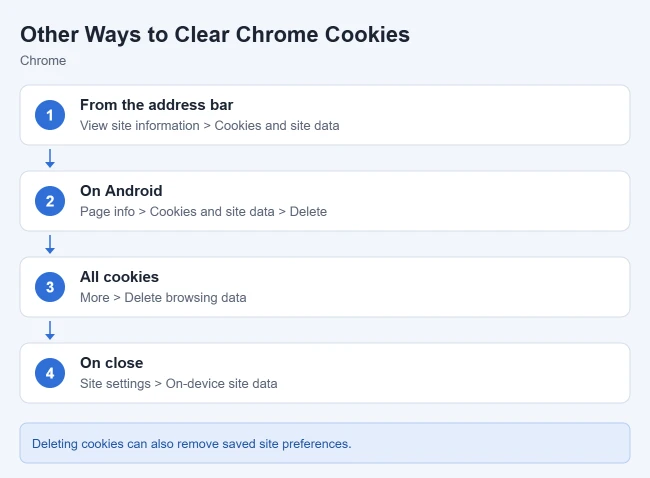
- Select Cookies and site data.
- Select Manage on-device site data. A list shows the site and any other domains that stored data while you were on the page, such as ad or video services.
- Select the trash icon next to each domain you want to clear.
- Select Done, then reload the page.
Another route from the same icon is Site settings, which opens the site’s own page in Settings. Its usage section shows how much data the site stores and has a button to delete it.
Delete a Single Cookie With Chrome DevTools
The methods above remove all of a site’s cookies at once. If you want to remove one specific cookie, such as a tracking cookie, and keep the one that holds your sign-in, use DevTools, Chrome’s built-in tool for web developers. Google’s DevTools cookie guide documents these controls.
- Go to the website.
- Press F12 or Ctrl + Shift + I on Windows, or Command + Option + I on a Mac.
- Select the Application tab. If you don’t see it, select the >> arrow to show more tabs.
- Under Storage, expand Cookies and select the site’s address.
- Type part of the cookie’s name in the Filter box if the list is long.
- Select the cookie, then select Delete selected in the toolbar above the list.
Cookie names are set by each site and aren’t always clear, so delete only what you can identify. If you remove the wrong one, you’ll usually just need to sign in again. Clear all in the same toolbar removes every cookie for that site.
How to Delete Cookies for One Site on Android
- Open Chrome on your Android phone or tablet and go to the website.
- Tap Page info at the left of the address bar.
- Tap Cookies and site data.
- Tap Delete next to the stored data and confirm.
Cookies don’t sync between devices, so clearing a site on your computer doesn’t clear it on your phone, and the reverse is true too.
Chrome on iPhone and iPad
For iPhone and iPad, the documented method deletes all cookies: tap More > Settings > Privacy and Security > Delete Browsing Data, check Cookies, Site Data, and confirm. There’s no single-site option in the iPhone app. If you mostly use Safari on your iPhone, Safari can delete one site’s data in Settings.
How to Clear Cookies Automatically When You Close Chrome
- Select More > Settings.
- Select Privacy and security > Site settings.
- Select Additional content settings > On-device site data.
- Choose Delete data sites have saved to your device when you close all windows.
Google’s on-device site data page says sites will probably still work but are less likely to remember you between visits. Expect to sign in again after every restart. For a one-time session that leaves no cookies behind, an Incognito window does the same job without changing your settings.
How to Delete All Cookies
Use this when many sites misbehave, not just one.
- Select More > Delete browsing data, or press Ctrl + Shift + Delete (Command + Shift + Delete on a Mac).
- Choose a time range, such as Last hour or All time.
- Check Cookies and other site data. Uncheck anything you want to keep, such as browsing history.
- Select Delete data.
This signs you out of most sites. To sign out of your Google Account on every website, you need to sign out of Chrome itself. To clear your browsing history as well, you can view or delete your Chrome history.
If pages still load wrong on a Windows 10 PC, the problem may be a different cache, so clear the computer cache in Windows 10 as well.
If the Site Isn’t in the List
- The site isn’t in the list. Search for just the main part of the name, such as “amazon” instead of “www.amazon.com.” If it still isn’t there, the site has no stored data in this Chrome profile.
- You see a different site list than expected. Each Chrome profile keeps its own cookies. Make sure you’re in the profile you use for that site.
- The site still doesn’t work. Reload the page while bypassing the cache with Ctrl + Shift + R (Command + Shift + R on a Mac). If the site reports that cookies are blocked, enable cookies in Chrome.
- Settings are locked. If you see “Managed by your organization” at the bottom of the More menu, your school or workplace may control cookie settings.
Chrome Cookie Questions
What’s the difference between first-party and third-party cookies?
First-party cookies are created by the site in the address bar, and third-party cookies are created by other sites whose content, such as ads or images, is embedded in the page. The site list in Settings includes both kinds.
Can I let one site use third-party cookies when they’re blocked?
Yes. Go to Settings > Privacy and security > Third-party cookies, select Add next to “Sites allowed to use third-party cookies,” enter the address, and select Add. Put [*.] before the domain to include all of its subdomains.
Will deleting a site’s cookies delete my saved password for it?
No. Passwords are stored separately in Google Password Manager. You’ll be signed out, but Chrome can fill in your saved login.
Does deleting cookies on my computer clear them on my phone?
No. Cookies stay on the device where they were saved, so clear each device separately.
Is Incognito mode a better option?
For a single private session, yes. Chrome deletes cookies from Incognito when you close all Incognito windows, and it blocks third-party cookies there by default.

Matthew Burleigh is the founder, head writer, and editor of Solve Your Tech, which he launched in 2012. He has written technology tutorials since 2008 and worked in IT since 2003, including small-business support, IT management, and consulting. He holds Bachelor’s and Master’s degrees in Computer Science from Arizona State University.
Matthew writes practical guides for Windows, iPhone and iPad, Microsoft Office, Outlook, Google apps, and Android. Solve Your Tech’s guides are checked step by step against the device or app maker’s own documentation and tested on his own devices whenever he has the hardware or software, with clear steps, sources, and update dates.
Read more about Matthew and how Solve Your Tech writes and updates its guides, or report a correction.