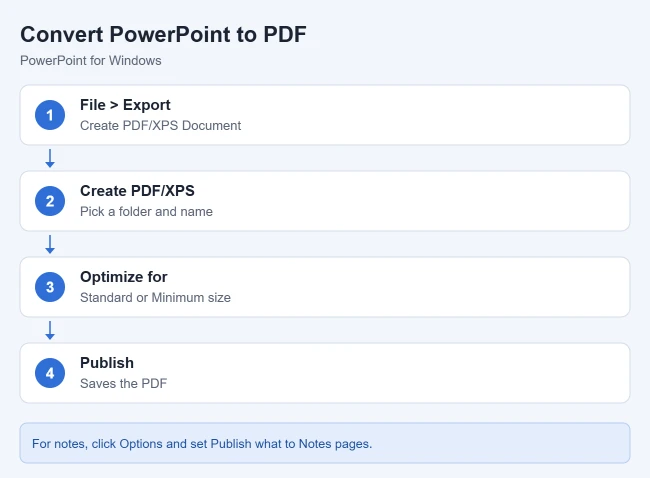
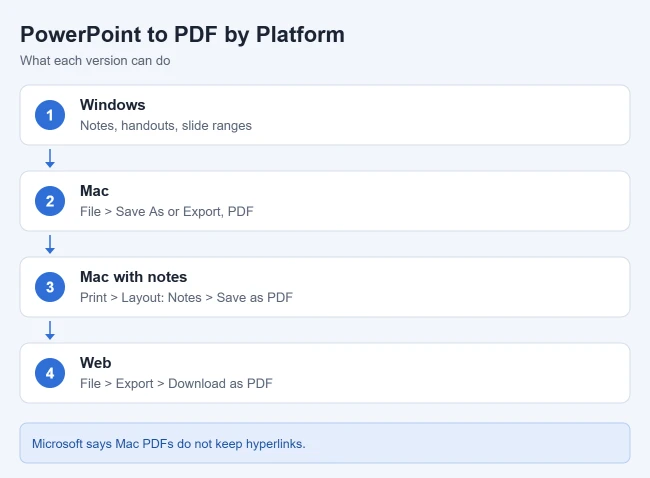
To convert a PowerPoint to a PDF on Windows, click File > Export > Create PDF/XPS Document > Create PDF/XPS, choose where to save it, and click Publish. To include your speaker notes, click Options first and set Publish what to Notes pages. On a Mac, use File > Save As and choose PDF.
These steps follow Microsoft’s Save PowerPoint presentations as PDF files guide for Windows, Mac, and the web. Option names for notes and handouts come from Adobe. Microsoft says a PDF freezes your formatting and layout, so people can view the slides without PowerPoint but can’t change them.
How to Convert PowerPoint to PDF on Windows
- Open the presentation in PowerPoint.
- Click File > Export.
- Click Create PDF/XPS Document, then Create PDF/XPS.
- In the Publish as PDF or XPS box, pick a folder and enter a file name.
- Next to Optimize for, choose Standard for higher quality, such as for printing, or Minimum size for a smaller file to email.
- Click Publish.
Result: PowerPoint saves a PDF copy of your slides. Your original presentation doesn’t change. File > Save As with PDF as the file type works too and opens the same options.
How to Save PowerPoint as a PDF With Notes
- In the Publish as PDF or XPS box, click Options.
- Under Publish what, choose Notes pages.
- Click OK, then Publish.
Result: Each PDF page shows one slide with its speaker notes below it. Adobe describes the Notes pages setting this way. If you have Adobe Acrobat installed, Adobe says its Create Adobe PDF option has a Convert Speaker Notes box instead.
Other PDF Options in PowerPoint for Windows
Microsoft lists these settings in the same Options window:
- Range: choose Current slide to save one slide, or enter slide numbers in the From and To boxes.
- Publish what: save handouts, comments, or Outline view instead of slides. For handouts, set how many Slides per page and the order (Horizontal or Vertical).
- Extras: include frame slides, hidden slides, comments, ink, or non-printing information such as document properties.
The difference between two common choices: handouts put several slides on each page without notes, while notes pages put one slide per page with its notes.
How to Save PowerPoint as a PDF on a Mac
Microsoft says both of these methods produce the same PDF:
- Click File > Save As, or File > Export.
- Choose a location if asked, then set File Format to PDF.
- Click Save or Export.
Result: You get a PDF of your slides. Microsoft notes that PowerPoint for Mac can’t save notes or handouts, include hidden slides, or make a smaller file when exporting a PDF. It also doesn’t keep hyperlinks.
To change quality on a Mac, Microsoft says to go to the PowerPoint menu > Preferences > General and set Print Quality (Paper/PDF) to High, Medium, or Low. High is the default.
How to Get Notes in a PDF on a Mac
Since the Mac export can’t include notes, Adobe describes printing to PDF instead:
- Click File > Print.
- Click Show Details.
- Set Layout to Notes.
- Open the PDF menu and choose Save as PDF, then click Save.
Result: According to Adobe, the PDF shows each slide with its notes. Menu names in the print window can vary by macOS and PowerPoint version.
How to Save as a PDF in PowerPoint for the Web
- Click File, then Export.
- Click Download as PDF.
Result: The PDF downloads to your computer. Microsoft says PDFs from PowerPoint for the web keep hyperlinks, are accessible, and tend to be smaller, so it suggests this route for Mac users who need working links: save the file to OneDrive and download the PDF from the web version.
Before you share it, open the PDF and check the headings and layout. If you used outlined PowerPoint text, make sure it’s still easy to read in the PDF.
Frequently Asked Questions
Why aren’t my speaker notes showing in the PDF?
Notes only appear when you choose Notes pages. If Publish what is left on Slides, the PDF only has the slides. On a Mac, use the print method above.
Can I save just one slide as a PDF?
Yes, on Windows. Microsoft says to click Options and choose Current slide under Range, or enter a range of slide numbers.
Related Guides
- How to turn a PowerPoint into a video
- How to save a PowerPoint as a Word document
- How to take a screenshot in PowerPoint

Matthew Burleigh is the founder, head writer, and editor of Solve Your Tech, which he launched in 2012. He has written technology tutorials since 2008 and worked in IT since 2003, including small-business support, IT management, and consulting. He holds Bachelor’s and Master’s degrees in Computer Science from Arizona State University.
Matthew writes practical guides for Windows, iPhone and iPad, Microsoft Office, Outlook, Google apps, and Android. Solve Your Tech’s guides are tested on current devices or checked against official product documentation, with clear steps, sources, and update dates.
Read more about Matthew and how Solve Your Tech writes and updates its guides, or report a correction.