To change what happens when you double tap an AirPod, put your AirPods in your ears, open Settings on your iPhone, tap your AirPods’ name near the top, tap Left or Right, and choose an action. Double tap only exists on the original AirPods and AirPods (2nd generation). Newer AirPods use a press and hold on the stem instead, and you change that action from the same screen.
These steps are for an iPhone or iPad running iOS 27 or iPadOS 27, and they follow Apple’s Change the settings of your AirPods and AirPods Pro and controls and gestures guide. iOS 26 and earlier use the same menus, though older versions may require tapping the Info button next to the AirPods name in Settings > Bluetooth first.
Which Control Can You Change on Your AirPods?
| AirPods model | Customizable control | Choices |
|---|---|---|
| AirPods (1st and 2nd generation) | Double tap | Siri, Play/Pause, Next Track, Previous Track, or Off |
| AirPods (3rd generation) | None | Press and hold always activates Siri |
| AirPods 4 | Press and hold | Siri on either AirPod |
| AirPods 4 with Active Noise Cancellation | Press and hold | Listening modes or Siri |
| AirPods 5 (all models) | Press and hold | Listening modes or Siri |
| AirPods Pro (1st, 2nd, and 3rd generation) | Press and hold | Listening modes or Siri |
Apple lists these options for every model, including AirPods 5 and AirPods 5 with Wireless Charging Case, in its controls and gestures guide. On every model except the 1st and 2nd generation AirPods, the media presses are fixed: press once to play or pause, press twice to skip forward, and press three times to go back. You can’t remap those presses for music. AirPods Max use the Digital Crown and a listening mode button instead of stems, so this guide doesn’t apply to them.
Not sure which model you have? Connect the AirPods, open Settings, tap their name, and scroll down to Model Name.
The same screen also shows the battery level, one of several ways to check AirPods battery life on iPhone.
Change the Double Tap on AirPods (1st or 2nd Generation)
- Open the charging case near your iPhone, then put the AirPods in your ears so they connect.
- Open the Settings app.
- Tap your AirPods’ name near the top of the screen.
- Under Double-Tap on AirPod, tap Left or Right.
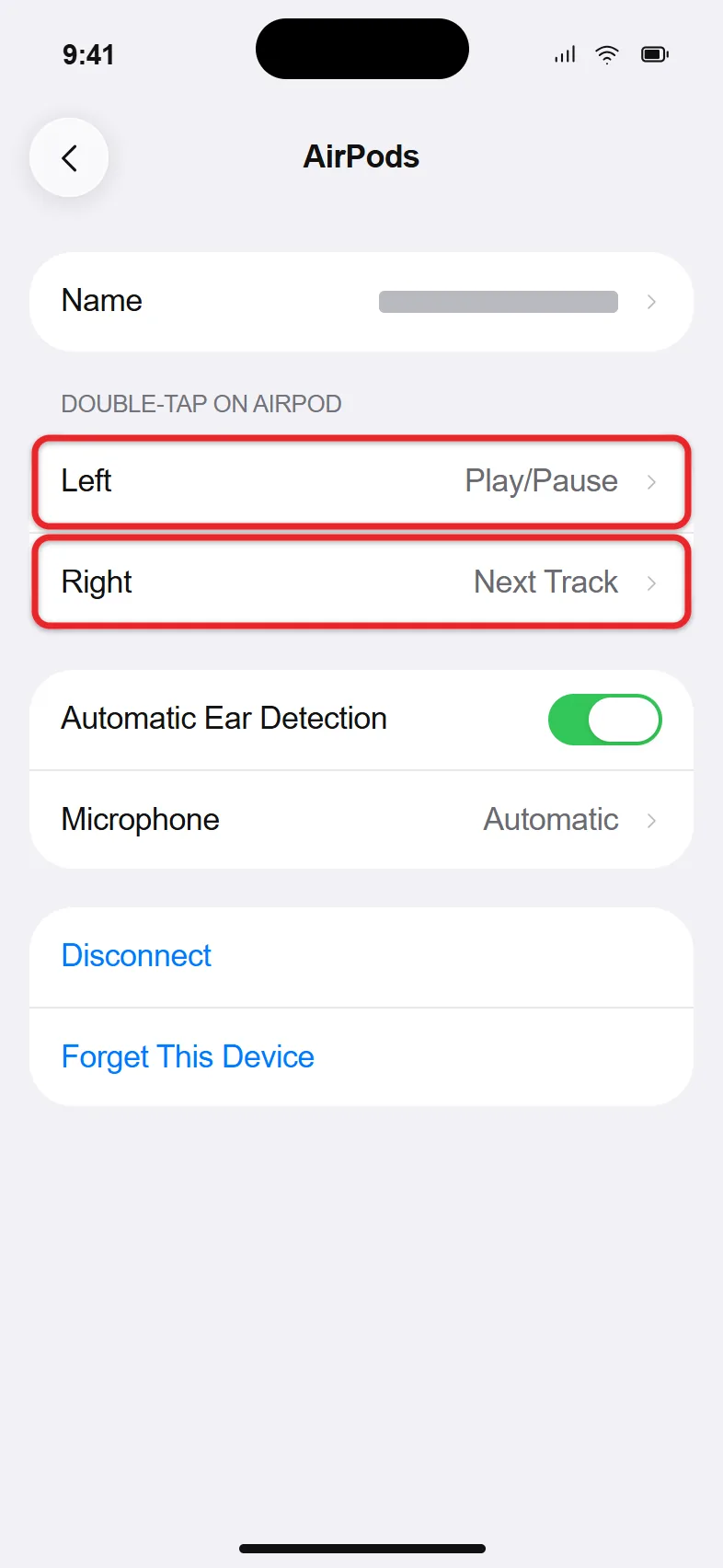
- Choose Siri, Play/Pause, Next Track, Previous Track, or Off.
- Go back and set the other AirPod if you want it to do something different.
The new action works right away. Double tap near the top of the stem to try it. Each AirPod keeps its own setting, so a common setup is Play/Pause on one side and Next Track on the other. A double tap also answers an incoming call, whatever action you picked.
Volume isn’t one of the double tap choices. To change the volume with these AirPods, ask Siri (“Turn the volume up”) or use the iPhone’s volume buttons.
If your AirPods stop short of full volume, check whether you need to turn off the volume limit on iPhone in Headphone Safety.
Change Press and Hold on AirPods Pro, AirPods 4 (ANC), and AirPods 5
On these models, press and hold switches between listening modes, such as Active Noise Cancellation and Transparency, by default. You can change which listening modes it cycles through, or make it activate Siri instead.
- Put in your AirPods and make sure they’re connected to your iPhone or iPad.
- Open Settings and tap your AirPods’ name.
- Under Press and Hold AirPods, tap Left or Right. If you don’t see that heading, tap Controls & Gestures first.
- To switch listening modes, select Listening Mode, then check the two or three modes you want to cycle through: Noise Cancellation, Transparency, Adaptive, and Off.
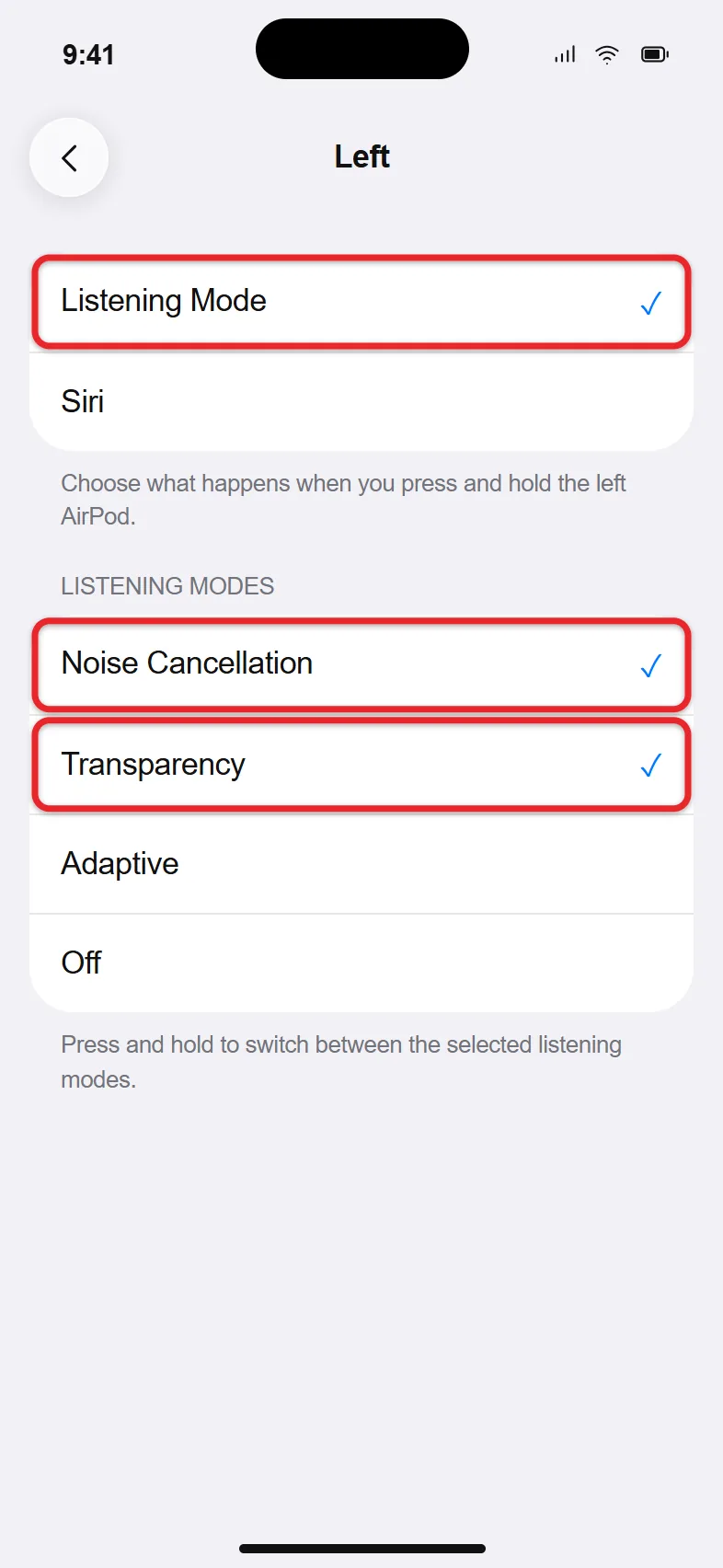
- To use Siri instead, select Siri.
A few rules to know:
- You can set one AirPod to Siri and the other to change listening modes.
- If both AirPods are set to Listening Mode, a change to the modes on one side applies to both.
- If Camera Remote is set to press and hold and a supported camera app is open, press and hold takes a photo instead of changing modes.
- On AirPods 4 with ANC, AirPods 5, and AirPods Pro 2 and 3, pressing and holding both stems at the same time starts Live Translation. That two-stem gesture is separate from the single-AirPod setting.
Adaptive is available on AirPods Pro (2nd generation) and later, AirPods 4 with ANC, and AirPods 5. AirPods Pro (1st generation) only offer Noise Cancellation, Transparency, and Off.
Change Press and Hold on AirPods 4
On AirPods 4 without Active Noise Cancellation, press and hold activates Siri. Open Settings, tap your AirPods’ name, then under Press and Hold AirPods tap Left or Right to choose whether that AirPod activates Siri. There are no listening modes to switch on this model.
What About AirPods (3rd Generation)?
On AirPods (3rd generation), press and hold is Siri only. There’s no option to change it to a listening mode or a playback control. If you want a stem control you can customize, you’d need AirPods 4, AirPods 5, or AirPods Pro.
Other Stem Controls You Can Change
The same AirPods screen in Settings has a few more press options. If you don’t see one, tap Controls & Gestures first.
| Setting | Models | Choices |
|---|---|---|
| Mute & Unmute and End Call | AirPods 3, 4, 5, and Pro | Press Once or Press Twice. Picking one for Mute & Unmute sets End Call to the other. |
| Camera Remote | AirPods 4, 5, Pro 2, and Pro 3 | Press Once, Press and Hold, or Off |
These options appear in Apple’s Change settings for AirPods or AirPods Pro guide. They only affect calls and the camera, so your music presses stay the same.
Make Presses Easier or Turn Off Volume Swipe
If double presses or press and hold don’t register reliably, change the timing in Accessibility:
- Open Settings and tap Accessibility.
- Tap AirPods.
- Choose a slower Press Speed so you have more time between presses, or a longer or shorter Press and Hold Duration.
- On AirPods Pro 2, AirPods Pro 3, and AirPods 5 with Wireless Charging Case, turn off Volume Swipe if you keep changing the volume by accident when you touch the stem.
Apple covers these options in its force sensor settings guide. On a Mac, they’re in System Settings > Accessibility > Audio.
Change the Controls From a Mac
You can also change these settings on a Mac that’s connected to your AirPods:
- Put the AirPods in your ears and connect them to the Mac.
- Open System Settings.
- Click your AirPods’ name in the sidebar. You may need to scroll down.
- Click Controls & Gestures if the controls aren’t shown.
- Under Double-Tap on AirPod or Press and Hold AirPods, click Left or Right and pick an action.
Settings you change on one Apple device follow your AirPods to your other devices signed in to the same Apple Account.
That shared Apple Account is also what lets you make AirPods switch to your iPhone automatically when you start playing audio on it.
Your AirPods also work with your watch for phone-free workouts once you connect headphones to your Apple Watch.
When Options Are Missing or the Action Doesn’t Work
I don’t see the double tap or press and hold options
The AirPods have to be connected. Put them in your ears, then reopen Settings. If the AirPods name isn’t at the top of Settings, open Settings > Bluetooth and tap the Info button next to them. Also check that your iPhone is on the latest iOS, since some options need recent software.
The new action isn’t working
Make sure you’re doing the right gesture. Double tap is a firm tap near the top of the stem on 1st and 2nd generation AirPods. On newer models, you squeeze the flat force sensor on the stem and hold until you hear a chime. If holding feels too short or too long, adjust Press and Hold Duration as described above. If it still doesn’t work, put both AirPods in the case for 30 seconds and try again.
Press and hold took a photo instead of changing modes
Camera Remote is set to Press and Hold, and a camera app was open. Change Camera Remote to Press Once or Off in your AirPods settings.
My settings don’t work on my Android phone
AirPods settings can only be changed on an Apple device, but the AirPods keep them afterward. Set the controls on an iPhone, iPad, or Mac before you pair your AirPods with an Android phone. Listening mode switching and Siri depend on the connected device, so some actions may not work on Android.
AirPods Control Questions
Can I set each AirPod to do something different?
Yes. You choose Left and Right separately, so each AirPod can have its own double tap or press and hold action.
Can I turn off double tap on AirPods?
Yes. On 1st and 2nd generation AirPods, choose Off for one or both AirPods under Double-Tap on AirPod.
Can I change what a single press or double press does on AirPods Pro?
Not for music. On AirPods Pro, AirPods 3, AirPods 4, and AirPods 5, a single press always plays or pauses, a double press skips forward, and a triple press goes back. During calls, you can choose whether one press or two presses mutes you or ends the call.
Where else can I switch noise control?
Open Control Center on your iPhone, touch and hold the volume slider, and tap Listening Mode. To use noise cancellation with just one AirPod in, enable noise cancellation for one AirPod. To have your AirPods lower your audio automatically when you start talking, turn on Conversation Awareness.
How do I put the controls back to the defaults?
Go back to the same screen and choose Listening Mode for press and hold on each AirPod, which is the default on models with listening modes. On 1st and 2nd generation AirPods, pick the double tap actions you want again for Left and Right.

Matthew Burleigh is the founder, head writer, and editor of Solve Your Tech, which he launched in 2012. He has written technology tutorials since 2008 and worked in IT since 2003, including small-business support, IT management, and consulting. He holds Bachelor’s and Master’s degrees in Computer Science from Arizona State University.
Matthew writes practical guides for Windows, iPhone and iPad, Microsoft Office, Outlook, Google apps, and Android. Solve Your Tech’s guides are checked step by step against the device or app maker’s own documentation and tested on his own devices whenever he has the hardware or software, with clear steps, sources, and update dates.
Read more about Matthew and how Solve Your Tech writes and updates its guides, or report a correction.