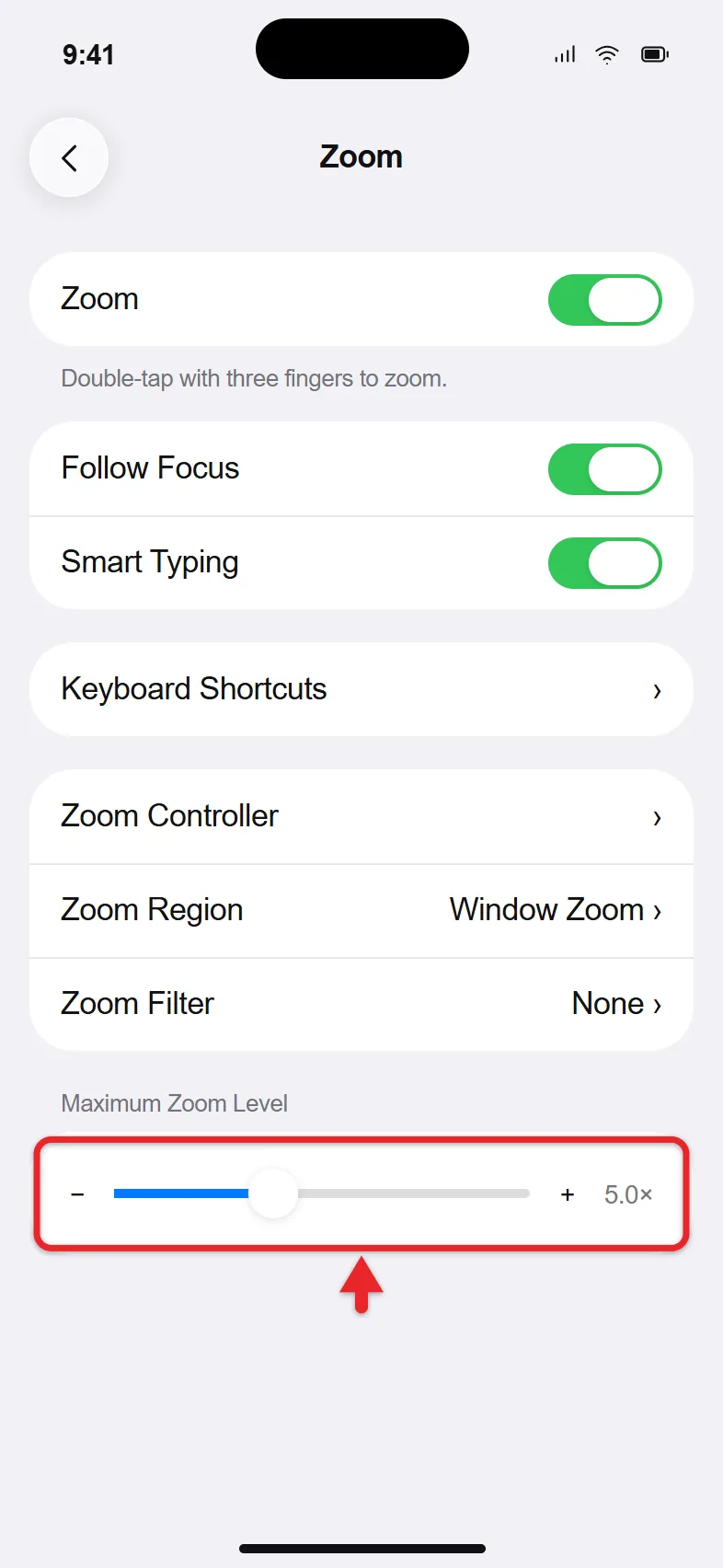
To set the maximum zoom level on an iPhone, open Settings > Accessibility > Zoom, turn on Zoom, and drag the Maximum Zoom Level slider left to lower the limit or right to raise it. After that, double-tap the screen with three fingers to zoom in or out, and the magnification never goes past the limit you chose.
These steps cover iOS 27 and iOS 26, and the same Settings path has been used since iOS 13 (iOS 12 and earlier put Accessibility under General). The Zoom settings are the same on an iPad. If your screen is already stuck magnified, double-tap it with three fingers first so you can see the full Settings screen.
What the Maximum Zoom Level Controls
Zoom is an accessibility feature that magnifies whatever is on the screen, in any app, including the Home Screen and Settings. The Maximum Zoom Level slider sets the ceiling for that magnification. It runs from slightly above normal size (about 1.2x) up to 15x, and the number next to the slider shows the current limit.
The slider does not set how much the screen is magnified right now. It only stops you from going further than that point. You can still zoom in less at any time with the three-finger gestures. That makes a lower maximum useful if you sometimes zoom so far that you lose your place, and a higher maximum useful if you need to read very small print.
A good starting point is a moderate level, such as 4x or 5x. Raise it only if text or small controls are still hard to read at that level.
Turn On Zoom and Set the Maximum Zoom Level
- Open Settings and tap Accessibility. Zoom is listed under Vision, not in Camera or Display settings.
- Tap Zoom, then turn on the Zoom switch. The screen may magnify right away. If it does, double-tap with three fingers to return to normal size.
- Scroll to Maximum Zoom Level and drag the slider. Drag left for a lower limit or right for a higher one, and watch the number change.
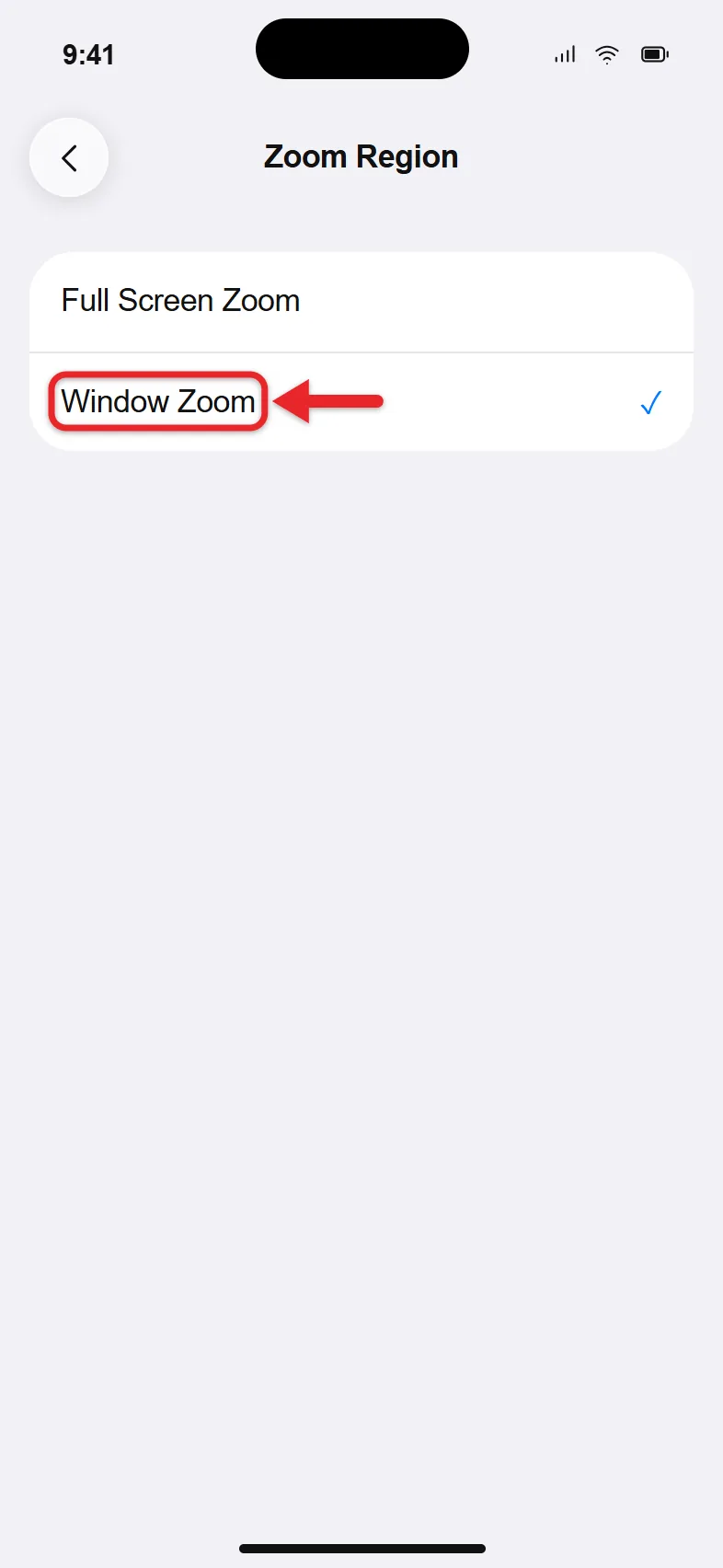
- Tap Zoom Region and choose Full Screen Zoom to magnify the whole display, or Window Zoom to magnify only the area inside a movable lens.
- Go to an app you use often and double-tap with three fingers to zoom in. Increase the magnification as far as it goes (see the next section). It should stop at the limit you set.
If the limit feels too high or too low, go back to Settings > Accessibility > Zoom and move the slider again. The change applies immediately, and you don’t need to restart the iPhone.
Use the Three-Finger Gestures
Apple’s Zoom guide for iPhone describes these gestures:
- Turn Zoom on or off: double-tap the screen with three fingers.
- Change the magnification: double-tap with three fingers, keep your fingers on the screen after the second tap, then drag up to zoom in or down to zoom out. This takes a little practice.
- Move around a magnified screen: drag with three fingers in Full Screen Zoom. In Window Zoom, drag the handle at the bottom of the lens.
- Open the Zoom menu: triple-tap with three fingers. The menu has a Zoom Level slider, plus options to choose the region, resize the lens in Window Zoom, choose a filter, and show the Zoom Controller.
The Zoom menu’s slider is a quick way to set the current level without the double-tap-and-drag gesture. It still stops at your Maximum Zoom Level.
Other Settings on the Zoom Screen
The same Zoom screen has several options that change how magnification behaves:
- Follow Focus: the zoomed area follows what you select, the text insertion point, and your typing.
- Smart Typing: switches to Window Zoom when the keyboard appears, so your text is magnified but the keyboard is not. It appears under Follow Focus.
- Keyboard Shortcuts: with an external keyboard connected, lets you toggle Zoom, change the zoom level, and move the window from the keyboard.
- Zoom Controller: turn on Show Controller to get a small on-screen button. Tap it to open the Zoom menu, double-tap it to zoom in or out, and drag it to pan. You can choose what single, double, and triple taps do, change its color, and set Idle Opacity so it fades when you aren’t using it.
- Zoom Filter: applies Inverted, Grayscale, Grayscale Inverted, or Low Light to the magnified area only.
If three-finger gestures are hard for you, turning on the Zoom Controller is the easiest way to adjust the level with one finger.
If you only want warmer colors in the evening rather than a zoom filter, turn on Night Shift on your iPhone instead.
Choose Full Screen Zoom or Window Zoom
Full Screen Zoom works best when everything on the iPhone is too small. Because the whole screen is enlarged, you will often need a three-finger drag to reach a button that is off the edge.
Window Zoom keeps most of the screen at normal size and enlarges only the area under the lens. It suits quick checks, such as reading a small label or the fine print on a webpage, because you can still see where you are on the page. You can switch between the two at any time from the Zoom menu.
Turn Zoom On or Off Faster
Zoom works with the Accessibility Shortcut, so you can switch it on or off with the side button instead of a gesture:
- Open Settings > Accessibility > Accessibility Shortcut.
- Tap Zoom so a check mark appears.
- Triple-click the side button (or the Home button on an iPhone that has one) to turn Zoom on or off.
If you pick more than one feature in Accessibility Shortcut, a triple-click shows a menu where you choose Zoom. Apple explains the setup in its Accessibility Shortcut article. On iPhone 8 and later, you can also open Settings > Accessibility > Touch > Back Tap, tap Double Tap or Triple Tap, and choose Accessibility Shortcut, so tapping the back of the phone does the same thing. This option is part of the Back Tap feature.
If the Screen Is Stuck Zoomed In
- Double-tap the screen with three fingers. On most phones, this returns the display to normal size at once.
- If it still looks magnified, drag with three fingers until you can reach Settings, then go to Settings > Accessibility > Zoom and turn off Zoom.
- If you set up the Accessibility Shortcut, triple-click the side button instead.
- If you can’t use the gestures at all, connect the iPhone to a computer. On a Mac with macOS Catalina or later, select the iPhone in a Finder window. On a PC or an older Mac, open iTunes and select the iPhone. Click Configure Accessibility, clear the Zoom checkbox, and click OK.
Apple’s article on magnified Home Screen icons lists the same fix. Don’t erase or reset the iPhone because the screen looks too big. Zoom is a setting, and turning it off fixes it. The same Zoom feature exists on iPad, and the steps to get rid of the magnifying glass on an iPad also cover the Magnifier app and a fix from a computer.
If you can reach Settings but not the slider, zoom out first with the double-tap-and-drag gesture, then lower Maximum Zoom Level so it doesn’t happen again.
If the problem is a black box that jumps between items and the phone reads them aloud, VoiceOver is on, not Zoom. Follow the steps to remove the black box around iPhone icons.
Zoom Compared With Other Ways to Make Things Bigger
The iPhone has several features that enlarge things, and they solve different problems:
| Feature | Where to find it | What it does |
|---|---|---|
| Zoom | Settings > Accessibility > Zoom | Magnifies the screen image in any app, up to your maximum level |
| Text Size | Settings > Appearance (Display & Brightness in iOS 26) | Makes text bigger in apps that support it, without panning |
| Display Zoom | Settings > Appearance (Display & Brightness in iOS 26) | Enlarges icons, buttons, and text across the whole interface |
| Magnifier | Magnifier app | Uses the camera to enlarge objects in front of you, such as a menu |
| Camera zoom | Camera app | Changes how close a photo or video looks; it doesn’t magnify the screen |
For everyday reading, larger text is usually more comfortable than zooming, because you don’t have to pan. You can make text messages bigger on iPhone and make apps bigger on an iPhone. On an iPad, you can also make text and apps bigger. Zoom is better for a quick close look at something small, or for apps that ignore your text size.
Zoom magnifies content. If you would rather listen to it, you can have iPhone read text aloud with Speak Screen or Speak Selection and adjust the speaking rate separately.
iPhone Zoom Questions
What is the highest zoom level on an iPhone?
The Maximum Zoom Level slider goes up to 15x. Most people find that too high for daily use, because only a few letters fit on the screen at once.
Does the maximum zoom level change pinch-to-zoom in Photos or Safari?
No. Pinching to zoom in a photo, map, or webpage is controlled by that app. The Maximum Zoom Level only limits the Accessibility Zoom feature.
Why can’t I zoom past a certain point?
The Maximum Zoom Level is set below where you want to go. Open Settings > Accessibility > Zoom and drag the slider to the right.
Is the maximum zoom level the same on iPad?
Yes. On an iPad, go to Settings > Accessibility > Zoom and use the same Maximum Zoom Level slider. The setting is stored on each device, so changing it on your iPhone doesn’t change your iPad.
Can I use Zoom and VoiceOver together?
Yes. Zoom works with VoiceOver. With Follow Focus on, the zoomed area moves to each item VoiceOver selects.

Matthew Burleigh is the founder, head writer, and editor of Solve Your Tech, which he launched in 2012. He has written technology tutorials since 2008 and worked in IT since 2003, including small-business support, IT management, and consulting. He holds Bachelor’s and Master’s degrees in Computer Science from Arizona State University.
Matthew writes practical guides for Windows, iPhone and iPad, Microsoft Office, Outlook, Google apps, and Android. Solve Your Tech’s guides are checked step by step against the device or app maker’s own documentation and tested on his own devices whenever he has the hardware or software, with clear steps, sources, and update dates.
Read more about Matthew and how Solve Your Tech writes and updates its guides, or report a correction.