Open Control Center, touch and hold Focus, then tap Driving. If Driving is not in the list, add it first under Settings > Focus, and it will show up in Control Center from then on.
These steps cover iOS 15 through iOS 27, the current version. On iOS 15 and later, Driving is a Focus mode inside the Focus control, so there is no separate “Do Not Disturb While Driving” button to add the way older tutorials describe.
Before You Start
Driving Focus replaced the older Do Not Disturb While Driving setting in iOS 15. A Focus is an iPhone mode that silences or limits notifications for a set period, and Driving is the version built for time behind the wheel.
Driving Focus silences or limits text messages and other notifications. Incoming calls are allowed only when the iPhone is connected to CarPlay, a car Bluetooth system, or a hands-free accessory.
Decide whether you want to turn Driving on yourself or have it start when the phone detects driving or connects to the car. Setting up the mode and switching it on are separate tasks, and both are covered below. Do the setup while you are parked. If a paired Apple Watch taps your wrist at every turn, that is a separate Maps setting, and you can stop Maps directions on Apple Watch.
Set Up Driving if It Is Missing
- Open Settings.
- Tap Focus. You see a list of Focus modes such as Do Not Disturb, Personal, Sleep, and Work.
- If Driving is listed, tap it to open its settings and skip to the next section.
- If it is not listed, tap the Add button, shown as a plus sign in the top-right corner.
- Tap Driving.
- Tap Customize Focus.
- Follow the onscreen options to choose allowed notifications, auto-reply, and how Driving turns on.
Setup and activation choices are covered in Apple’s Use the Driving Focus on your iPhone. You do not need to create a custom Focus named Driving when Apple already supplies this mode.
Turn Driving On in Control Center
- Open Control Center. On an iPhone with Face ID (iPhone X and later), swipe down from the top-right corner of the screen. On an iPhone with a Home button, swipe up from the bottom edge. Both gestures are shown in Apple’s Access Control Center on your iPhone.
- Find the Focus control. It shows a crescent moon or the icon of whichever Focus you used last.
- Touch and hold Focus. The control expands into a list of your Focus modes.

- Tap Driving. Its row highlights to show it is on.
- Close Control Center and check for the car icon in the status bar and on the Lock Screen.
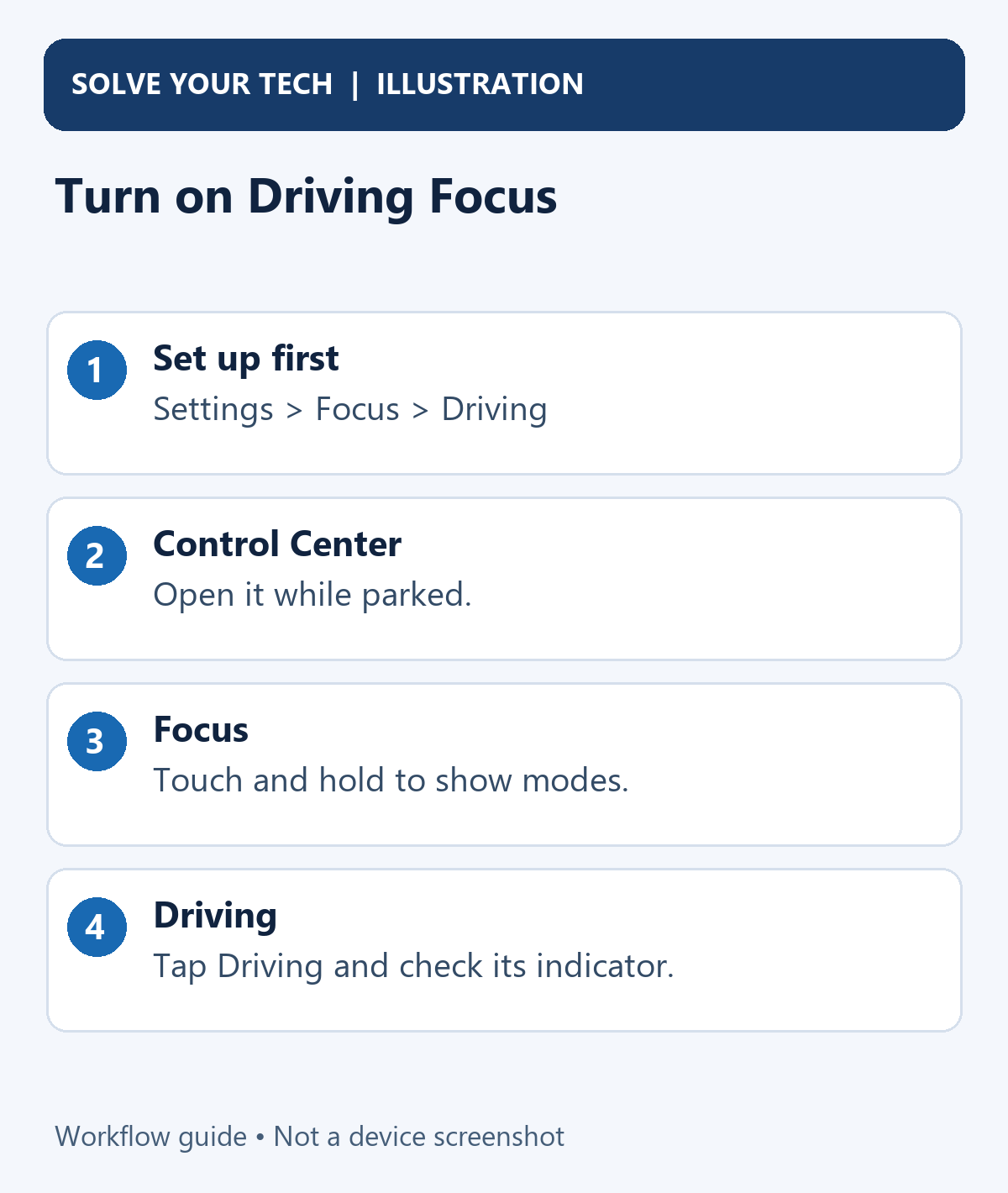
If another Focus is active, the control shows that mode’s name or icon. Expand the control to choose Driving. Tapping the control without expanding the list may switch on the Focus it is showing instead of the one you want. Only one Focus can be on at a time, so turning on Driving turns off any other Focus that was active.
Once Driving is on, your status is also shown automatically in Messages, so people texting you can see that you have notifications silenced.
If the Focus Control Is Missing From Control Center
On iOS 18 and later you can rearrange and remove controls, so the Focus control may have been taken out by accident. To put it back, open Control Center, touch and hold an empty area until the controls start to jiggle, tap Add a Control, and pick Focus from the list. Tap an empty area to finish. You can also turn Driving on without Control Center by going to Settings > Focus > Driving and setting up an automatic trigger, as described below.
Turn Driving Off
Open Control Center, touch and hold Focus, and tap Driving again so it is no longer highlighted. The car icon disappears from the status bar.
You can also turn it off from the Lock Screen. If Driving started automatically while you are a passenger, tap the Driving notification on the Lock Screen and choose I’m Not Driving.
Turning Driving off ends the current session only. It does not remove an automatic trigger. If Driving turns on again when you connect to the car or start moving, review While Driving and Activate With CarPlay in Settings.
Choose How Driving Starts Automatically
- Open Settings > Focus > Driving.
- Under Turn On Automatically, tap While Driving.
- Select the activation method you want.
- Go back and review Activate With CarPlay separately if you use CarPlay.
Automatically: The iPhone turns Driving on when it detects motion that looks like driving. Because it is detecting movement rather than identifying who is at the wheel, it can also turn on on a bus, a train, or when you ride as a passenger.
When Connected to Car Bluetooth: Driving starts when the iPhone connects to a car’s Bluetooth system. The phone has to actually connect to the car; turning Bluetooth on is not enough by itself.
Manually: You decide when to turn Driving on through Control Center. This suits you if automatic detection does not match your routine.
Activate With CarPlay: Driving turns on when the iPhone connects to CarPlay. This trigger is separate, so turn it off too if you picked Manually and want full control.

Apple’s Driving Focus user guide lists these methods. There is no sensitivity setting for motion detection, so choose Manually or Car Bluetooth if automatic detection turns on too often.
| Option | Best for | Watch out for |
|---|---|---|
| Automatically | Drivers with no car Bluetooth or CarPlay | Can turn on as a passenger |
| Car Bluetooth | Cars with a Bluetooth stereo | Only works once the phone connects |
| Manually | Full control from Control Center | Easy to forget to turn on |
| With CarPlay | CarPlay users | Stays separate from the While Driving choice |
Choose Who Can Notify You
- Open Settings > Focus > Driving.
- Under Allowed Notifications, tap People.
- Choose Allow Notifications From to list only the people who can reach you, or Silence Notifications From to list the people to mute.
- Tap Add People, select contacts, and tap Done.
Calls follow the separate Driving rule above: they come through only when the iPhone is connected to CarPlay, a car Bluetooth system, or a hands-free accessory. With Driving set up, you can also ask Siri to read replies to you so you do not need to look at the screen. If you want Siri to read incoming alerts aloud in the car, read about what Announce Notifications does on iPhone.
Set Up an Auto-Reply
- Open Settings > Focus > Driving.
- Tap Auto-Reply.
- Choose who gets the reply: No One, Recents, Favorites, or All Contacts.
- Edit the auto-reply message if you want a different explanation, such as when you expect to arrive.
- Read the finished text and check who will receive it.
People who get the auto-reply can send urgent as an extra message to get a notification through to you, according to Apple. Tell family members about this so they know how to reach you if something cannot wait.
Auto-Reply is part of Driving Focus. If your main goal is general quiet time rather than driving, use Do Not Disturb instead.
Focus Status tells people using supported apps that your notifications are silenced. It does not tell them the name of the Focus you are using, so they will not see the word “Driving.” Status is shared only while a Focus is on and only with apps you give permission.
If people see that notice when you are not driving, you can fix notifications silenced on iPhone.
Share Across Devices must be on to share Focus Status. Go to Settings > Focus > Focus Status and turn on Driving if you want it included.
Troubleshooting
Driving is not in the Focus list: Add it under Settings > Focus, then tap the Add button and choose Driving.
The Focus control is gone: Add it back with Add a Control as described above, or rely on an automatic trigger.
It turns on when you are not driving: Choose I’m Not Driving on the Lock Screen for that trip. For a lasting fix, change While Driving from Automatically to Car Bluetooth or Manually.
It starts again after you turn it off: Turning off a session does not disable future triggers. Review While Driving and Activate With CarPlay.
It does not start with the car: Confirm the iPhone connects to the car’s Bluetooth or CarPlay, not just that Bluetooth is on. Check that the trigger you want is selected under While Driving.
Contacts do not receive the auto-reply: Confirm Driving is on, the contact is in the selected audience, and Auto-Reply is not set to No One. The Focus Status notice in Messages is not the same as an auto-reply.
Your screen looks like an older tutorial: Check your iOS version under Settings > General > About. On iOS 15 and later, Driving is part of the Focus control, not a separate Control Center button.
Frequently Asked Questions
Where did Do Not Disturb While Driving go?
Apple replaced it with Driving Focus in iOS 15. You turn it on from the Focus control in Control Center or set it to start automatically in Settings.
Can someone reach me in an emergency?
Yes. People who get your auto-reply can send the word urgent as an extra message to get their notification through. Calls also ring when the iPhone is connected to CarPlay, car Bluetooth, or a hands-free accessory.
Is Driving the same as Do Not Disturb?
No. Both are Focus modes, but Driving can turn on when your iPhone detects driving or connects to your car, and it can send an auto-reply about driving.
Does Driving Focus affect a passenger’s iPhone?
Only if that iPhone has its own automatic trigger turned on. A passenger whose phone turns on Driving can choose I’m Not Driving on the Lock Screen.
How do I know Driving Focus is on?
A car icon appears in the status bar and on the Lock Screen, and the Driving row is highlighted when you expand Focus in Control Center.
If you use CarPlay every day, you can also tidy the car screen by learning how to remove apps from CarPlay on an iPhone.

Matthew Burleigh is the founder, head writer, and editor of Solve Your Tech, which he launched in 2012. He has written technology tutorials since 2008 and worked in IT since 2003, including small-business support, IT management, and consulting. He holds Bachelor’s and Master’s degrees in Computer Science from Arizona State University.
Matthew writes practical guides for Windows, iPhone and iPad, Microsoft Office, Outlook, Google apps, and Android. Solve Your Tech’s guides are checked step by step against the device or app maker’s own documentation and tested on his own devices whenever he has the hardware or software, with clear steps, sources, and update dates.
Read more about Matthew and how Solve Your Tech writes and updates its guides, or report a correction.