To remove an installed theme in desktop Google Chrome, open More > Settings > Appearance, then select Reset to default. Chrome returns to its classic theme right away. If a background picture or a dark look remains, check Customize Chrome and the light or dark setting separately.
These steps cover current Chrome on Windows, Mac, Linux and ChromeOS computers. Chrome on Android, iPhone and iPad has no installable themes, only a light or dark appearance, explained below.
Choose the appearance setting you want to change
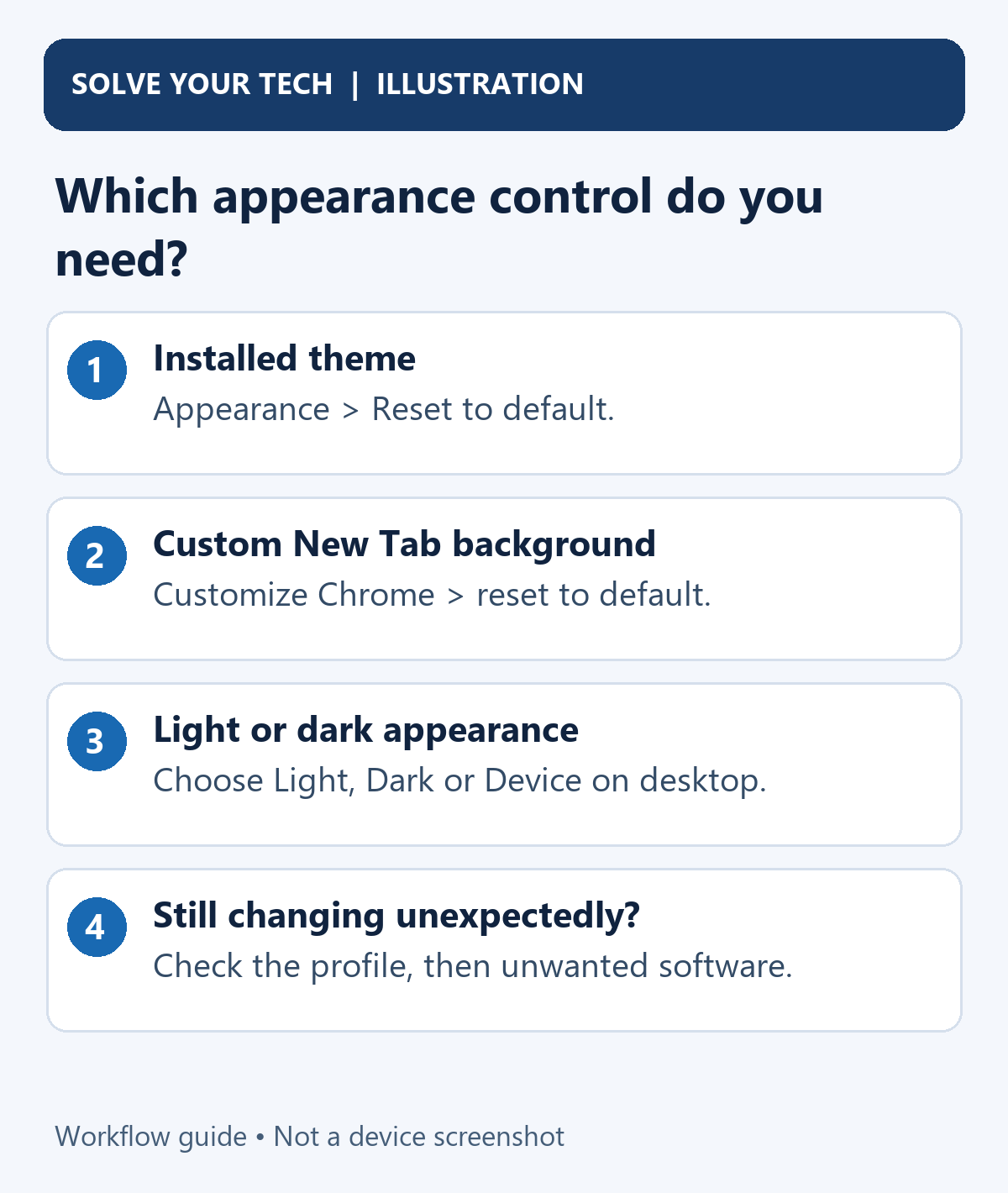
A theme from the Chrome Web Store changes the frame around Chrome and the background of a new tab. Chrome also lets you pick a New Tab background or a browser color, and choose a light or dark appearance. Any of those can make it look as though an unwanted theme is still active.
| What you see | Start here |
|---|---|
| Artwork or colors from an installed theme | Settings > Appearance > Reset to default |
| A custom photo or color on the New Tab page | New Tab > Customize Chrome > Reset to Default Chrome |
| Dark toolbar and settings after removing a theme | Customize Chrome > Light, Dark, or Device |
| A theme you added a moment ago | The Undo button at the top of the window |
These steps follow Google’s theme removal instructions.
Remove an installed Chrome theme
- Open Google Chrome on your computer.
- Click the three-dot More menu at the top right, then click Settings.
- Click Appearance on the left.
- Next to Theme, click Reset to default. Chrome returns to its classic theme. You do not need to restart the browser.

- Open a new tab. If a photo or dark appearance remains, use the matching section below.
To jump straight to this page, type chrome://settings/appearance in the address bar and press Enter.
If you do not see a Reset to default button, Chrome is already using its default theme. What you are seeing comes from a New Tab background, a color choice, or dark mode.
Chrome keeps only one installed theme at a time, so there is no list of old themes to clear. Installing a new theme replaces the current one.

Remove a custom New Tab background or color
Use this method for a photo, an uploaded picture, a Chrome background collection or a browser color picked in Chrome itself. It helps when resetting an installed theme did not remove the picture you meant to clear.
Google’s help says this panel works when you are signed in to your Google Account and Google is your default search engine. If Customize Chrome is missing, check those two settings first.
- Open a new tab in the Chrome profile you want to change. Use Chrome’s New Tab page, not an ordinary website with a Google search box.
- Select Customize Chrome at the bottom right. Chrome opens its customization side panel.
- Look under Appearance for the theme and color controls. Change theme is where a gallery theme or uploaded image was chosen.
- If a collection is set to change daily, open it and turn off Refresh daily so a new picture stops appearing.
- Select Reset to Default Chrome at the bottom of the panel. The background and colors return to the default.
- Close the panel and open another new tab to check. If the toolbar stays dark, check the appearance mode in the next section.
Google’s New Tab customization guide documents the panel and its reset control.
Change a dark appearance on desktop
Returning to the classic theme and choosing a light appearance are separate tasks. Chrome can stay dark because its mode is set to Dark, or because Device follows a dark setting on your computer.
- Open Chrome’s New Tab page and select Customize Chrome.
- Under Appearance, find the choices Light, Dark, and Device.
- Select Light for Chrome’s light appearance. Select Device if you want Chrome to follow the computer’s light or dark setting.
- Check the toolbar and a settings page in a normal window, not an Incognito window.
If you chose Device and Chrome is still dark, change the computer’s own mode:
- Windows 11: open Settings > Personalization > Colors and choose Light under Choose your mode, as described in Microsoft’s color settings guide.
- Mac: open System Settings > Appearance and select Light, following Apple’s appearance guide. Auto switches to dark in the evening.
Incognito windows usually look dark. Look for the Incognito label at the top right before assuming that a theme has returned. Switching appearance does not turn a private window into a normal one.
Google’s dark mode help explains the desktop choices and the difference from Incognito browsing.
What about Chrome on a phone or tablet?
Chrome on phones and tablets does not use Chrome Web Store themes, so there is no theme to remove. You can only switch between a light and dark appearance.
Android
In Chrome for Android, tap More > Settings > Theme and choose Light, Dark, or System default. System default uses a dark appearance when the phone uses Dark theme or Battery Saver.
Select Light for a light appearance, then check a normal browsing tab. An Incognito tab can still look dark.
iPhone and iPad
Chrome for iPhone and iPad follows the device’s Dark Mode setting. Open Settings > Display & Brightness, choose Light, then reopen Chrome.
Restore the old theme or choose another one
If you want a different look, install another theme from the Chrome Web Store.
- In desktop Chrome, open More > Settings.
- Under Appearance, select Themes to open the Chrome Web Store theme gallery.
- Select a thumbnail to preview a theme. Open the listing for the one you want and confirm its name.
- Select Add to Chrome. The theme applies immediately, and the button changes to show that it was added.
- If you change your mind right away, select Undo in the bar at the top of the window.
The Undo button is not a history of earlier themes. Once it is gone, reinstall the previous theme from its Chrome Web Store listing, if it is still available.
If the Theme Comes Back
- Wrong profile. Each Chrome profile keeps its own theme. Check the profile icon at the top right and reset the theme in the window that shows it.
- Your Google Account brought it back. Google stores themes with your settings in your Google Account, so the same theme appears when you sign in to Chrome on another computer. Reset it once while signed in, and the default follows you instead.
- An extension is changing the look. Older themes and some add-ons are extensions. Type chrome://extensions in the address bar, then turn off or Remove anything that changes Chrome’s look or New Tab page.
- A work or school computer. If Chrome says it is managed by your organization, an administrator may set the theme, and the reset button may not stick. Ask your IT team.
- Settings keep changing on their own. Follow Google’s unwanted software guidance, then consider a full Chrome reset.
If Chrome opens to a page you did not choose rather than an unwanted look, change your Chrome startup page in Settings.
Frequently asked questions
Will removing a theme delete my bookmarks or passwords?
No. Reset to default only changes the theme. Your bookmarks, passwords and history stay. Do not delete your Chrome profile to remove a theme, because that erases its local data.
Should I remove it from Manage extensions?
Use Appearance to restore the classic theme. If an actual extension supplies an unwanted feature or New Tab page, review that extension separately. Our Chrome extension removal guide explains removing, disabling and unpinning an extension.
Does resetting the theme restart Chrome?
No. The classic theme appears at once, and your open tabs stay where they are.
Why did the webpage text stay the same size?
A theme is an appearance choice, not the default webpage font-size control. Use our Chrome font size and zoom guide if the problem is small text rather than colors or artwork.
Next step: if you also want the row of site icons gone from the New Tab page, turn off Show shortcuts in the same Customize Chrome panel.

Matthew Burleigh is the founder, head writer, and editor of Solve Your Tech, which he launched in 2012. He has written technology tutorials since 2008 and worked in IT since 2003, including small-business support, IT management, and consulting. He holds Bachelor’s and Master’s degrees in Computer Science from Arizona State University.
Matthew writes practical guides for Windows, iPhone and iPad, Microsoft Office, Outlook, Google apps, and Android. Solve Your Tech’s guides are checked step by step against the device or app maker’s own documentation and tested on his own devices whenever he has the hardware or software, with clear steps, sources, and update dates.
Read more about Matthew and how Solve Your Tech writes and updates its guides, or report a correction.