To get Google Maps on an iPhone, open the App Store, search for Google Maps, tap Get, and then open the app and sign in with your Google Account. The app is free and needs iOS 16 or later.
Apple Maps comes built in, but Google Maps lets you use the saved places, lists and home and work addresses tied to your Google Account. You can keep both apps on your phone. Details below come from the Google Maps App Store listing and Google’s Maps Help.
In this guide:
How to Install Google Maps on iPhone
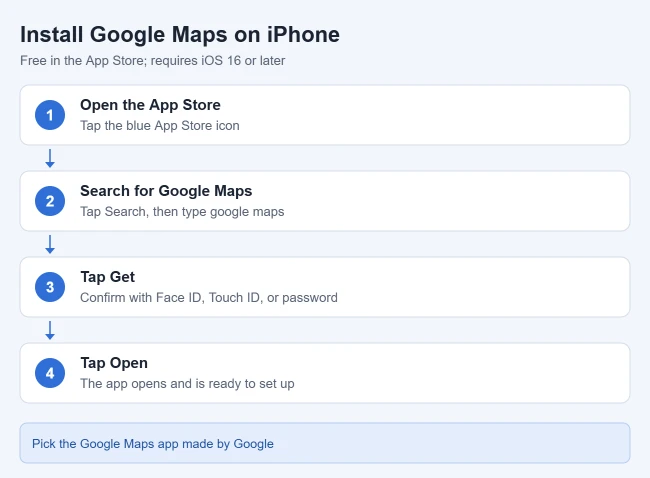
- Open the App Store.
- Tap Search, type google maps, and select the Google Maps app made by Google.
- Tap Get. If you’ve downloaded it before, tap the download icon instead.
- Confirm with Face ID, Touch ID, or your Apple Account password.
- Tap Open when the download finishes.
Result: Google Maps appears on your Home Screen next to Apple Maps.
If the App Store says the app isn’t compatible, check your iOS version. The listing currently requires iOS 16.0 or later. To find apps faster next time, see how to browse apps by category.
How to Sign In and Allow Location Access
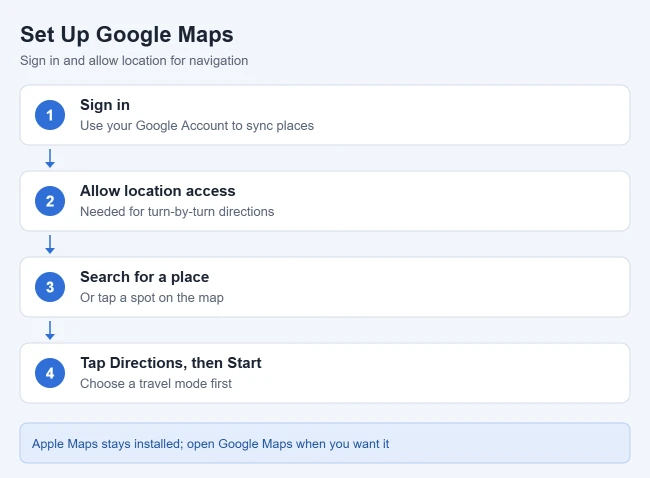
- Open Google Maps and sign in with your Google Account, or pick an account already on your iPhone.
- When asked, allow Google Maps to use your location.
- Set your home and work addresses so you can get directions to them faster.
Google says navigation needs GPS and permission to use your current location and speakers. If you chose not to share your location, Apple explains that you can change it later in Settings > Privacy & Security > Location Services. Tap Google Maps and choose an option. Leave Precise Location on for accurate turn-by-turn directions.
Result: Your saved places sync to the app, and the blue dot shows where you are.
How to Get Directions in Google Maps
Per Google’s navigation guide:
- Search for a place, or tap it on the map.
- Tap Directions in the bottom left.
- Choose how you’re traveling, such as driving, transit, or walking. Tap a gray line to pick another route.
- Tap Start. To stop, drag up from the bottom and tap Exit.
Result: You get voice directions with live traffic. Google notes that lane guidance and some navigation features aren’t available in every country, region, or language. To control music from the navigation screen, see how to connect Spotify to Google Maps on an iPhone.
The app’s main tabs are Explore, You and Contribute. Features like Location sharing, Timeline and Offline maps are under your profile picture in the top right. If a friend has shared with you, here is how to see a shared location in Google Maps. To mark a spot, see how to drop a pin at your current location.
Can You Make Google Maps the Default on iPhone?
Only in some places. Apple’s default apps guide says the Navigation default is available in the European Union and Japan. There, go to Settings > Apps > Default Apps > Navigation and choose Google Maps, so location links open in it instead of Apple Maps.
In other countries, including the US, Apple Maps stays the default. Open Google Maps yourself when you want it. Some apps let you pick it for links; for example, here’s how to make Discord map links open in Google Maps.
Frequently Asked Questions
Is Google Maps free on iPhone?
Yes. It’s free to download from the App Store.
Do I need a Google Account?
Signing in lets you sync saved places, lists and your home and work addresses across devices. You can add your Google account to the iPhone to use it in Mail as well.
Can I make Google Maps the default in the US?
Not currently. Apple lists the Navigation default only for the European Union and Japan, so in the US you open Google Maps yourself.
Can I see the map scale while driving?
Yes. See how to always show the scale in Google Maps on an iPhone.
Use ride-sharing apps with Maps? See how to check extension permissions in iPhone Maps.

Matthew Burleigh is the founder, head writer, and editor of Solve Your Tech, which he launched in 2012. He has written technology tutorials since 2008 and worked in IT since 2003, including small-business support, IT management, and consulting. He holds Bachelor’s and Master’s degrees in Computer Science from Arizona State University.
Matthew writes practical guides for Windows, iPhone and iPad, Microsoft Office, Outlook, Google apps, and Android. Solve Your Tech’s guides are tested on current devices or checked against official product documentation, with clear steps, sources, and update dates.
Read more about Matthew and how Solve Your Tech writes and updates its guides, or report a correction.