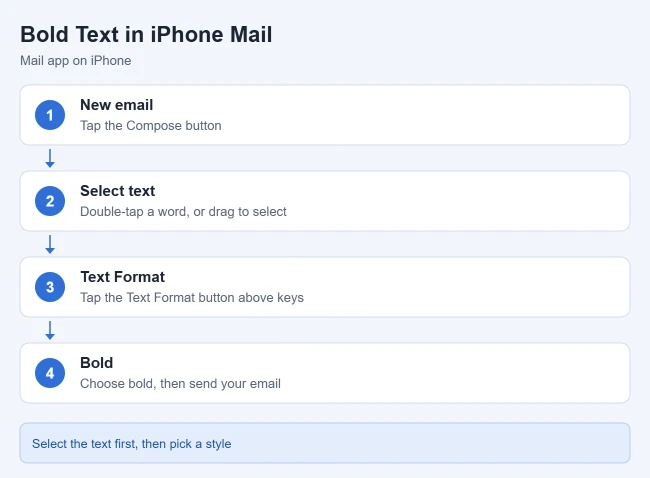
To bold text in an email on your iPhone, open the Mail app and start a new message. Select the words you want to bold, tap the Text Format button above the keyboard, then choose bold. The same menu also has italic, font, color, and list options.
This guide covers the built-in Mail app on iPhone. The steps follow Apple’s Send email in Mail on iPhone and Select, edit, and move text guides, checked in October 2026. Other email apps, such as Gmail or Outlook, have their own formatting tools.
How to Bold Text in an iPhone Email
- Open the Mail app on your iPhone. Result: your inbox opens.
- Tap the Compose button to start a new email, or open a reply or a draft. Result: a new message opens with the keyboard.
- Type your message. Result: your text appears in the body of the email.
- Select the text you want to bold. Double-tap a word, triple-tap a paragraph, or double-tap and hold, then drag the grab points to select more. Result: the text is highlighted.
- Tap the Text Format button above the keyboard. Result: the formatting options appear.
- Choose bold. Result: the selected text turns bold.
- Close the formatting options and tap Send when your email is ready. Result: your email is sent with the bold text.
Tips for Selecting Text
Apple lists a few quick ways to select text in any app on iPhone:
- One word: double-tap it with one finger.
- A paragraph: triple-tap it with one finger.
- A block of text: double-tap and hold the first word, then drag the grab points.
If you bold the wrong text, swipe left with three fingers to undo, or tap Undo at the top of the screen.
Other Formatting Options in Mail
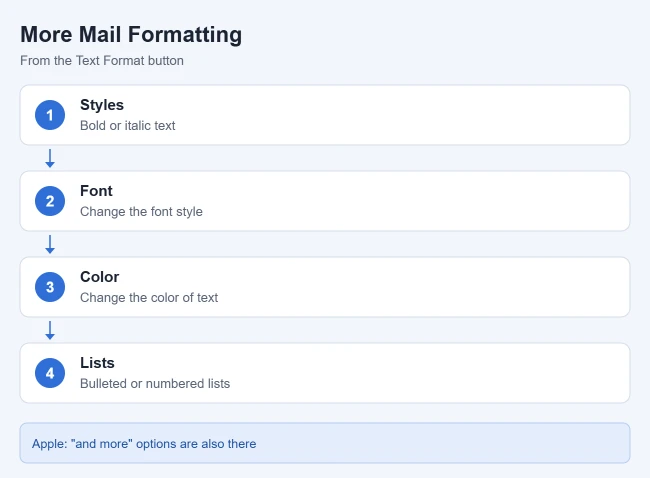
Apple says the Text Format button lets you change the font style and color of text, use a bold or italic style, add a bulleted or numbered list, and more. Use the same steps above: select your text, tap Text Format, and pick an option.
- Italic: good for titles or a light emphasis.
- Font and color: change how selected text looks.
- Lists: turn lines into a bulleted or numbered list.
Keep formatting light. A few bold words make an email easier to scan, but a lot of styling can be harder to read.
Will the Recipient See the Bold Text?
Usually, yes. Most email apps show formatted messages. If the person reads email in an app or setting that shows plain text only, the words still arrive, but the bold styling may not appear.
Bold Text in Messages
You can also bold text in the Messages app. Apple says to select the text, tap the Text Format button above the keyboard, and choose bold, italic, underline, or strikethrough. Formatting only shows for people using iMessage on iOS 18 or later and other recent Apple systems; otherwise the message appears as plain text. See Apple’s guide to formatting messages.
Frequently Asked Questions
Can I bold text in the subject line?
No. Formatting applies to the body of the email. The subject line is plain text.
Why is there no Text Format button?
Make sure you are typing in the body of the message, not the To or Subject field, and that the keyboard is showing. Updating your iPhone to the latest iOS can also help, since older versions put formatting in a different menu.
Can I remove the bold later?
Yes. Select the bold text, tap the Text Format button, and choose bold again to turn it off.
Related Guides
- How to remove Sent from my iPhone from emails
- How to use the Mail app on iPhone
- How to add, turn off, or delete an email account on iPhone
Need a special character in your email, like a temperature? See how to type a degree symbol on iPhone.

Matthew Burleigh is the founder, head writer, and editor of Solve Your Tech, which he launched in 2012. He has written technology tutorials since 2008 and worked in IT since 2003, including small-business support, IT management, and consulting. He holds Bachelor’s and Master’s degrees in Computer Science from Arizona State University.
Matthew writes practical guides for Windows, iPhone and iPad, Microsoft Office, Outlook, Google apps, and Android. Solve Your Tech’s guides are tested on current devices or checked against official product documentation, with clear steps, sources, and update dates.
Read more about Matthew and how Solve Your Tech writes and updates its guides, or report a correction.