A white cursor in Google Docs usually comes from your computer’s pointer settings or from a dark-mode tool in your browser, not from the document. On Windows, set the pointer style to black or inverted in Settings > Accessibility > Mouse pointer and touch; if the cursor still looks wrong, open the document in an incognito window to check whether an extension is changing the page colors. Google Docs has no setting of its own for cursor color.
These fixes cover Google Docs in Chrome, Edge, Firefox, and Safari on Windows 11 and on a Mac running a current version of macOS (including macOS Tahoe), plus a short note for Chromebooks. Menu names were checked against Microsoft, Apple, and Google help pages.
First, Figure Out Which Cursor Is White
Two different things are called “the cursor,” and they are fixed in different places:
- The mouse pointer is the shape that moves with your mouse or touchpad. Over the page it becomes an I-beam (a thin vertical bar with small crossbars), and over menus it is an arrow. Its color comes from your computer’s pointer settings, not from Google Docs.
- The text cursor (also called the insertion point or caret) is the blinking line that shows where your next letter will appear. In a normal Google Docs page it is dark, so a white or missing text cursor usually means something is changing the page colors.
If only the I-beam is white, jump to the Windows or Mac pointer fixes. If the blinking line is white or invisible, start with the incognito test and the dark-mode checks.
| What you see | Most likely cause | Where to fix it |
|---|---|---|
| White I-beam over a white page, normal arrow over menus | Windows pointer style or Text Select pointer | Fix 4 or Fix 5 |
| White pointer everywhere, not only in Docs | Pointer style set to white | Fix 4 (Windows) or Fix 6 (Mac) |
| Page looks dark or colors look inverted | Dark-mode extension or Chrome flag | Fix 2 or Fix 3 |
| Problem only in one document | Page color or text formatting | Fix 7 |
| Pointer flickers or vanishes only in the browser | Zoom, graphics acceleration, or an old browser | Fix 8 |
Fix 1: Test the Document in an Incognito Window
Incognito (Chrome) or InPrivate (Edge) windows normally run without your extensions, so this test tells you quickly whether an extension is involved.
- In Chrome or Edge, press Ctrl + Shift + N on Windows or Command + Shift + N on a Mac. In Firefox, press Ctrl + Shift + P (Command + Shift + P on a Mac). A private window opens.
- Go to docs.google.com and sign in to your Google account.
- Open the same document and click in the text.
If the cursor looks normal here, an extension or browser setting in your regular window is the cause. Continue with Fix 2 and Fix 3. If it is still white, the cause is probably your computer’s pointer settings, so skip to Fix 4 (Windows) or Fix 6 (Mac).
Fix 2: Turn Off Extensions That Change Page Colors
Dark-mode extensions are the most common culprit because they repaint the page, and the cursor gets repainted with it. Grammar tools, custom font extensions, and high-contrast extensions can also change how the page draws.
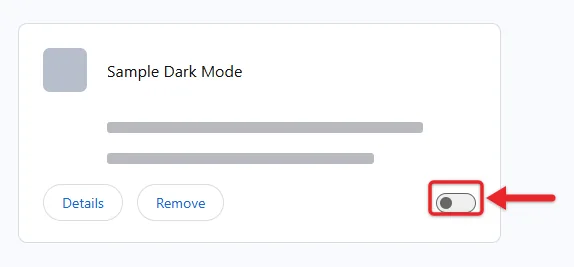
- In Chrome, click the three-dot menu at the top right, then select Extensions > Manage extensions. Google’s Chrome Web Store help on managing extensions shows the same page.
- Turn off the switch for any dark-mode, contrast, or color extension.
- Go back to your document and reload the page with Ctrl + R (Command + R on a Mac).
- If the cursor is back to normal, you found the cause. If not, turn the next extension off and reload again, one at a time.
You don’t have to give up a dark-mode extension you like. Most of them let you switch them off for one website from their toolbar button or settings, so you can exclude docs.google.com and keep dark mode everywhere else. In Edge, the same list is at Settings and more (three dots) > Extensions > Manage extensions.
Fix 3: Turn Off Chrome’s Auto Dark Mode Flag
Chrome has an experimental setting called Auto Dark Mode for Web Contents that forces every website, including Google Docs, into dark colors by inverting them. If you turned it on at some point, it can make the page dark and the cursor light.
- Type chrome://flags in the address bar and press Enter. In Edge, type edge://flags instead.
- Type Auto Dark Mode for Web Contents in the search box at the top.
- If the menu next to it says Enabled, change it to Default or Disabled.
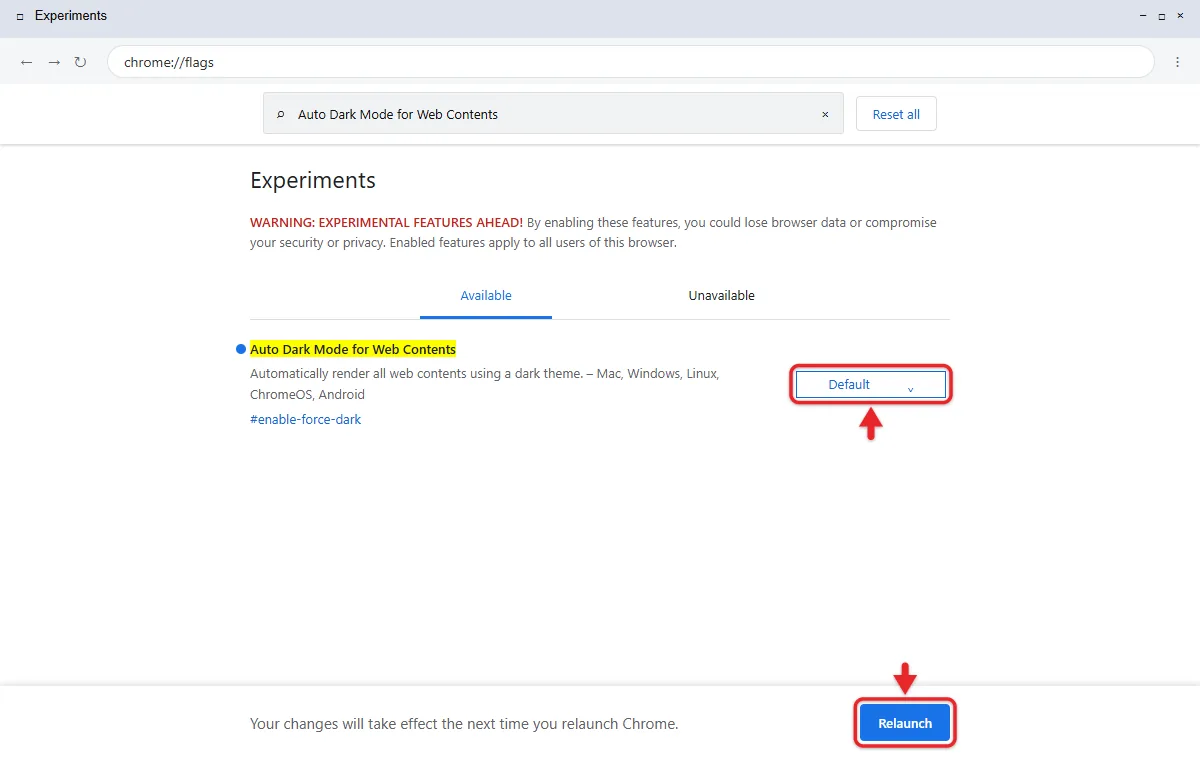
- Click Relaunch at the bottom of the window. The browser restarts and reopens your tabs.
Chrome’s normal dark theme, set from Customize Chrome on a New Tab page, only darkens Chrome’s own toolbar and pages, according to Google’s Chrome dark mode help. It does not change the document page, so you can leave it on.
Fix 4: Change the Mouse Pointer Style in Windows 11
If the I-beam is white everywhere you type, change the pointer style. A black or inverted pointer stands out on a white page.
- Press Windows key + U to open Accessibility settings.
- Click Mouse pointer and touch.
- Under Mouse pointer style, click the black pointer or the inverted pointer. Inverted switches between black and white depending on what is under it. You can also choose a bright color, or click Choose another color for any color you like.
- Drag the Size slider to the right if you want a bigger pointer.
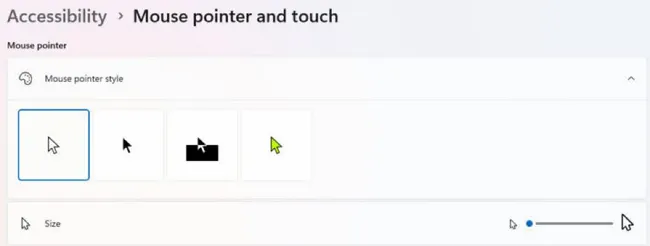
- Go back to Google Docs and move the pointer over the page. The I-beam now uses the style you picked.
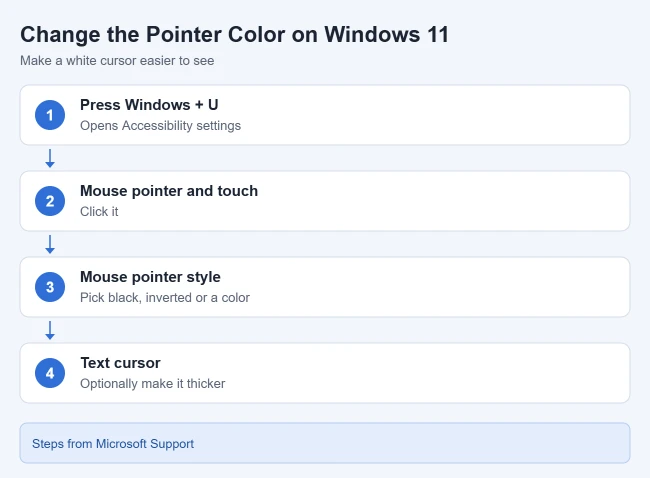
Microsoft’s accessibility steps for the mouse and keyboard list the same options. They also cover the blinking text cursor: on the Accessibility page, click Text cursor, drag the Text cursor thickness slider to make the line wider, or turn on Text cursor indicator to add a colored marker to it. More pointer designs and sizes are available when you change your mouse cursor in Windows.
Fix 5: Swap the Text Select Pointer in Mouse Properties
Some people find the I-beam still looks pale over Google Docs even after changing the style. In that case, replace only the text-select pointer with Windows’ darker alternative. This uses the older Mouse Properties window, which Microsoft’s mouse settings page describes.
- Press Windows key + R, type main.cpl, and press Enter. The Mouse Properties window opens. You can also get there from Settings > Bluetooth & devices > Mouse > Additional mouse settings.
- Click the Pointers tab.
- In the Customize list, click Text Select (the I-beam).
- Click Browse. A folder of Windows cursor files opens.
- Choose beam_r.cur and click Open. The preview next to Text Select changes to a darker I-beam.
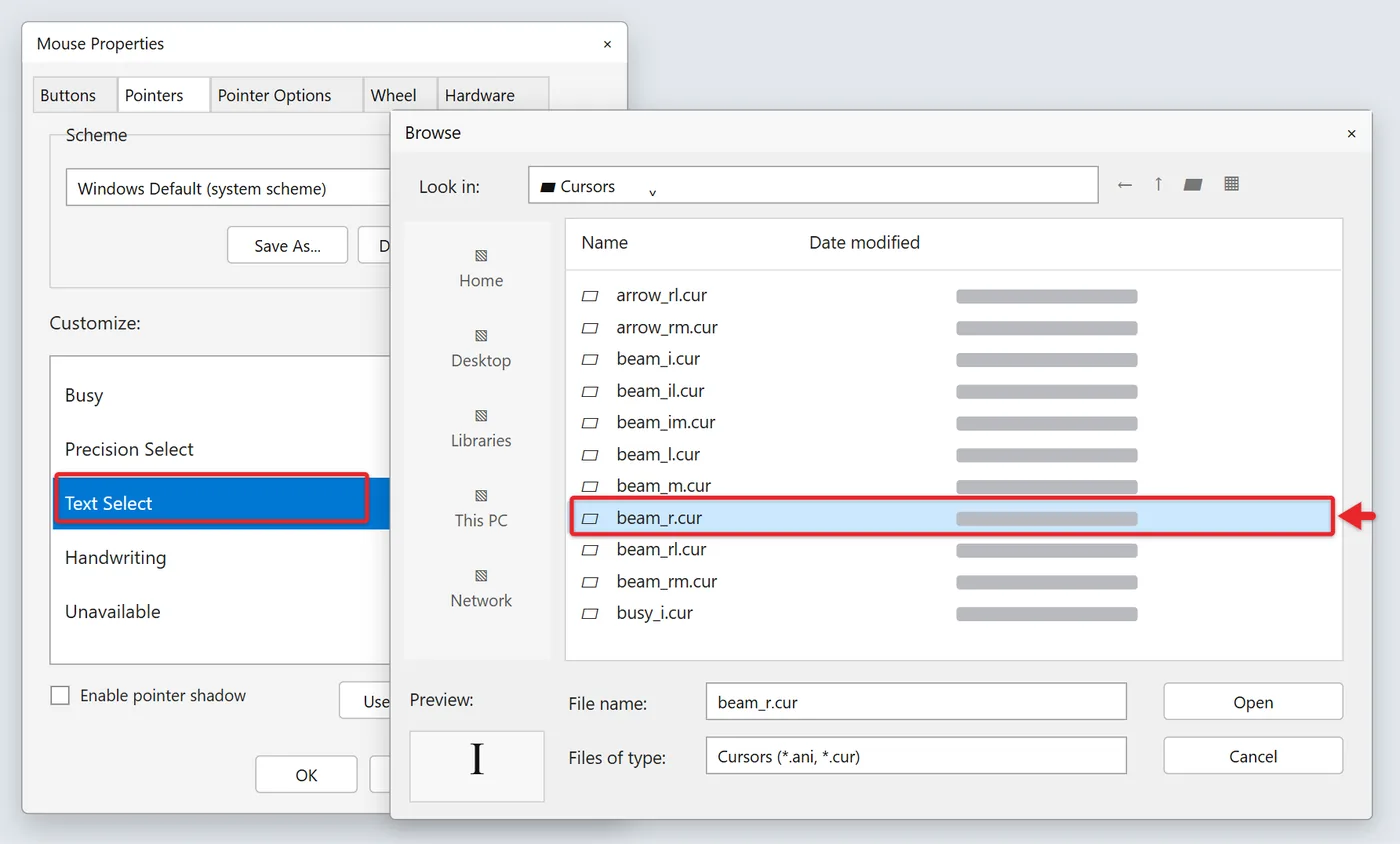
- Click Apply, then OK.
To change every pointer at once instead, open the Scheme list on the same tab and choose Windows Black (system scheme). To undo any of this later, select the pointer and click Use Default, or pick Windows Default (system scheme) from the Scheme list.
While Mouse Properties is open, check the Pointer Options tab too. If Hide pointer while typing is checked, the pointer vanishes as soon as you type, which can look like a cursor problem. Uncheck it if that bothers you, and check Show location of pointer when I press the CTRL key so you can find the pointer any time with a tap of Ctrl.
Fix 6: Change the Pointer Colors on a Mac
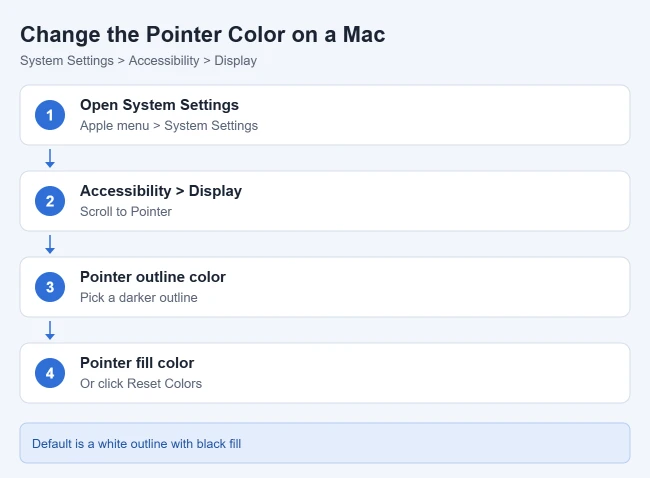
On a Mac, the pointer has an outline color and a fill color. Apple’s Make the pointer easier to see on Mac guide lists these steps:
- Choose Apple menu > System Settings.
- Click Accessibility in the sidebar, then click Display. You may need to scroll down.
- Under Pointer, click Pointer fill color and choose a dark color.
- Click Pointer outline color and choose a color that contrasts with the fill.
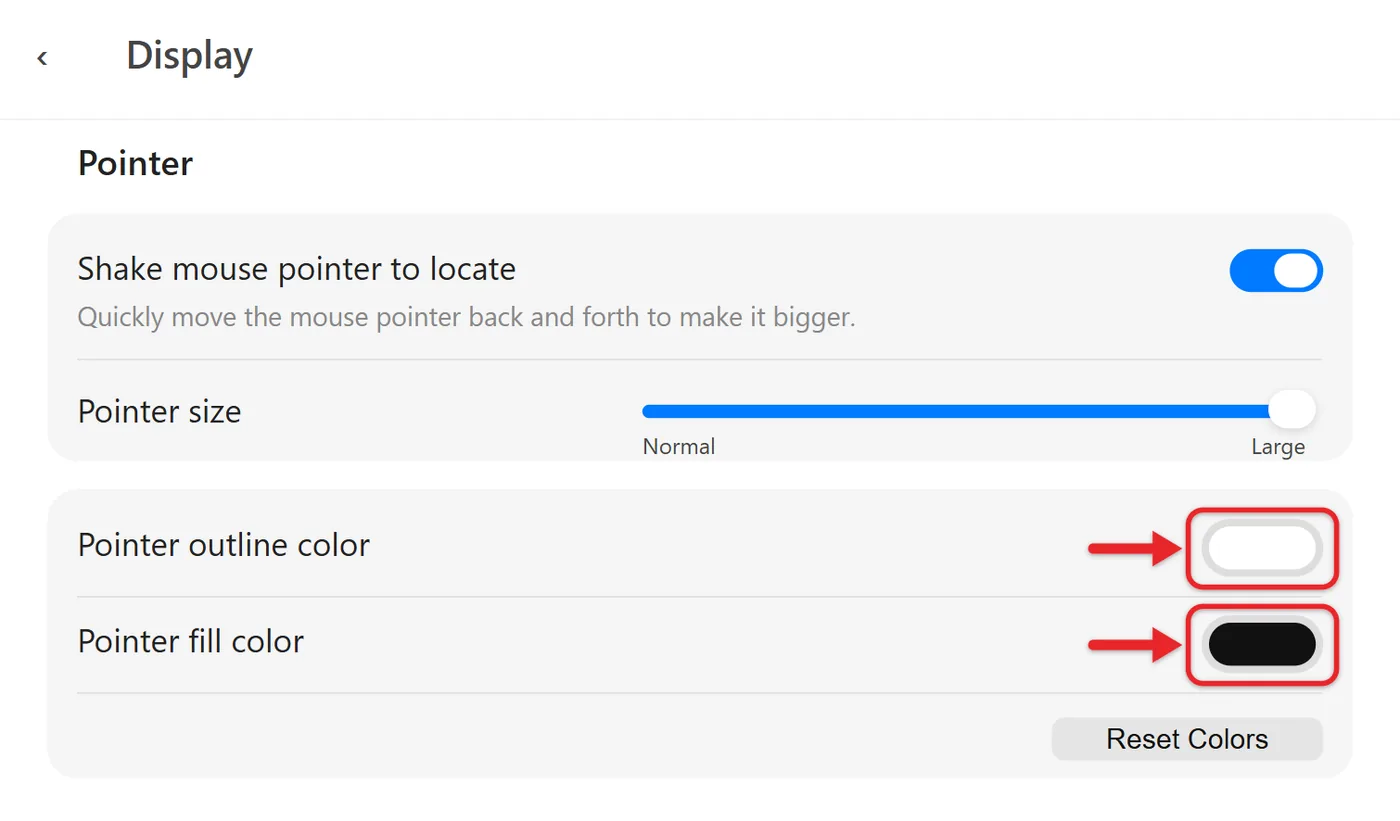
- To go back to Apple’s standard black pointer with a white outline, click Reset Colors.
On the same screen you can drag Pointer size to make the pointer bigger and turn on Shake mouse pointer to locate, which makes the pointer grow for a moment when you shake the mouse or swipe quickly on the trackpad.
On a Chromebook: Google’s Chromebook accessibility help says you can change the cursor’s size and color. Select the time at the bottom right (or press Alt + Shift + S), then Settings > Accessibility > Cursor and touchpad.
Fix 7: Check the Document’s Page Color
If the cursor only looks wrong in one document, check whether someone gave that document a dark background. Unlike browser settings, a page color is saved in the file, so it looks the same on every computer.
- In the document, click File > Page setup.
- Look at Page color. If it is a dark color, change it to white.
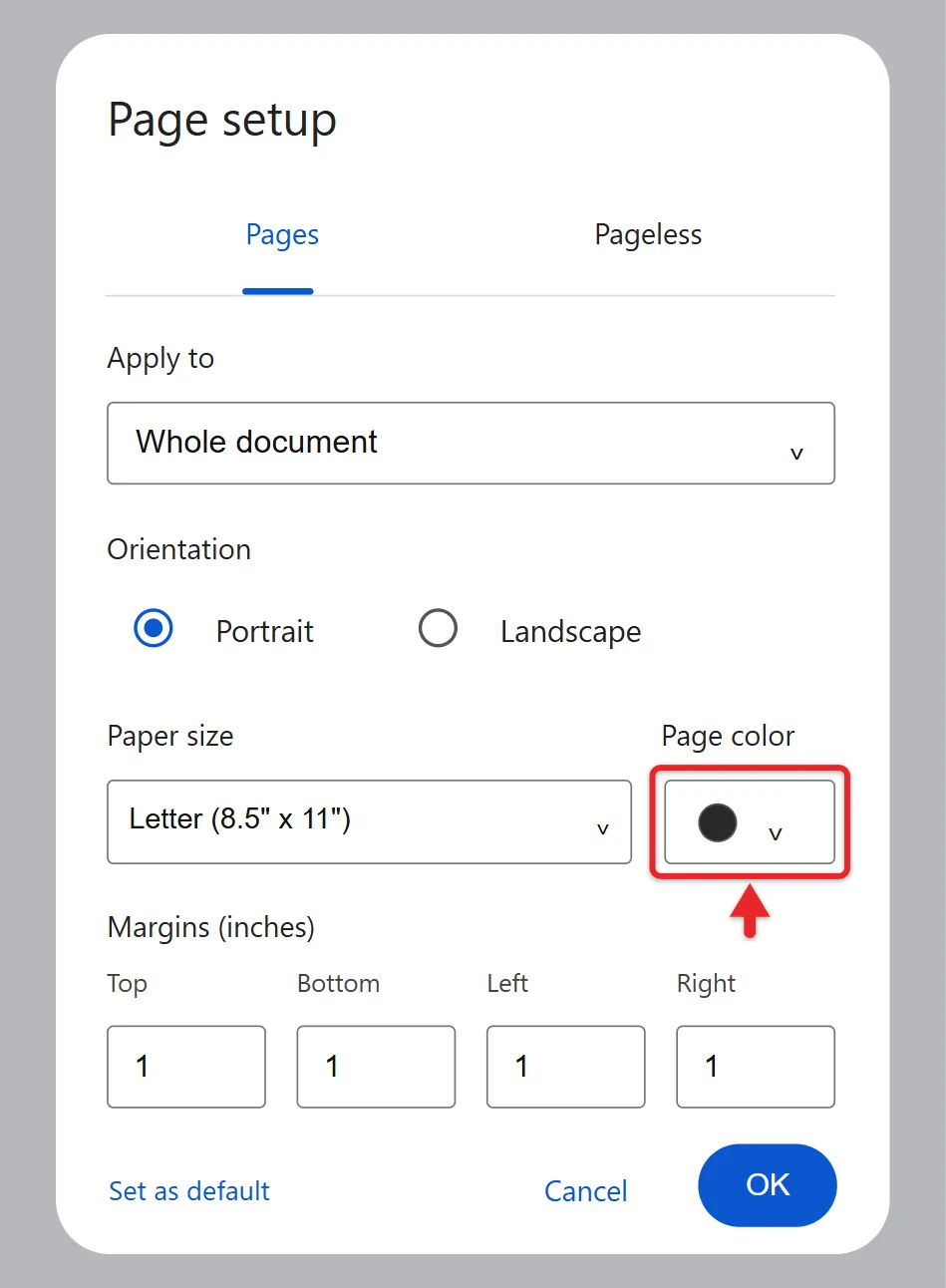
- Click OK.
Google’s page setup help notes that you can change the background color in both pages and pageless documents. To rule out the rest of the document’s formatting, open a new blank document from docs.google.com and type a few words. If the cursor looks normal there, the problem is in the original file’s formatting, not your computer.
Fix 8: Check the Browser Zoom, Graphics Setting, and Updates
If the cursor flickers, looks distorted, or turns white only in one browser, work through these checks in order.
- Reset browser zoom. Click on the page and press Ctrl + 0 (Command + 0 on a Mac) to return the browser to 100%. Unusual zoom levels can make the cursor look thin or misplaced. The zoom box in the Docs toolbar is separate and only resizes the page.
- Toggle graphics acceleration in Chrome. Open the three-dot menu > Settings > System. Turn off Use graphics acceleration when available (older versions call it Use hardware acceleration when available), then click Relaunch. If nothing changes, turn it back on, because it helps video and scrolling run smoothly.
- Update the browser. In Chrome, open the three-dot menu > Help > About Google Chrome. Chrome checks for an update and asks you to relaunch if one is installed.
- Clear cached files. Press Ctrl + Shift + Delete (Command + Shift + Delete on a Mac), check Cached images and files, choose a time range, and click the delete button. Leave cookies unchecked if you don’t want to be signed out of websites.
- Try another browser. Open the document in Edge, Firefox, or Safari. If the cursor looks fine there, the problem is limited to your usual browser’s settings or profile.
- Update Windows and your graphics driver. Open Settings > Windows Update and install any updates, including optional driver updates. On a Mac, use System Settings > General > Software Update. Restart afterward.
If you use an external monitor, also try the document on your laptop’s built-in screen. A problem that follows one monitor points to that display’s scaling or settings rather than Google Docs.
How to Confirm the Fix Worked
Open any Google Doc, move the pointer over the text, and click to place the cursor. The I-beam should be easy to see against the white page, and the blinking text cursor should appear dark where you clicked. Type a word and select it to make sure highlighting looks normal too.
Every fix here can be reversed. Turn an extension back on from Manage extensions, set a flag back to Default, pick the white style in Mouse pointer and touch, click Use Default in Mouse Properties, or click Reset Colors on a Mac.
Frequently Asked Questions
Can I change the cursor color inside Google Docs?
No. Google Docs has no cursor-color setting. The pointer color comes from Windows, macOS, or ChromeOS, so change it in your computer’s accessibility settings as shown above.
Does Google Docs have its own dark mode that could cause this?
Not in a web browser. Google’s Docs dark theme help covers only the Google Docs apps for phones and tablets. On a computer, a dark Docs page always comes from an extension, a browser flag, or a dark page color in the file.
Why is the cursor white only in Google Docs?
Google Docs draws its own editing page instead of using a standard text box, so tools that recolor web pages affect it in ways you don’t see in other apps. Also, the white I-beam is easiest to lose on a large white page, which is exactly what a Docs document is.
Will changing my pointer affect other people who edit the document?
No. Pointer style, browser extensions, and flags only change what you see on your own computer. The page color in File > Page setup is the only setting here that changes the document for everyone.
My cursor disappears completely, not just turns white. What should I do?
That is usually a different problem, such as a turned-off touchpad or a pointer that is hidden while you type. Those fixes are in getting your cursor back on a Windows 11 laptop.
Prefer reading with less glare? Your phone can also show Google Docs in dark mode.

Matthew Burleigh is the founder, head writer, and editor of Solve Your Tech, which he launched in 2012. He has written technology tutorials since 2008 and worked in IT since 2003, including small-business support, IT management, and consulting. He holds Bachelor’s and Master’s degrees in Computer Science from Arizona State University.
Matthew writes practical guides for Windows, iPhone and iPad, Microsoft Office, Outlook, Google apps, and Android. Solve Your Tech’s guides are checked step by step against the device or app maker’s own documentation and tested on his own devices whenever he has the hardware or software, with clear steps, sources, and update dates.
Read more about Matthew and how Solve Your Tech writes and updates its guides, or report a correction.