To stop YouTube from using cellular data on your iPhone, open Settings, tap Cellular, scroll down to YouTube in the list of apps, and turn its switch off. Apple says that when cellular data is off for an app, the iPhone uses only Wi-Fi for it, so the YouTube app will only load videos while you are connected to Wi-Fi.
Streaming video is one of the heaviest uses of a data plan, so this one switch is a quick way to protect a limited allowance. The steps below follow Apple’s cellular data settings guide for iOS 27 and YouTube’s video quality help article. If you would rather keep watching away from Wi-Fi but use less data, skip to the section on using less data.
Before You Start
- What you need: an iPhone with a cellular plan and the YouTube app installed. You do not need to sign in to YouTube or change anything inside the app.
- Which versions: the labels here match iOS 27. Apple’s guide shows the same per-app switches for earlier versions, although the layout of the Cellular screen has changed over time.
- Different names: in some regions the menu is called Mobile Data or Mobile Service instead of Cellular. On an iPad with cellular service, you might see Cellular Data in Settings instead.
- What changes: only the YouTube app is affected. Calls, texts, and every other app keep working as before.
How to Turn Off Cellular Data for YouTube
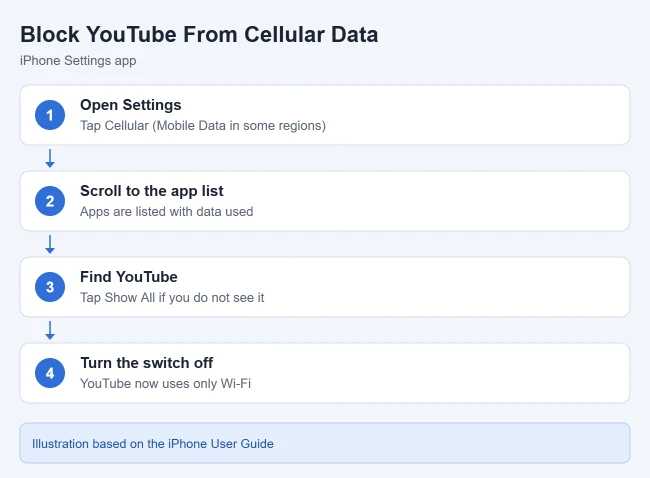
Know this first: once the switch is off, the YouTube app cannot stream, search, or refresh when you are away from Wi-Fi. Uploads need Wi-Fi as well, and you can review the full quality upload settings for them. If you rely on YouTube for directions, music, or how-to videos while you are out, consider the data-saving options later in this article instead.
- Open the Settings app on your iPhone.
- Tap Cellular (or Mobile Data or Mobile Service). The Cellular screen opens with your plan options at the top.
- Scroll down to the list of apps and services. Each app has a switch, and the amount of cellular data it has used appears below its name.
- If you do not see YouTube, tap Show All to open the full list of apps.
- Turn off the switch next to YouTube. The switch changes from green to gray.
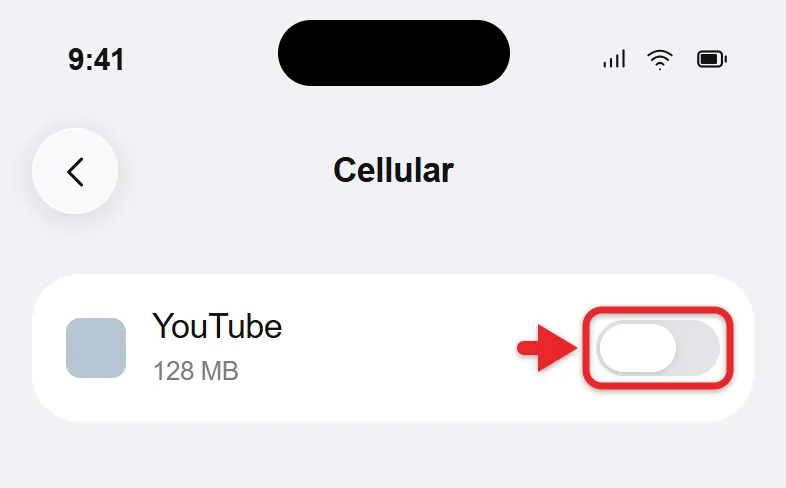
The change takes effect right away and does not need a restart. From then on, YouTube uses only Wi-Fi for data (details in Apple’s cellular data support article).
How to confirm it worked
Go back to Settings > Cellular and check that the YouTube switch is gray. For a practical check, open the YouTube app while your iPhone is not connected to Wi-Fi. Videos should not load, and you may see a message saying that cellular data is turned off for YouTube. Join a Wi-Fi network and the app works normally again.
How to undo it
Return to Settings > Cellular, find YouTube, and turn its switch back on. Nothing in your YouTube account, history, or subscriptions is changed by this setting, so there is nothing else to restore.
What Still Works With the Switch Off
- YouTube on Wi-Fi. At home, at work, or on any other Wi-Fi network, the app behaves exactly as it did before.
- Downloaded videos. If you have YouTube Premium, videos you download on Wi-Fi can be watched offline. YouTube’s offline viewing article says downloads can be played for up to 29 days before the device needs to reconnect to the internet, and less in some countries and regions. Here is how downloading a YouTube video works on an iPhone 11.
- YouTube in a browser. The switch applies to the YouTube app only. If you open YouTube in Safari or another browser, that browser’s own switch decides whether cellular data is used. You can turn off cellular data for Safari as well, but that blocks every website in Safari when you are away from Wi-Fi.
- Other YouTube apps. YouTube Music, YouTube Kids, and YouTube TV are separate apps, and each one has its own switch in the same list.
How to Keep YouTube on Cellular but Use Less Data
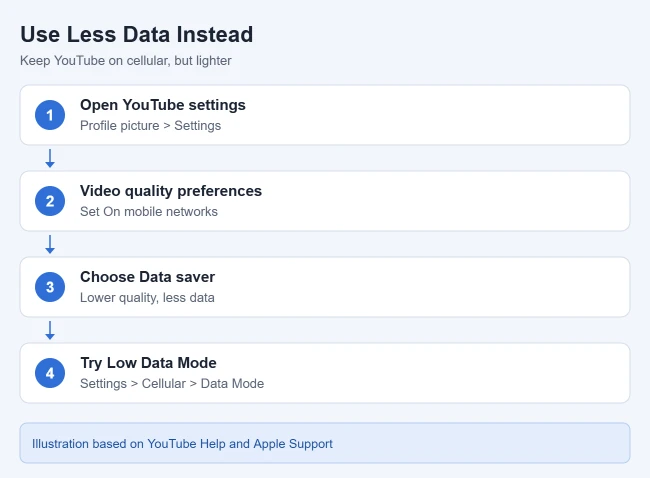
Blocking YouTube completely is not always practical. These settings leave the app working on cellular but reduce how much data it uses. Each one is separate, so you can use one or all of them.
Set a lower video quality for mobile networks
YouTube lets you choose one video quality for mobile networks and another for Wi-Fi:
- Open the YouTube app and tap your profile picture.
- Tap Settings.
- Tap Video quality preferences.
- For mobile networks, choose Data saver. This gives lower picture quality, but videos may start faster.
- Leave Wi-Fi on Auto or Higher picture quality if you want sharper video at home.
The other choices are Auto, which adjusts quality to your conditions, Higher picture quality, which uses more data, and Advanced, which lets you pick a resolution yourself. To change the quality of only the video you are watching, tap Settings in the video player, tap Quality, and pick an option.
Stop videos from playing in your feed
YouTube can play videos silently as you scroll the Home feed, a feature it calls Playback in feeds. YouTube Help says this may be on by default on both Wi-Fi and mobile data. To limit it, tap your profile picture, then Settings > General > Playback in feeds, and choose Wi-Fi only or Off. To stop the next video from starting on its own, turn off Autoplay in YouTube on iPhone as well.
Turn on Low Data Mode
Low Data Mode is an iPhone setting that restricts background network use across the whole phone. Go to Settings > Cellular > Cellular Data Options. Depending on your plan, either turn on Low Data Mode there, or tap Data Mode and choose Low Data Mode. With Dual SIM (two phone lines on one iPhone), tap one of your numbers first.
Apple’s Low Data Mode article says the mode turns off Background App Refresh, pauses automatic downloads and backups, and reduces the quality of streaming content, though each app decides how it responds.
Joining a friend’s Personal Hotspot also uses cellular data, so you may want to stop your iPhone from joining hotspots automatically.
Check Connectivity Assist
Connectivity Assist is the iOS 27 name for the feature that used to be called Wi-Fi Assist. It uses cellular data alongside Wi-Fi when the Wi-Fi connection is slow or unusable, and it can increase cellular data use. It now lives in Settings > Wi-Fi rather than in Cellular settings. Scroll down on the Wi-Fi screen and turn Connectivity Assist off if you want your iPhone to stay on weak Wi-Fi instead of adding cellular data. On earlier iOS versions, look for Wi-Fi Assist at the bottom of the Cellular screen.
This matters only for apps that are still allowed to use cellular data. With the YouTube switch off, the app stays on Wi-Fi only.
How to Check How Much Data YouTube Uses
Open Settings > Cellular, scroll to the list of apps, and tap Show All. The figure under YouTube is the cellular data it has used in the current period. That period does not follow your billing month. It runs from the last time the statistics were reset, so the number can cover a long stretch of time.
To start a fresh count, scroll to the bottom of the Cellular screen and tap Reset Statistics. Doing this on the day your billing cycle begins makes the numbers easier to compare with your plan. Your carrier has the most accurate usage figures for the current period, so treat the iPhone numbers as a guide.
Troubleshooting
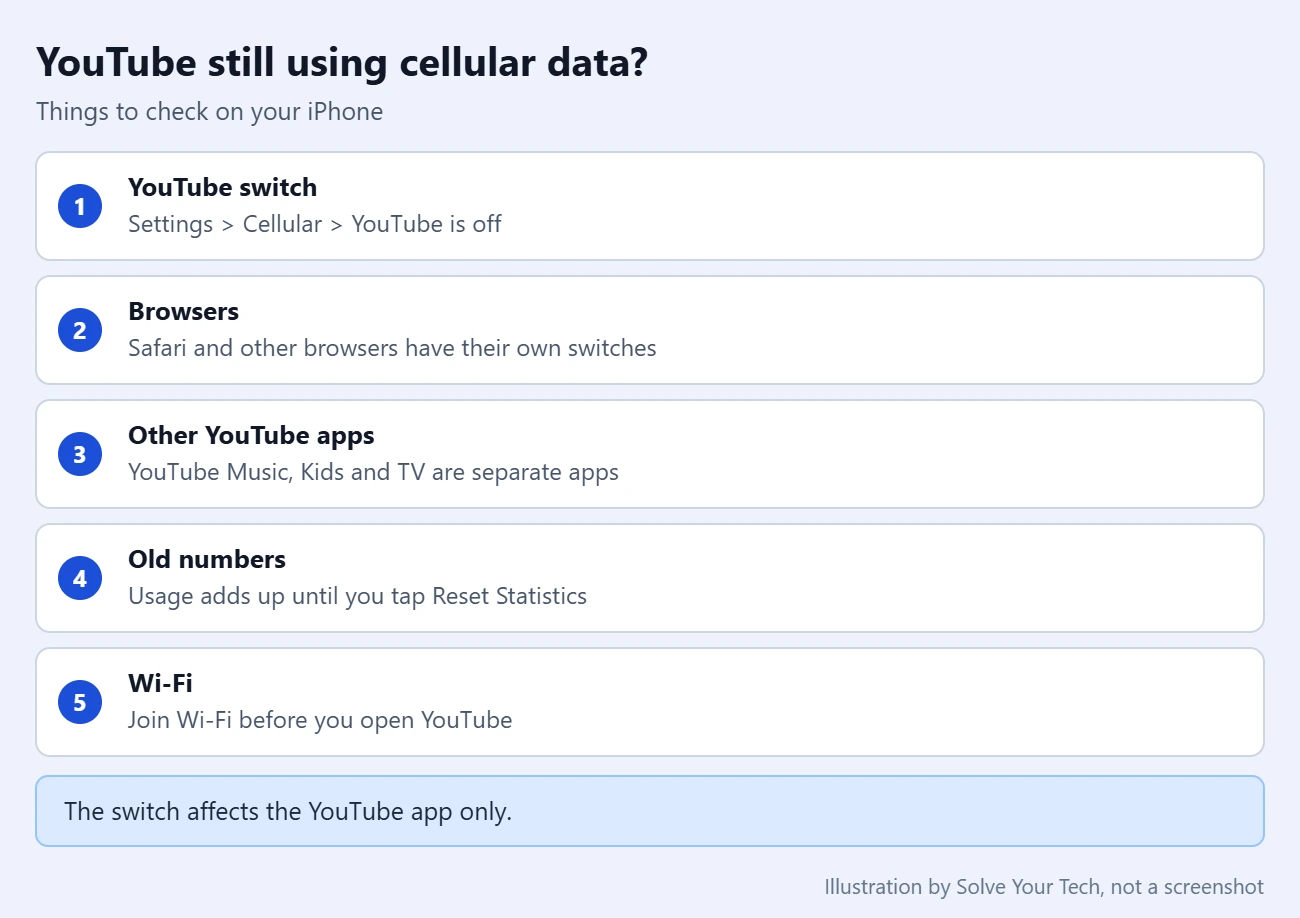
- YouTube is not in the list. Tap Show All, since the first screen may show only some apps. If it is still missing, confirm that the app is installed and that you are looking at the YouTube app and not YouTube Music.
- There is no Cellular menu. Look for Mobile Data or Mobile Service. A Wi-Fi-only iPad has no cellular settings at all.
- The switches are dimmed and will not move. A Screen Time restriction or a work or school management profile may be locking cellular settings. Check Settings > Screen Time > Content & Privacy Restrictions, or ask the person who manages the device.
- The data number under YouTube is still large. The total includes everything used since the last reset. Tap Reset Statistics, then check again in a few days. It should stay at or near zero.
- Data is still disappearing. Look at your browsers and other video apps in the same list. Tap System Services to see data used by the iPhone itself. Cellular data cannot be turned off for individual system services.
- YouTube will not load at all. That is the expected result away from Wi-Fi. Connect to Wi-Fi, or turn the YouTube switch back on.
Frequently Asked Questions
Does turning off cellular data for YouTube affect YouTube Music?
No. YouTube Music is a separate app with its own switch in the Cellular list. Turning off YouTube leaves YouTube Music, YouTube Kids, and YouTube TV unchanged, so switch off each one you want to limit.
Will YouTube still send notifications?
Apple’s documentation does not say how notifications behave for an app whose cellular switch is off, so do not count on receiving YouTube alerts while you are away from Wi-Fi. They should arrive as usual once the iPhone is back on Wi-Fi.
Can I watch downloaded YouTube videos with cellular data off?
Yes, if you have YouTube Premium and downloaded the videos beforehand. Downloads play without an internet connection. Some features, such as commenting and liking, are not available offline.
Does this setting stop YouTube from using data on Wi-Fi?
No. The switch controls cellular data only. On Wi-Fi, YouTube uses as much data as the video quality requires. If your home internet has a data cap, lower the Wi-Fi quality in Video quality preferences.
Is it better to turn off the switch or use Data saver?
Turning off the switch is the only way to make sure the YouTube app uses no cellular data. Data saver reduces usage but does not stop it. Choose the switch if you are close to your limit, and Data saver if you still need YouTube when you are out. To find the video quality settings, read about watching YouTube videos on an iPhone.
Next Steps
The same switch works for any app in the Cellular list. For example, you can stop X (Twitter) from using cellular data on your iPhone. To cut usage across your whole plan, there are more ways to reduce cellular data on an iPhone. If you watch gaming videos or live streams, learn where to find YouTube gaming content on iPhone in the current app.
Netflix has its own in-app data settings too; here’s how Netflix Save Data and Maximum Data work on iPhone.
If Disney+ is your other big data user, you can also make it use less data when streaming on an iPhone.

Matthew Burleigh is the founder, head writer, and editor of Solve Your Tech, which he launched in 2012. He has written technology tutorials since 2008 and worked in IT since 2003, including small-business support, IT management, and consulting. He holds Bachelor’s and Master’s degrees in Computer Science from Arizona State University.
Matthew writes practical guides for Windows, iPhone and iPad, Microsoft Office, Outlook, Google apps, and Android. Solve Your Tech’s guides are checked step by step against the device or app maker’s own documentation and tested on his own devices whenever he has the hardware or software, with clear steps, sources, and update dates.
Read more about Matthew and how Solve Your Tech writes and updates its guides, or report a correction.