If your line spacing in Word looks too big, select the text (press Ctrl+A for all of it), go to Home > Line and Paragraph Spacing, and choose a smaller number like 1.0. Extra space between paragraphs comes from the Before and After settings in Line Spacing Options; set them to 0 pt to remove it.
These steps come from four Microsoft articles: Remove double line spacing, Change the line and paragraph spacing in Word, Adjust indents and spacing, and Change the default line spacing in Word. They apply to Word for Microsoft 365, Word 2024, 2021, 2019, and 2016 on Windows and Mac, with notes for Word for the web.
How to fix line spacing that is too big
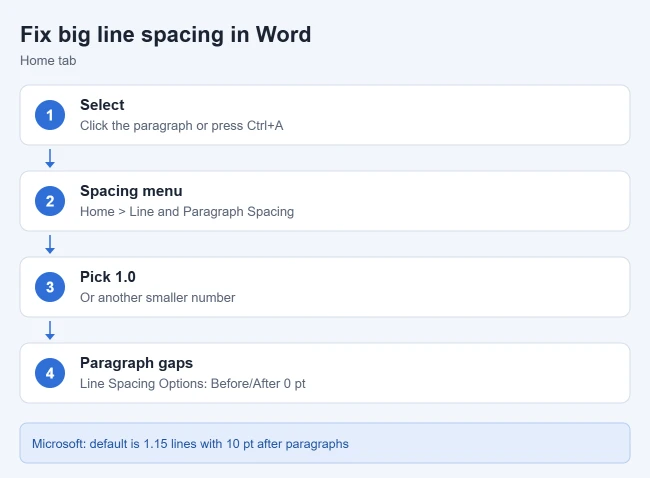
- Select the paragraph, or press Ctrl+A (Command+A on a Mac) to select everything.
- Go to Home > Line and Paragraph Spacing. In Word for the web, it’s Home > Line Spacing.
- Choose 1.0 for single spacing, or another smaller option.
Result: the lines in your selection move closer together. Microsoft says Word’s default is 1.15 lines, which adds a bit of room between lines.
How to remove extra space between paragraphs
- Select the text.
- Go to Home > Line and Paragraph Spacing > Line Spacing Options.
- Under Spacing, set Before and After to 0 pt.
- Select OK.
Result: the gap between paragraphs shrinks. Microsoft notes Word adds 10 points after each paragraph by default, and headings get space above them.
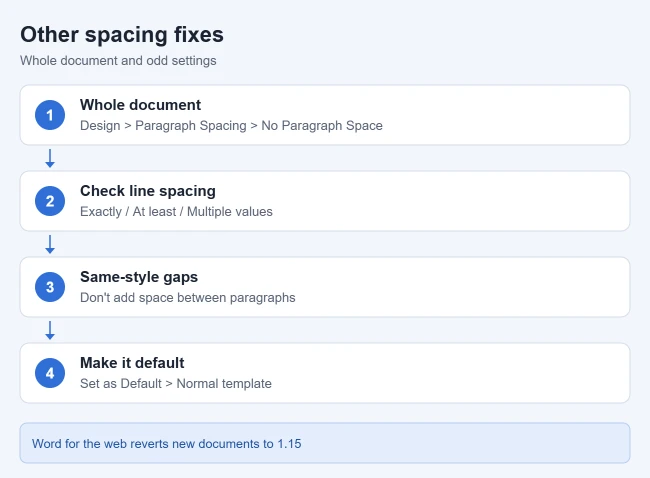
To keep spacing between other paragraphs but remove it inside a list, check Don’t add space between paragraphs of the same style in the same dialog. Microsoft gives bulleted lists as the typical use.
Fix the spacing for the whole document at once
On Windows or Mac, go to Design > Paragraph Spacing and choose No Paragraph Space to single-space the document. Microsoft says this overrides the current style set; to undo it, return to Design > Paragraph Spacing and pick the option under Style Set (often Default).
Still too big? Check the line spacing type
In Line Spacing Options, look at the Line spacing box. Microsoft describes these settings:
- Single, 1.5 lines, Double: fixed multiples of single spacing.
- At least: sets a minimum, but the line grows to fit the largest font or graphic on it, so one big character or image can spread lines out.
- Exactly: fixed spacing in points, such as 12 pt for 10-point text.
- Multiple: a multiplier, so 3 means triple spacing.
If the box shows a large Multiple or At least value, change it to Single or a smaller number.
How to change the default spacing for new documents
- Go to Home > Line and Paragraph Spacing > Line Spacing Options.
- Choose your line spacing and your Before and After settings.
- Select Set as Default.
- Choose All documents based on the Normal template and select OK.
Result: new documents use your spacing. Microsoft notes Word for the web goes back to 1.15 spacing each time you create a new document.
Frequently asked questions
Why is Word’s spacing so big by default?
Microsoft says the 1.15 line spacing and 10 points after each paragraph are there for readability. You can change both and save them as your default.
Does this work in Word for the web?
Yes. Microsoft’s web steps use Home > Line Spacing and the same Line Spacing Options. The difference is that Word for the web can’t keep a new default; new documents start at 1.15 again.
More Word Guides
- How to add or remove borders in Word
- How to wrap text around a picture in Word
- Why Word deletes text as you type

Matthew Burleigh is the founder, head writer, and editor of Solve Your Tech, which he launched in 2012. He has written technology tutorials since 2008 and worked in IT since 2003, including small-business support, IT management, and consulting. He holds Bachelor’s and Master’s degrees in Computer Science from Arizona State University.
Matthew writes practical guides for Windows, iPhone and iPad, Microsoft Office, Outlook, Google apps, and Android. Solve Your Tech’s guides are tested on current devices or checked against official product documentation, with clear steps, sources, and update dates.
Read more about Matthew and how Solve Your Tech writes and updates its guides, or report a correction.