To take a screenshot in PowerPoint, click the slide, then choose Insert > Screenshot. Pick an open window from the gallery to insert the whole window, or choose Screen Clipping and drag to capture just part of the screen. To save a picture of a slide itself instead, use Save As (Windows) or Export (Mac) with an image format, or your computer’s screenshot shortcut.
These steps cover PowerPoint for Microsoft 365, PowerPoint 2024, 2021, 2019, and 2016 on Windows and Mac, the versions Microsoft lists for the Screenshot command. PowerPoint 2013 has the same Insert > Screenshot button and steps, though Microsoft no longer supports that version.
How to Insert a Screenshot in PowerPoint
Before you start, open the window you want to capture and leave it open. Microsoft’s Insert a screenshot or screen clipping page says windows minimized to the taskbar can’t be captured.
- In PowerPoint, click the slide where you want the image.
- On the Insert tab, in the Images group, click Screenshot. A menu opens with thumbnails of your open windows under Available Windows.
- Click a window thumbnail to insert that whole window, or click Screen Clipping to capture only part of the screen.
- If you chose Screen Clipping, PowerPoint gets out of the way, the screen turns white or frosted, and the pointer becomes a cross. Hold the left mouse button and drag across the area you want.
- Let go of the mouse button. The capture lands on the slide, selected and ready to move or resize.
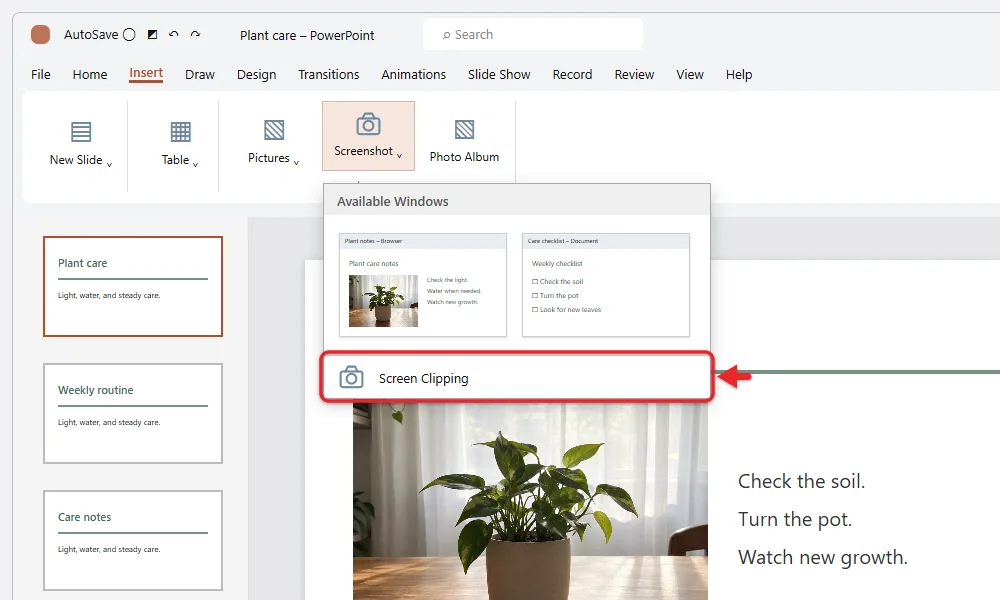
- With the picture selected, use the Picture Format tab (called Picture Tools in older versions) to crop, add a border, or resize it. Drag a corner handle to resize without stretching the image.
You can add only one screenshot at a time, so repeat the steps for each extra capture.
Tips for Screen Clipping
- Pick the right window first. Screen Clipping captures part of the first window in the Available Windows gallery. Click the window you want just before you switch to PowerPoint so it moves to the first spot.
- Capture a web page. Open the page in your browser, scroll to the part you need, then go straight to PowerPoint and click Screenshot.
- Crop out private details. Drag tightly around what matters, or use Crop on the Picture Format tab after inserting, so email addresses, tabs, and notifications don’t end up on the slide.
- Add alt text. Right-click the picture and choose View Alt Text (or Edit Alt Text in some versions) to describe it for people who use screen readers.
Use Your Computer’s Screenshot Shortcut Instead
The Screenshot button can’t capture menus that close when you click away, and it isn’t listed for PowerPoint for the web. Your operating system’s tools handle those cases. Take the screenshot, click the slide, and press Ctrl + V (Windows) or Command + V (Mac) to paste it.
On Windows
- Windows key + Shift + S opens the Snipping Tool bar. Choose Rectangle, Window, Full screen, or Freeform, then drag or click. The capture is copied to the clipboard, ready to paste. Microsoft’s Snipping Tool guide lists the modes and shortcuts.
- Print Screen copies the whole screen to the clipboard. On PCs set to use Print Screen for screen capture, it opens the Snipping Tool bar instead.
- Alt + Print Screen copies only the active window.
- To capture a menu, open the Snipping Tool app, set a delay, select New, and open the menu before the timer ends.
For more Snipping Tool options, learn how to use Snipping Tool on Windows 11.
On a Windows 10 computer, the article on printing the screen in Windows 10 lists every built-in capture shortcut and where the images are saved.
On a Mac
Apple’s Take a screenshot on Mac guide lists these shortcuts:
- Shift + Command + 4 turns the pointer into a crosshair. Drag over the area you want.
- Shift + Command + 4, then the Space bar, captures one window or menu. Click the window to capture it.
- Shift + Command + 3 captures the whole screen.
- Add Control to any of these shortcuts to copy the screenshot to the clipboard instead of saving a file on the desktop.
Our Mac screenshot guide covers the Screenshot app and where files are saved.
How to Save a PowerPoint Slide as a Picture
If you want an image of a slide itself, for an email, a document, or social media, export it instead of taking a screenshot. Exporting saves the whole slide cleanly, without the PowerPoint window around it.
On Windows
- Select the slide in the thumbnail pane on the left.
- Click File > Save As, or Save a Copy if the file is stored on OneDrive or SharePoint, and choose a folder.
- In Save as type, choose JPEG, PNG, GIF, or SVG.
- Click Save, then choose Just This One.
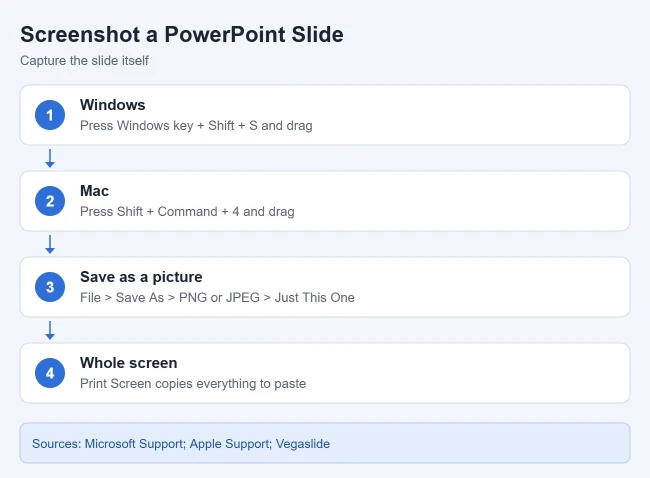
Choose All Slides in the last step to save every slide as its own image. Both options are covered in Save a slide as an image.
On a Mac
- Open the slide you want.
- Choose File > Export.
- In the File Format menu, choose JPEG or PNG.
- Choose Save Current Slide Only, or Save Every Slide for the whole deck.
- Enter a Width and Height if you want a specific image size, then click Export.
Microsoft’s PowerPoint for Mac export guide notes that animations, transitions, and media don’t carry over into the images.
PNG keeps text and lines sharp, so it’s usually the better choice for slides with words or screenshots. JPEG makes smaller files for photo-heavy slides.
Which Method Should You Use?
| You want to | Use |
|---|---|
| Put another app or web page on a slide | Insert > Screenshot |
| Capture a menu, or work in PowerPoint for the web | Your computer’s screenshot shortcut, then paste |
| Share one slide as an image | Save As (Windows) or Export (Mac) with PNG or JPEG |
| Grab part of a slide quickly | Windows key + Shift + S, or Shift + Command + 4 |
Troubleshooting
The window you want isn’t in the gallery
Only windows that aren’t minimized appear. Restore the window from the taskbar or Dock, then click Screenshot again.
Screen Clipping captured the wrong window
Screen Clipping uses the first window in the gallery. Click the window you want, switch back to PowerPoint, and try again.
The Screenshot gallery is empty on a Mac
macOS needs permission before an app can capture the screen. Open System Settings > Privacy & Security > Screen & System Audio Recording and turn on Microsoft PowerPoint, then quit and reopen PowerPoint. The setting is described in Apple’s screen recording privacy guide.
The Screenshot button is greyed out or missing
The Screenshot command is part of desktop PowerPoint on Windows and Mac, not PowerPoint for the web. In the browser version, take the screenshot with your computer’s shortcut and paste it onto the slide. In the desktop app, click a slide in the main editing area and check the Insert tab again.
Your screenshot shortcut doesn’t work
Another app, such as a cloud storage app or a third-party capture tool, can take over the Print Screen key. Close it or change its hotkey. On a laptop, Print Screen may share a key, so hold Fn as well. Some security software and streaming sites also block captures, which leaves a black image.
Frequently Asked Questions
Does the Screenshot button work in other Office apps?
Yes. The same command is in Excel, Outlook, and Word, on the Insert tab.
In Excel, you can also insert a picture into a cell so the image stays with its row of data.
Can I save a screenshot from a slide as its own file?
Yes. Right-click the picture on the slide, choose Save as Picture, and pick a format such as PNG or JPEG.
Why does my screenshot look blurry on the slide?
PowerPoint scales a large capture to fit the slide, which can make small text hard to read. Capture a smaller area, zoom in on the content before you capture, or crop the picture so the important part fills more of the slide.
Can I take a screenshot during a slide show?
Yes, with your computer’s shortcut. Windows key + Shift + S on Windows or Shift + Command + 4 on a Mac works while the slide show is running.
If you plan to share the finished deck, you can also save the PowerPoint as a PDF.

Matthew Burleigh is the founder, head writer, and editor of Solve Your Tech, which he launched in 2012. He has written technology tutorials since 2008 and worked in IT since 2003, including small-business support, IT management, and consulting. He holds Bachelor’s and Master’s degrees in Computer Science from Arizona State University.
Matthew writes practical guides for Windows, iPhone and iPad, Microsoft Office, Outlook, Google apps, and Android. Solve Your Tech’s guides are checked step by step against the device or app maker’s own documentation and tested on his own devices whenever he has the hardware or software, with clear steps, sources, and update dates.
Read more about Matthew and how Solve Your Tech writes and updates its guides, or report a correction.