To send a Google Meet link, go to meet.google.com, click New meeting, choose Create a meeting for later, copy the link that appears, and paste it into a message. For a meeting at a set time, create a Google Calendar event with Google Meet video conferencing and add your guests, so the link goes out with the invite.
Someone asks you to send the Meet link before a call in ten minutes, and you haven’t created a meeting yet.
Pick the Right Way to Send the Link
Every method produces the same kind of link (a meet.google.com address with a meeting code), but they suit different situations. Use this table to jump to the one you need.
| Your situation | Best method | Why |
|---|---|---|
| Call starts in a few minutes | Meet: Create a meeting for later | Gives you a link to paste anywhere without joining yet |
| You’re already in the call | Meeting details > Copy joining info | Copies the link and joining details from inside the meeting |
| Meeting at a set date and time | Google Calendar event with Meet | Guests get an invite with the link, time and a reminder |
| You live in your inbox | Gmail’s Meet section | Send or copy an invite without leaving Gmail |
| You’re on your phone | Meet app: New > Create link | Copy or share the link straight to a text or chat |
| You’re already chatting with the person | Google Chat: Send a Meet link | Drops a link into the conversation |
Google’s own help page on starting or scheduling a Google Meet video meeting recommends using Meet together with Google Calendar. A Calendar event also keeps the link tied to an event your guests can find later.
Before you start, sign in to the Google Account you want to host with. A personal Gmail account and a work or school account (Google Workspace) can both create links, but some host controls differ, as covered further down.
Send a Meet Link From a Computer Right Now
This is the fastest route when someone is waiting on you.
- Open a browser and go to meet.google.com. Sign in if asked.
- Click New meeting.
- Choose Create a meeting for later. A box appears with your meeting link.
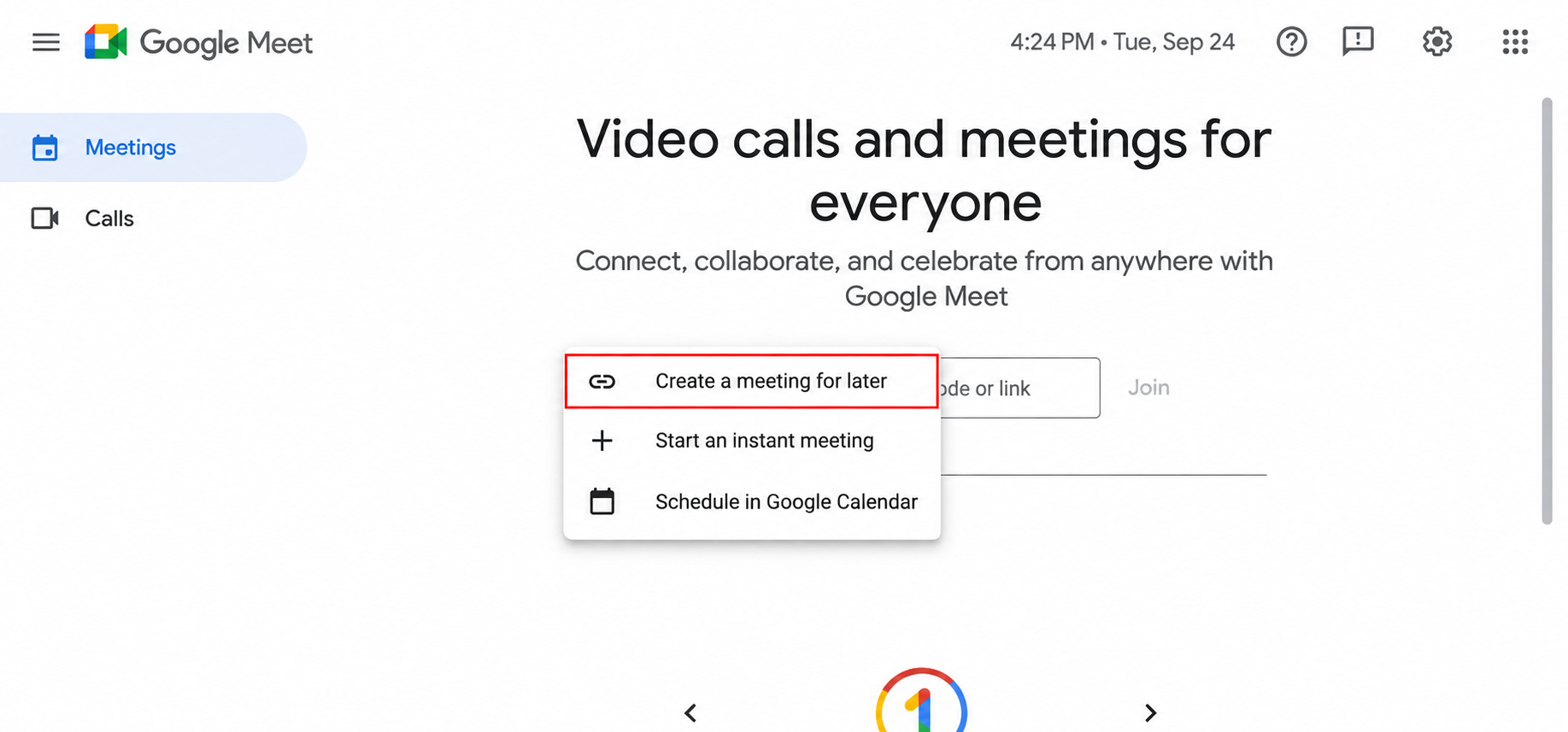
- Copy the meeting link.
- Paste it into an email, a chat message, a text or wherever the other person asked for it.
- When it’s time to start, paste the link into your browser’s address bar, or type it into the “Enter a code or link” field on the Meet home page, then click Join.
The other choices on the New meeting menu do different things. Start an instant meeting creates a new meeting and puts you in it right away; you’d then share the link from inside the call (see the next section). Schedule in Google Calendar sends you to Calendar to set up an event.
Worked example: Marcus gets a message at 1:50 asking for a link to a 2:00 call. He goes to meet.google.com, clicks New meeting, chooses Create a meeting for later, copies the link, and pastes it into his reply with the line “Here’s the link for 2:00.” At 1:59 he pastes the same link into his browser and joins. His contact clicks the link from the message and joins too.
If you’re sending the link by text or a chat app, add the time in the same message. A bare link doesn’t tell anyone when to show up.
If you started an instant meeting or someone new needs to join a call that’s already running, copy the details from inside the meeting.
- In the meeting, open Meeting details.
- Click Copy joining info. This copies the meeting link along with other joining details.
- Paste it into an email or message to the person you want to add.
Google lists this same Copy joining info step for adding a Meet meeting to another scheduling system, such as a calendar that isn’t Google Calendar. Paste the copied details into the event’s description or location field.
Depending on the meeting’s access setting, the new person may have to ask to join. If they do, you’ll see a request in the meeting and can admit them. Who has to ask is explained under controlling who can join, below.
Send a Meet Invite From Google Calendar
For any meeting that isn’t happening right now, a Calendar invite is the most dependable way to send the link. Guests get the date, time and link in one place, and the link stays attached to the event.
- Open Google Calendar on your computer.
- At the top left, click Create, then choose Event. Give it a title, date and time.
- Add guests by typing their email addresses.
- Click Add Google Meet video conferencing. A “Join with Google Meet” link appears in the event.
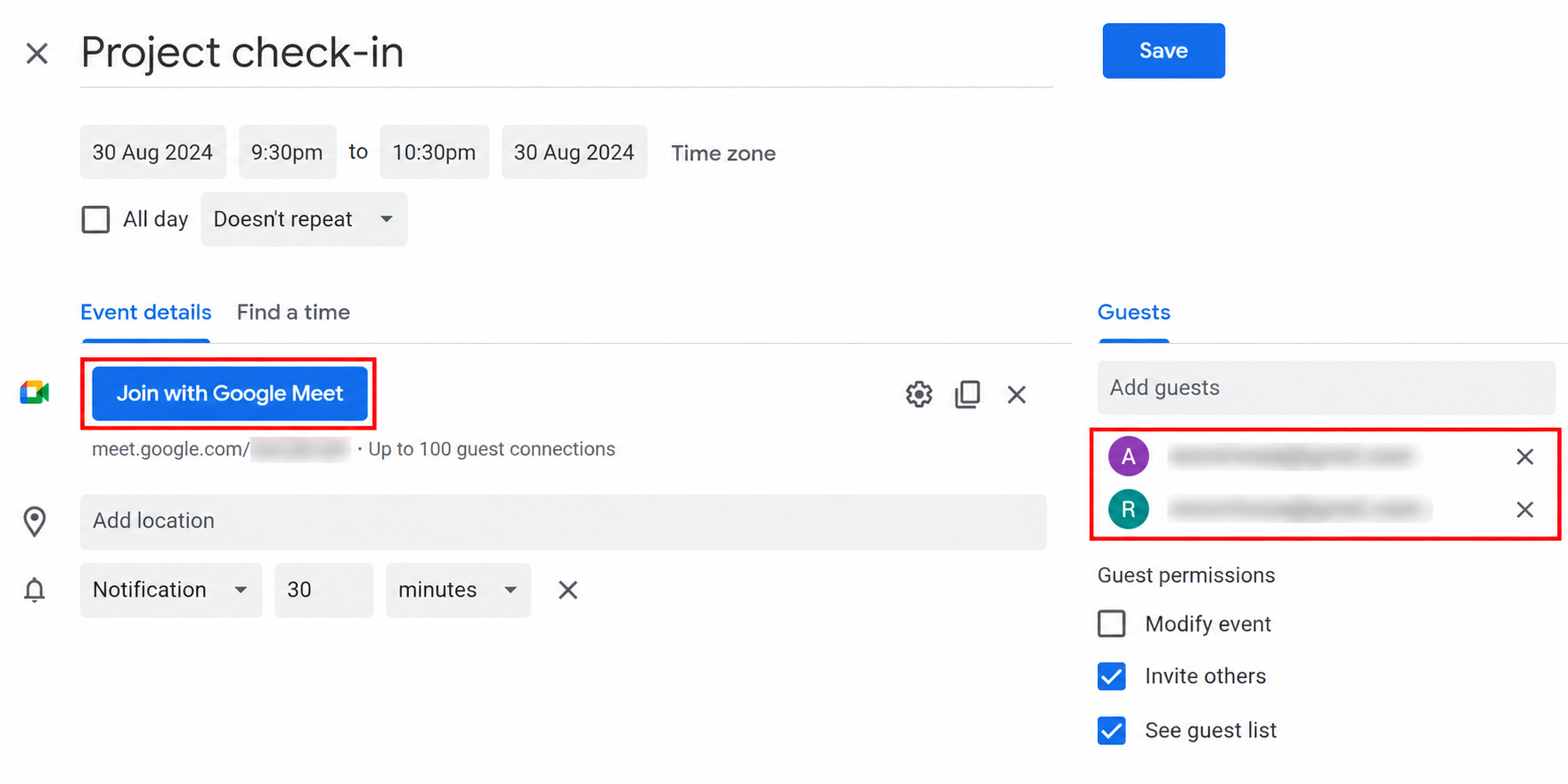
- Click Save.
- When Calendar asks whether to notify guests, click Send to email them the invite.
Each guest receives an email with the event details and a join button. The meeting also shows in their calendar if they accept it. If you’re getting too many invite emails yourself, you can stop Google Calendar email notifications without affecting what guests receive.
A few things Google notes about Calendar invites:
- If you use Google Workspace Essentials, you can’t schedule a meeting in Google Calendar. Use the Meet or Gmail method instead.
- Workspace users can also add a dial-in number to the event.
- Guests can forward the meeting link to other people. If an uninvited person tries to join, someone has to accept their request. For meetings organized by a personal Google Account, only the meeting creator can admit them.
Set host controls before the meeting
While the event is open, you can decide who gets in without asking.
- In the event, next to “Join with Google Meet,” click Video call options.
- In the side panel, click Host controls.
- Scroll to “Meeting access” and choose an access type.
- Click Save, or close the Host controls panel.
Google applies these settings per meeting, and recurring meetings keep the same settings as the first meeting in the series.
Send a Meet Invite From Gmail
Gmail has a Meet section in its left sidebar, which is handy if you’re already answering the email that asked for the link.
- Open Gmail on your computer.
- In the left sidebar, click Meet, then New meeting.
- Click Send invite to share the meeting by link or email.
- In the options that appear, click Copy meeting invite to copy the details and paste them yourself, or click Share via email to send an email invite.
- Click Join now when you’re ready to start, and Leave call to end it.
The first time you join, Gmail asks for permission to use your microphone and camera. Grant it in the browser so the call works when you open it.
If you don’t see Meet in the sidebar, it may have been hidden in Gmail’s settings. The steps for hiding the Meet section in Gmail show where that setting lives, so you can turn it back on.
Send a Link From Google Chat
Google lists a Send a Meet link option in Chat for personal accounts, Google One and Workspace Individual subscriptions, and school accounts.
- Open Google Chat, or open Gmail and click Chat on the left.
- Open the conversation with the person or group.
- To the left of the message box, click Google Workspace tools.
- Click Send a Meet link, then send the message.
On a Google Workspace Business or Enterprise account, click More options at the top right of the conversation instead, then Send a Meet link.
In a one-to-one conversation you can also click Start a video call at the top right to call the person directly instead of sending a link.
Send a Meet Link From Your Phone
The Google Meet app works the same way on Android phones and tablets and on iPhone and iPad, according to Google’s help page for each.
Create and share a link in the Meet app
- Open the Google Meet app. Install it from the Play Store or App Store first if you don’t have it.
- At the bottom right, tap New.
- Tap Create link.
- Tap Copy to copy the link so you can paste it into a text or email, or tap Share to send it straight to another app.
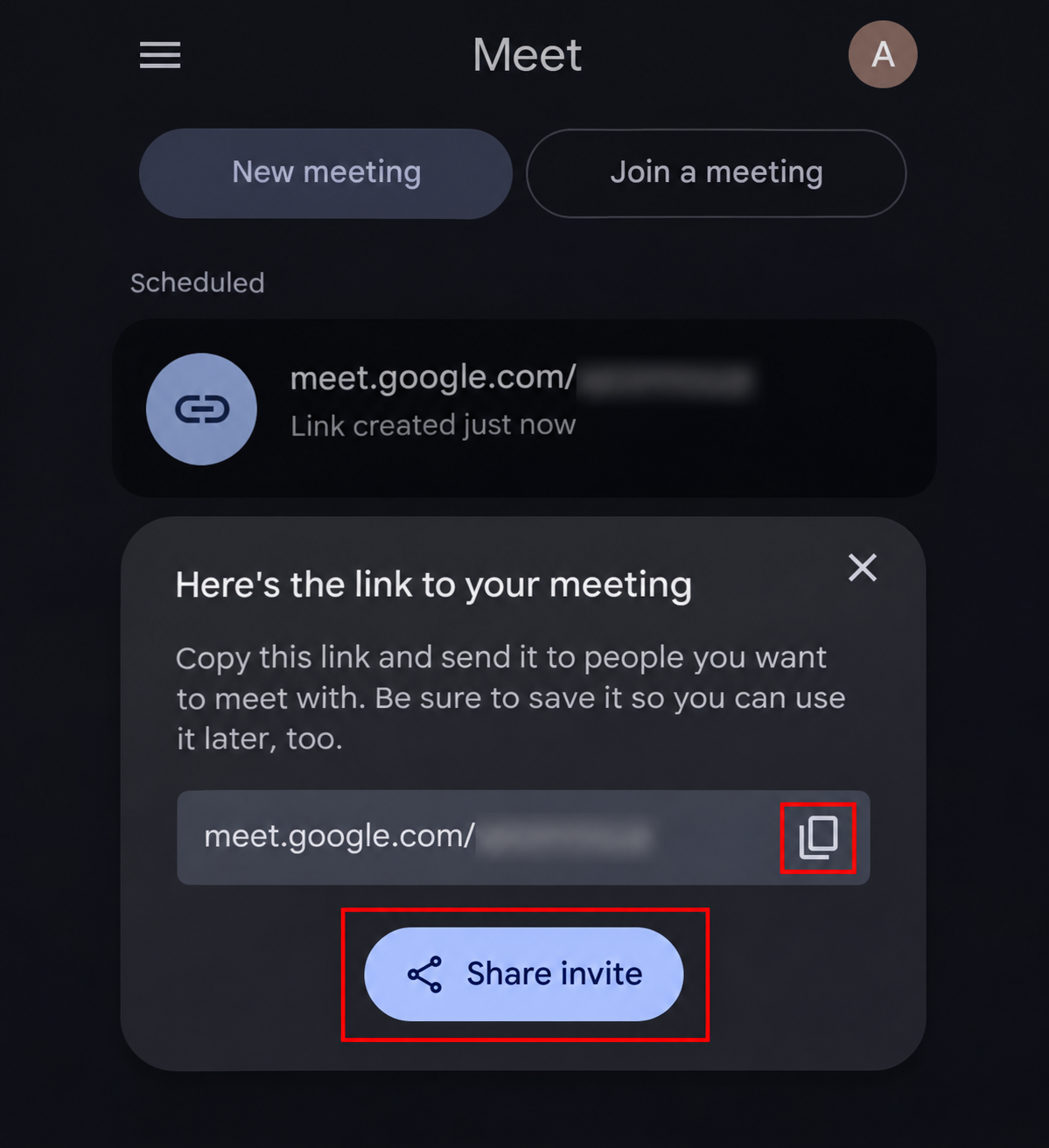
- To start the meeting yourself, tap Join meeting (on iPhone and iPad, then tap Join).
Schedule from the Meet app
- In the Meet app, tap New, then Schedule.
- The Google Calendar app opens a new event. Add a title, time and guests.
- Tap Save at the top right.
- Go back to Meet. The meeting is on the Meet home screen, and the link is in the calendar event.
Schedule in the Google Calendar app
- Open the Google Calendar app.
- Tap Add (labeled Create in some versions), then Event.
- Add guests and the meeting details. Tap Add video conferencing to attach a Meet link.
- Tap Done, then Save.
Google advises keeping the Meet app up to date for the best performance. If an option on these lists isn’t there, an app update usually brings the current layout.
Personal vs. Work or School Accounts
The steps above work for most accounts, but a few details depend on who issued your Google Account.
| Feature | Personal account | Work or school (Workspace) |
|---|---|---|
| Create and send a link | Yes | Yes |
| Restricted meeting access | Not available | Available |
| Default access for new meetings | Trusted | Trusted (Classroom meetings: Restricted) |
| Dial-in number in Calendar events | Not listed by Google | Workspace users |
| Meeting nicknames | Not available | Available |
| Schedule from Google Calendar | Yes | Yes, except Workspace Essentials |
If you’re on a work or school account and something is missing, your administrator may have turned it off. That’s a setting only they can change.
Control Who Can Join With Your Link
Anyone who has the link can try to join, so think about who might see it before you post it anywhere public. Meet has three access types, set under Host controls > Meeting access:
- Open: anyone with the meeting link can join. No one has to knock.
- Trusted: people in the host’s organization, and people outside it who were invited through a Google Calendar event, join without knocking. Everyone else has to knock (ask to join).
- Restricted: only people invited through a Calendar event or by a host from inside the meeting can join directly. Everyone else has to knock. Google says this isn’t available for consumer (personal) accounts.
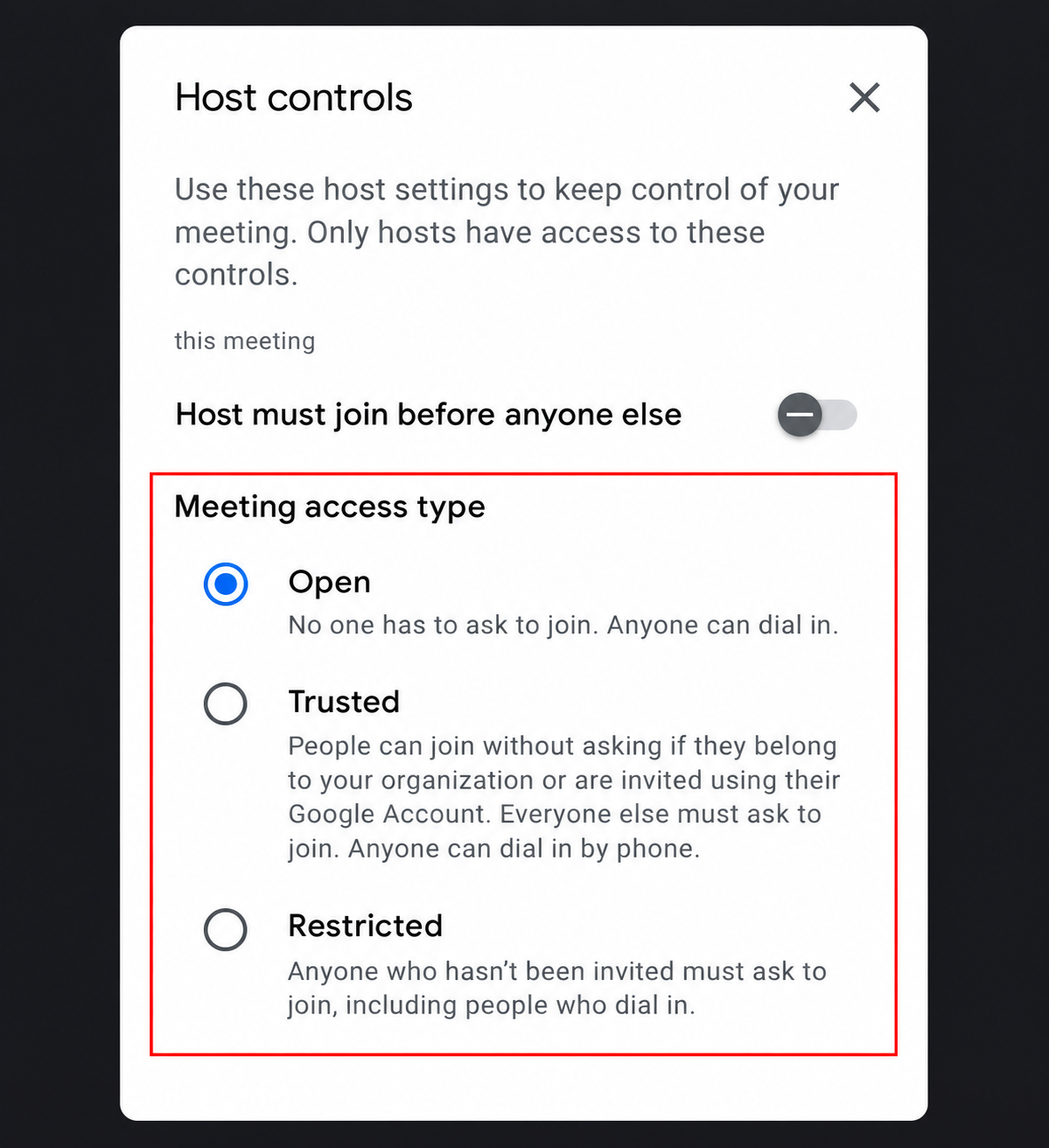
Google says new meetings start as Trusted for personal and enterprise accounts, and anyone invited through a Google Calendar invite counts as trusted. For education accounts, meetings created through Google Classroom start as Restricted.
You can also change access during the meeting: click Host controls at the bottom right and scroll to “Meeting access.”
Two more controls are worth knowing:
- Host must join before anyone else: turn this on in Host controls if you don’t want guests chatting in the meeting before you arrive. Google notes that Workspace users who have the waiting room feature won’t see this option.
- Automatic denials: anonymous users and third-party bots, such as note takers, that try to use “Ask to join” are automatically denied without any action from you.
Because a Calendar invitation makes a guest trusted, sending the link through a Calendar event usually means fewer join requests to approve than pasting a bare link into a text.
Why a Meet Link Stops Working
Meet links don’t last forever. Google’s page on meeting codes in Google Meet says the code expires based on what product the meeting was created from:
| Where you created the meeting | When the code expires |
|---|---|
| Google Calendar | When it hasn’t been used for 60 days and isn’t tied to any future calendar events |
| Google Chat, Google Classroom, Gmail or meet.google.com | 365 days after last use |
| A third-party program, such as Outlook | 365 days of non-use; each use adds another 365 days |
| A nickname (Workspace only) | As soon as everyone leaves the meeting |
So a link from Create a meeting for later keeps working for a year after its last use, and a link on a recurring Calendar event stays valid as long as future events exist.
There’s one more cause of a “wrong” link. Google warns that if you create Google Calendar events with Meet codes in Apple Calendar or another calendar app, a new meeting code may be generated automatically for privacy and security, and you get an email when that happens. If guests say the link you sent doesn’t match the event, check that email and send the current link. Google suggests managing Meet links in the Google Calendar app or at calendar.google.com to avoid this.
Google Meet Link Questions
Can someone without a Google account join?
They can open the link, but whether they get in depends on the access type. Under the default Trusted setting, someone who isn’t invited through Calendar and isn’t signed in to your organization has to ask to join, and you admit them. Anonymous users who try “Ask to join” are denied automatically, so ask guests to sign in to any Google Account if they get stuck.
Can I reuse the same link for a weekly meeting?
Yes. The simplest way is a recurring Google Calendar event with Meet added. Google keeps a Calendar meeting code valid while it’s tied to future calendar events, so the link in the series keeps working. A nickname is not a good reusable link, because nickname codes expire once everyone leaves.
Is it safe to post a Meet link on social media?
It’s better not to. Anyone who finds an Open meeting’s link can walk in. If you need a public session, use Trusted access so strangers have to knock, and watch the join requests.
Why can’t I add Meet to a Calendar event?
If you’re a Workspace Essentials user, Google says you can’t schedule Meet in Calendar. Create the link in Meet or Gmail and paste it into the event instead. On other work accounts, an administrator may have limited the option.
Can I send the link before the time is set?
Yes. Create a meeting for later gives you a link with no date attached. Send it now, then send the time separately, or create a Calendar event later and paste the same link into its description.
If you use Zoom for some calls too, the process for setting up a Zoom meeting is a useful comparison. For your next Meet call, try the Calendar route once: it puts the link, the time and a reminder in front of your guests together.
Google Meet Help documentation checked November 6, 2026. Button names can vary slightly between the web, Android and iPhone versions.

Matthew Burleigh is the founder, head writer, and editor of Solve Your Tech, which he launched in 2012. He has written technology tutorials since 2008 and worked in IT since 2003, including small-business support, IT management, and consulting. He holds Bachelor’s and Master’s degrees in Computer Science from Arizona State University.
Matthew writes practical guides for Windows, iPhone and iPad, Microsoft Office, Outlook, Google apps, and Android. Solve Your Tech’s guides are checked step by step against the device or app maker’s own documentation and tested on his own devices whenever he has the hardware or software, with clear steps, sources, and update dates.
Read more about Matthew and how Solve Your Tech writes and updates its guides, or report a correction.