To resize an image in Paint, open the picture, select Resize and skew in the Image group (or press Ctrl + W), choose Percentage or Pixels, and enter the new size. Keep Maintain aspect ratio turned on so the picture doesn’t stretch, select OK, then use File > Save as to save a resized copy.
These steps are for the current Paint app in Windows 11, including version 25H2. Paint is free and included with Windows. A short section near the end covers the older Paint in Windows 10, which Microsoft stopped supporting in October 2025.
Before you start
- Know the size you need. A website, form, or email limit usually tells you a maximum width or height in pixels, or a maximum file size. Pixels are the tiny dots that make up a digital picture; a photo listed as 4000 x 3000 is 4,000 pixels wide and 3,000 pixels tall.
- Check the current size. After you open the picture in Paint, look at the status bar along the bottom of the window. It shows the image’s width and height in pixels. You can also select File > Image properties (or press Ctrl + E).
- Plan to keep the original. Resizing smaller throws away pixels for good once you save over the file. Saving a copy with Save as keeps the full-size version safe.
Resize an image in Paint on Windows 11
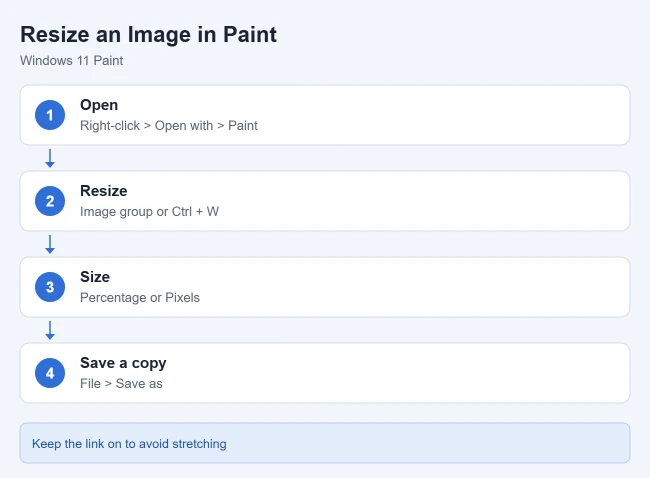
- In File Explorer, right-click the picture and select Open with > Paint. If Paint isn’t listed, select Choose another app and pick Paint. The picture opens on the Paint canvas.
- Check the size in the status bar at the bottom of the window so you have a starting point.
- In the Image group on the toolbar, select Resize and skew, or press Ctrl + W. The Resize and skew window opens.
- Under Resize, choose Percentage to scale the picture by a proportion, or Pixels to type an exact width or height.
- Make sure Maintain aspect ratio is turned on. In current versions this is the link button between the Horizontal and Vertical boxes; in older versions it is a check box. With it on, the picture keeps its shape.
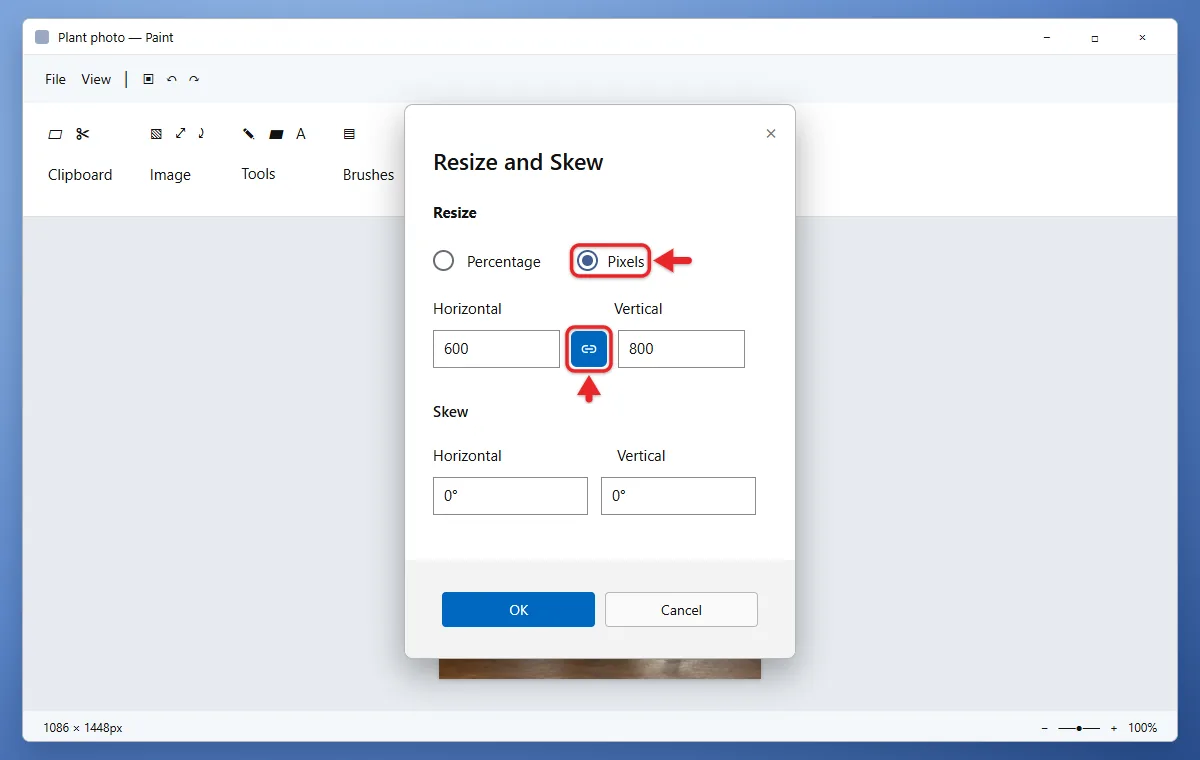
- Type the new value in Horizontal (width) or Vertical (height). Paint fills in the other box for you. For example, a 4000 x 3000 photo set to 1200 pixels wide becomes 1200 x 900.
- Leave both Skew boxes at 0. Skew tilts the picture at an angle; it doesn’t change its size.
- Select OK. The picture and the canvas shrink or grow to the new size, and the status bar shows the new dimensions.
- Select File > Save as, pick a format such as PNG picture or JPEG picture, give the file a new name, and select Save.
If the result looks wrong, press Ctrl + Z right away to undo the resize and try different numbers. Undo works until you close Paint, but it can’t bring back a file you already saved over.
Percentage or pixels: which to use
Both options produce the same kind of result. The difference is how you describe the new size.
| Use this | When | Example |
|---|---|---|
| Percentage | You want the picture smaller or larger by a proportion and don’t need an exact number | 50 turns a 4000 x 3000 photo into 2000 x 1500 |
| Pixels | A site or form names a specific width or height | 1200 wide turns 4032 x 3024 into 1200 x 900 |
| Pixels with the ratio off | You must hit two exact numbers and can accept some stretching | 1200 x 800 from a 4:3 photo squashes it slightly |
Percentage is the quickest choice when you only need a smaller file to email. Pixels is the better choice when an upload page says something like “images must be 1200 pixels wide or less.”
If you need two exact numbers that don’t match the photo’s shape, such as 1200 x 800 from a 4:3 phone photo, crop first instead of turning off the aspect ratio. The next section shows how.
Crop first to reach an exact size
Cropping removes the edges you don’t need, so the picture can match a new shape without distortion.
- In the Image group, select Select, then choose Rectangle.
- Drag across the part of the picture you want to keep. Watch the selection size in the status bar; for a 1200 x 800 result, aim for a 3:2 shape, such as 3000 x 2000.
- Select Crop in the Image group. Everything outside your selection is removed.
- Press Ctrl + W and resize as usual. With the ratio on, 3000 x 2000 set to 1200 wide becomes exactly 1200 x 800.
Resize part of a picture or the canvas
Only one part of the picture: use Select to draw around the area, then press Ctrl + W. Paint resizes only the selection and leaves the rest of the picture alone. You can also drag the small square handles on the corners of the selection. This is handy when a pasted screenshot or logo is too big for the rest of the picture.
The canvas, not the picture: the canvas is the white working area under your picture. Drag the handle on its right edge, bottom edge, or bottom-right corner to make it bigger or smaller, or type an exact canvas size in File > Image properties. Shrinking the canvas cuts off part of the picture; enlarging it adds blank space. Use this when you want room around a picture, not when you want the picture itself smaller.
Sizing a picture for your wallpaper? After resizing it, you can also resize your desktop background in Windows 11 with the Fill or Fit options.
Choose a file format when you save
Microsoft says Paint can save in several formats, including PNG, JPEG, BMP, and GIF. You choose the format in File > Save as.
- JPEG is usually the smallest choice for photos. Paint doesn’t offer a quality slider, so you can’t trade a little quality for an even smaller file.
- PNG keeps text and sharp edges crisp, which makes it the better choice for screenshots, diagrams, and logos. PNG photos are often much larger than JPEG.
- BMP files are very large and rarely needed today.
- GIF is limited to 256 colors, so photos lose detail.
If you save a picture with a new extension and can’t tell which file is which, turn on file name extensions in File Explorer. If your picture came from an iPhone as a HEIC file, convert the HEIC to JPG on Windows 11 before resizing.
How resizing affects quality
Making a picture smaller keeps it looking sharp, because Paint has more detail than it needs. Making it larger is different: Paint has to invent pixels between the existing ones, and the result looks soft or blocky. Doubling a small picture (200 percent) usually shows visible blur, and going higher makes it worse.
A few habits help:
- Start from the largest original you have, not a copy you already shrank.
- Resize once to the final size. Repeated shrinking and enlarging builds up blur.
- Judge the result at 100 percent zoom. The zoom level and its controls are at the bottom right of the Paint window. A picture viewed larger than 100 percent always looks rougher than it is.
Clean up a screenshot before resizing
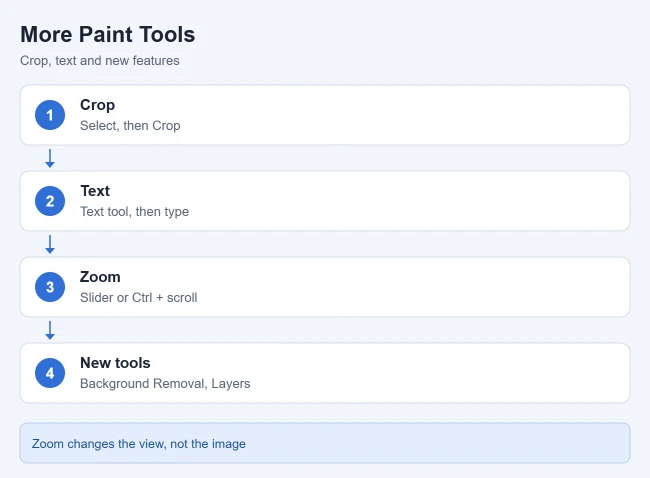
Screenshots are one of the most common things people resize in Paint. To get one ready:
- Paste it. Take a screenshot with Windows + Shift + S, open Paint, and press Ctrl + V. For every capture shortcut, read about taking a screenshot on Windows 11.
- Crop it. Use Select and Crop as described above to remove the taskbar, extra windows, or private details.
- Add a label. Choose the Text tool (the A button), click where the text should go, type, and pick a font, size, and color.
- Resize last. Shrink the cleaned-up screenshot with Ctrl + W, then save it as PNG so the text stays readable.
Resize in Paint on Windows 10 (legacy)
Windows 10 uses the older Paint with a ribbon. Microsoft ended Windows 10 support on October 14, 2025, but the app still works.
- Open the picture in Paint.
- On the Home tab, in the Image group, select Resize (or press Ctrl + W).
- In the Resize and Skew window, choose Percentage or Pixels.
- Check Maintain aspect ratio, enter the new Horizontal or Vertical value, and select OK.
- Select File > Save as and choose a format.
In the older Paint, the canvas sometimes stays larger than the shrunken picture, leaving white space at the right or bottom. Drag the canvas handle in to the edge of the picture before saving.
Other built-in ways to resize
Paint handles one picture at a time. If you need something else:
- Many pictures at once: Microsoft’s free PowerToys includes Image Resizer. Select several pictures in File Explorer, right-click, and choose Resize with Image Resizer, then pick a size preset or enter a custom size. Microsoft’s Image Resizer documentation explains the Fit, Fill, and Stretch options and how resized copies are named.
- Quick resize while viewing a photo: the Photos app in Windows 11 has a Resize image option in its See more (three dots) menu. Photos is meant for viewing, organizing, and simple adjustments, while Paint is for creating and editing images.
Troubleshooting
- The picture looks stretched or squashed. Maintain aspect ratio was off, or you typed both numbers. Press Ctrl + Z, turn the link button on, and enter only one value.
- The picture is blurry. You enlarged it, or you resized a copy that had already been shrunk. Go back to the original file and resize once.
- The file is still too big. Fewer pixels make a smaller file, but format matters too. Save a photo as JPEG instead of PNG or BMP, or resize to a smaller width.
- There is white space around the picture. You resized a selection instead of the whole picture, or you’re using the older Paint. Drag the canvas handles in to the picture’s edges, or use Crop.
- The second box changed when I typed in the first. That is the aspect ratio lock at work. It keeps the shape. Turn it off only if you need two exact numbers.
- I saved over my original. Paint can’t undo a saved file after you close it. If the folder syncs to OneDrive, open the file’s Version history in OneDrive to restore the earlier version.
- Paint is missing. In Windows 11, Paint is a Microsoft Store app. Search for Paint in the Microsoft Store and select Get or Install to put it back.
Frequently asked questions
Does resizing a picture make the file smaller?
Usually. Fewer pixels means less data, so shrinking a 4000 x 3000 photo to 2000 x 1500 cuts the pixel count by three quarters. The final file size also depends on the format you save in and what the picture shows.
Can I resize without losing quality?
Shrinking keeps the picture looking sharp at its new size, although the removed detail is gone from that copy. Enlarging always loses some sharpness, because Paint can’t add detail that wasn’t there.
How do I resize a picture to inches for printing?
Paint works in pixels. Multiply the inches you want by the print resolution. At 300 pixels per inch, a 4 x 6 inch print needs 1200 x 1800 pixels.
Can I resize several pictures at once in Paint?
No. Paint opens one picture at a time. Use PowerToys Image Resizer for batches.
Does resizing change my original file?
Only if you select Save or press Ctrl + S. Use Save as with a new name to keep the original.
Is Paint free?
Yes. Microsoft’s Paint page says Paint is included in Windows, and it costs nothing to use the resize tools.
Once your picture is the right size, attach it to an email or upload it, and keep the full-size original in case you need a different size later.

Matthew Burleigh is the founder, head writer, and editor of Solve Your Tech, which he launched in 2012. He has written technology tutorials since 2008 and worked in IT since 2003, including small-business support, IT management, and consulting. He holds Bachelor’s and Master’s degrees in Computer Science from Arizona State University.
Matthew writes practical guides for Windows, iPhone and iPad, Microsoft Office, Outlook, Google apps, and Android. Solve Your Tech’s guides are checked step by step against the device or app maker’s own documentation and tested on his own devices whenever he has the hardware or software, with clear steps, sources, and update dates.
Read more about Matthew and how Solve Your Tech writes and updates its guides, or report a correction.