To require your Apple Account password for each App Store purchase, open Settings > your name > Media & Purchases > Password Settings, then choose Always Require. If you use Face ID or Touch ID for purchases, Password Settings doesn’t appear, because biometric authorization is already required for every download.
These steps are for iOS 27 and match iOS 26 and earlier, with older Screen Time paths listed separately.
Choose between requiring your password, blocking purchases with Screen Time, or Ask to Buy for a child. For one game, see how to block in-app purchases in Pokémon GO.
Know Which Password the Setting Uses
Apple Account password: Used to authorize purchases and downloads when password authorization is selected. Older screens and guides call this your Apple ID password.
iPhone passcode: Used to unlock your phone and authorize certain device actions. It is not the password you are choosing under Media & Purchases.
Screen Time passcode: Protects restrictions such as blocking in-app purchases. It is a separate control, even if someone has chosen the same digits as their device passcode.
Always Require uses your Apple Account password, not your iPhone passcode. Don’t type the device passcode into a field that asks for your Apple Account password.
Require Your Password for Each Purchase
- Open Settings on the iPhone.
- Tap your name at the top to open your Apple Account settings.
- Tap Media & Purchases. A menu opens with account options.
- Tap Password Settings. If you don’t see it, Face ID or Touch ID is on for purchases; see the section on missing settings below.
- Under Purchases and In-App Purchases, choose Always Require.
- If asked, enter the password for the Apple Account used for Media & Purchases to confirm.
- Return to Password Settings and check that Always Require is selected.
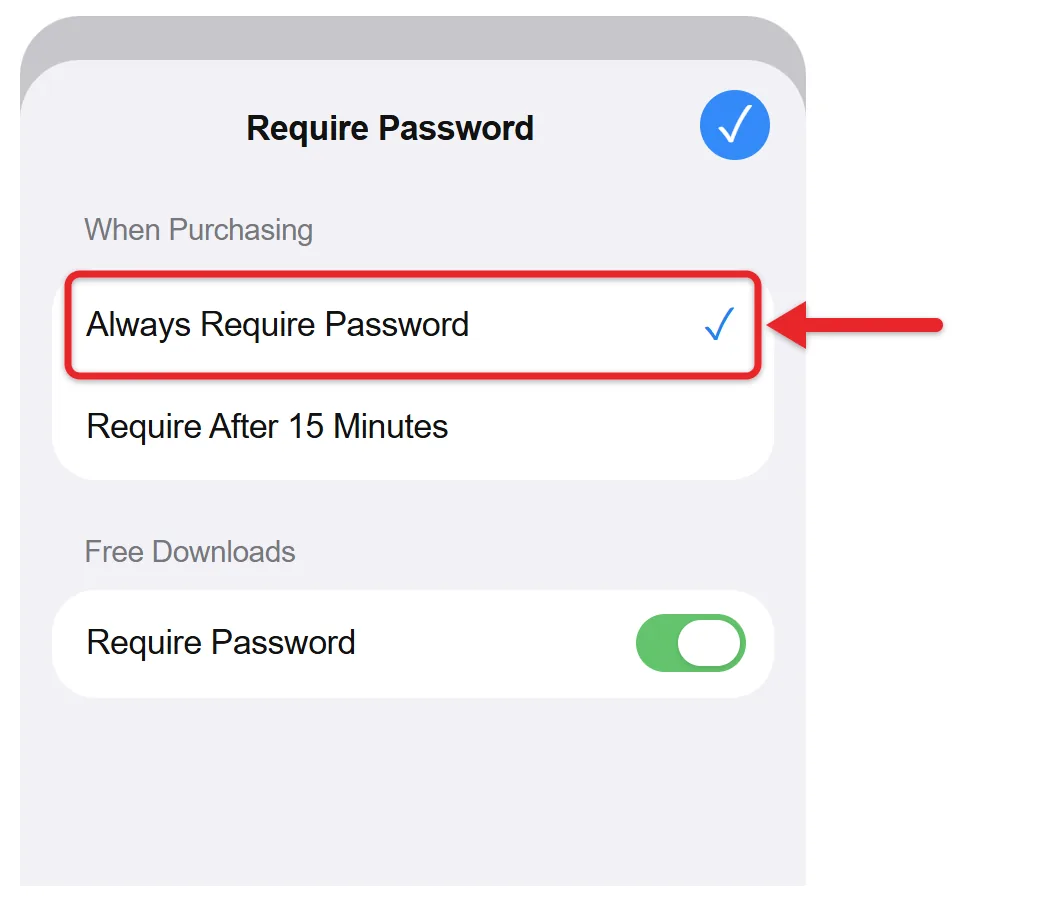
Apple also offers Require After 15 Minutes. After you enter your password once, that option lets more purchases go through without a password for the next 15 minutes. Choose Always Require if you want a fresh password request each time, which matters most when a child or another person sometimes uses your phone.
Apple’s purchase-password guide states that you can’t completely turn off password protection for paid items on iPhone or iPad. Don’t look for a “Never Require” option for paid purchases in this menu.
Require a Password for Free Downloads
Free downloads have a separate setting when password authorization is being used.
- Return to Settings > your name > Media & Purchases > Password Settings.
- Find Free Downloads.
- Turn on Require Password if you want password authorization for free downloads too.
An app that’s free to install can still offer paid subscriptions or in-app purchases. Read the price and any subscription terms before you approve one.
If you pay with gift card credit, you can check your Apple gift card balance from the same App Store account screen.
Why Password Settings May Be Missing
If Face ID or Touch ID is turned on for purchases, Apple says Password Settings will not appear. The biometric method requires authorization for every download, including free downloads.
To check which method you are using, open Settings > Face ID & Passcode or Touch ID & Passcode, enter the device passcode, and look at iTunes & App Store. This is the purchase-specific biometric control; it is separate from using Face ID or Touch ID to unlock your iPhone.
If you’d rather type your Apple Account password, turn off iTunes & App Store in the Face ID or Touch ID settings, then return to Media & Purchases > Password Settings and select Always Require. Make sure you know the password first.
Which one is stronger? Face ID or Touch ID can only be approved by an enrolled face or fingerprint, while a password can be typed by anyone who knows it. If someone else knows your Apple Account password, keep Face ID on for purchases, or change the password.

Block In-App Purchases Instead
A required password permits a purchase after someone authorizes it. If you want to prevent in-app purchases altogether, use Screen Time. Screen Time must be turned on first. Apple’s in-app purchase guide lists these steps for iOS 27:
- Open Settings > Screen Time.
- Tap Apps & Websites, then tap App Store.
- Tap In-app Purchases and select Blocked.
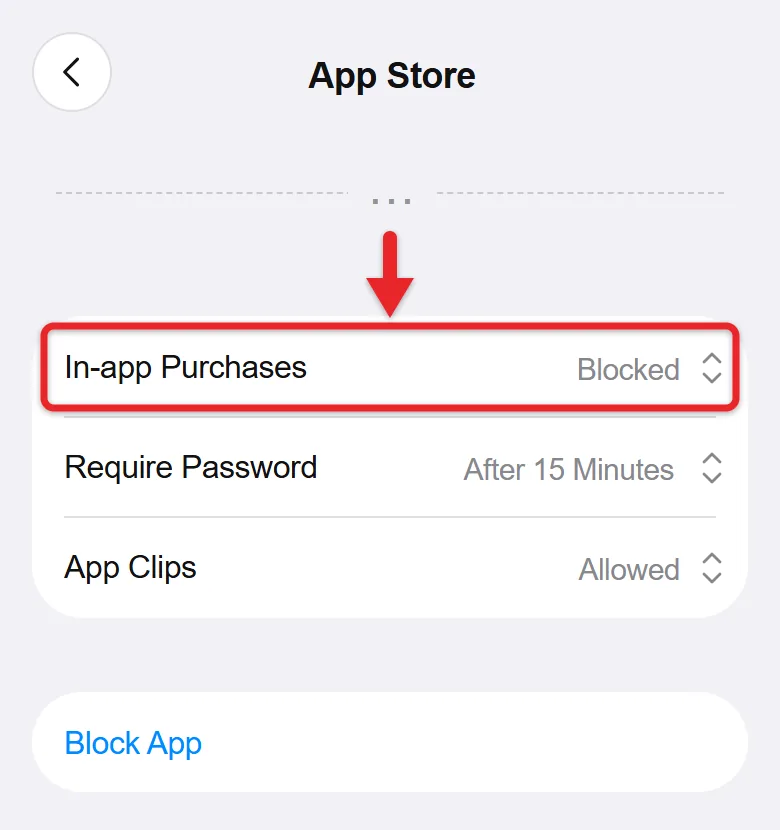
On iOS 26 and earlier, the path is different:
- Open Settings > Screen Time and tap Content & Privacy Restrictions.
- Turn Content & Privacy Restrictions on.
- Tap App Store, Media, Web & Games. In iOS 17 and earlier this is called iTunes & App Store Purchases.
- Tap In-app Purchases and choose Don’t Allow.
Set a Screen Time passcode that the other person doesn’t know, so they can’t change the restriction. Apple’s App Store restrictions guide covers the broader controls. This block is separate from the password setting under your Apple Account.
If you also want to prevent new app installations, you can block the App Store with Screen Time. For an explanation of the broader controls, here’s what restrictions on iPhone mean.
For a Child’s iPhone
With Family Sharing, a parent or guardian can turn on Ask to Buy. It sends a child’s purchase and download requests to an adult, who approves or declines them from their own device. Apple’s Ask to Buy guide gives these iOS 27 steps on the parent’s iPhone:
- Open Settings and tap Family.
- Tap your child’s name.
- Tap Apps & Websites, entering the Screen Time passcode if asked, then tap Restrictions.
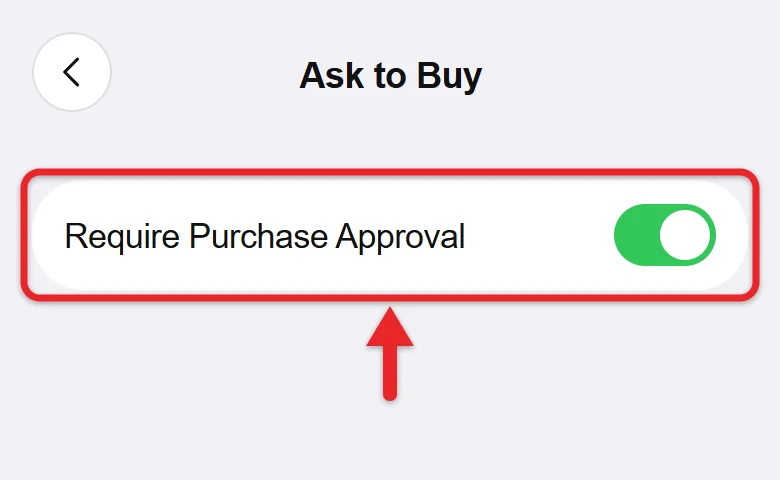
- Tap Ask to Buy and turn on Require Purchase Approval.
Things to know about Ask to Buy:
- The child needs their own Apple Account in your Family Sharing group. Don’t share one account between a parent and a child.
- It’s on by default for children under 13, and in some regions it stays on for children under 18.
- It covers new App Store downloads, in-app purchases and redownloads of shared apps. Redownloading the child’s own purchases, installing updates and redeeming codes don’t send a request.
- A request that isn’t approved within 24 hours expires, and the child has to send it again.
- The organizer can make another adult in the family a Parent/Guardian so they can approve requests too.
Ask to Buy and Screen Time work together: Screen Time decides what can be bought at all, and Ask to Buy sends the rest to you for approval. If children use your own iPhone instead, keep Always Require on and use Face ID so only you can approve.
On Other Apple Devices
Apple’s purchase-password guide also covers other devices:
- Mac: choose Apple menu > System Settings, click your name, click Media & Purchases, and choose settings for purchases and free downloads. If Touch ID is on for purchases, this menu doesn’t appear.
- Apple TV: go to Settings > Users and Accounts, select your account, and choose options under Require Password. Unlike an iPhone, Apple TV lets you turn off password protection for both free and paid items.
Check That It Worked Without Buying Anything
Return to Password Settings to confirm Always Require, or check that purchase biometrics are enabled. Review Require Password for free downloads separately. If using Screen Time, confirm In-app Purchases shows Blocked or Don’t Allow.
If a download doesn’t behave as expected, check the Apple Account shown under Media & Purchases, the Face ID or Touch ID purchase setting, and whether the item is a new purchase or a redownload. Redownloading something you already own may not ask for payment approval the same way a new purchase does.
Change the Setting Later
To change the password frequency, return to Password Settings and select the available option you prefer. To restore biometric purchase authorization, return to Face ID & Passcode or Touch ID & Passcode and enable iTunes & App Store.
To lift a Screen Time block, change In-app Purchases back to Allowed or Allow with the Screen Time passcode. Changing the password frequency does not remove that separate restriction. If your household also uses an Android phone or tablet, you can require authentication for Google Play purchases there.
App Store Password Questions
Will this cancel an existing subscription?
No. Purchase authorization settings do not cancel subscriptions already running. To stop a renewal, follow the steps to cancel subscriptions on iPhone and check the cancellation details for that subscription.
Why do I see Face ID instead of a password box?
Purchase biometrics are enabled. Apple requires that authorization for every download, including free items. Turn off iTunes & App Store under Face ID & Passcode if you prefer password authorization.
Can I require authorization and also block purchases?
Yes, but each setting has its own job. A block prevents the restricted transaction; a password or biometric check authorizes transactions that are allowed. Check the restriction first when a purchase can’t go through.
Does Always Require use my iPhone passcode?
No. It asks for your Apple Account password, or Face ID or Touch ID if those are on for purchases. Your iPhone passcode only unlocks the phone.
What if I was charged for a purchase I didn’t approve?
Check your purchase history under Settings > your name > Media & Purchases > View Account > Purchase History, then use Apple’s report a problem process for that item. Turn on Always Require or Face ID for purchases so it doesn’t happen again.
Next step: if a child uses the iPhone, set a Screen Time passcode that only you know.

Matthew Burleigh is the founder, head writer, and editor of Solve Your Tech, which he launched in 2012. He has written technology tutorials since 2008 and worked in IT since 2003, including small-business support, IT management, and consulting. He holds Bachelor’s and Master’s degrees in Computer Science from Arizona State University.
Matthew writes practical guides for Windows, iPhone and iPad, Microsoft Office, Outlook, Google apps, and Android. Solve Your Tech’s guides are checked step by step against the device or app maker’s own documentation and tested on his own devices whenever he has the hardware or software, with clear steps, sources, and update dates.
Read more about Matthew and how Solve Your Tech writes and updates its guides, or report a correction.