To unlock an iPhone with Face ID, set it up first in Settings > Face ID & Passcode > Set Up Face ID. After that, wake the iPhone, look at it until the padlock at the top of the Lock Screen opens, and swipe up from the bottom of the screen to reach your Home Screen.
These steps are written for iOS 26 and iOS 27 and apply to the iPhone 11 and every newer iPhone with Face ID, including the iPhone 16e. iOS 27 still supports the iPhone 11, so an iPhone 11 on current software sees the same menus. iPhone SE models have a Home button and use Touch ID instead, so their settings screen is called Touch ID & Passcode. The setup steps follow Apple’s Face ID setup guide.
Before You Start
Face ID needs a passcode. The passcode is the backup way into your iPhone when Face ID can’t recognize you, and iOS asks you to create one during setup if you don’t already have one. If you want to change or check your code first, see our guide to changing or turning off an iPhone passcode.
Find a spot with good light, take off sunglasses, and hold the phone upright in portrait orientation. Face ID scans with the TrueDepth camera in the notch or Dynamic Island at the top of the screen, so make sure a case or screen protector isn’t covering it.
Set Up Face ID
- Open the Settings app.
- Tap Face ID & Passcode and enter your passcode. If you don’t have a passcode yet, iOS asks you to create one before you continue.
- Tap Set Up Face ID. An introduction screen appears.
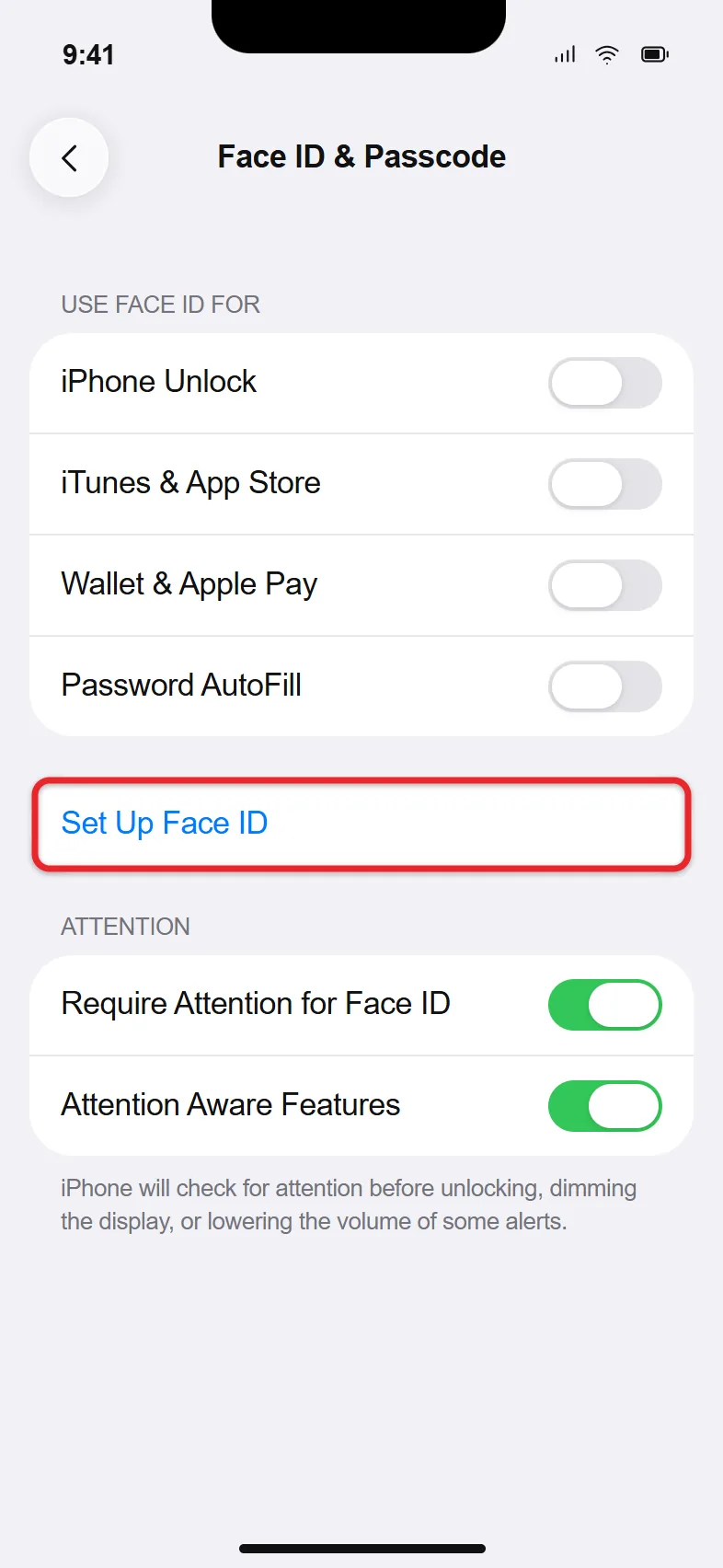
- Hold the iPhone upright in front of your face and tap Get Started. A circular frame appears on the screen with your face in it.
- Move your head slowly in a circle until the ring around the frame fills in. If you can’t move your head, tap Accessibility Options and the iPhone will scan you without the full circle.
- Tap Continue when the first scan finishes, then move your head in a circle again for the second scan.
- Tap Done. You return to the Face ID & Passcode screen, and the options under Use Face ID For are now available.
The whole process takes under a minute. Apple says your Face ID data is encrypted and stays on the iPhone. It isn’t uploaded to iCloud.
Unlock Your iPhone With Face ID
- Wake the iPhone. Press the side button, tap the screen, or pick the phone up. The Lock Screen appears with a closed padlock icon at the top.
- Look at the screen. When Face ID recognizes you, the padlock opens. You can see notification previews at this point, but you’re still on the Lock Screen.
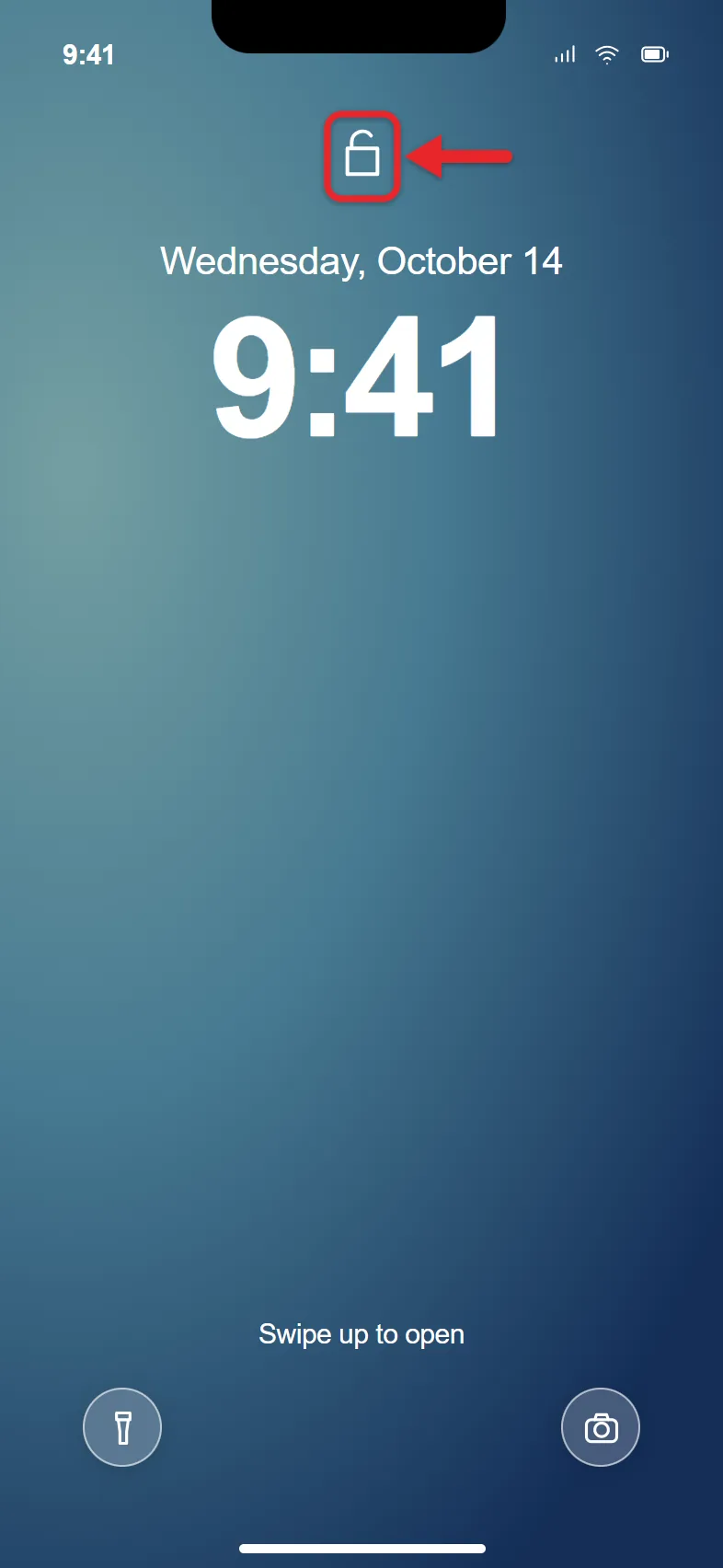
- Swipe up from the bottom edge of the screen. Your Home Screen, or the last app you used, opens.
Recognizing your face doesn’t take you past the Lock Screen by itself. The swipe in step 3 is what opens the phone. Apple describes these Face ID gestures on its support site.
Hold the phone about 10 to 20 inches from your face. On the iPhone 11 and iPhone 12, Face ID works only when the phone is upright. The iPhone 13 and later also unlock in landscape orientation on iOS 16 or later.
If you’re wearing a paired Apple Watch, you can also unlock your iPhone with your Apple Watch when Face ID can’t see your whole face.
Make Sure Face ID Is Turned On for Unlocking
Face ID can handle several jobs, and each has its own switch. If you finished setup but the phone still asks for your passcode every time, check this screen.
- Open Settings > Face ID & Passcode and enter your passcode.
- Under Use Face ID For, turn on iPhone Unlock. The switch turns green.
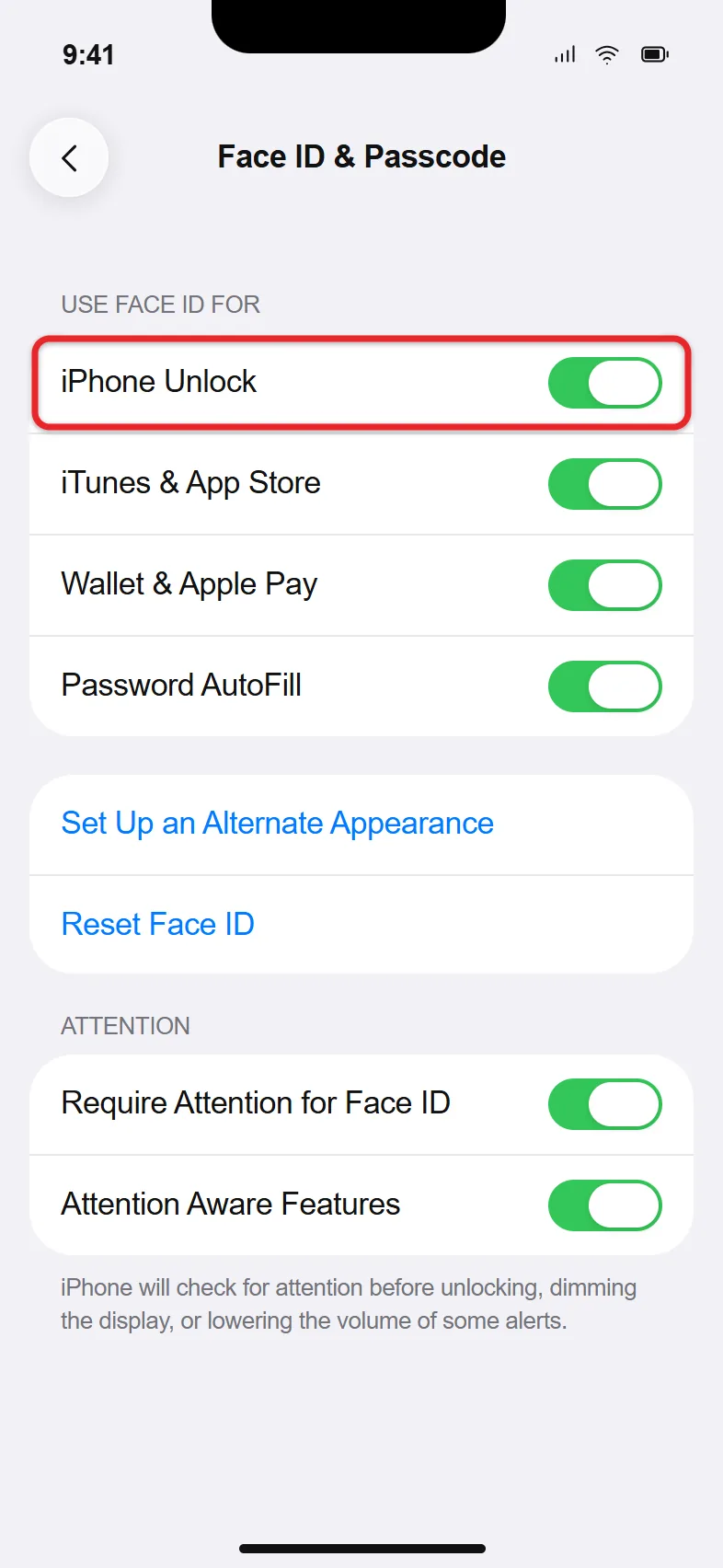
- Turn on any other uses you want, such as App Store purchases, Apple Pay, Password AutoFill, and Other Apps (banking or password apps that support Face ID).
The switches work independently. For example, you can turn off iPhone Unlock and keep using Face ID for Apple Pay. In that case you unlock the phone with your passcode, and nothing else about your Face ID setup changes.
Add Glasses, a Mask, or a Second Appearance
Face ID adapts to gradual changes like a growing beard. For bigger differences, there are three options on the Face ID & Passcode screen.
Set Up an Alternate Appearance. Use this if Face ID often misses you while you wear certain glasses, heavy makeup, or another look you switch between. Tap Set Up an Alternate Appearance and repeat the two scans while wearing that look. Face ID then accepts either appearance. Keep in mind that anyone you scan here can unlock the phone and use every Face ID feature you’ve turned on, including purchases.
Face ID with a Mask (iPhone 12 and later, iOS 15.4 or later). Turn on Face ID with a Mask, choose to use Face ID with a mask when asked, and complete the scan. This version reads the area around your eyes, so the mask can’t sit too high. It works only in portrait orientation and isn’t designed for sunglasses. The iPhone 11 doesn’t offer this option. Apple’s mask setup page lists the requirements.
Add Glasses. After you turn on Face ID with a Mask, tap Add Glasses to scan yourself wearing a pair of glasses. You can add up to four pairs.
When Your iPhone Asks for the Passcode Anyway
Even with Face ID working, your iPhone asks for the passcode in these situations, according to Apple’s Face ID security overview:
- You just turned it on or restarted it.
- It hasn’t been unlocked in more than 48 hours.
- The passcode hasn’t been used in about six and a half days and Face ID hasn’t unlocked it in the last 4 hours.
- It received a remote lock command, for example from Find My.
- Face ID failed to match a face five times in a row.
- You held the side button and either volume button to bring up the power off or Emergency SOS screen.
That last one is useful on purpose. If you want to switch off Face ID quickly, hold the side button and a volume button for about two seconds, then tap Cancel or press the side button to lock the phone. The next unlock needs your passcode, and Face ID works normally after that.
If Face ID Doesn’t Unlock Your iPhone
Work through these checks in order. They’re based on Apple’s Face ID troubleshooting article.
- iPhone Unlock is off. Go to Settings > Face ID & Passcode and confirm iPhone Unlock is turned on.
- The camera is covered or dirty. Wipe the top of the screen and remove a case or screen protector that covers the TrueDepth camera.
- Your face is partly hidden. Face ID needs to see your eyes, nose, and mouth unless you set up Face ID with a Mask. Some sunglasses block the infrared light it uses, so try without them.
- You’re holding the phone sideways. An iPhone 11 or iPhone 12 only unlocks in portrait orientation. Mask unlocking is portrait only on every model.
- Your eyes aren’t open or looking at the screen. Face ID checks that you’re paying attention. People who can’t look directly at the screen can turn this off at Settings > Accessibility > Face ID & Attention > Require Attention for Face ID, though Face ID is more secure with it on.
- Software needs an update or restart. Install any available update in Settings > General > Software Update, restart the iPhone, and enter your passcode once before trying Face ID again.
- The scan is old or poor. Go to Settings > Face ID & Passcode, tap Reset Face ID, then tap Set Up Face ID and scan again in good light. Resetting deletes your current face data but doesn’t erase anything else.
If setup keeps asking you to position your face in the frame and never moves forward, or an alert says Face ID has been disabled, the TrueDepth camera may need repair. Contact Apple Support for service.
Face ID is separate from other kinds of iPhone locks. It doesn’t help with a forgotten passcode, Activation Lock, or a phone that only works with one carrier. To check whether your iPhone is carrier-locked, go to Settings > General > About and look at Carrier Lock. No SIM restrictions means it works with any carrier.
Frequently Asked Questions
Does the iPhone 11 have Face ID?
Yes. The iPhone 11, iPhone 11 Pro, and iPhone 11 Pro Max all use Face ID, and none of them have a Home button or Touch ID. They don’t support Face ID with a Mask or landscape unlocking, which came with later models.
Can someone unlock my iPhone with a photo of me?
Face ID uses depth information from the TrueDepth camera, not a flat picture. Apple puts the chance of a random person unlocking your iPhone with Face ID at less than 1 in 1,000,000 with one appearance set up. The odds are higher for identical twins, close siblings, and children under 13, so Apple suggests relying on a passcode in those cases.
Can I set up Face ID for two people?
There’s no separate second-person slot, but the Set Up an Alternate Appearance option accepts any face. If you scan another person there, they can unlock your phone and use every Face ID feature you’ve turned on.
How do I turn off Face ID?
Open Settings > Face ID & Passcode, enter your passcode, and turn off the switches under Use Face ID For. To delete your face data completely, tap Reset Face ID. Your passcode stays in place either way.
Why does my iPhone still ask for a passcode after a restart?
That’s by design. After any restart, the iPhone needs the passcode once before Face ID works again. The same thing happens if you haven’t unlocked the phone for 48 hours.

Matthew Burleigh is the founder, head writer, and editor of Solve Your Tech, which he launched in 2012. He has written technology tutorials since 2008 and worked in IT since 2003, including small-business support, IT management, and consulting. He holds Bachelor’s and Master’s degrees in Computer Science from Arizona State University.
Matthew writes practical guides for Windows, iPhone and iPad, Microsoft Office, Outlook, Google apps, and Android. Solve Your Tech’s guides are checked step by step against the device or app maker’s own documentation and tested on his own devices whenever he has the hardware or software, with clear steps, sources, and update dates.
Read more about Matthew and how Solve Your Tech writes and updates its guides, or report a correction.