To remove a worksheet tab in Excel Online, right-click the sheet’s tab at the bottom of the workbook and choose Delete. The tab disappears along with everything on that sheet, including its data, formulas, and charts.
Excel Online is now called Excel for the web. These steps are for Excel for the web in any current browser, opened from office.com, OneDrive, SharePoint, or Teams, and they follow Microsoft’s Insert or delete a worksheet guide. The same right-click Delete command works in the Excel desktop app for Windows and Mac, which has a few extra shortcuts covered further down.
Deleting a sheet removes its contents, not just the tab name. If you only want the tab out of sight, hide it instead (covered below).
Before You Start
- You need edit access. A file shared with you as view-only can’t be changed.
- The workbook needs at least two sheets. Excel won’t let you delete the last visible sheet.
- Check for links to the sheet. Formulas on other sheets that use this sheet’s data will break. The formula section below shows what to look for.
- Keep a way back. Files in OneDrive or SharePoint keep version history, but a quick downloaded copy is the safest backup for an important workbook.
Delete a Worksheet in Excel for the Web
- Open the workbook in Excel for the web. You need edit access to the file.
- Find the sheet tabs along the bottom of the workbook, just above the status bar. If you have more tabs than fit, click the All Sheets menu next to the tabs to see the full list.
- Click the tab you want to remove and check that it’s the right sheet.
- Right-click the tab. On a Mac trackpad, click with two fingers.
- Choose Delete from the menu.
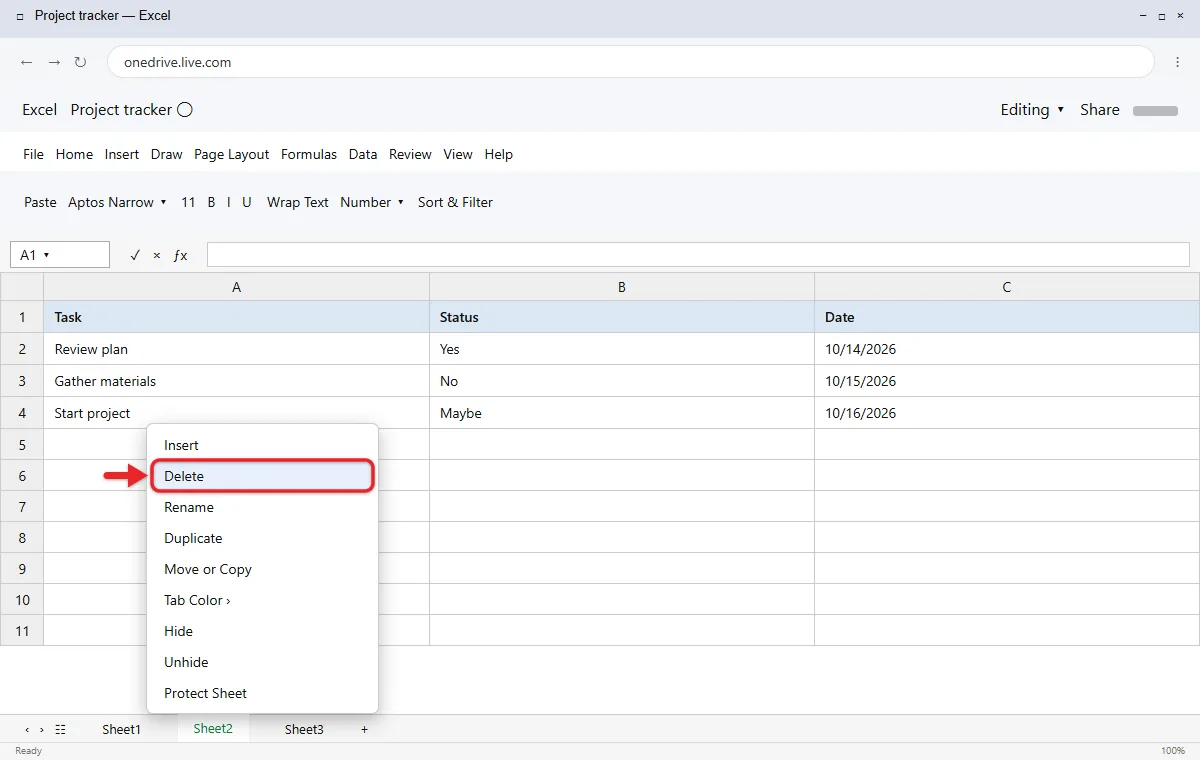
- If Excel asks you to confirm, click OK.
The tab is removed and Excel opens the next sheet. Excel for the web saves the change automatically, so there’s no separate Save step.
Make sure you right-click the sheet tab and not a cell. Right-clicking inside the grid opens a different menu with Delete options for cells, rows, and columns.
Use the Home tab instead
If right-clicking is awkward, for example on a touchscreen laptop, use the ribbon:
- Click the tab of the sheet you want to remove so it’s the active sheet.
- On the Home tab, click the arrow under or next to Delete.
- Choose Delete Sheet.
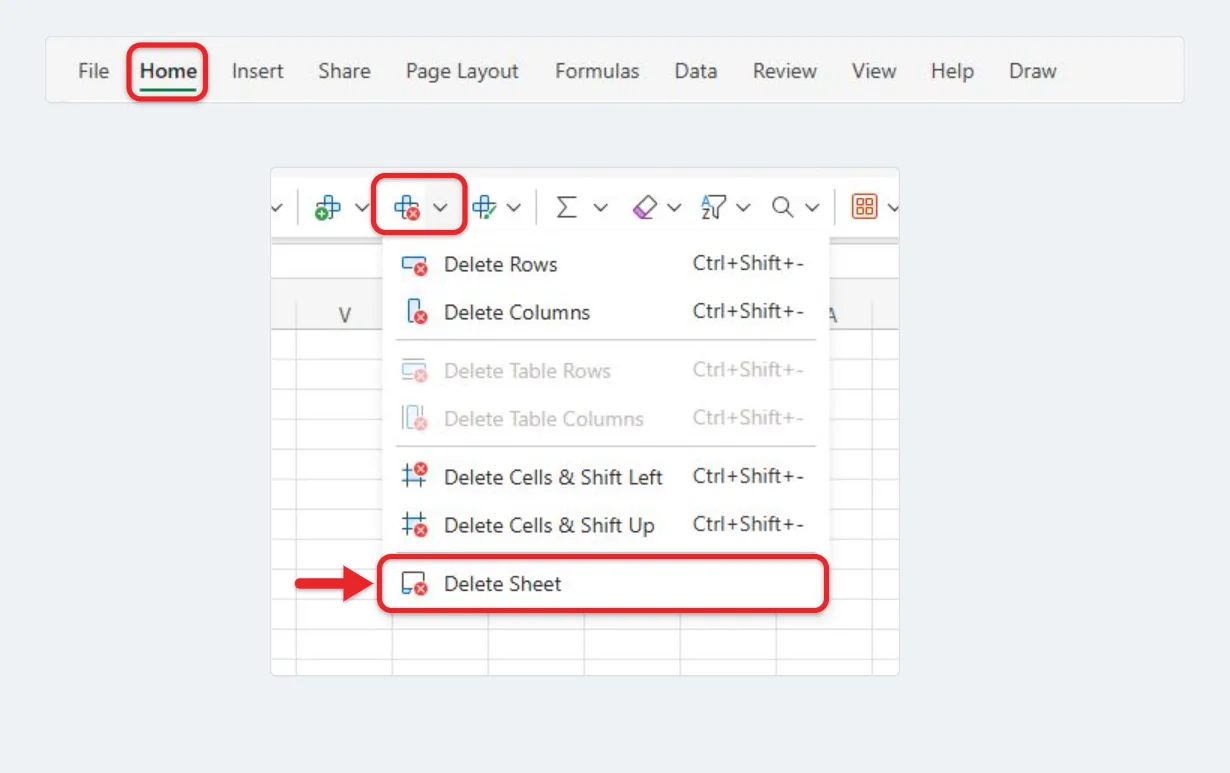
This command always deletes the sheet that’s open on screen, so look at the highlighted tab before you click.
Delete More Than One Worksheet
Excel for the web lets you select only one sheet at a time. Microsoft’s Select worksheets page confirms this, so holding Ctrl or Shift while you click tabs won’t group them. Repeat the steps for each sheet you want to remove.
Check the tab name each time, because Excel switches to a different sheet after every deletion. Writing down the names of the sheets you’re removing before you start helps you avoid deleting the wrong one.
If you have a lot of sheets to remove, the desktop app is faster. Click Editing in the upper-right corner of Excel for the web, choose Open in Desktop App, and use the grouping steps in the next section.
Delete a Sheet in the Excel Desktop App
The desktop app for Windows and Mac uses the same right-click Delete and Home > Delete > Delete Sheet commands, plus a few extras:
| Task | Windows | Mac |
|---|---|---|
| Delete the active sheet from the keyboard | Press Alt, then H, D, S one at a time | Use the right-click menu or Home > Delete > Delete Sheet |
| Select several sheets that sit next to each other | Click the first tab, hold Shift, click the last tab | Same, with Shift |
| Select sheets that aren’t next to each other | Hold Ctrl and click each tab | Hold Command and click each tab |
| Select every sheet | Right-click a tab and choose Select All Sheets | Same |
When several tabs are selected, the word Group appears in the title bar. Right-click any selected tab and choose Delete to remove them all at once. You can’t delete every sheet in a workbook, so leave at least one tab unselected. To cancel a group without deleting anything, click a tab that isn’t selected or right-click a selected tab and choose Ungroup Sheets.
If a sheet contains data, the desktop app warns that it will permanently delete the sheet. Click Delete to continue. Unlike most actions, deleting a sheet in the desktop app can’t be undone with Ctrl+Z. If AutoSave is off and you haven’t saved since the deletion, close the workbook without saving to get the sheet back.
Delete Sheets With an Office Script
If you have a Microsoft 365 work or school account, Excel for the web has an Automate tab with Office Scripts. A script can delete a named sheet without any clicking, which helps when you clean up the same workbook layout every week.
- Click Automate > New Script.
- Replace the sample code with this, changing “Old Data” to the exact sheet name:
function main(workbook: ExcelScript.Workbook) {
  workbook.getWorksheet("Old Data")?.delete();
}- Click Run.
The script deletes the sheet with no warning. Microsoft lists the account types that include Office Scripts in its Office Scripts platform requirements. Personal and family Microsoft 365 plans aren’t on that list, so use the manual steps if you don’t see the Automate tab.
Check Formulas After You Delete a Sheet
If other sheets pulled data from the deleted sheet, their formulas now show #REF!. For example, a summary sheet with the formula =January!B2 breaks when you delete the January sheet.
Before deleting a sheet that might feed other sheets, look at your summary or total sheets for formulas that mention its name. In the desktop app, press Ctrl+F, click Options, set Within to Workbook and Look in to Formulas, and search for the sheet name followed by an exclamation point. Also check Formulas > Name Manager for named ranges that point to the sheet.
After deleting it, check the remaining sheets for #REF! errors, broken charts, and drop-down lists that used values from that sheet. Microsoft’s guide to avoiding broken formulas explains what causes these errors.
If you aren’t sure whether other sheets depend on it, hiding the sheet is the safer choice.
Get a Deleted Worksheet Back
Try Undo right away
Press Ctrl+Z (or Command+Z on a Mac), or click the Undo button on the Home tab, immediately after deleting. If the sheet doesn’t come back, use Version History.
Restore an earlier version
Workbooks saved in OneDrive or SharePoint keep earlier versions that you can go back to. A personal Microsoft account keeps the last 25 versions of a file. Work and school libraries keep a number set by the organization.
- Click File > Info > Version History. In some layouts it’s File > Version History.
- Pick a version from before you deleted the sheet. It opens so you can look at it.
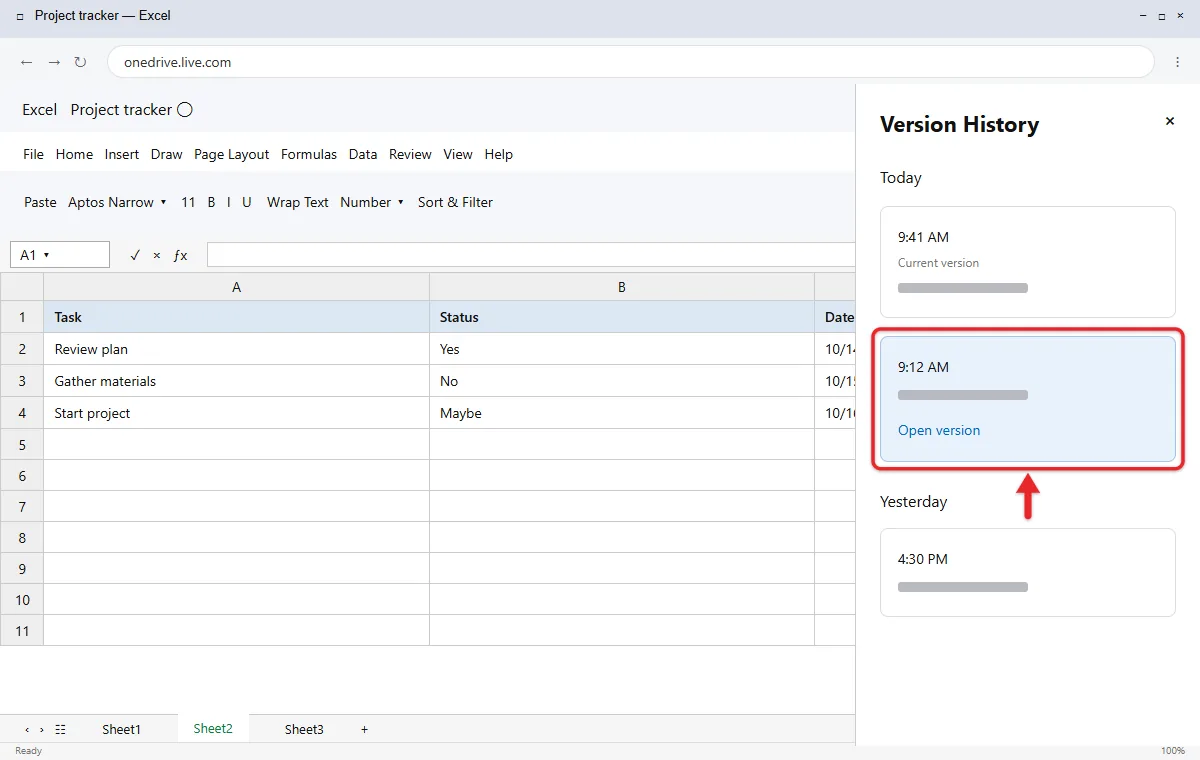
- Check that the missing sheet and its data are there.
- Click Restore to replace the current workbook with that version.
Restoring replaces the whole workbook, so any changes made after that version are lost. If you’ve done other work since then, copy the cells you need from the older version and paste them into a new sheet in the current workbook instead. Microsoft’s version history guide has more detail. For more recovery options, read about restoring a deleted worksheet in Excel.
Before deleting anything important, you can also download a copy of the workbook with File > Create a Copy > Download a Copy.
If you only need one tab as its own file, use the desktop app to save one sheet in Excel as a separate file.
Hide a Worksheet Tab Instead of Deleting It
Hiding removes the tab from view but keeps the sheet and its data in the workbook. Formulas that use the sheet keep working.
- Right-click the sheet tab.
- Choose Hide.
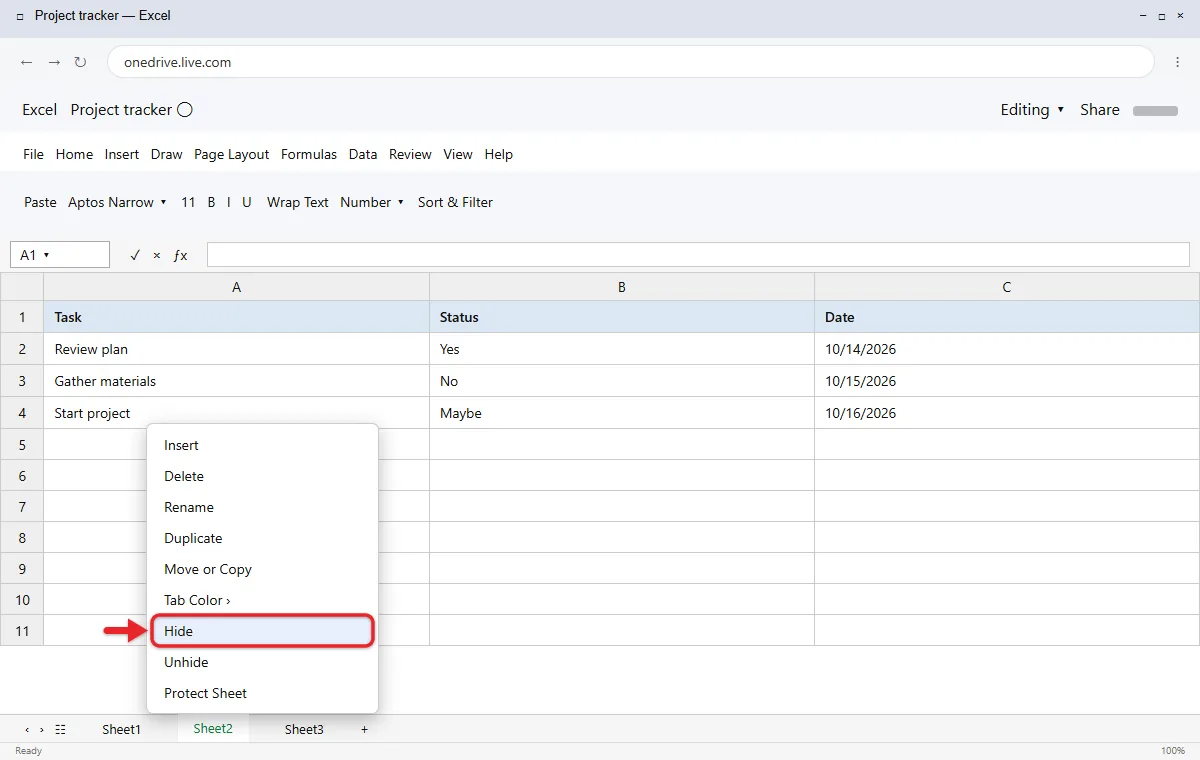
To bring it back, right-click any visible tab, choose Unhide, select the sheet, and click OK. Microsoft’s Hide or unhide worksheets page has the same steps. If a sheet you know exists doesn’t appear in the Unhide list, it may have been made “very hidden” with a macro, and the person who built the workbook has to change it in the desktop app.
Anyone who can edit the workbook can unhide the sheet, so don’t use hiding to keep private data away from people you share the file with. Delete the sheet, or share a copy without it. To let people read the file without changing or deleting sheets, make the spreadsheet read-only for others.
Why Can’t I Delete a Worksheet in Excel Online?
Delete is grayed out or missing
The workbook’s structure may be protected. Workbook protection blocks deleting, adding, renaming, hiding, and moving sheets. The person who protected the file has to remove the protection in the Excel desktop app with Review > Protect Workbook (it may ask for the password).
You only have view access
If the workbook was shared with you as view-only, you can’t change it. Ask the owner for edit access, or ask them to delete the sheet.
It’s the only sheet in the workbook
A workbook must have at least one visible sheet. Click the + button next to the tabs to add a new sheet, then delete the old one. If the other sheets are hidden, unhide one first.
The file is in Viewing mode
If you see Viewing in the upper-right corner, click it and switch to Editing.
The file is an older format or opened read-only
Files in older formats such as .xls, or files opened from an email attachment preview, can open without editing. Save the file to OneDrive, open it from there, and convert it to .xlsx if Excel offers to.
Frequently Asked Questions
Does deleting a worksheet tab delete the data?
Yes. The tab is the worksheet, so deleting it removes all the data, formulas, and charts on it. Use Rename if you only want to change the tab’s name.
What’s the difference between deleting and hiding a sheet?
Deleting removes the sheet and its data. Hiding keeps the sheet in the workbook but takes its tab out of view, and you can unhide it at any time.
Will other people see the change?
Yes. In a shared workbook, the sheet is removed for everyone who opens the file, including people who have it open at the same moment.
Is there a keyboard shortcut to delete a sheet?
Excel has no single-key shortcut for this. In the Windows desktop app, pressing Alt, H, D, S in sequence runs Home > Delete > Delete Sheet. In Excel for the web, the right-click menu or the Home tab is the reliable route.
Can I delete a sheet in the Excel phone app?
Yes. In Excel for iPhone, iPad, or Android, tap the sheet tab to open its menu, then tap Delete. The same edit-access and last-sheet rules apply.
Next step: if you deleted a sheet by mistake and Undo didn’t work, go straight to File > Info > Version History while the older version is still available.

Matthew Burleigh is the founder, head writer, and editor of Solve Your Tech, which he launched in 2012. He has written technology tutorials since 2008 and worked in IT since 2003, including small-business support, IT management, and consulting. He holds Bachelor’s and Master’s degrees in Computer Science from Arizona State University.
Matthew writes practical guides for Windows, iPhone and iPad, Microsoft Office, Outlook, Google apps, and Android. Solve Your Tech’s guides are checked step by step against the device or app maker’s own documentation and tested on his own devices whenever he has the hardware or software, with clear steps, sources, and update dates.
Read more about Matthew and how Solve Your Tech writes and updates its guides, or report a correction.