To open AOL Mail straight to your Inbox, go to mail.aol.com instead of aol.com, sign in, and bookmark that address (or make it your browser’s startup page). The news page appears when you sign in from the AOL homepage, because that sign-in sends you back to aol.com instead of to your mail.
These steps apply to AOL Mail on the web in a desktop browser (Chrome, Edge, Safari, or Firefox), with a short section for phones and tablets. Older versions of AOL Mail had a checkbox under Options > Mail Settings called Show me Today on AOL when signing in. The current version of AOL Mail doesn’t have that menu or checkbox, so there’s nothing to uncheck. What controls the page you see now is the address you start from.
Why You See the News Page Instead of Your Email
AOL has two different front doors:
- aol.com is the AOL homepage, with news, weather, games, and shopping. When you click Sign in there, AOL signs you in and returns you to the homepage. Your email is one more click away, behind the Mail link at the top of the page.
- mail.aol.com is AOL Mail itself. When you sign in from here, AOL sends you directly to your mailbox.
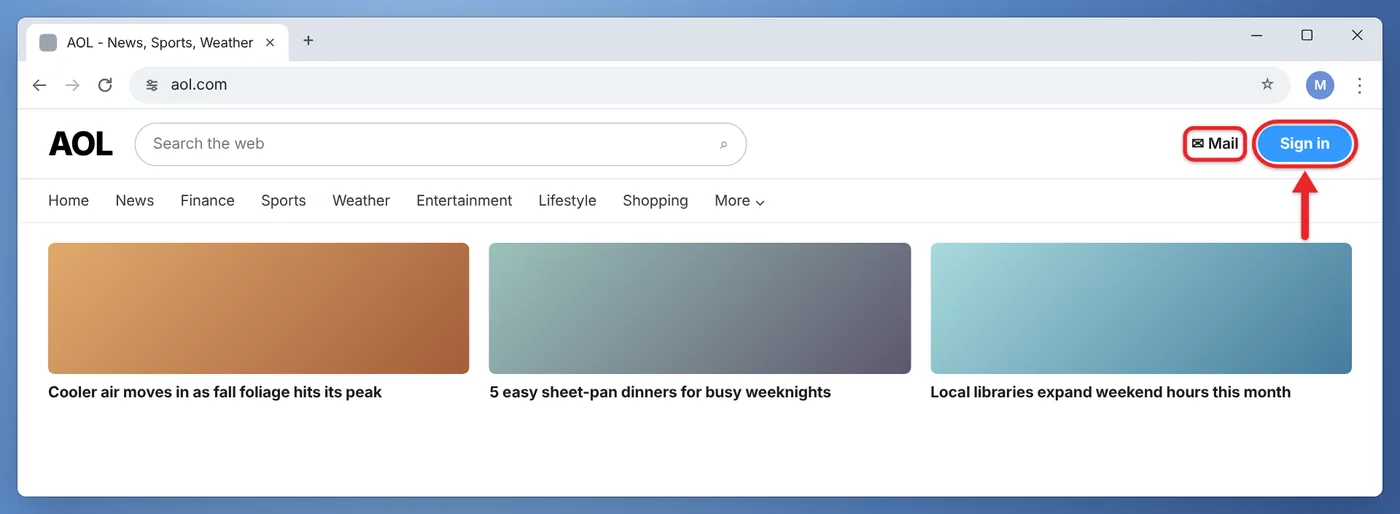
So if your bookmark, browser homepage, or habit takes you to aol.com, you’ll keep seeing news first. Pointing those at mail.aol.com fixes it.
Which Fix Should You Use?
| If you usually… | Do this |
|---|---|
| Click a bookmark or favorite to check email | Make a new bookmark for mail.aol.com, or edit the old one |
| Check email as soon as you open the browser | Set mail.aol.com as the startup page |
| Check email on a phone | Bookmark mail.aol.com in the phone’s browser, or use a mail app |
You can use more than one of these. None of them changes anything in your AOL account.
Open AOL Mail Directly to Your Inbox
- Open your web browser and type mail.aol.com in the address bar, then press Enter. If you’re already signed in, your Inbox opens. If you’re signed out, you’ll see a short AOL Mail welcome page with a Login button at the top.
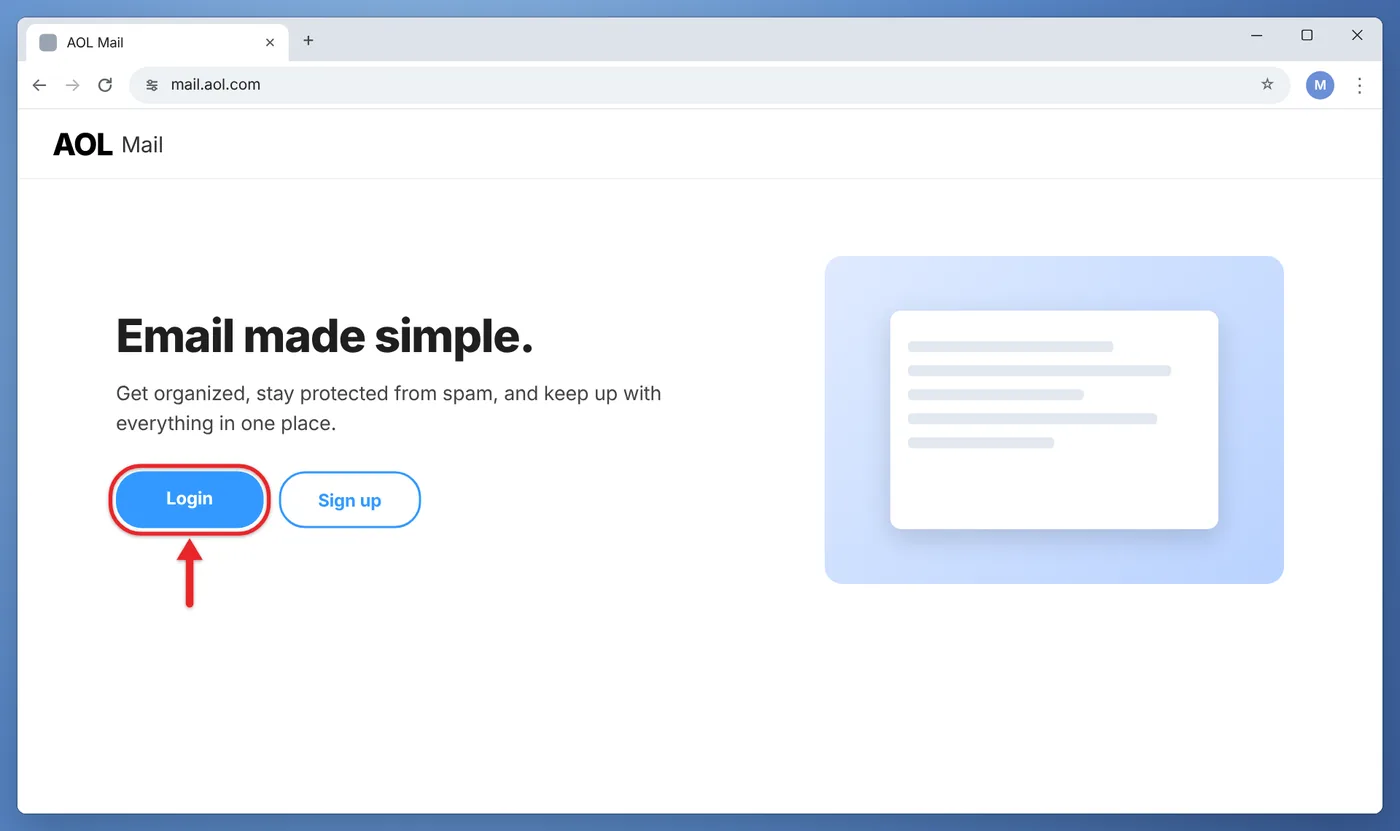
- Click Login. The Sign in to AOL page opens and asks for your Email or phone number.
- Enter your AOL email address or phone number and click Next.
- Finish signing in with your password or the verification method your account uses. When sign-in finishes, AOL takes you to your mail instead of the homepage.
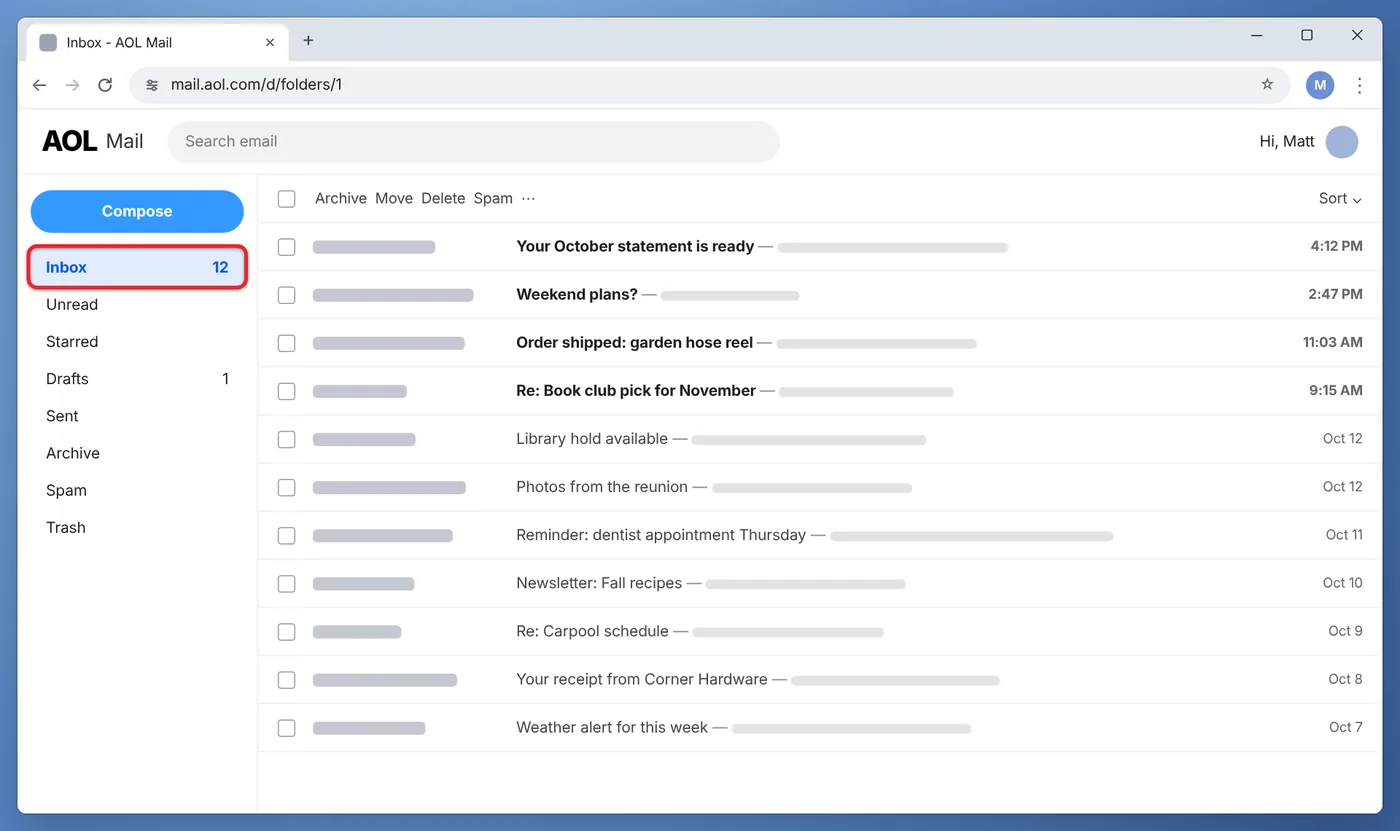
- If a folder other than your Inbox is showing, click Inbox in the folder list on the left side of the window.
- Bookmark the page so you can come back to it in one click. In Chrome, Edge, or Firefox, press Ctrl + D on Windows or Command + D on a Mac, then click Done (or Save). In Safari on a Mac, press Command + D and click Add.
From now on, open AOL Mail from that bookmark instead of from aol.com. If you’re having trouble with the sign-in screens themselves, the AOL Mail sign-in guide walks through each one.
Fix an Existing AOL Bookmark
If you already have a bookmark for AOL, you can fix it instead of making a new one. Right-click the bookmark, choose Edit (Edit Bookmark in Firefox, Edit Address in Safari), and change the address from aol.com to https://mail.aol.com. Then delete any other AOL bookmark that still points to the homepage so you don’t click the wrong one out of habit.
Check That It Worked
Close the browser, open it again, and click your new bookmark. The address bar should start with mail.aol.com, and you should see your folder list with Inbox on the left. If you see headlines and weather instead, the bookmark still points to aol.com.
Make AOL Mail the First Page Your Browser Opens
If you check email every time you open your browser, set mail.aol.com as the startup page. Then the browser opens to your mail with no extra clicks. A startup page is what opens when the browser launches. A homepage is what opens when you click the Home button. Some browsers treat them as separate settings. The article on making Yahoo your homepage on Windows 11 explains this in more detail.
Google Chrome
- Click the three-dot More menu at the top-right of Chrome and choose Settings.
- Select On startup in the menu on the left.
- Choose Open a specific page or set of pages, then click Add a new page.
- Type https://mail.aol.com and click Add. The next time you open Chrome, it loads AOL Mail.
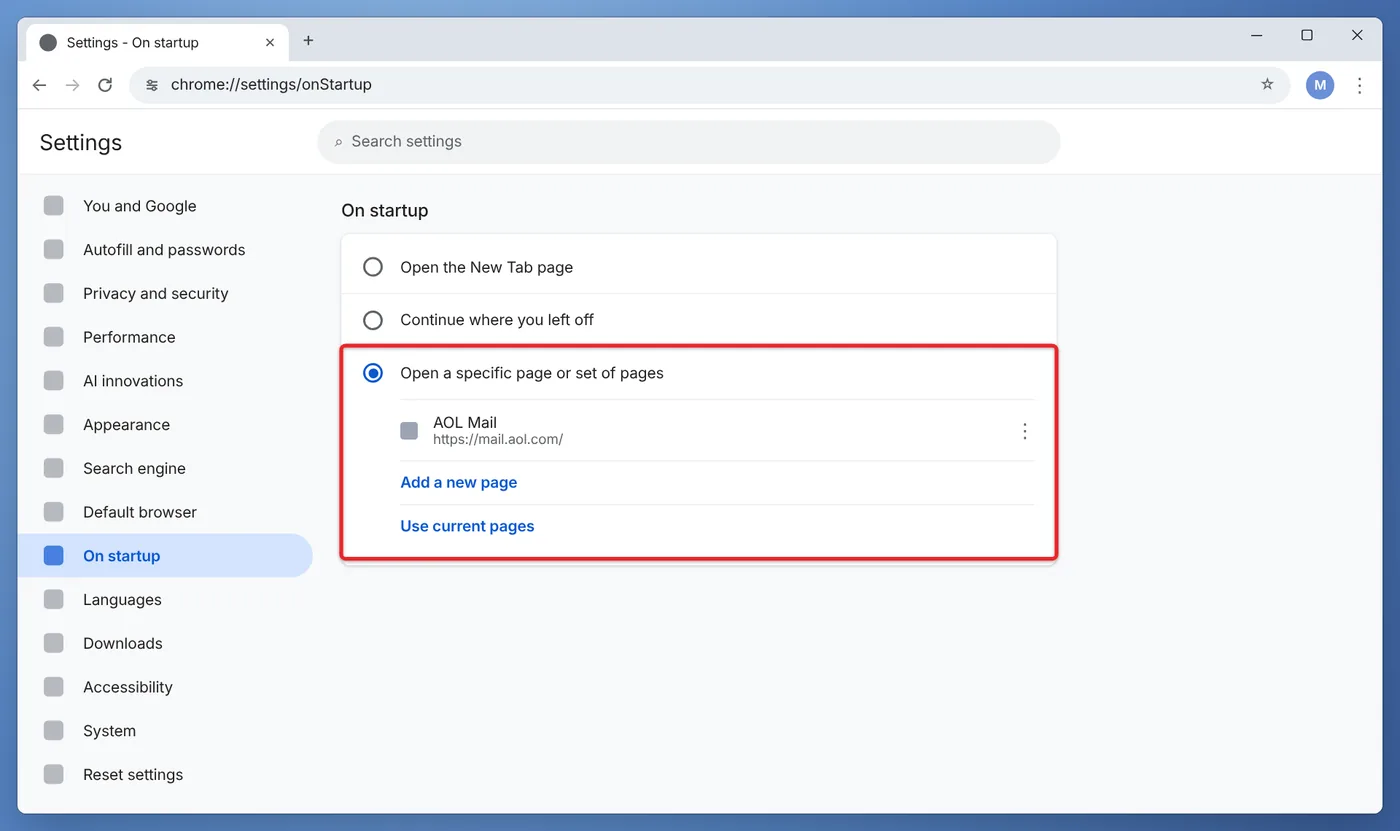
If aol.com is already listed as a startup page, click the three dots next to it and choose Remove. Google’s Chrome startup page instructions and the steps for changing the startup page in Google Chrome have more detail.
Microsoft Edge
- Click the three dots (Settings and more) at the top-right of Edge and choose Settings.
- Select Start, home, and new tabs on the left.
- Under When Edge starts, choose Open these pages.
- Click Add a new page, type https://mail.aol.com, and click Add.
If AOL Mail is already open in a tab, you can use Use all open tabs instead of typing the address. Microsoft’s Edge startup settings page shows the same options.
Safari on a Mac
- Choose Safari > Settings from the menu bar and click General.
- Type https://mail.aol.com in the Homepage field. If AOL Mail is open in the front window, you can click Set to Current Page instead.
- Set New windows open with to Homepage. You can set New tabs open with to Homepage too if you want every new tab to show your mail.
Apple’s Safari homepage guide covers the same settings.
Firefox
- Click the menu button (three lines) and choose Settings.
- Select the Home panel.
- In the drop-down next to Homepage and new windows, choose Custom URLs. If Firefox asks, click Choose a specific site.
- Type https://mail.aol.com in the address box. Firefox saves the change on its own.
Mozilla’s Firefox home page instructions also show how to drag a tab onto the Home button.
On a Phone or Tablet
The same idea works on a phone. Open your browser, go to mail.aol.com, sign in, and save it as a bookmark or favorite so you don’t start from the AOL homepage. On an iPhone or iPad, follow the steps for bookmarking a website in Safari to add it to your Favorites.
If you’d rather not use a browser at all, you can add your AOL account to your phone’s built-in mail app or use AOL’s own app from the App Store or Google Play. Either one opens your messages without going through the AOL homepage.
If AOL Mail Still Opens to the News Page
- Your bookmark points to aol.com. Click the bookmark and look at the address bar. If it says aol.com, edit the bookmark so it says mail.aol.com.
- You clicked Sign in on the AOL homepage. That sign-in returns you to aol.com by design. Click Mail at the top of the homepage, or go to mail.aol.com and sign in there.
- Your browser still starts on aol.com. Check the startup page or homepage setting for your browser in the section above. You might have two startup pages listed, one of which is aol.com.
- mail.aol.com shows a welcome page instead of your mail. You’re signed out. Click Login and sign in, and AOL Mail opens your mailbox afterward.
- You have to sign in every single time. Your browser may be deleting cookies when it closes, or you may be using a private or incognito window. Cookies are the small files that keep you signed in. A normal window that keeps cookies for aol.com will keep you signed in between visits.
- The page looks broken or keeps bouncing back to the homepage. Clear your browser’s cache and cookies, close and reopen the browser, and go to mail.aol.com again. Clearing cookies signs you out of websites, so you’ll need to sign in again.
- You can’t remember your username. Click Forgot username on the Sign in to AOL page and follow the prompts.
- You can’t find Options or Mail Settings. Those menus belonged to the older AOL Mail. Some guides still say to pick a start page or landing page there, but the current version has no “Today on AOL” or start page setting, so use the bookmark or startup page method instead.
If you use a shared or public computer, don’t set AOL Mail as a startup page that stays signed in. Sign out when you’re done so the next person can’t open your mail.
AOL Mail Inbox Questions
Where did the “Show me Today on AOL when signing in” setting go?
It was part of an older version of AOL Mail that had an Options > Mail Settings menu. The current AOL Mail doesn’t show a news page when you go to it directly, so the setting isn’t there anymore. Starting from mail.aol.com gives you the same result the old checkbox did.
What’s the direct web address for AOL Mail?
It’s https://mail.aol.com. That address opens your mailbox if you’re signed in, or a page with a Login button if you aren’t.
Can I stop aol.com from showing news?
No. The AOL homepage is a news and content page for everyone who visits it. You can skip it by opening mail.aol.com, but you can’t turn the homepage into an inbox.
Will changing my startup page affect my AOL account?
No. Startup pages and bookmarks are browser settings. They change what your browser opens, not anything in your AOL account, and you can switch them back at any time.
Do I need to do this on every device?
Yes. Bookmarks and startup pages belong to each browser on each device, unless your browser syncs bookmarks for you. Set up mail.aol.com on each computer and phone you use.
Does this work if I use AOL Desktop Gold?
AOL Desktop Gold is a separate paid program with its own window and settings. These steps are for AOL Mail in a regular web browser like Chrome, Edge, Safari, or Firefox.
Once your inbox opens the way you want, you can BCC someone from your AOL account when you email a group, view an email’s full headers in AOL Mail to check who really sent a message, or hide the reading pane in AOL Mail for a wider message list.

Matthew Burleigh is the founder, head writer, and editor of Solve Your Tech, which he launched in 2012. He has written technology tutorials since 2008 and worked in IT since 2003, including small-business support, IT management, and consulting. He holds Bachelor’s and Master’s degrees in Computer Science from Arizona State University.
Matthew writes practical guides for Windows, iPhone and iPad, Microsoft Office, Outlook, Google apps, and Android. Solve Your Tech’s guides are checked step by step against the device or app maker’s own documentation and tested on his own devices whenever he has the hardware or software, with clear steps, sources, and update dates.
Read more about Matthew and how Solve Your Tech writes and updates its guides, or report a correction.