You need a small batch of business cards for an event this week, and Google Docs is the tool you already have open. Docs has no business card template of its own, so the reliable method is a table: on a Letter page, insert a 2 x 5 table, set each cell to 3.5 x 2 inches in Table options, design one card, copy it into the other nine cells, and print.
Before You Start: Card Size and What Docs Can Do
These steps are for Google Docs in a web browser on a computer. A few facts decide how you build the cards.
- Standard US card size: 3.5 x 2 inches (88.9 x 50.8 mm). Ten of them fit on one 8.5 x 11 inch Letter sheet in two columns of five.
- No built-in card template: Google’s template help lists examples such as resumes, budgets, order forms, press releases and business proposals. Business cards are not among them, so plan to build your own or copy a shared template.
- Page settings are limited: File > Page setup in Docs offers orientation, paper size, margins and page color. Google does not document a custom paper size for Docs, so you should not count on making a 3.5 x 2 inch page there. Google Slides does document a custom size (see Google’s slide size help), which is covered in Method 3.
- No bleed: Docs has no bleed or crop-mark setting, which professional printers use to print color right to the trimmed edge. Keep designs on a white or light background, or leave a white border inside each card.
Decide what goes on the card before you design it: your name, job title, business name, phone, email and website are the usual set. A logo or a short tagline is optional. Fewer lines make a card easier to read and easier to fit.
Method 1: Build a Ten-Card Sheet With a Table
This is the method to use for printing at home, because every card ends up the right size on a normal sheet of paper.
Set Up the Page
- Open a blank document in Google Docs.
- Go to File > Page setup. If the document is in pageless format, select Pages at the top of the dialog first, because these settings are not available in pageless mode.
- Set Orientation to Portrait and Paper size to Letter (8.5 x 11 in).
- Under Margins, enter 0.5 inch for top and bottom and 0.75 inch for left and right. Two 3.5 inch columns use 7 inches of the 8.5 inch width, and five 2 inch rows use 10 of the 11 inches, so these margins center the grid.
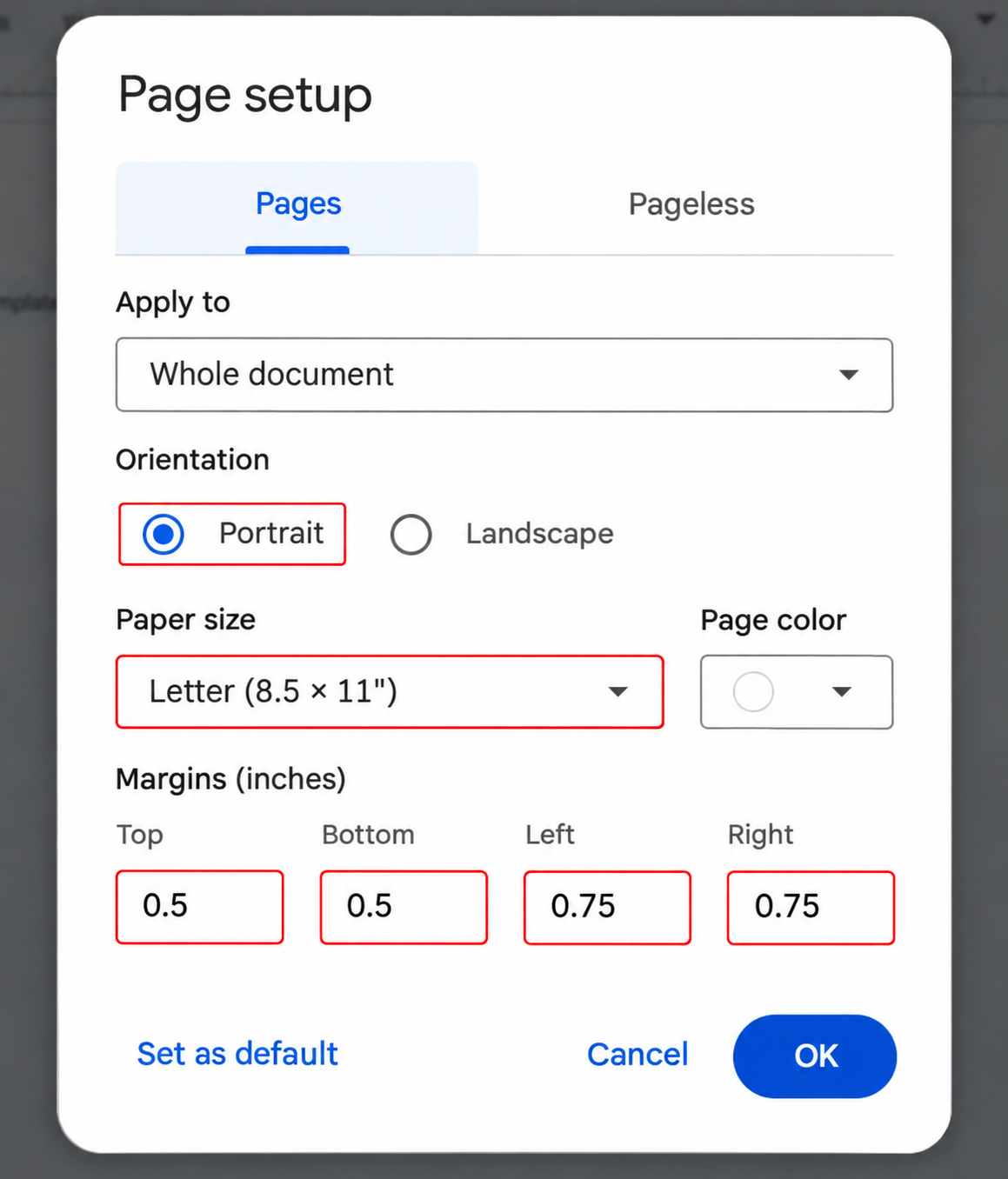
- Select OK.
Insert and Size the Table
- Go to Insert > Table and drag across the grid to pick 2 columns by 5 rows.
- Click inside the table, then go to Format > Table > Table options (or right-click the table and choose Table options). Google lists these settings on its table editing help page.
- Set Column width to 3.5 inches and the minimum Row height to 2 inches.
- Set Cell padding to about 0.15 inch so text does not touch the cut line, and set Cell vertical alignment to Middle so each card’s text sits in the center.
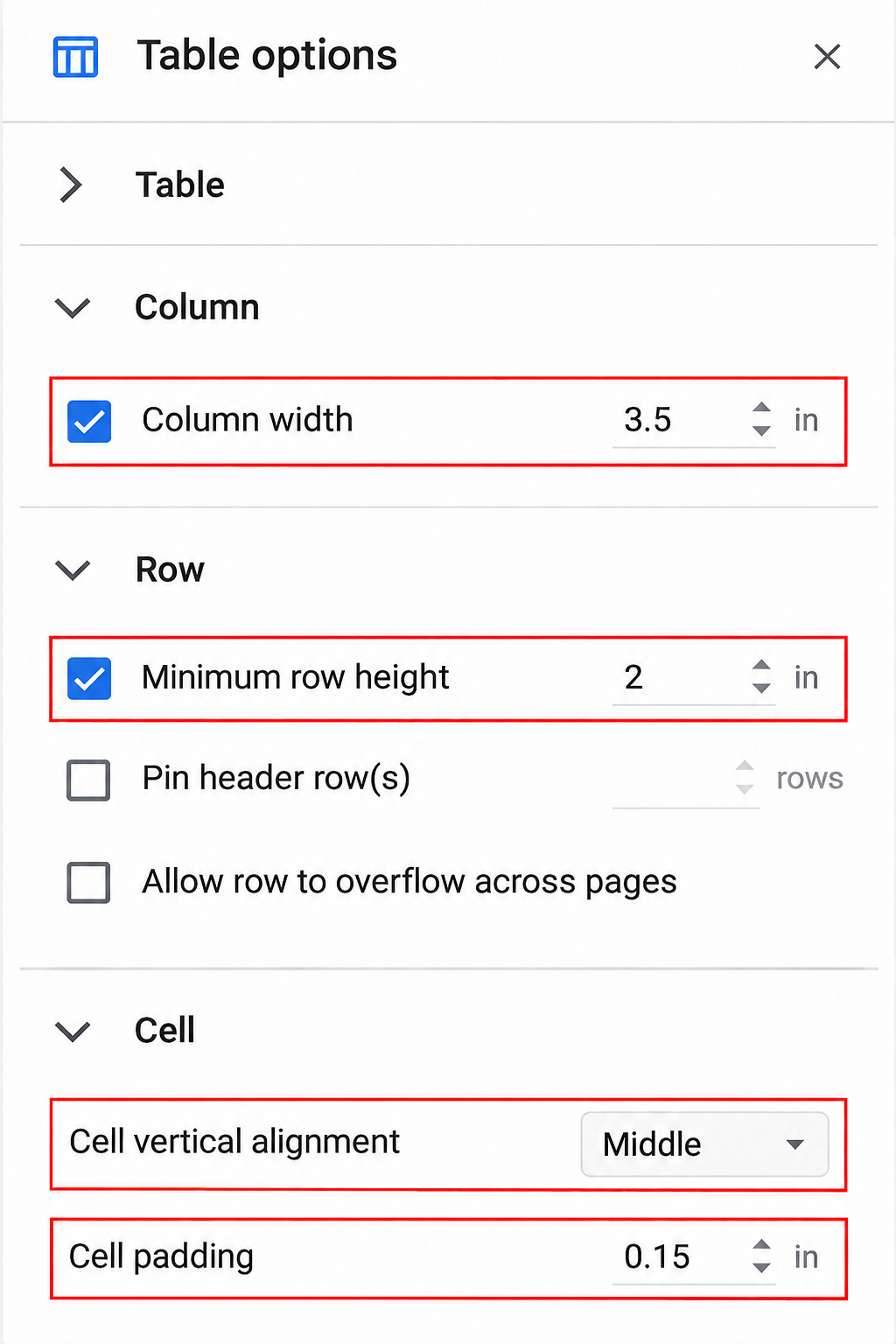
- Select OK. If any rows look uneven, select the whole table, right-click and choose Distribute rows.
Row height in Docs is a minimum, so a cell grows if its content does not fit. If one row is taller than the others, the text in that card is too large or has an extra blank line. For more on table controls, see creating and editing tables in Google Docs.
Set the Cut Lines
The table borders can serve as your cutting guides. Select the whole table and use the Border color and Border width buttons that appear on the toolbar. A thin light gray line (0.5 pt) is easy to cut along and barely shows if you trim slightly off it. If you plan to use a paper cutter with a ruler, you can set the width to 0 pt for no lines at all.
Design the Front of the Card
Work in the top left cell only. When it looks right, you will copy it to the rest.
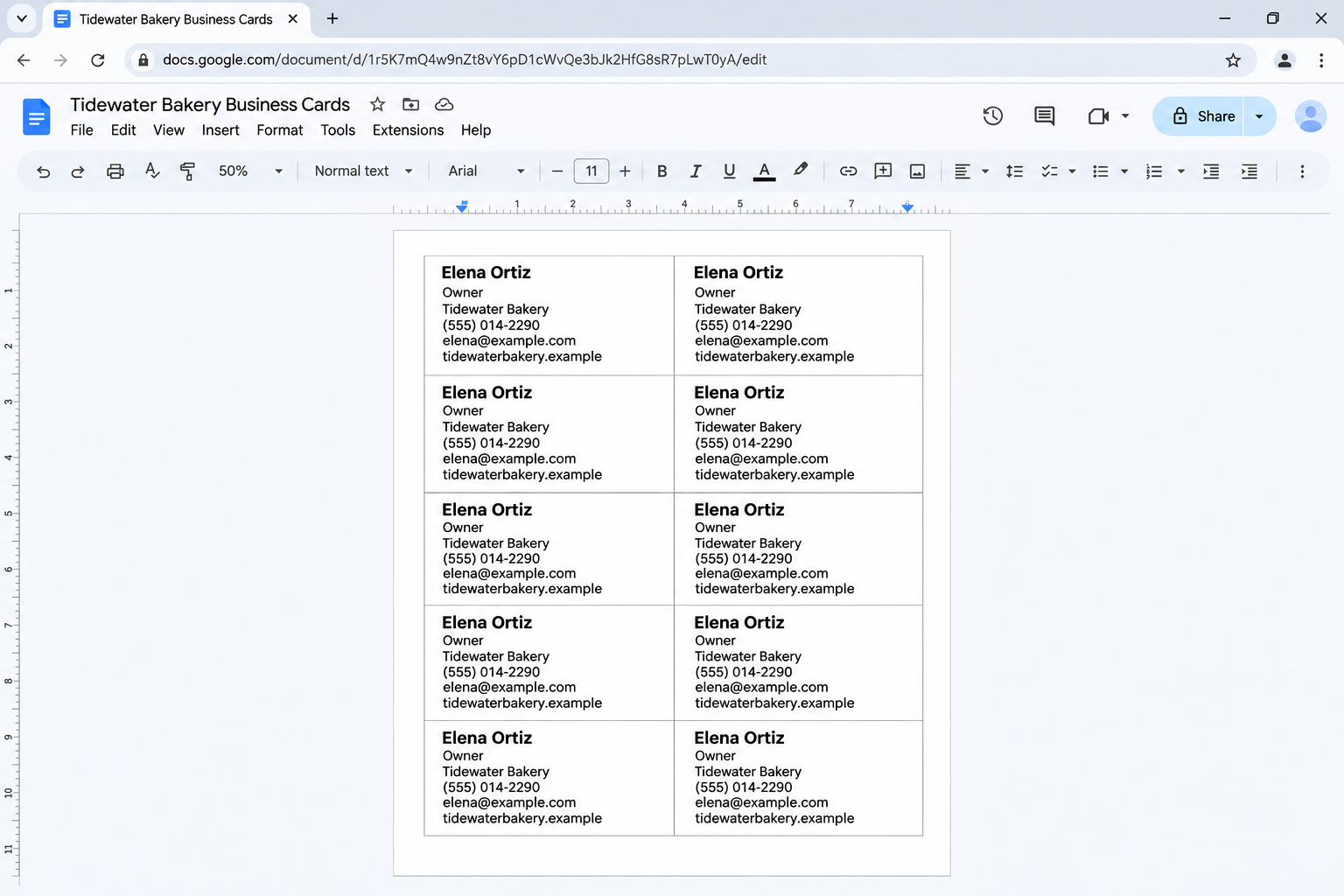
- Type the details, one per line. For a fictional example, Elena Ortiz might enter: Elena Ortiz / Owner, Tidewater Bakery / (555) 014-2290 / elena@example.com / tidewaterbakery.example.
- Make the name the largest line. Sizes differ between sources, so treat these as a starting point: about 14 pt for the name, and 8 to 10 pt for the rest. Stick to one or two plain fonts.
- Use the alignment buttons to center the text or align it left. Left-aligned text with the logo on the right is a common, tidy layout.
- To add a logo, click where it should go and choose Insert > Image. Drag a corner to shrink it to roughly 0.75 inch tall. Inserting and cropping pictures in Google Docs explains the wrap and crop options if the logo will not sit where you want it.
- To color a card, select the cell and use the Background color button on the toolbar. Keep strong colors away from the cell edge, since a slightly off cut shows a white sliver.
When the first card is done, select everything inside that cell, copy it, then click in each of the other nine cells and paste. Check that no row grew taller after pasting.
If you want text and a logo to overlap freely rather than flow line by line, a text box or drawing gives more control. Inserting a text box in Google Docs covers that, but text boxes inside table cells can be harder to copy evenly, so keep the layout simple when you can.
Add a Back Side for Two-Sided Cards
- Click below the table and insert a page break (Insert > Break > Page break).
- On page 2, insert a second 2 x 5 table with exactly the same Table options settings.
- Design the back in one cell (a logo, a tagline, or a QR code image that links to your website) and copy it into the other nine.
- Print page 1, put the sheet back in the printer, and print page 2 on the other side, or use your printer’s two-sided option.
Watch out for one detail: when a sheet flips on its long edge, the left column of the back lines up with the right column of the front. If every back is identical, this does not matter. If the backs differ (for two people’s cards on one sheet, for example), swap the columns on page 2. Always test on plain paper first and hold the sheet up to a light to check that the grids line up.
Method 2: Start From a Template
Since Google’s own gallery does not include business cards, templates come from two other places.
- A shared Google Docs template: if a coworker or your organization shares a card layout, open it and choose File > Make a copy. Your copy is saved to your Drive and you can edit it freely. On a work or school account, also check Template gallery at the top right of the Docs home screen, since some template features are only available for work or school accounts and your organization may have added its own designs.
- A Word template: you can upload a .docx card template to Drive and open it in Docs (in Docs, look for File > Open > Upload). Word card templates often rely on text boxes and exact positions, so check every card after it opens. If the layout shifts badly, it is usually quicker to rebuild it with the table method or to finish the job in Word, where making and printing business cards in Microsoft Word has built-in card sheet support.
Perforated card sheets sold at office supply stores come in their own layouts. If you buy them, measure the sheet’s top margin, side margin and the gap between cards with a ruler, and adjust your Page setup margins and column widths to match before you print the real batch.
Method 3: Design One Exact-Size Card in Slides or Drawings
If you want a design with shapes and overlapping elements, or a print shop wants a single card-size file, Google Slides is the better tool, because it lets you set a custom page size.
- Create a new presentation in Google Slides.
- Go to File > Page setup, open the size list and choose Custom.
- Enter 3.5 by 2, pick inches as the unit, and select OK.
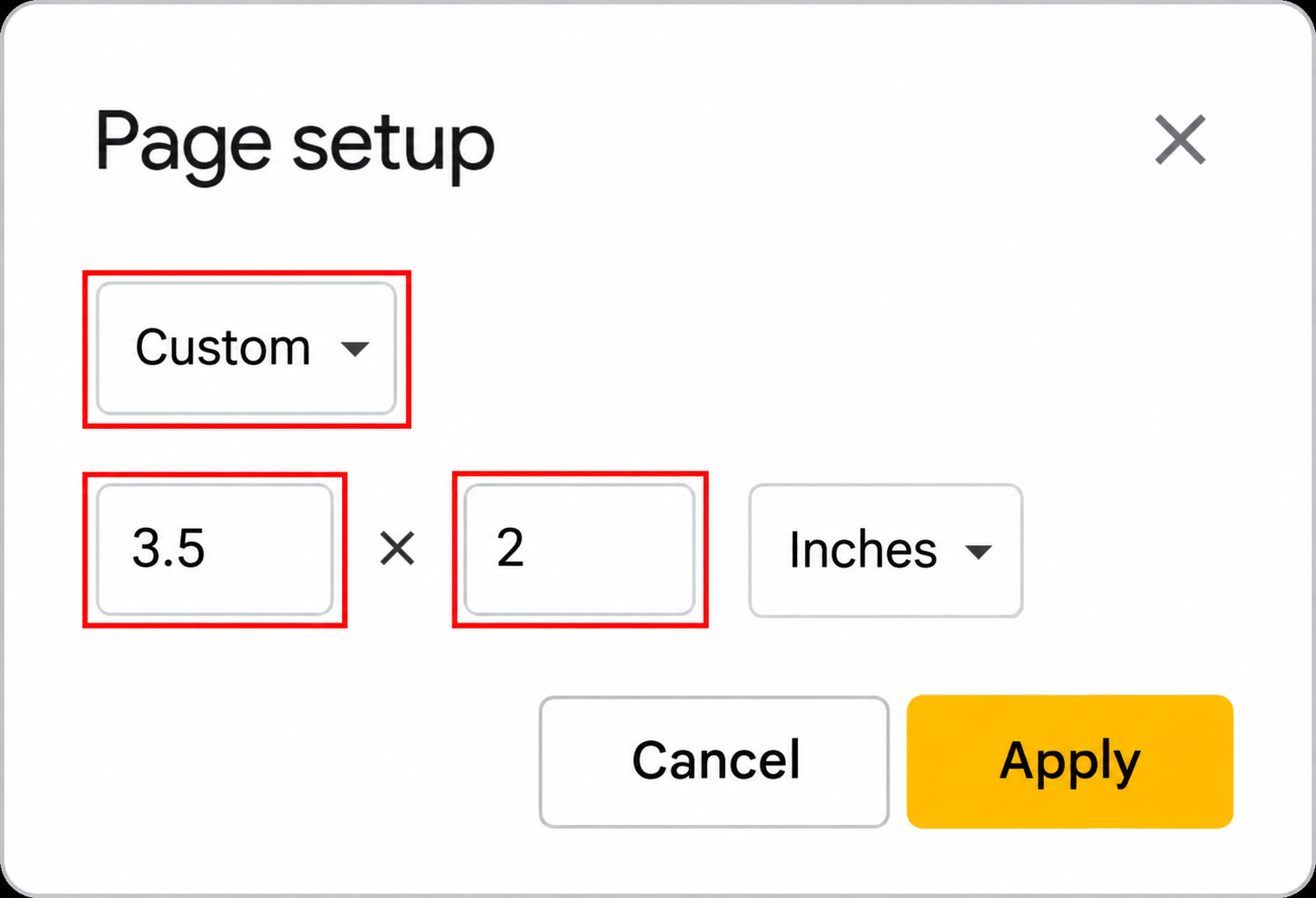
- Design the front on slide 1 and the back on slide 2, using text boxes, shapes and images.
- Download it as a PDF to send to a printer. Converting Google Slides to PDF shows the download steps.
Google Drawings is a middle option inside Docs. In your document, choose Insert > Drawing > New, then use the text box, shape, Word Art and image tools to lay out a card, and select Save and close. The drawing lands where your cursor was, so click inside a table cell first. Drag its corner to fit the 3.5 x 2 cell, then copy it to the other cells. You can also start a standalone drawing from Drive with New > More > Google Drawings.
Print or Export Your Cards
- Go to File > Print. In Firefox and Safari, Docs downloads a PDF first, and you print from that file.
- In the print dialog, keep the scale at 100 percent (turn off any “fit to page” setting) so the cards stay 3.5 x 2 inches.
- Print one sheet on plain paper. Measure a card with a ruler, and lay the sheet over your cardstock or perforated sheet to check alignment.
- Load cardstock (check your printer’s manual for the heaviest paper it accepts) and print the batch.
- Cut along the lines with a paper cutter or a ruler and craft knife. Scissors work, but straight edges are hard to get by hand.
To send the cards to a print shop instead, go to File > Download and choose PDF. Ask the shop whether they accept a 10-up sheet or want one card per page, and whether they need bleed. If they need bleed, the Slides method is easier to adapt. Colors on screen and on paper often differ, so ask for a proof if the color matters.
Fix Common Problems
- The table spills onto a second page. A row grew past 2 inches, or the margins are larger than 0.5 inch top and bottom. Reduce font size or remove a blank line in the tall row, and recheck Page setup. Docs usually keeps an empty line after a table; if that line creates a blank extra page, make that line’s font size very small.
- A card splits across two pages. In Table options, under Row, clear Allow row to overflow across pages so each card stays on one page. Google notes this option works only in pages format, not pageless.
- Text gets cut off at the edge. Increase cell padding, and keep important text at least 0.125 inch inside the cut line.
- The cards print smaller than 3.5 x 2. The print dialog scaled the page. Set scale to 100 percent or “actual size.”
- The logo looks blurry. The image file is too small. Use the largest version of the logo you have; shrinking a large image looks sharp, enlarging a small one does not.
Questions About Business Cards in Google Docs
Can I make a vertical business card?
Yes. Switch the page to landscape (File > Page setup > Orientation > Landscape) and insert a 5-column by 2-row table, with each column 2 inches wide and each row 3.5 inches tall. Five columns use 10 of the 11 inch width and two rows use 7 of the 8.5 inch height, so set the left and right margins to 0.5 inch and the top and bottom to 0.75 inch. You still get 10 cards per sheet.
Can I make business cards in Google Docs on a phone?
Editing a finished card on a phone is possible, but building the table and setting Table options is much easier in a browser on a computer, where all the menus described here are available.
How many cards should I print at home?
Home printing suits a small run, such as one to five sheets (10 to 50 cards) for a single event. For a few hundred cards, a print shop is usually cheaper per card and gives cleaner cuts.
Print your plain-paper test sheet now, before you buy cardstock. It is the fastest way to catch a wrong margin or a card that runs too tall.

Matthew Burleigh is the founder, head writer, and editor of Solve Your Tech, which he launched in 2012. He has written technology tutorials since 2008 and worked in IT since 2003, including small-business support, IT management, and consulting. He holds Bachelor’s and Master’s degrees in Computer Science from Arizona State University.
Matthew writes practical guides for Windows, iPhone and iPad, Microsoft Office, Outlook, Google apps, and Android. Solve Your Tech’s guides are checked step by step against the device or app maker’s own documentation and tested on his own devices whenever he has the hardware or software, with clear steps, sources, and update dates.
Read more about Matthew and how Solve Your Tech writes and updates its guides, or report a correction.