No. Facebook allows one personal account per person, and its Help Center says you can no longer create additional profiles under that account. Additional profiles that already exist still work. For a business, brand, club, or public presence, the supported option is a Facebook Page created from your existing account.
This covers Facebook on a computer and in the Facebook app for iPhone and Android, based on Meta’s Help Center rules.
Using a different email address or phone number doesn’t make a second personal account allowed. The same rules explain why you cannot create an anonymous Facebook account.
What Facebook’s Rules Say
- One personal account. Facebook’s multiple-account policy says maintaining more than one personal account is against its Community Standards. Meta’s Terms of Service also ask you to create only one account, your own, and use it for personal purposes.
- Your real name on the main profile. The main profile must use the name you go by in everyday life.
- No new additional profiles. Meta launched additional profiles in 2023, but the current additional-profile help says the creation feature is no longer available. Existing additional profiles were not affected.
- Personal profiles aren’t for businesses. A business, brand, or product belongs on a Page, not on a personal profile.
A separately registered account with its own email and password is not an additional profile. It’s a second personal account, and the one-account rule applies to it in full.
Pick the Option That Fits Your Goal
People usually want a second account for one of a few reasons. Each has a supported answer.
| What you want | Supported option |
|---|---|
| A business, brand, club, or cause | A Facebook Page |
| A public following as a creator | Professional mode on your main profile, or a Page |
| A space for a hobby or community | A Facebook group you create from your profile |
| Posts only some friends can see | Audience settings and friend lists on your main profile |
| A nickname or former name people can find | An “other name” on your main profile |
| An extra profile you made before creation ended | Switch to it from your account |
Facebook’s profile-types explanation compares Pages, professional mode, and additional profiles. Professional mode adds creator tools to your main profile. It doesn’t create another profile or account.
If you only want to read public Pages and posts, you may not need an account at all, since you can view Facebook without an account.
Switch to an Existing Additional Profile
These steps apply only if an additional profile already exists under the account you are using. They don’t create one.
On a Computer
- Sign in to your Facebook account at facebook.com with its normal login. An additional profile doesn’t have its own password.
- Click your profile picture at the top right. The account menu opens.
- Choose See all profiles. Your main profile, any additional profiles, and any Pages you manage appear.
- Select the additional profile you want to use. Its name and picture now show at the top right.
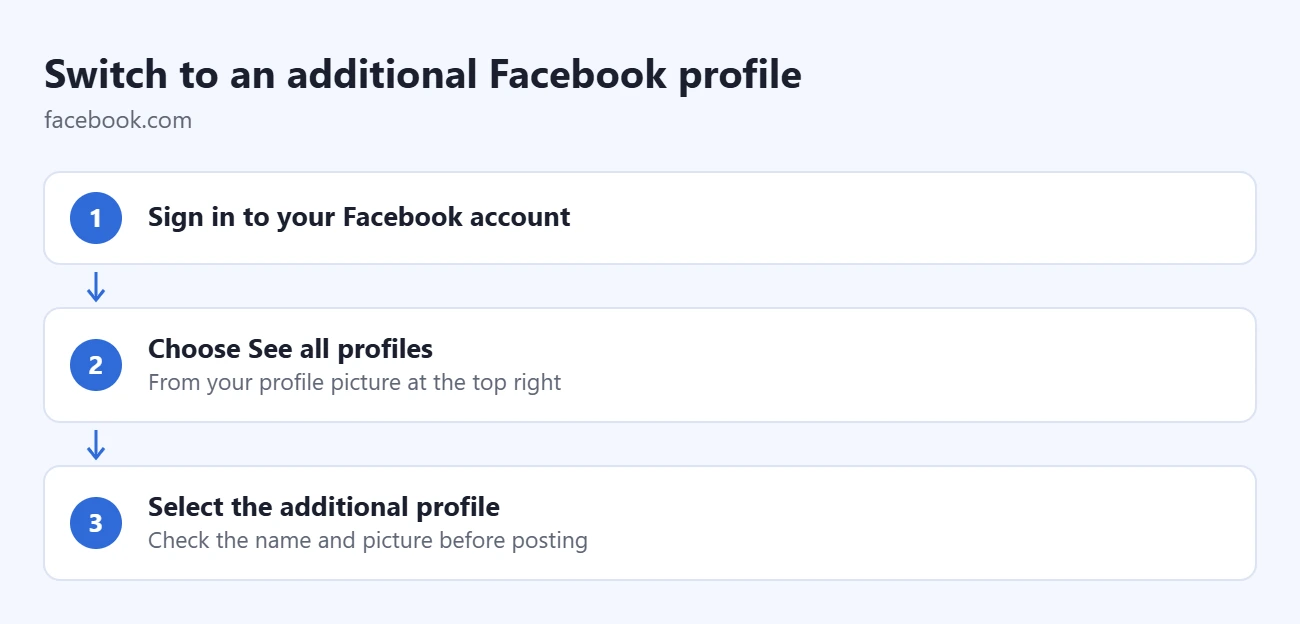
Check the name and picture before you post, comment, or send a friend request. To go back, open the same menu and choose your main profile. Facebook’s switching instructions confirm this route.
In the Facebook App
- Tap Menu. On iPhone it’s your profile picture at the bottom right; on Android it’s at the top right.
- Tap the down arrow next to your name. A list of your profiles and Pages opens.
- Tap the additional profile. The app reloads as that profile.
If a profile is missing, check that you signed in to the account that contains it. Switching can’t bring back a deleted profile, and a profile you made as a separate registered account won’t appear in this list.
Create a Page for a Separate Public Presence
Decide what should be public first. Pages are public by design. Don’t add a home address, private phone number, or other personal details just because an optional field asks. You need your main profile to create and manage a Page, and the Page still has its own name, followers, posts, and inbox.
On Facebook’s computer website, the current Page creation guide uses this route:
- Log in to Facebook and click Pages on the left. Select Create Page.
- Choose Public Page, then Next and Get Started.
- Enter the Page’s name and category. Add a short bio if you want, then select Create Page. Your new Page opens with setup prompts.
- Add business details, a profile picture, and a cover photo. Select Next to move through each screen. Skip the WhatsApp prompt if you don’t need it.
- Choose whether to invite friends, then select Done. Invitations are optional, and friends don’t follow the Page automatically.
Look over the Page’s name, category, and public information before you share its address. To act as the Page later, use the same See all profiles menu described above.
Once the Page is ready, it can host events too, so you can create a Facebook event for your Page. Keep in mind that Page events are always public.
If someone else will help run the Page, give them Page access through their own account. Never share your personal Facebook password. Managing a Page and removing your access are different tasks, and the Facebook Page access guide covers both. To see why your friends and posts don’t move over to a Page, read about converting a Facebook profile to a Page.
Keep Parts of Your Life Separate Without a Second Account
Many people want a second account for privacy, such as keeping coworkers away from family photos. Your main profile can do much of that.
- Set a default audience. In Settings & privacy > Settings > Audience and visibility > Posts, choose who sees your future posts.
- Choose an audience per post. When you write a post, tap the audience button under your name and pick Friends except… or Specific friends.
- Hide your friends list and limit friend requests from the same Audience and visibility section.
For help with each of these settings, read about making your Facebook account private. If you want old classmates to find you by a maiden name or nickname, add it as an other name. You’ll find those steps alongside how to edit your Facebook profile name.
Common Questions and Problems
Why is Create new profile missing?
Meta has ended additional-profile creation. Its September 2023 announcement described a feature that could create several profiles, but that announcement is history, not current instructions. Updating the app or signing out won’t bring the option back.
Do existing additional profiles need separate passwords?
No. They use your account’s login. A different email address and password belong to a separate registered account, not an additional profile.
Can I delete an existing additional profile and make a replacement?
Don’t delete one expecting to replace it, because new additional profiles can’t be created. If you only want a break, review temporary deactivation before choosing permanent deletion. The steps to remove an additional profile cover backups, picking the correct profile, and what the confirmation removes.
A temporary break can also keep your chats running if you deactivate Facebook but keep Messenger.
I already have two personal accounts. What should I do?
Facebook doesn’t merge personal accounts. Its account consolidation guidance says to pick the account you’ll keep, save anything important from the other one, and hand off any Pages or groups it manages before you close it. Then add friends from the account you kept. When you’re ready, permanently delete the other Facebook account.
My account was disabled. Can I just make a new one?
No. Meta’s rules don’t allow opening a new account to get around a disabled one. Follow the appeal or review option Facebook shows when you sign in to the disabled account.
Will an additional profile make me anonymous?
No. It stays part of the same Facebook account. A separate friends list and Feed don’t make it an independent login, and Meta says other people may still be able to work out which profiles belong to you. Check which profile is active and who can see each post.

Matthew Burleigh is the founder, head writer, and editor of Solve Your Tech, which he launched in 2012. He has written technology tutorials since 2008 and worked in IT since 2003, including small-business support, IT management, and consulting. He holds Bachelor’s and Master’s degrees in Computer Science from Arizona State University.
Matthew writes practical guides for Windows, iPhone and iPad, Microsoft Office, Outlook, Google apps, and Android. Solve Your Tech’s guides are checked step by step against the device or app maker’s own documentation and tested on his own devices whenever he has the hardware or software, with clear steps, sources, and update dates.
Read more about Matthew and how Solve Your Tech writes and updates its guides, or report a correction.