If Facebook says your account is locked for security, open Facebook yourself, sign in, select Get started and complete the checks it shows. Meta may ask for a code, your date of birth, an ID photo or a short selfie video, and resetting your password alone usually won’t remove a security lock.
These steps cover the Facebook app for iPhone and Android and facebook.com in a web browser. Meta changes its recovery screens often and picks the checks for each account, so your screens may not match every step exactly. Use these steps only for your own account.
Before You Start
A few things raise your chances of getting through Facebook’s checks on the first try:
- Use a phone or computer you’ve signed in with before. Meta recognizes familiar devices and locations during recovery, so your usual phone on your home Wi-Fi is a better choice than a new device.
- Have your email inbox and phone nearby. Codes go to the email address or mobile number saved on the account.
- Know the date of birth on your profile. Meta asks for the date you gave when you signed up.
- Keep a driver’s license, passport or other government ID handy in case Facebook asks for it.
- Go straight to Facebook. Open the app or type facebook.com into your browser. Don’t use links in texts, direct messages or emails you didn’t expect.
Choose the Correct Recovery Route
Read the exact message Facebook shows before you do anything. A locked account, a forgotten password, a hacked account and a suspended account each have a different fix.
| What you see | What it means | Where to start |
|---|---|---|
| “Your account has been locked” | Facebook saw unusual activity and paused the account | Unlock an Account Locked for Security, below |
| Wrong password, with no lock message | You forgot the password or someone changed it | Recover the Account if You Can’t Log In, below |
| Posts, messages or settings you didn’t make | Someone else got in | The hacked-account guide (link below) |
| “We suspended your account” or “We disabled your account” | Meta decided the account broke its rules | The review or appeal option on that screen |
- An attacker changed your account or sent messages: follow this hacked Facebook account recovery guide for the official hacked-account route and security cleanup. Meta’s hacked-account page is at facebook.com/hacked.
- Suspended or disabled: follow the review or appeal instructions shown when you log in. Meta’s suspension and disability guidance is separate from unlocking a security lock. Follow the deadline shown on your screen, because appeal periods vary.
If the obstacle is a two-factor login code, read about recovering Facebook access when you cannot complete two-factor authentication. That challenge needs an available verification method or account-specific recovery checks; resetting the password alone does not remove it.
These problems can overlap. For example, an attacker’s login attempt can trigger a security lock. Note the message, use the recovery checks Facebook offers, then secure the account after access returns.
Unlock an Account Locked for Security
Meta’s unlocking guide says unusual activity can lead to a security lock. You may see the lock message when you sign in, or get an email about it.
- Open the Facebook app, or type facebook.com into your browser yourself instead of tapping a link in an unexpected email.
- Sign in to the affected account. Check that the name and photo shown are yours, then read the lock message.
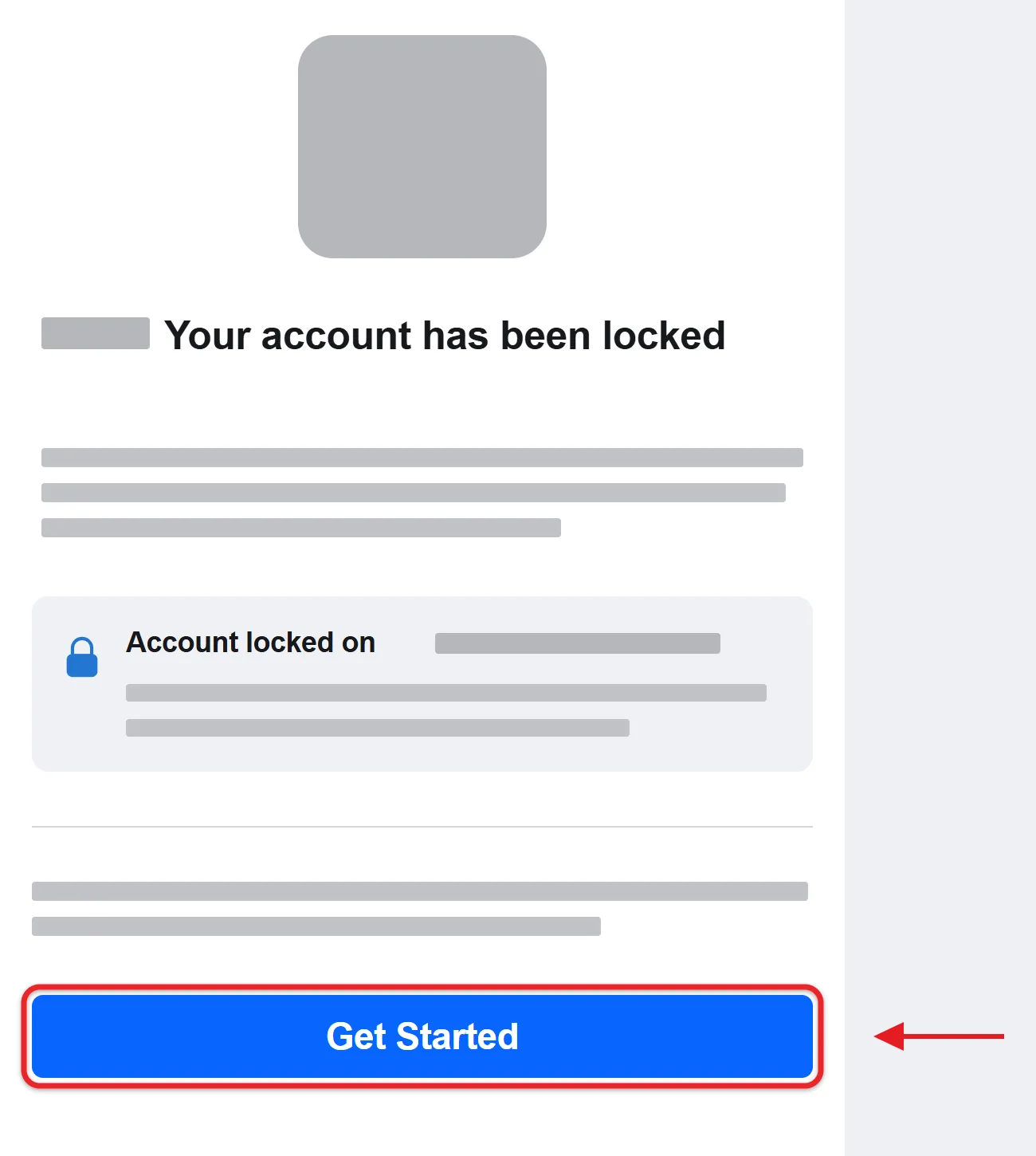
- Select Get started when Facebook shows its unlock flow. The first security check appears.
- Complete each check offered for your account. If an email address or phone number is shown, confirm it belongs to you before you request or enter a code.
- Follow any identity-verification or waiting instructions. Resetting the password over and over won’t skip a check.
- When Facebook lets you back in, check your recovery email, phone number and recent activity.
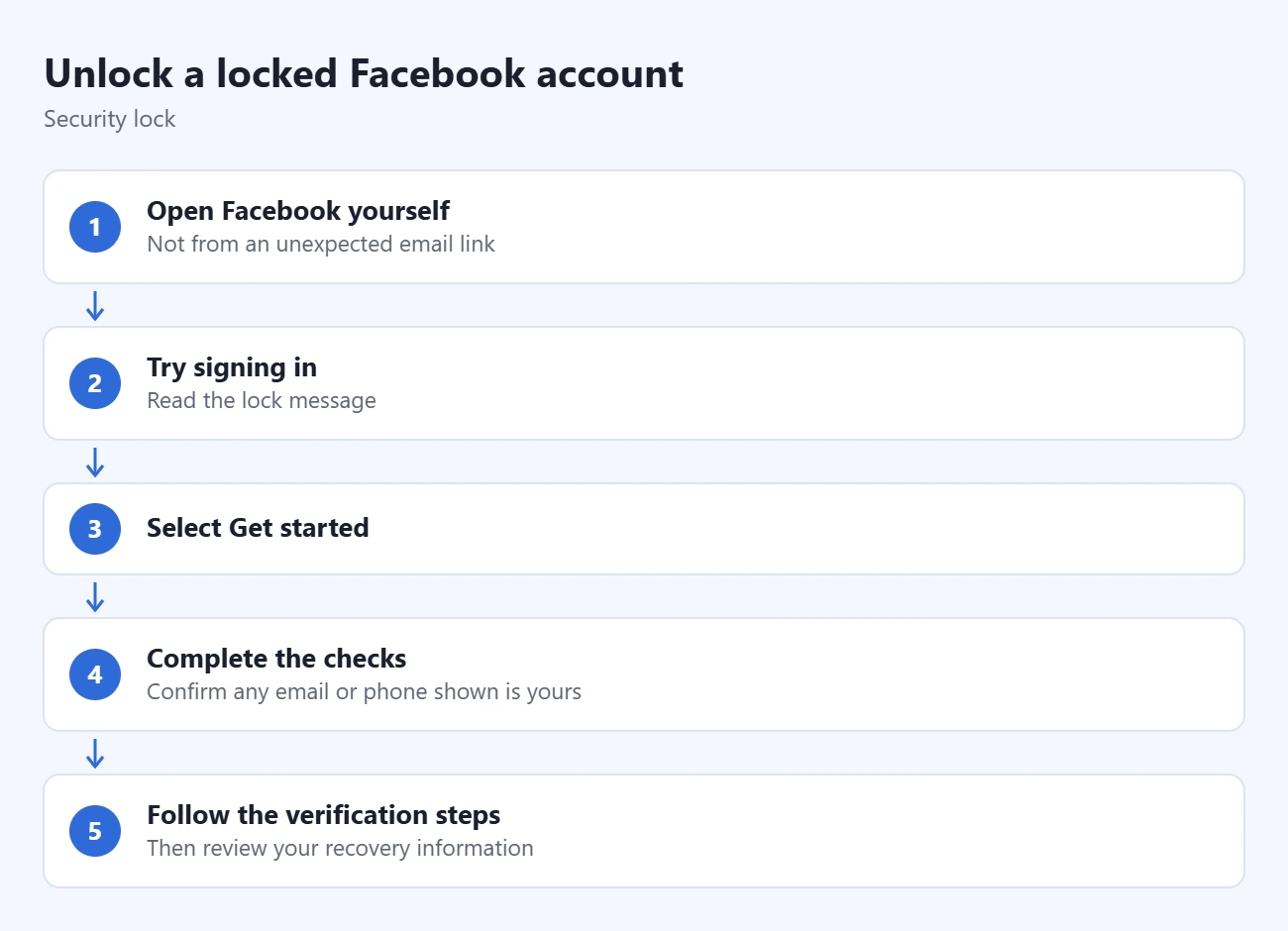
Facebook picks the checks for each account, but a typical unlock looks like this:
- Enter the code Facebook sends to your email address or phone number.
- Confirm your date of birth.
- Review recent logins, posts or messages and mark which ones were yours.
- Upload a photo of a government ID, or record a short selfie video, if Facebook asks.
- Create a new password when Facebook prompts you. Use one you haven’t used on Facebook or any other site.
You’ll know it worked when your News Feed loads and the lock message no longer appears when you sign in.
Recover the Account if You Can’t Log In
If there’s no lock message and you can’t sign in, start with Meta’s login recovery guidance.
- On the Facebook sign-in screen, tap or click Forgot password?. On a computer, you can also go to facebook.com/login/identify.
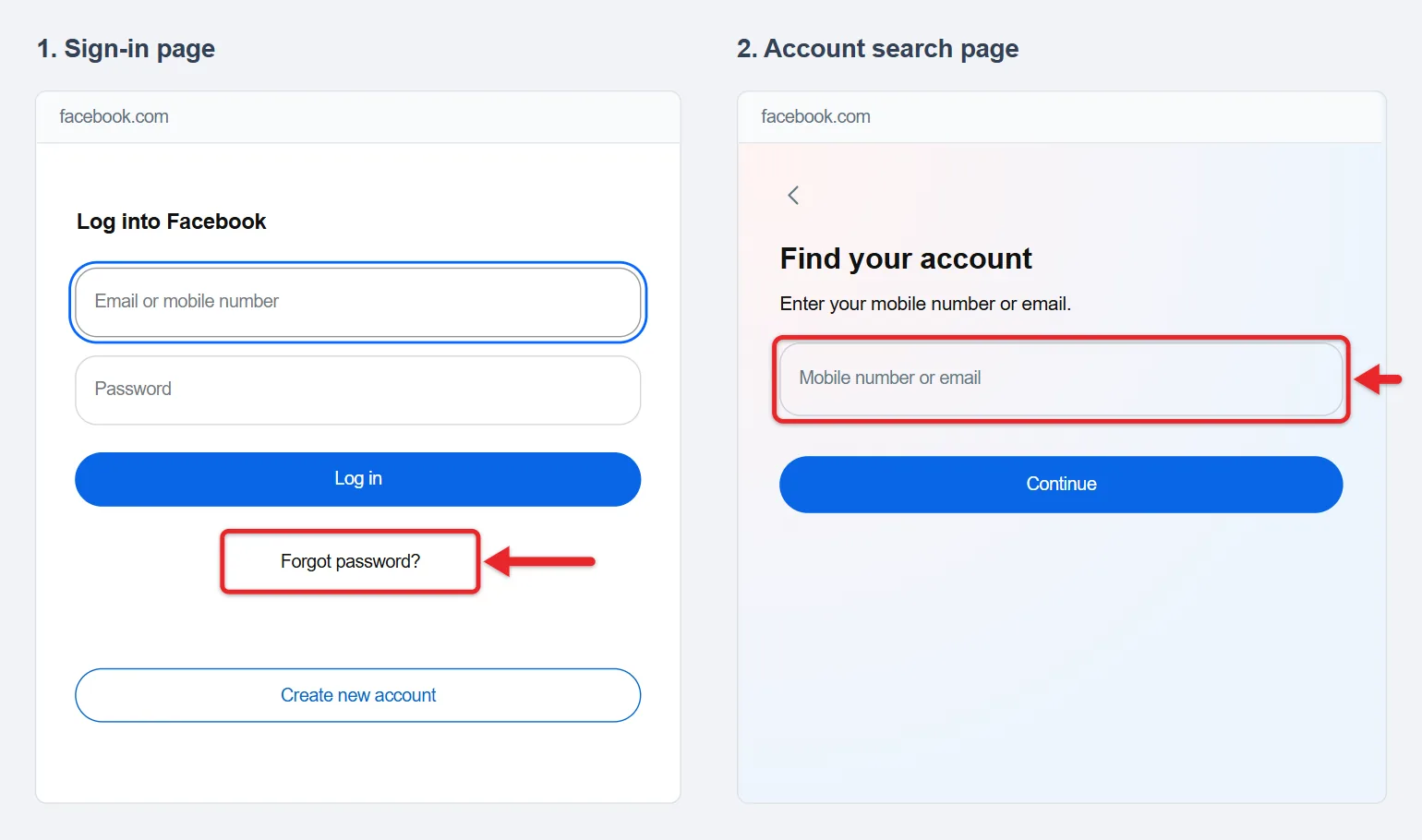
- Enter the email address, mobile number or name on the account, then search.
- Select your account from the results.
- Choose where to send the code, then enter it when it arrives.
- Create a new password and sign in.
If you no longer have the email or phone saved on the account, look for Try another way or a similar option on the code screen. Meta’s options depend on the account and region. The older “No longer have access to these?” link doesn’t appear for everyone, so use whatever your screen offers.
If Facebook Asks You to Confirm Your Identity
Use only the verification request inside Facebook’s own process. Meta’s identity confirmation hub explains security checks, ID upload requirements and account-dependent options.
- Date of birth: use the date you entered when you signed up, even if your profile now shows something else.
- ID photo: take a clear, close-up picture in good lighting and follow the upload instructions. Send only the documents asked for; extra submissions can slow the review.
- Readable details: blurry photos, missing information, screenshots, photocopies and documents not fully in the frame can be rejected.
- Selfie video: Meta added an optional selfie video as a way to confirm your identity when the usual recovery methods don’t work. Follow the on-screen prompts to turn your head, and record in good light.
- Privacy: read how Meta will use and store your ID before you send it. How long it’s kept depends on the purpose, so there’s no single deletion period.
You’ll only see the options Facebook offers for your account and country. If a method from an older tutorial, such as identifying friends in photos, isn’t on your screen, use the ones that are.
Avoid Fake Recovery Help
Locked-out users are a favorite target for scammers. Keep these rules in mind:
- Don’t call “Facebook support” phone numbers from search results or comments. Scammers post fake numbers. Use the help options inside the Facebook app or Help Center, or one of the safe ways to contact Facebook directly.
- Never pay a “recovery expert” or hacker. No outside person can unlock your account for a fee. Many take the money and disappear, and some take over the account.
- Never share passwords, codes or ID photos with anyone who contacts you through messages, comments or email. A friend can help you read the instructions but can’t verify your ownership for you.
- Be wary of “your page will be deleted” messages. Fake Meta notices often link to sign-in pages that steal passwords.
Fake Marketplace buyers often ask for codes too, so learn to set up Facebook Marketplace safely.
If the Confirmation Code Does Not Arrive
- Check that Facebook is sending the code to the correct email address or phone number.
- For email, check spam and junk folders as well as the inbox.
- For SMS, check blocked or filtered messages, your signal and whether the phone can receive texts. Restart the phone if needed.
- If messages still don’t arrive, ask your carrier whether your plan can receive short-code text messages.
- If you have already requested several codes, wait a day before trying again. Follow any other limit shown instead of requesting codes over and over.
A code sent to an old number can’t be redirected to a friend’s phone. If the listed contact method is gone, use the recovery route for lost email or phone access.
Why You May Need to Wait After a Security Check
Meta’s security-check waiting guidance describes a 24-hour wait after you complete a security check. During that period, friends can still see the account, but its owner can’t use it.
Not every locked account is back within 24 hours. Follow the status Facebook shows and wait out any stated period before trying again. Creating a new account while you wait doesn’t restore the old one and can make things more confusing for both you and your friends.
Why Facebook Locks Accounts
Facebook locks an account when something about it looks risky. Common triggers include:
- A sign-in from a new device or an unfamiliar location.
- Many failed password attempts in a row.
- Your password showing up on a phishing site or in a data breach.
- Bursts of activity that look automated, such as sending a lot of friend requests or messages at once, or using third-party automation tools.
- Messages or posts that look like spam, which can mean someone else is using the account.
A lock is a safety pause, not a punishment. A rule violation leads to a suspension or disabled-account notice instead, which has its own review process.
After You Regain Access
Once you’re back in, take a few minutes to make another lock less likely and recovery easier next time.
- Check your contact details. In Settings & privacy > Settings > Accounts Center > Personal details > Contact info, remove any email or phone you don’t recognize and keep ones you can actually use.
- Review where you’re signed in. In Accounts Center, open Password and security > Where you’re logged in and log out of devices you don’t know.
- Change your password if you haven’t already, using a strong one you don’t use anywhere else.
- Turn on two-factor authentication in Password and security > Two-factor authentication. An authentication app or passkey is harder to steal than a text message.
- Run Security Checkup, which Meta redesigned to point out risky settings in one place.
- Review recent posts and messages for anything you didn’t send, and warn friends if scam messages went out.
If anything suggests a compromise, follow the security checklist in the hacked-account guide linked above. Menu names in Accounts Center can shift as Meta updates the app; search Settings for “password” or “two-factor” if you can’t find them.
Don’t confuse a security lock with Facebook’s profile lock privacy feature, which you turn on yourself to limit what strangers see. If that’s the feature you meant, read about locking your Facebook profile.
To hide more of your posts and details from strangers, here’s how to make your Facebook account private.
Common Questions
Does resetting the password unlock the account?
It fixes a forgotten password, but a security lock may still require the checks Facebook shows. Complete those checks; a new password won’t override them.
Does a security lock mean my account is permanently disabled?
No. Security locks and enforcement actions (suspended or disabled accounts) have different screens and instructions. An appeal deadline isn’t a code-delivery problem, so read the message carefully.
How long does it take to unlock a Facebook account?
Many people get back in right after the checks, but some security checks come with a 24-hour wait, and ID reviews can take longer. Watch your email for updates from Facebook.
Can I unlock my account without my old phone number or email?
Sometimes. Use Try another way or the lost-access option Facebook offers, which may ask for ID or a selfie video. If no option appears, try again from a device and network you’ve used with the account before.
Can someone guarantee to unlock it for a fee?
No. Anyone who charges to unlock a Facebook account is almost always a scammer. Keep your password, codes and ID inside Facebook’s own recovery process.
Next step: once you’re back in, turn on two-factor authentication so a stolen password alone can’t lock you out again.

Matthew Burleigh is the founder, head writer, and editor of Solve Your Tech, which he launched in 2012. He has written technology tutorials since 2008 and worked in IT since 2003, including small-business support, IT management, and consulting. He holds Bachelor’s and Master’s degrees in Computer Science from Arizona State University.
Matthew writes practical guides for Windows, iPhone and iPad, Microsoft Office, Outlook, Google apps, and Android. Solve Your Tech’s guides are checked step by step against the device or app maker’s own documentation and tested on his own devices whenever he has the hardware or software, with clear steps, sources, and update dates.
Read more about Matthew and how Solve Your Tech writes and updates its guides, or report a correction.