You cannot turn off Facebook two-factor authentication from outside your account. If you are stuck at the security-code screen, first regain access with an available verification method or Facebook’s identity-confirmation process. Resetting your password is a separate step; it does not mean the second verification requirement has disappeared.
Two-factor authentication, or 2FA, adds a check beyond your password when Facebook does not recognize the device or browser. This guide explains recovery for a personal Facebook account, then where to review its authentication settings after you get back in.
Start With the Code Screen
Use Facebook’s official two-factor login troubleshooting guide. Start on a device and browser you have previously used with your account when possible. If another device still has Facebook open, keep that session available while you recover access.
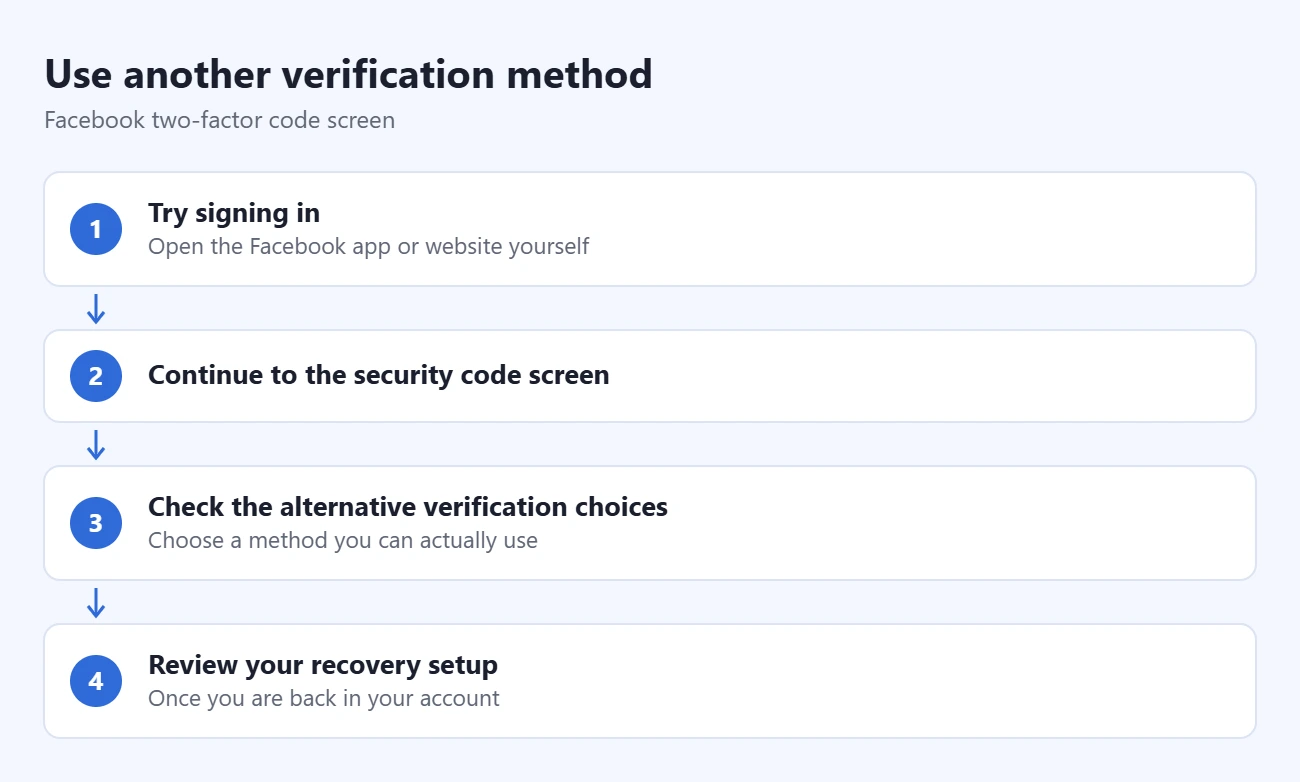
- Open the Facebook app or website yourself and try signing into your account.
- Continue until Facebook asks for your security code. A correct password alone does not complete this challenge.
- Check the alternative verification choices shown there. Choose a method you can actually use, rather than starting another password reset every time.
- If an available method succeeds, continue into your account and review your recovery setup.
The choices vary by account, device, and previously configured methods. If your message says the account is locked, suspended, or disabled, that can involve an additional process. Our locked Facebook account guide helps distinguish those messages from an ordinary login-code request.
Try a Verification Method You Still Control
- Text message: If Facebook offers a code to your registered number, check cellular reception and allow a few minutes for delivery. A delay does not establish that 2FA is broken.
- Another signed-in device: Check Facebook notifications on that phone, tablet, or browser. Facebook may offer approval of the new login attempt.
- Saved recovery code: Enter an unused code you previously saved in place of the authentication code. Each code works once.
- An existing authentication method: Use your configured authenticator app or compatible security key if you still have it and the login flow offers that method.
Installing a new authenticator app does not, by itself, recreate the Facebook entry you lost. Likewise, a friend’s phone number is not a replacement for a method associated with your account.
If You Have No Usable Code or Signed-In Device
Look for Facebook’s help option at the authentication challenge. Its computer instructions describe Need another way to authenticate? > Other Options > Get more help. Mobile instructions may use Having trouble? or Need help?.
Follow the identity-confirmation options Facebook offers for your account. Provide the requested information only through the official flow. An ID check may be requested, but do not assume every account receives the same choices, a particular upload form, or a guaranteed recovery time.
If you use Facebook Lite and cannot reach identity confirmation, Facebook’s troubleshooting guide directs you to the full app or a web browser. If the options still do not appear, keep following the help route tied to the displayed problem rather than guessing old recovery-form addresses.
Password Reset and Lost Email Access Are Separate Problems
Facebook’s general login recovery guide recommends a password reset when you can receive its emails or texts and need to recover your password. Check spam or junk mail, reception, and delivery delays if that reset code does not arrive.
A password-reset code and a 2FA challenge serve different purposes. Successfully setting a new password can still leave you at the authentication screen. Return to the 2FA recovery choices instead of expecting another password change to switch security off.
If you cannot access the account’s email or number, use the lost-contact-information route linked from that official guide. If you suspect someone changed your account, it also directs you to Facebook’s hacked-account process on a previously used device.
Review Your Settings After Access Returns
Facebook’s explanation of two-factor authentication gives this account-settings route:
- Open your profile-picture menu and select Settings & privacy > Settings.
- Open Accounts Center > Password and security > Two-factor authentication.
- Select the affected Facebook account and review the methods configured for it.
- Follow the prompts to add a method you can use. Test access before relying on a replacement.
Facebook is gradually moving some people to Meta Account settings, so your settings location may differ. Follow the labels and prompts your account shows. Changing authentication settings can require additional verification even when you already have an open session.
Keep 2FA enabled if you can use a reliable method. If you choose to turn it off after recovery, use the option Facebook makes available inside your authenticated account and understand that you are removing an extra protection. There is no equivalent switch on the logged-out recovery page.
Save Recovery Codes Before the Next Lockout
Facebook’s recovery-code instructions explain how to generate 10 backup login codes. In the account’s 2FA settings, look under Additional methods > Recovery codes > Get new codes. You may need to enter your password again.
Store them securely where you can reach them if your phone is lost. Do not share them with someone offering recovery help. Request a new set from within your account if you run out or lose them; you cannot create an account’s codes merely by knowing its email address.
Common Questions
Can I disable 2FA with only my Facebook password?
A password is not a substitute for the second check when Facebook requests one. Complete an available verification or recovery method before changing account settings.
Will account recovery always remove 2FA?
Do not assume so. Recovery is about proving ownership and restoring access. Check the authentication methods after you regain access and follow any further prompts.
Should I pay someone who promises to bypass the code?
Keep passwords, login codes, and identity documents within the official recovery process. Someone making a guarantee through messages or comments cannot replace Facebook’s account checks.
Start with the authentication screen and the methods still available to you. Once you recover access, update your usable verification methods and save recovery codes before closing your working session.

Matthew Burleigh has been writing tech tutorials since 2008. His writing has appeared on dozens of different websites and been read hundreds of millions of times.
After receiving his Bachelor’s and Master’s degrees in Computer Science he spent several years working in IT management for small businesses. However, he now works full time writing content online and creating websites.
His main writing topics include iPhones, Microsoft Office, Google Apps, Android, and Photoshop, but he has also written about many other tech topics as well.