To freeze columns in Google Sheets on a computer, click a cell in the last column you want to keep on screen, then click View > Freeze and choose how many columns to freeze. Rows work the same way from the same menu. To undo it, click View > Freeze and choose No columns or No rows.
Freezing pins rows at the top or columns at the left side of a sheet, so they stay visible while the rest of the data scrolls. It is most often used to keep a header row or a column of names in view. The steps below follow Google’s help page for freezing rows and columns, which covers computers, Android, iPhone, and iPad.
Before You Start
- Where this applies: Google Sheets in a web browser on a computer, and the Google Sheets app on Android, iPhone, and iPad. The computer and app steps are different, so they are kept in separate sections.
- Edit access: Freezing changes the sheet, so you need to be able to edit it. Google notes that people who can only view or comment on a spreadsheet cannot make changes.
- One sheet at a time: A freeze generally applies to the sheet tab you have open. If your file has several tabs, repeat the steps on each tab that needs frozen rows or columns.
- Freezing starts at the edge: The Freeze menu counts rows from the top of the sheet and columns from the left side. You pick how many to freeze, not a block in the middle.
How to Freeze Columns in Google Sheets on a Computer
- Open your spreadsheet in Google Sheets in a web browser.
- Click a cell in the last column you want to keep visible. For example, click any cell in column B if you want columns A and B to stay on screen. You can also click the column letter to select the whole column.
- Click View in the menu bar at the top of the window.
- Point to Freeze. A submenu opens with choices for rows and for columns.
- Choose how many columns to freeze. The submenu offers 1 column and 2 columns, plus an Up to column choice that uses the column of the cell you selected in step 2.
The frozen columns now stay at the left side of the sheet when you scroll to the right. Sheets typically shows a thicker gray line along the right edge of the last frozen column to mark where the frozen area ends.
Google’s help page describes the last step as “Select how many rows or columns to freeze” and does not list each menu label. The wording of the Up to choice has changed over time, so it may read slightly differently in your menu, but it always refers to the row or column you selected.
How to Freeze Rows in Google Sheets on a Computer
- Click a cell in the last row you want to keep visible. To freeze only a header in row 1, you can skip this step.
- Click View > Freeze.
- Choose 1 row to freeze the top row, 2 rows to freeze the top two, or the Up to row choice to freeze every row from the top down to the one you selected.
Scroll down to check the result. The frozen rows stay at the top of the sheet and the rows below slide underneath them. If you have not set up column labels yet, our guide on how to make a header row in Google Sheets covers that first.
How to Freeze Rows and Columns at the Same Time
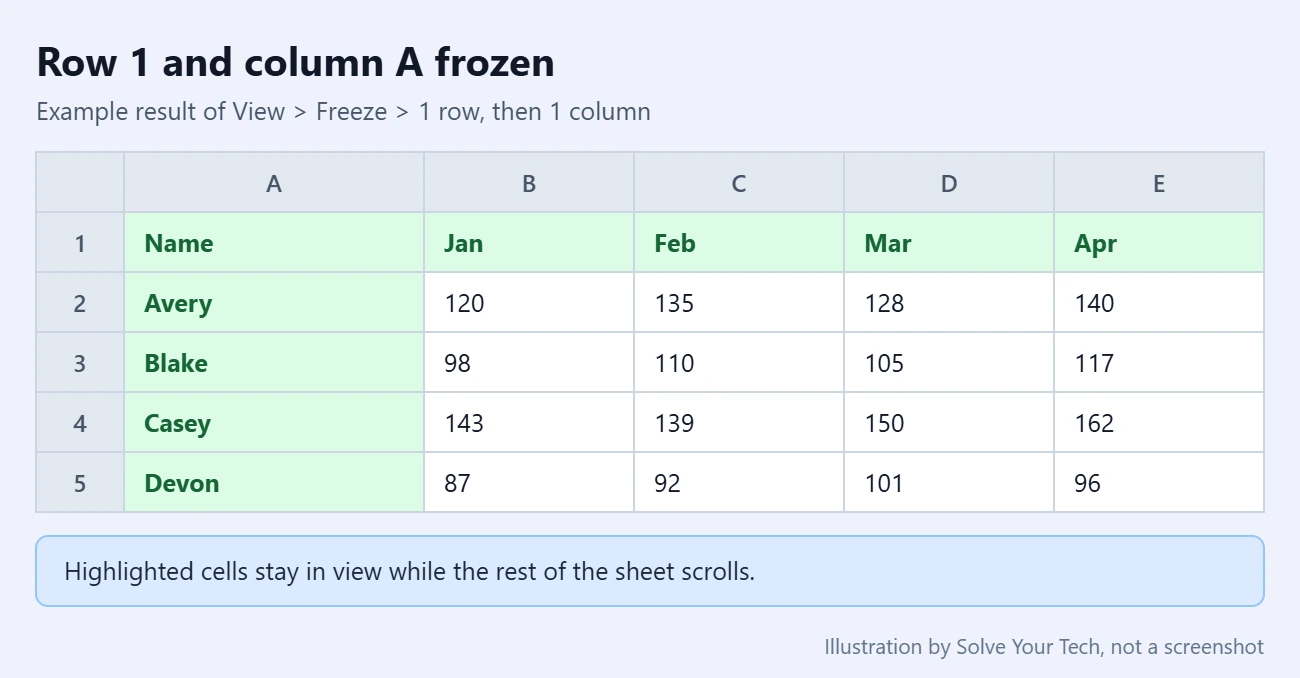
Rows and columns are set separately in the same submenu, and one setting does not replace the other. To freeze both, open the menu twice.
- Click View > Freeze and choose the number of rows, such as 1 row.
- Click View > Freeze again and choose the number of columns, such as 1 column.
With one row and one column frozen, the header row stays in place when you scroll down and the first column stays in place when you scroll right. This is the closest match to the Freeze Panes command in Microsoft Excel. If you use both programs, see how to freeze panes in Excel for the Excel version.
How to Freeze by Dragging the Gray Bars
There is also a mouse method that skips the menu. Google’s help page does not describe it, so treat the details below as a commonly reported shortcut and use the View menu if you do not see it.
- Look at the top-left corner of the grid, in the empty box above row number 1 and to the left of column letter A. Two thick gray bars sit on the bottom and right edges of that box.
- Hover over the horizontal bar until the pointer changes to a hand, then drag it down and release it below the last row you want frozen.
- Drag the vertical bar to the right and release it after the last column you want frozen.
To remove a freeze this way, drag the bar back to the corner. The result is the same as using the menu, so the View > Freeze submenu shows the new setting afterward.
How to Freeze Rows or Columns in the Google Sheets App
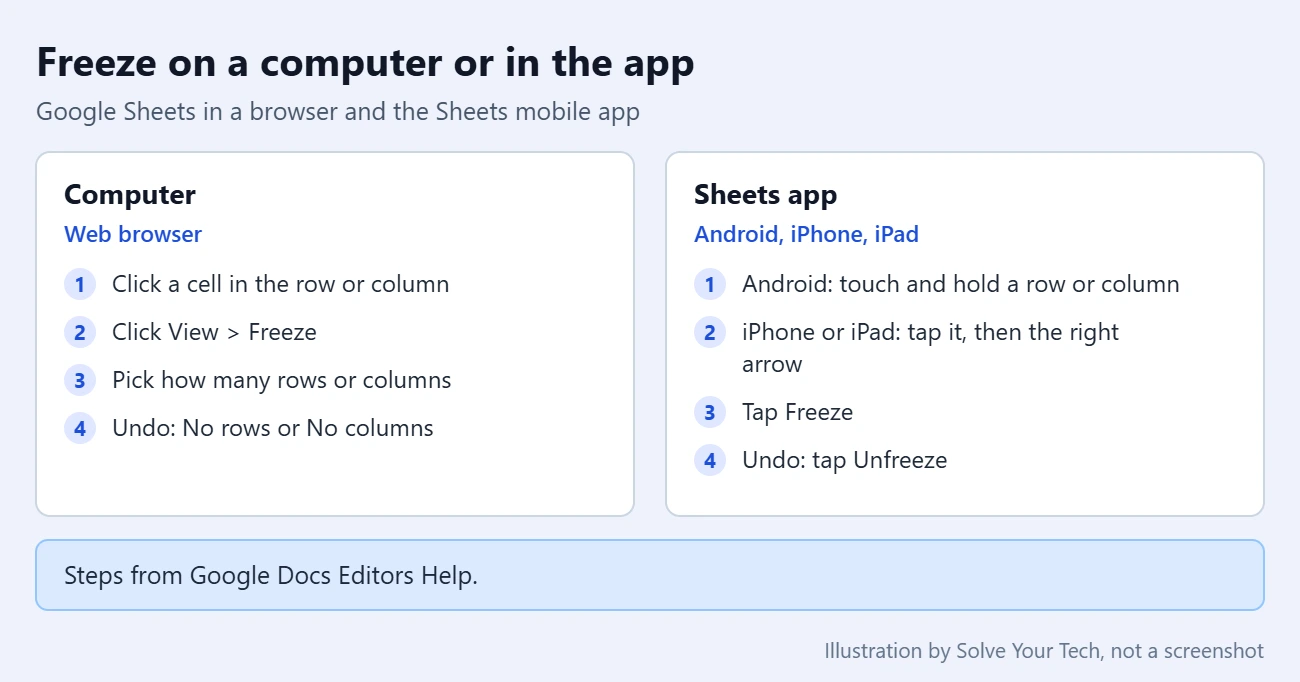
The mobile app does not use the View menu. You select a row or column and choose Freeze from the menu that pops up. The gesture is slightly different on each platform.
Android phone or tablet
- Open the spreadsheet in the Google Sheets app.
- Touch and hold a row or column.
- In the menu that appears, tap Freeze.
iPhone or iPad
- Open the spreadsheet in the Google Sheets app.
- Tap a row number or column letter.
- In the menu that appears, tap the right arrow, then tap Freeze.
The app menu is short, and some choices can be hidden until you tap the arrow at the end of it. If you do not see Freeze right away, look there.
How to Check That the Freeze Worked
- Scroll the sheet. Scroll down to test frozen rows and scroll right to test frozen columns. The frozen part should stay put.
- Look for the divider. A thicker gray line usually separates the frozen area from the rest of the grid.
- Check the count. If the wrong number of rows or columns is frozen, open View > Freeze and pick a different choice. The new choice replaces the old one for that direction.
How to Unfreeze Rows or Columns
Unfreezing only changes how the sheet scrolls. It does not delete or move any data, and you can freeze the same rows or columns again at any time.
| Device | How to unfreeze |
|---|---|
| Computer | Click View > Freeze, then choose No rows or No columns. |
| Android | Touch and hold the frozen row or column, then tap Unfreeze. |
| iPhone or iPad | Tap the frozen row number or column letter, tap the right arrow, then tap Unfreeze. |
On a computer, No rows and No columns are separate choices. If you froze both, choose each one in turn to clear the sheet completely.
Freezing Is Not the Same as Locking or Hiding
These three features are easy to mix up because they all change how rows and columns behave.
- Freeze keeps rows or columns on screen while you scroll. Anyone who can edit the sheet can still change the frozen cells.
- Protect limits who can edit a sheet or a range of cells. On a computer it is under Data > Protect sheets and ranges. Google explains the options in its guide to protecting a sheet or range.
- Hide removes a row or column from view without deleting it. See how to hide a column in Google Sheets for those steps.
If your goal is to stop other people from changing a header, freeze it so it stays visible and protect it so it cannot be edited. One does not do the job of the other.
Troubleshooting: Why Can’t I Freeze Columns or Rows?
I can’t find the Freeze option
On a computer, Freeze is in the View menu, not Format or Data. If the whole menu bar is missing, the menus have been hidden. Our guide on how to unhide the menu in Google Sheets shows how to bring it back. In the mobile app, select a row or column first, because Freeze only appears in the pop-up menu for a selected row or column.
The file is view-only
If you were given view or comment access, you cannot change the sheet. Ask the owner for edit access, or make your own copy with File > Make a copy and freeze the rows or columns there.
The Up to choice freezes the wrong amount
The Up to choice is based on the cell that is selected when you open the menu. Click a cell in the last row or column you want frozen, then open View > Freeze again and check the row number or column letter shown in the menu before you click it.
Merged cells get in the way
Several spreadsheet guides report that Sheets will not freeze a boundary that cuts through merged cells. Google’s help page does not mention this, so we cannot confirm the exact behavior. If a freeze fails on a sheet with merged headers, either freeze enough rows or columns to include the whole merged block, or select the merged cells and use Format > Merge cells to unmerge them first.
Too much of the screen is frozen
Frozen rows and columns take up space that the rest of the sheet could use, and on a small screen a large frozen area can leave very little room to scroll. Freeze only what you need, which is usually one or two header rows and one label column. If the sheet feels stuck, choose No rows and No columns and start again with a smaller number.
Frequently Asked Questions
Can I freeze more than two rows or columns in Google Sheets?
Yes. Click a cell in the last row or column you want frozen, then click View > Freeze and pick the Up to choice. The fixed choices stop at two, but the Up to choice freezes everything from the edge of the sheet to your selected cell.
Can I freeze a row in the middle of a sheet?
Not on its own. The Freeze menu counts from row 1 and column A, so freezing row 5 also freezes rows 1 through 4. If you only want one lower row to stay in view, consider moving it to the top of the sheet or hiding the rows above it.
Do frozen rows repeat on every printed page?
They can, but it is a print setting. According to Google’s printing instructions for Sheets, you freeze the row or column first, click File > Print, click Headers & footers, and choose Repeat frozen rows or Repeat frozen columns. Our guide to Google Sheets print settings walks through the rest of that screen.
Is there a keyboard shortcut to freeze rows or columns?
Google’s list of Sheets keyboard shortcuts does not include one for Freeze. It does list shortcuts that open the View menu: Alt + V in Google Chrome on Windows (Alt + Shift + V in other browsers) and Ctrl + Option + V on a Mac. From there, choose Freeze with the mouse or arrow keys.
Does freezing change my data or formulas?
No. Freezing only controls which rows and columns stay on screen when you scroll. The cell contents and cell addresses stay the same, so formulas that refer to those cells keep working.
Next Steps
Once your headers stay in view, a few related tools make a long sheet easier to work with.
- Create a filter in Google Sheets so you can sort and narrow the data under your frozen header row.
- Insert or delete rows and columns when the layout needs to change.
- Embed a Google Sheet in WordPress if you want to show the finished sheet on a website.

Matthew Burleigh has been writing tech tutorials since 2008. His writing has appeared on dozens of different websites and been read hundreds of millions of times.
After receiving his Bachelor’s and Master’s degrees in Computer Science he spent several years working in IT management for small businesses. However, he now works full time writing content online and creating websites.
His main writing topics include iPhones, Microsoft Office, Google Apps, Android, and Photoshop, but he has also written about many other tech topics as well.