To find a file on your iPhone, open the Files app, tap Browse, and choose the location where the file was saved: iCloud Drive, On My iPhone, or a connected cloud service. If you do not know the folder, type part of the filename into the search field in Files. Downloads from the web usually sit in a Downloads folder, and camera photos stay in the Photos app.
This guide covers the Files app on iPhone and iPad with iOS 18 and later, including iOS 26 and iOS 27. Files is built into every iPhone and iPad, and the steps follow Apple’s instructions.
Before you start
- You need the Files app. It has a blue folder icon. If it is not on your Home Screen, swipe down on the Home Screen and search for Files.
- Know the two main storage places. iCloud Drive is Apple’s online storage that syncs files between devices signed in to the same Apple Account. On My iPhone is storage on the phone itself.
- Not everything is a file in Files. Your photo library lives in the Photos app, and some apps keep their documents inside the app.
- Nothing in these steps deletes anything. Looking, browsing and searching are safe. The only step that changes a file is recovering a deleted one, and that is explained in its own section.
Find a file in the Files app
Browsing by location is the most reliable route, because it shows everything stored in that place and not only what you opened lately.
- Open Files.
- Tap Browse. If the app opens inside a folder, tap Browse again until you see the list of locations.
- Under Locations, tap the place where the file was saved. Choose iCloud Drive for synced files, including Pages, Numbers and Keynote documents, or On My iPhone for files stored only on this phone. If the Locations list is collapsed, tap Locations to expand it.

- Tap a folder to open it. Keep tapping folders until you see the file.
- Tap the file. It opens in the app that created it. If that app is not installed, the iPhone shows a preview of the file instead.
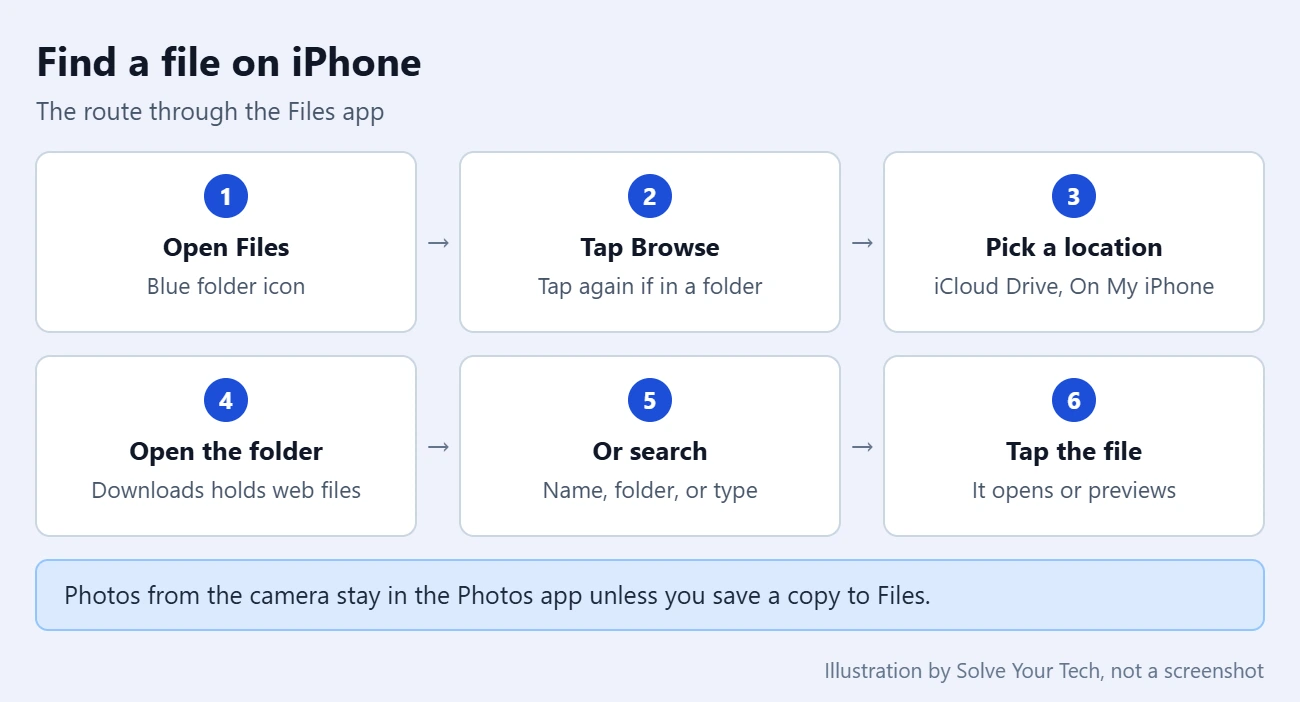
Apple lists these locations in its article Find files on your iPhone or iPad.
On an iPad, the steps are the same. Browse appears as a sidebar, and on-device storage is called On My iPad. From the same sidebar, an iPad can also open a shared folder on a PC, Mac or NAS once you connect the iPad to a network server.
Search for a file by name or type
Use search when you remember something about the file but not where it went.
- Open Files.
- Tap the search field. If you cannot see one, swipe down on the screen to reveal it.
- Type a filename, a folder name, or a document type such as PDF. Part of a name is enough.
- Look below the search field for the search scope, which is the area being searched. Tap Recents, or the name of a location or tag, to narrow or widen the results.

- Tap Search to hide the keyboard and see more results, then tap a result to open it.
If a search returns nothing, check the scope first. A search limited to one folder or to Recents will miss a file saved somewhere else. The search options are explained further in Find and view files and folders in Files on iPhone.
The Recents view shows files you opened recently. It is a quick shortcut, but it is not a full list of what is stored on the phone, so do not treat an empty Recents view as proof that a file is gone.
Sort a long folder
In a crowded folder, sorting can bring the file to the top. Open the location or folder, tap the options button, and choose Name, Kind, Date, Size, or Tags. Sorting by Date is useful for something you saved today. Sorting only changes the order on screen. It does not move or rename anything.
Find files you downloaded
Files downloaded from the internet or saved from your mail app normally go to a folder named Downloads.
- Open Files and tap Browse.
- Tap the Downloads folder if it is shown on the Browse screen.
- If you do not see it, tap iCloud Drive, then Downloads.
- Still not there? Tap On My iPhone and look for a Downloads folder in that location too.
Safari also keeps its own short list. Apple’s downloaded files instructions say you can open Safari and tap the downloads button to check the status of a download in progress or to open a finished one quickly. If the download never finished, the file will not be in any folder yet.
If the download is a song you want in the Music app rather than Files, follow the steps for downloading an MP3 to iPhone.
Downloaded the file in Chrome instead? Here is how to see recent downloads in Google Chrome on iPhone and other devices.
Check where Safari saves downloads
Safari can be set to save to one of three places. Checking the setting tells you which folder to open. You do not need to change it.
- Open Settings.
- Tap Apps, then tap Safari. If your iPhone has no Apps entry, it is likely running an older iOS version; look for Safari in the main Settings list.
- Tap Downloads.
- Read which option has the checkmark: iCloud Drive (the Downloads folder in iCloud Drive), On My iPhone (the Downloads folder on the phone), or Other (a different folder that was chosen earlier).

- Go back to Files and open that location.
These three choices come from Apple’s Safari settings guide. If you do decide to switch the setting, it affects where future downloads are saved, so older files may be in the previous location. Once you have located a downloaded archive, you can open the ZIP file on iPhone or iPad to extract its contents.
The same folders exist on Apple’s tablet, and the steps for finding downloads on an iPad cover the sidebar layout used there.
iCloud Drive or On My iPhone: which one has your file?
Most missing-file problems come down to looking in one of these locations when the file is in the other.
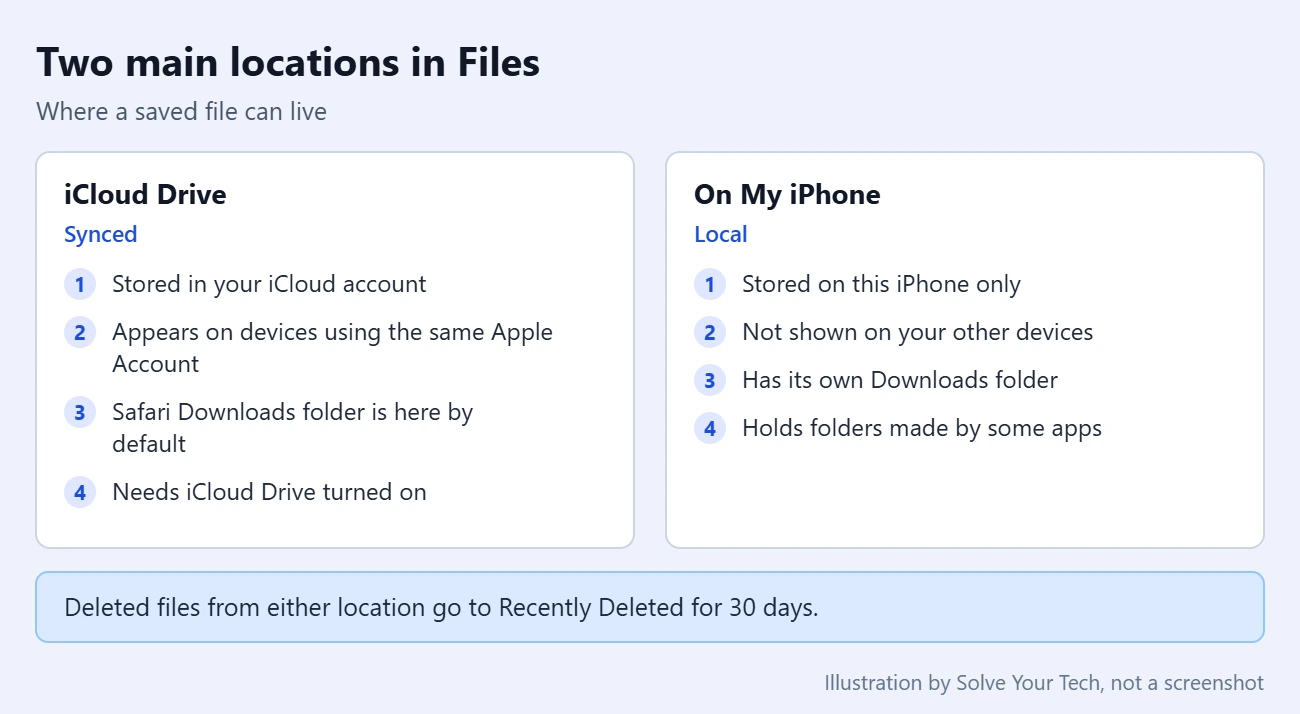
| Location | What it holds | Where else you can see it |
|---|---|---|
| iCloud Drive | Files, folders and downloads that sync through iCloud, including Pages, Numbers and Keynote documents | Other devices signed in to the same Apple Account, and iCloud.com |
| On My iPhone | Files saved locally on the phone | Only this iPhone |
| A cloud app such as Dropbox, Box, Google Drive or OneDrive | Files kept in that service | Wherever you use that service |
| An external drive | Files on a connected USB drive or SD card reader | Any device the drive is plugged into |
If iCloud Drive is empty or missing, check that it is switched on. Go to Settings, tap your name, tap iCloud, tap Drive, and see whether Sync this iPhone is on. This is described in Apple’s iCloud Drive setup instructions. For more detail, here is how to show iCloud Drive in the Files app on an iPhone.
Add Google Drive, Dropbox, or OneDrive to Files
Files kept in another company’s cloud service only show up in Files after you add that service as a location.
- Download the service’s own app from the App Store and set it up.
- Open Files and tap Browse.
- Tap the More button (three dots), then tap Edit.
- Turn on the switch next to each service you want to use.

- Tap Done. The service now appears under Locations, and you can browse it like any other folder.
To undo this, repeat the steps and turn the switch off. That only hides the location in Files. It does not delete the files held by the service. If a service is not offered in the Edit list, Apple’s third-party cloud apps instructions say to check with the cloud provider. With OneDrive added, you can also email OneDrive files from an iPad or iPhone as a link or an attachment.
Files on a USB drive or SD card
A connected storage device is listed by its name under Locations on the Browse screen. Tap the name to see what is on it. You may need an adapter, the drive must use a supported format such as exFAT, FAT32 or APFS with a single data partition, and external hard drives often need their own power source. The details are in Connect external storage devices to iPhone. If the drive name does not appear, the format or power supply is the first thing to check.
On an iPad, the steps for accessing a USB drive on iPad cover adapters, copying files and drives that do not show up.
Find photos, email attachments, and files kept inside apps
Some items never reach the Files app unless you put them there.
- Photos and videos. Your photo library is stored in the Photos app. A picture is only in Files if you saved a copy to iCloud Drive or another location.
- Email attachments. An attachment stays in the message until you save it. In Mail, touch and hold the attachment and choose Save to Files, or Save Image to put a picture in Photos. To track down the message, add an Attachments mailbox to iPhone Mail or turn on the mailbox filter and enable Only Mail with Attachments, as shown in Apple’s Mail attachment instructions.
- Documents created in an app. Open the app you used and look in its own document list or use its search. Some apps store work in an app-named folder inside iCloud Drive or On My iPhone, and others do not show their contents in Files at all.
- Scans. A scan made in Notes stays in that note. A scan made from the Files app is saved in the folder you were in. The steps for scanning documents on iPhone cover both methods.
You can also try the iPhone’s system-wide search, called Spotlight. Swipe down on the Home Screen and type the name. Content from an app appears there only if the app supports Spotlight indexing, so a missing result does not mean the file is gone. Searching inside Files is the more dependable test.
Make a file easier to find next time
Two built-in labels put a file or folder one tap away on the Browse screen.
- Tags. Touch and hold a file or folder, tap Tags, choose one or more tags, then tap Done. To see tagged items later, tap Browse and tap the tag name under Tags. Tap a tag again to remove it.
- Favorites. Touch and hold a folder and tap Favorite. The folder is then listed under Favorites on the Browse screen.
- Clear names. Touch and hold a file and choose Rename. A name you would actually type into search is the best one to use.
If you still cannot find the file
Go down the checks below one at a time. Each one only looks at something, apart from the recovery step.
- Search with less. Type only a few letters of the name, or just the type, such as PDF or ZIP, and make sure the scope is not limited to one folder.
- Open every location. Check iCloud Drive, On My iPhone, and each cloud service under Locations, including the Downloads folder in both of the first two.
- Check that the save happened. Go back to the web page, message or app where you saw the item. If you only viewed it, there may be no saved copy yet.
- Check Recently Deleted. In Files, tap Browse, then Recently Deleted under Locations.
- Check another device or iCloud.com. A file in iCloud Drive is shown on every device signed in to the same Apple Account, so it may be visible there even if this iPhone has not finished syncing.
Recover a file from Recently Deleted
Read this before you tap anything in Recently Deleted. Files deleted from Recently Deleted are removed immediately and cannot be recovered through this feature. Choose Recover, not Delete.
- In Files, tap Browse, then tap Recently Deleted.
- Touch and hold the file you want back.
- Tap Recover. To restore several at once, tap the More button, tap Select, choose the files, then tap Recover.

- Open the folder the file was in before. Recovered files return to their original location.
Files deleted from iCloud Drive or On My iPhone stay in Recently Deleted for 30 days and are then removed permanently, according to Apple’s file recovery instructions. Deleting a file from iCloud Drive on one device also removes it from your other devices, which is why a file can vanish from the iPhone after it was deleted somewhere else.
Do not delete folders, remove apps, or turn off iCloud Drive in the hope that a missing file will reappear. Work out where the original was saved before you change or remove anything.
Frequently asked questions
Where is the Files app on my iPhone?
Files is an Apple app with a blue folder icon. If it is not on a Home Screen page, swipe down on the Home Screen and type Files in the search field, then tap the app in the results.
Where do downloads go on an iPhone?
Safari saves downloads to the location selected in Settings > Apps > Safari > Downloads. That is the Downloads folder in iCloud Drive, the Downloads folder in On My iPhone, or another folder you picked. Apple’s advice for a missing download is to check the Downloads folder in iCloud Drive first.
Why can I not find my photos in Files?
Your photo library is stored in the Photos app, not in Files. A photo appears in Files only if you saved a copy to iCloud Drive, On My iPhone, or a cloud service.
Why is Google Drive or Dropbox not showing in Files?
The service’s app has to be installed and set up first. Then open Files, tap Browse, tap the More button, tap Edit, and turn the service on. If it is not in the list, check with the provider.
Does Recents show every file on my iPhone?
No. Recents shows recently opened files. To see everything in a location, tap Browse and open iCloud Drive or On My iPhone.
Can I get back a file I deleted by mistake?
Often, yes. Files deleted from iCloud Drive or On My iPhone go to Recently Deleted for 30 days. Touch and hold the file there and tap Recover. After 30 days, or if the file was deleted from Recently Deleted, this feature can no longer restore it.
Next step
Once you have found the file, you may want a copy on a computer. Moving files from iPhone to a PC covers both the cloud and cable options.

Matthew Burleigh is the founder, head writer, and editor of Solve Your Tech, which he launched in 2012. He has written technology tutorials since 2008 and worked in IT since 2003, including small-business support, IT management, and consulting. He holds Bachelor’s and Master’s degrees in Computer Science from Arizona State University.
Matthew writes practical guides for Windows, iPhone and iPad, Microsoft Office, Outlook, Google apps, and Android. Solve Your Tech’s guides are checked step by step against the device or app maker’s own documentation and tested on his own devices whenever he has the hardware or software, with clear steps, sources, and update dates.
Read more about Matthew and how Solve Your Tech writes and updates its guides, or report a correction.