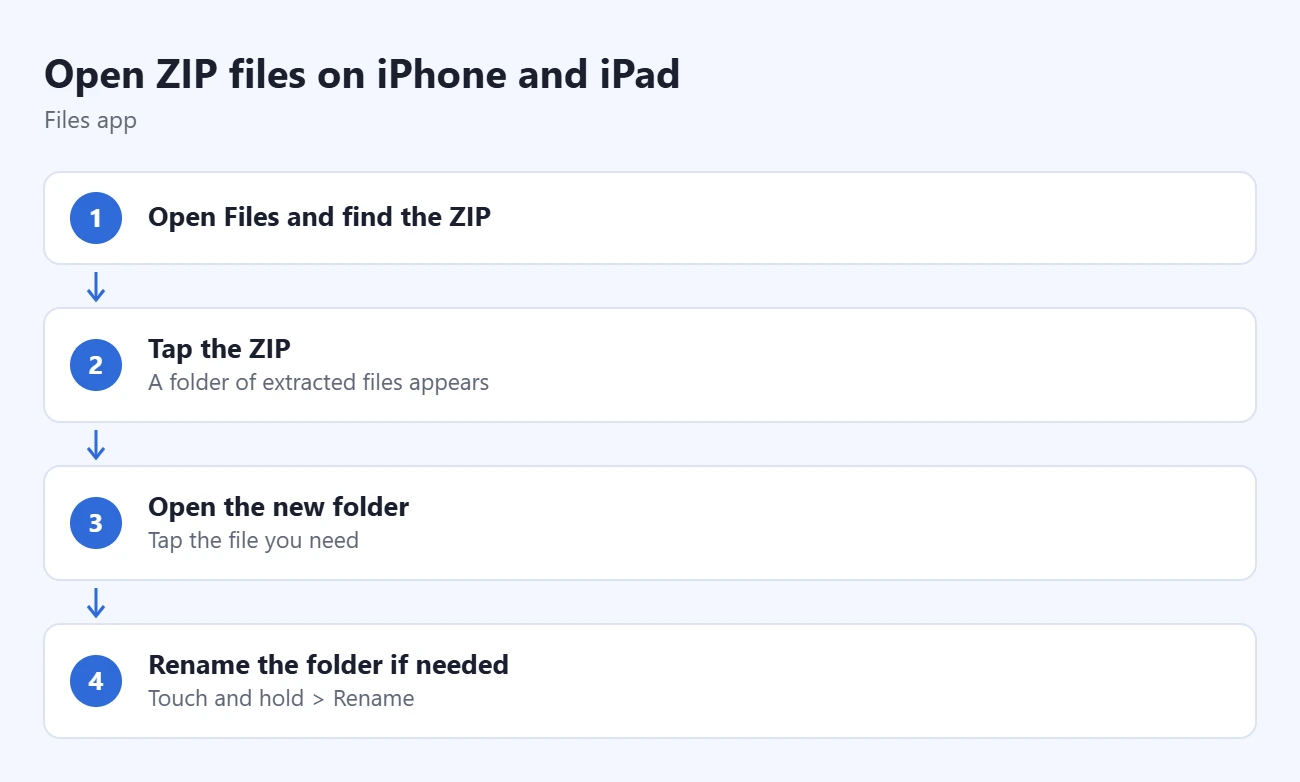
To open a ZIP on an iPhone or iPad, find it in the Files app and tap it. Files creates a folder containing the extracted items. Open that folder to use the documents or pictures inside. For an ordinary ZIP, you do not need to install a separate extraction app.
The basic opening procedure is the same on both devices. This guide also explains how to get an attachment into Files, find a download, create a ZIP, and distinguish an extraction problem from a document that needs another app.
If you are unsure where the archive was saved, see how to find your files on iPhone. It explains Files locations, search scope, Safari download destinations and connected cloud services before you attempt extraction.
Find or Save the ZIP First
Keep the original archive until you have checked its contents. Extraction creates working copies; it is not a reason to discard the only copy of something important.
A downloaded archive
On an iPhone, open Files > Browse > Downloads. If Downloads is not shown, look in iCloud Drive. Apple also recommends Safari’s download button to check a download’s progress or reach downloaded items in its iPhone downloads instructions.
On an iPad, use our guide to finding downloads in Files if you are unsure where Safari saved the archive. Knowing its location is more useful than tapping the download link repeatedly.
An email attachment
In Apple’s Mail app on iPhone, touch and hold the attachment and choose Save to Files. Complete the save to a folder you can find again, then open Files. This follows Apple’s Mail attachment instructions.
Another mail or messaging app may offer different controls. Look for its option to save or share the attachment into Files. Do not assume that viewing an attachment inside the message has saved an extracted folder.
Open and Extract on iPhone or iPad
Apple documents the following process for both devices in Create or open ZIP files.
- Open Files and locate the archive. Navigate to the folder where you saved it. Confirm you are selecting the intended ZIP, rather than a document or folder with a similar name.
- Tap the ZIP. Allow the operation to finish. A folder containing the extracted files should appear.
- Open the resulting folder. Check its contents against what the sender said it contains, then tap the document or picture you need.
- Give the folder a clear name if needed. Touch and hold the extracted folder and choose Rename. Changing the folder name helps organization; it does not convert any file inside.
For example, a class-notes archive might contain two PDFs and an image. Check all three items before deciding the extraction is complete. If the PDFs open but another file does not, the ZIP has already been extracted; that remaining file needs its own compatible viewer.
Alternative: Uncompress
You can also touch and hold the archive and choose Uncompress. Apple documents this option in its iPhone Files guide and iPad Files guide. Check the resulting folder rather than repeatedly starting extraction.
If Something Does Not Open
- You cannot find the archive: return to the app that received it and confirm the save location. For a browser download, check that the download completed before trying again.
- No extracted folder appears: check the file’s real format with its sender. Changing an ending to
.zipdoes not make incompatible or damaged data into a ZIP. - An error mentions space: extraction needs room for the expanded contents as well as the archive. Do not assume the ZIP’s small downloaded size is the space the extracted folder will need.
- The archive is password protected: ask its sender about the required password and compatible extraction method. Apple’s basic procedure does not promise support for every encryption method. A password alone does not establish that this workflow will open it.
- The folder opens but a file inside does not: ask which app or format that document requires. Extraction does not install software or convert Windows programs into iPhone or iPad apps.
If a fresh, completed download still fails, ask the sender to check the archive or provide the needed files another way. Keep the original while investigating. Installing an arbitrary extractor is not a guaranteed repair.
Create a ZIP in Files
For one file or folder, touch and hold it and choose Compress. To package a selection, the controls differ slightly:
- iPhone: open the location in Files, tap More > Select, choose the items, then tap the lower-right More button and Compress.
- iPad: open the location, tap Select, choose the items, then tap More > Compress.
Apple says a single selected file produces a ZIP with the same name; a selection of several files produces Archive.zip. Touch and hold the archive and choose Rename for a clearer name. Inspect the packaged contents before sending it.
Frequently Asked Questions
Does a ZIP guarantee a smaller file?
No. Treat it as a way to package items together, then check the result’s size against the destination’s limit. Photos and other already compressed content may not shrink much.
Can I edit every file after extraction?
Only if you have an app that supports that file type and the necessary access. Being able to extract a document is different from being able to edit it.
Should I remove the original ZIP?
First check the extracted contents and keep another copy of anything important. Avoid deleting either copy while an extraction problem is unresolved.
Start by saving the archive to a known location in Files, extract it once, and check the new folder before opening or sharing its contents.

Matthew Burleigh is the founder, head writer, and editor of Solve Your Tech, which he launched in 2012. He has written technology tutorials since 2008 and worked in IT since 2003, including small-business support, IT management, and consulting. He holds Bachelor’s and Master’s degrees in Computer Science from Arizona State University.
Matthew writes practical guides for Windows, iPhone and iPad, Microsoft Office, Outlook, Google apps, and Android. Solve Your Tech’s guides are tested on current devices or checked against official product documentation, with clear steps, sources, and update dates.
Read more about Matthew and how Solve Your Tech writes and updates its guides, or report a correction.