To send a ZIP in Outlook, start a message, use the attachment control to browse your computer, choose the archive, and check that it is attached before sending. You do not need a special ZIP sending tool. If the archive is too large, share a cloud link instead.
The steps below distinguish new Outlook for Windows, classic Outlook for Windows, and Outlook.com or Outlook on the web. Follow the section that matches your app; a browser mailbox and the Windows desktop program do not always use the same labels.
Prepare and Check the Archive
If you already have the ZIP, find its saved location and inspect its contents. Confirm it contains the intended documents, rather than assuming that a similar filename identifies the correct package.
To package several Windows files first, use our guide to creating and extracting a ZIP. Create the archive before attaching it in Outlook. Keep your originals until you have checked the packaged files.
A useful example is a project handoff containing a PDF, a spreadsheet and a short text note. Name the archive for the project, then open it and confirm those three items are present. Tell your recipient what to expect so that a missing file is easier to spot.
If you only need to send one Word file, you can attach it directly without packaging it into a ZIP. See our guide to emailing a Word document for the attachment and shared-link choices, including Gmail and mobile options.
Attach in Your Version of Outlook
Microsoft’s attachment instructions document these routes.
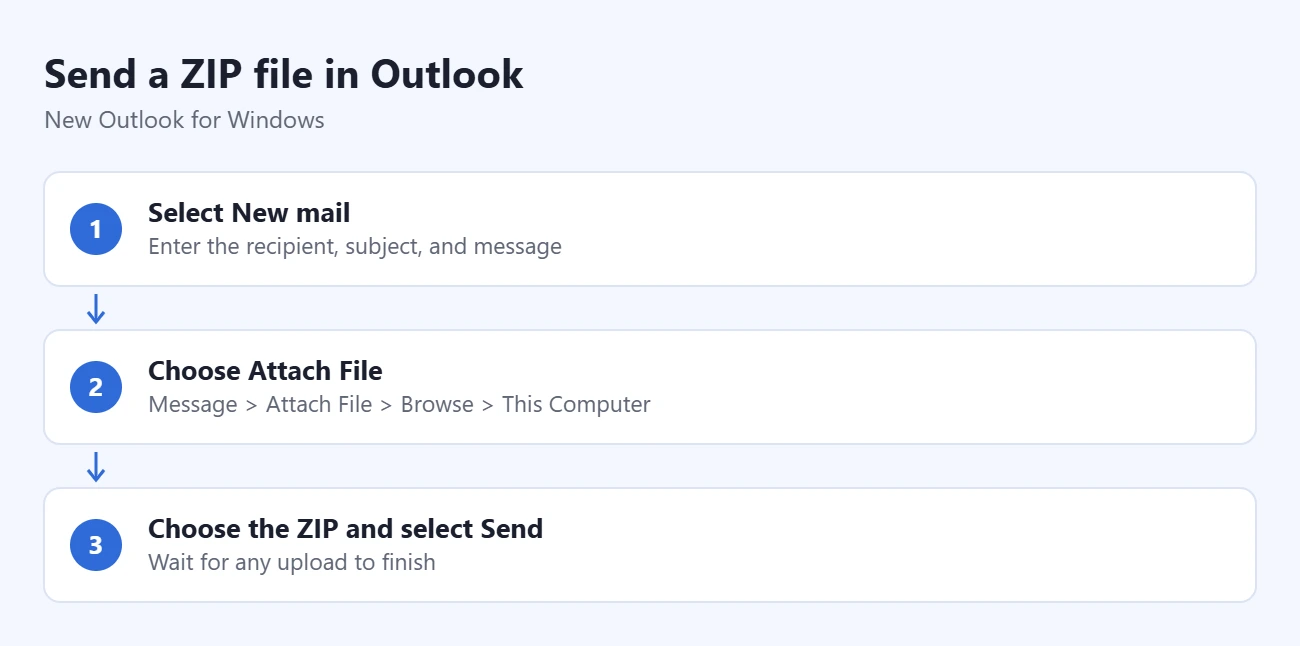
New Outlook for Windows
- Select New mail and enter the recipient, subject and message.
- In the message, choose Message > Attach File in the Insert group, then Browse > This Computer.
- Choose the ZIP in the file picker and open it. Check the archive’s name in the draft, wait for any upload to finish, then select Send.
Classic Outlook for Windows
- Select New Email and address the message.
- Choose Message > Attach File in the Include group, then Browse This PC.
- Choose the ZIP and select Insert. Review the draft and attachment, then select Send.
Outlook.com or Outlook on the Web
- Create a message and enter its recipients and text.
- Select Attach > Browse this computer.
- Choose the ZIP and select Open. Wait for the upload, check the attachment and send.
File Copy or Sharing Link?
A traditional attachment gives the recipient a separate copy. A OneDrive link points to the shared item instead. Decide which result you want before sending; a link is useful for a large archive, but the recipient needs permission to reach it. On a tablet, see how to email OneDrive files from an iPad.
For example, if you send an attachment called Project-handoff.zip and later revise a local spreadsheet, that sent archive is still the earlier package. Do not assume changing your working files updates a ZIP you already sent.
Use a OneDrive link for a large ZIP
Upload the ZIP to your OneDrive first. On the OneDrive website, select the archive and choose Share. Review the link’s settings before copying it: choose the intended people and viewing access where available. Apply the settings, copy the sharing link, then paste it into the Outlook message. If the access needs to change afterward, here is how to change OneDrive sharing permissions. For an archive that is several gigabytes or more, see how to upload large files to OneDrive before you share it.
Microsoft’s OneDrive sharing guide explains these options. An organization-only link may be unsuitable for someone outside your workplace. A disabled sharing option can reflect your organization’s restrictions; ask its administrator about an approved way to share.
If the recipient needs to download and extract the ZIP, check that the chosen access allows that. Do not merely copy the address of a private file and assume another person can open it.
Attachment Size Limits
There is no single number that describes every Outlook app, connected account and recipient. The sender’s service, app and receiving mailbox can impose different limits. Check the error message and the service’s guidance for your account.
Microsoft’s large-file guidance gives 20 MB for internet email accounts and a 10 MB default for Exchange accounts, including message content. Its separate Outlook.com attachment help lists a 25 MB total message limit. These are different documented contexts, not a promise that every ZIP under 25 MB will send.
Check the finished archive’s size. ZIP can bundle files without reducing their size much, particularly if they were already compressed. Splitting a package into several attachments in the same email still adds to that message’s total. A sharing link is often the clearer option when the package exceeds the applicable limit.
If the Attachment Does Not Send or Open
- Outlook rejects the size: use the cloud-link route and review access. Repeatedly selecting the same oversized archive will not change its size.
- A file is blocked: consult Microsoft’s blocked-attachment guidance and your workplace’s sharing rules. Packaging files does not make their contents harmless or guarantee acceptance by another mail system. Microsoft recommends a OneDrive link for blocked types.
- The email remains in Outbox: check your connection and any displayed error before sending another copy. Microsoft’s Sent Items guidance explains that an unsent message may remain in Outbox.
- A sharing link denies access: check the intended recipient’s access in OneDrive. Reattaching the same restricted link does not grant permission.
- The recipient cannot extract the ZIP: confirm the download finished and ask which error appears. Check your original archive; if it works locally, arrange a fresh download or another approved sharing method.
- A document will not open after extraction: the document may need a compatible app. ZIP extraction and opening the enclosed file are separate tasks.
Frequently Asked Questions
Can I attach more than one ZIP?
Yes, but check the combined message size. Separate attachments in one message do not each get the entire message limit. Give the archives distinct names so the recipient can identify them.
Does Outlook add a password to the ZIP?
No. Attaching an archive is not the same as creating an encrypted one. If you need protection, use your organization’s approved sharing method and confirm that the recipient can use it. Do not assume a plain ZIP has become private because it was attached to email.
Does Sent Items prove the recipient received the file?
It lets you inspect the sent message and check what you attached; it does not establish that the recipient downloaded or successfully extracted the archive. For an important handoff, ask them to confirm that they can access the expected files.
Choose the matching Outlook method, inspect the ZIP before sending, and switch to a properly shared link if a size or access problem prevents the handoff.

Matthew Burleigh is the founder, head writer, and editor of Solve Your Tech, which he launched in 2012. He has written technology tutorials since 2008 and worked in IT since 2003, including small-business support, IT management, and consulting. He holds Bachelor’s and Master’s degrees in Computer Science from Arizona State University.
Matthew writes practical guides for Windows, iPhone and iPad, Microsoft Office, Outlook, Google apps, and Android. Solve Your Tech’s guides are tested on current devices or checked against official product documentation, with clear steps, sources, and update dates.
Read more about Matthew and how Solve Your Tech writes and updates its guides, or report a correction.