If you own a Google Doc on a personal Google Account, open version history, select More, and choose Delete history or Delete this and older versions. Deletion is permanent. On a work or school account, or if you aren’t the owner, make a copy or limit others to view-only access instead.
You are about to share a document with a client, and the version history still holds an early draft with internal notes you’d rather they never see.
What You Can Delete, and Who Can Do It
Google Docs saves versions of a document automatically as people edit it. Google’s version history help page sets three conditions on removing them:
- Only the file owner can delete version history. Editors can browse it but can’t remove it.
- Only personal Google Accounts have the option. If you sign in with a work or school account managed by Google Workspace, you won’t see it.
- It’s permanent. Google says deleting version history can’t be undone.
There are two delete choices, and they do different things:
| Option | What it removes | Good for |
|---|---|---|
| Delete history | The unnamed versions | A general cleanup while keeping versions you deliberately named |
| Delete this and older versions | The selected unnamed version and earlier unnamed versions | Removing unnamed drafts through the version you select |
Before you delete anything, glance through the history so you know what you’re removing. If you’re new to the panel, see how to see editing history in Google Docs. If an old draft might be useful later, open it and use More > Make a copy to save it as a separate file first.
Delete All Unnamed Versions at Once
This works in Google Docs in a web browser on a computer.
- Open the document while signed in to the personal Google Account that owns it.
- At the top right, click the Last edit link (the version history icon). You can also look for File > Version history > See version history.
- In the version history panel, click More (the three-dot menu) at the top of the panel.
- Select Delete history.
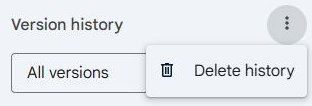
- Read the confirmation, then click Delete forever.
Your document’s current content doesn’t change. Only the saved past versions go. Any versions you named stay. If a named version also needs to go, the copy method below is the reliable route.
Delete a Version and Everything Older
Use this when you want history to begin just after a particular point, such as the first clean draft.
- Open version history from the Last edit link.
- Select the newest version you want to delete. That unnamed version and earlier unnamed versions will be removed. Named versions are kept. Expand grouped versions if you need a specific edit.
- Click More next to that version.
- Select Delete this and older versions, then click Delete forever.

Take a worked example: a proposal went through a rough outline with internal pricing notes, two drafts, and a clean version marked for review. To keep the review version and everything after it, select the last early draft (the one just before the review version). The outline and both drafts are removed, and history starts at the review version.
No Delete Option? Make a Copy Instead
If you don’t see Delete history, you’re most likely on a work or school account, or someone else owns the file. In that case, the practical route is a fresh copy that you share in place of the original.
- In the document, click File > Make a copy.
- Give the copy a name and choose a folder.
- Decide on Copy comments and suggestions. Leave it unchecked if comments contain internal discussion.
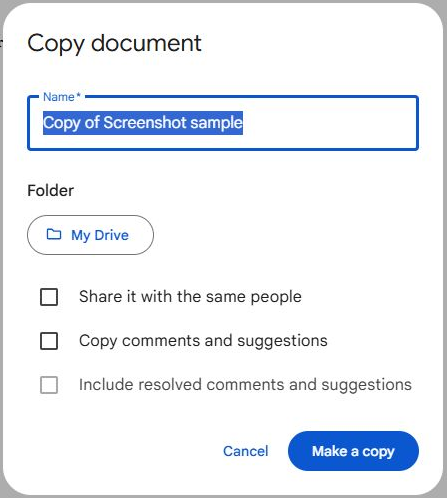
- Click OK.
- Open the copy and check its version history before sharing. A new copy typically starts its own history from the moment it was created, but confirm that old drafts don’t appear.
Another route is to select all the text in the document, copy it, and paste it into a brand-new Google Doc. The new file starts with no earlier versions, but check formatting, images and comments, which may not carry over the same way.
Google’s help on copying a file covers these options. For more ways to duplicate files, see making a copy of a file in Google Drive. Remember that the original keeps its full history, so restrict or remove access to it if others could still open it. On a work account, check whether your organization requires keeping the original.
Keep People From Seeing Version History
Sometimes you don’t need to delete anything. Google says that people without permission to edit a file can’t see its version history. So if your client only needs to read or comment:
- Click Share in the document.
- Next to the person’s name, or under General access for link sharing, choose Viewer or Commenter instead of Editor.
- Click Done or Save.
If someone needs to edit, give them edit access only on a cleaned copy. To review who currently has access, see how to stop sharing a Google Docs file.
Tidy the History Instead of Deleting It
If the history is just cluttered rather than sensitive, naming versions is gentler. Click More next to a version and choose Name this version, then turn on Only show named versions at the top of the panel to hide everything else from your view. Google allows up to 40 named versions per document. The unnamed versions still exist and come back when you turn the toggle off, so this doesn’t hide anything from other editors. Here’s more on naming a version in Google Docs.
To bring back an earlier draft, select it and click Restore this version, then Restore. Restoring typically saves the old content as the newest version rather than erasing what came after.
Delete Versions of Uploaded Files in Google Drive
Files you upload to Drive without converting them, such as PDFs, images or Word files, have a separate version system. According to Google’s Drive help on file versions:
- In Google Drive, select the file and click More.
- Choose File information > Manage versions.
- Next to a version, click More and choose Delete. You can also choose Keep forever for versions you want to protect.
Google notes that older versions of these files can be deleted automatically after 30 days or once 100 newer versions exist, unless they’re marked Keep forever. This doesn’t apply to Google Docs, Sheets or Slides files.
Google Docs Version History Questions
Can an Editor Delete the Version History?
No. Google limits deletion to the file owner. An editor who wants a clean file can make their own copy, but that doesn’t change the original.
Can I Delete Just One Version From the Middle?
Google documents only the two options above: delete all unnamed versions, or delete a chosen unnamed version and earlier unnamed versions. There’s no documented option to remove a single version and keep the ones on both sides of it.
Does Show Editors Reveal Who Wrote Something After I Delete History?
Show editors (select text, right-click, Show editors) is only on Google Workspace Business Standard, Business Plus, Enterprise Standard, Enterprise Plus and Education Plus. Deleting version history is only on personal Google Accounts, so you won’t have both on the same document.
Does Deleting History Delete the Document?
No. The current document stays as it is. To remove the whole file, see deleting a document in Google Docs.
Before you share, open the version history one last time and scroll to the oldest entry, so you know exactly what an editor would still be able to see.

Matthew Burleigh is the founder, head writer, and editor of Solve Your Tech, which he launched in 2012. He has written technology tutorials since 2008 and worked in IT since 2003, including small-business support, IT management, and consulting. He holds Bachelor’s and Master’s degrees in Computer Science from Arizona State University.
Matthew writes practical guides for Windows, iPhone and iPad, Microsoft Office, Outlook, Google apps, and Android. Solve Your Tech’s guides are checked step by step against the device or app maker’s own documentation and tested on his own devices whenever he has the hardware or software, with clear steps, sources, and update dates.
Read more about Matthew and how Solve Your Tech writes and updates its guides, or report a correction.