You built a page in Google Docs, maybe a form or a weekly plan, and want an exact copy of it on the next page. Docs has no “duplicate page” button, but the workaround is quick: make sure the document uses Pages format, select everything on the page, copy it, put your cursor at the end, add a page break (Ctrl+Enter, or Cmd+Enter on a Mac) and paste.
Why There’s No Copy Page Command
Google Docs treats a document as one flow of text. The page lines you see are just where that text happens to break, so there’s nothing called a “page” to copy as a unit. Copying a page really means copying the content on it and starting it on a fresh page.
That matters for two reasons. First, the copy only stays on its own page if a page break sits in front of it. Second, page breaks only exist in Pages format, so check that first.
Switch to Pages Format First
Docs has two layouts. Pages shows separate pages with margins, headers and footers. Pageless shows one long continuous sheet. Google’s page setup help says you can switch either way:
- Go to File > Page setup.
- At the top of the dialog, choose Pages.
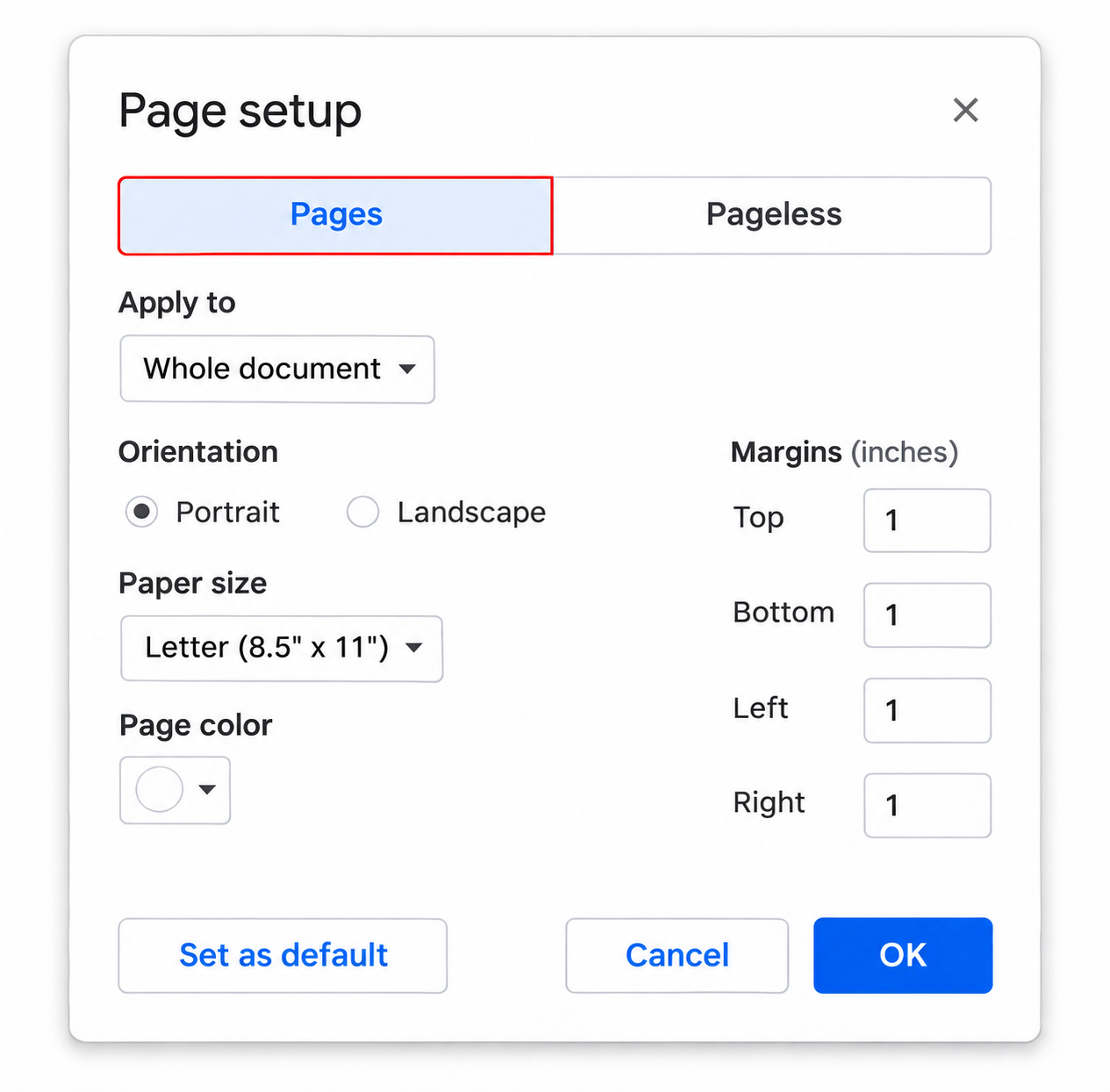
- Click OK.
Or use Format > Switch to Pages format. If you see visible gaps between pages already, you’re in Pages format and can skip this. Pageless documents also hide headers, footers and watermarks, which is one more reason a copied form can look different there.
Copy a Page Inside the Same Document
Here’s the fictional example. Tomas keeps a one-page weekly meal plan in Docs and wants four copies, one per week, in the same file.
- Select the page. Click just before the first character on the page, scroll to the last character on that page, hold Shift and click after it. Dragging works too, but Shift+click is more accurate on a long page. If the whole document is one page, press Ctrl+A (Cmd+A on a Mac) to select everything.
- Copy it. Press Ctrl+C (Cmd+C). Tables, images and text all copy as long as they’re in the selection.
- Go to the end of the page. Click after the last character on that page (or at the very end of the document if you want the copy last).
- Add a page break. Go to Insert > Break > Page break, or press Ctrl+Enter (Cmd+Enter). The cursor jumps to the top of a new page.
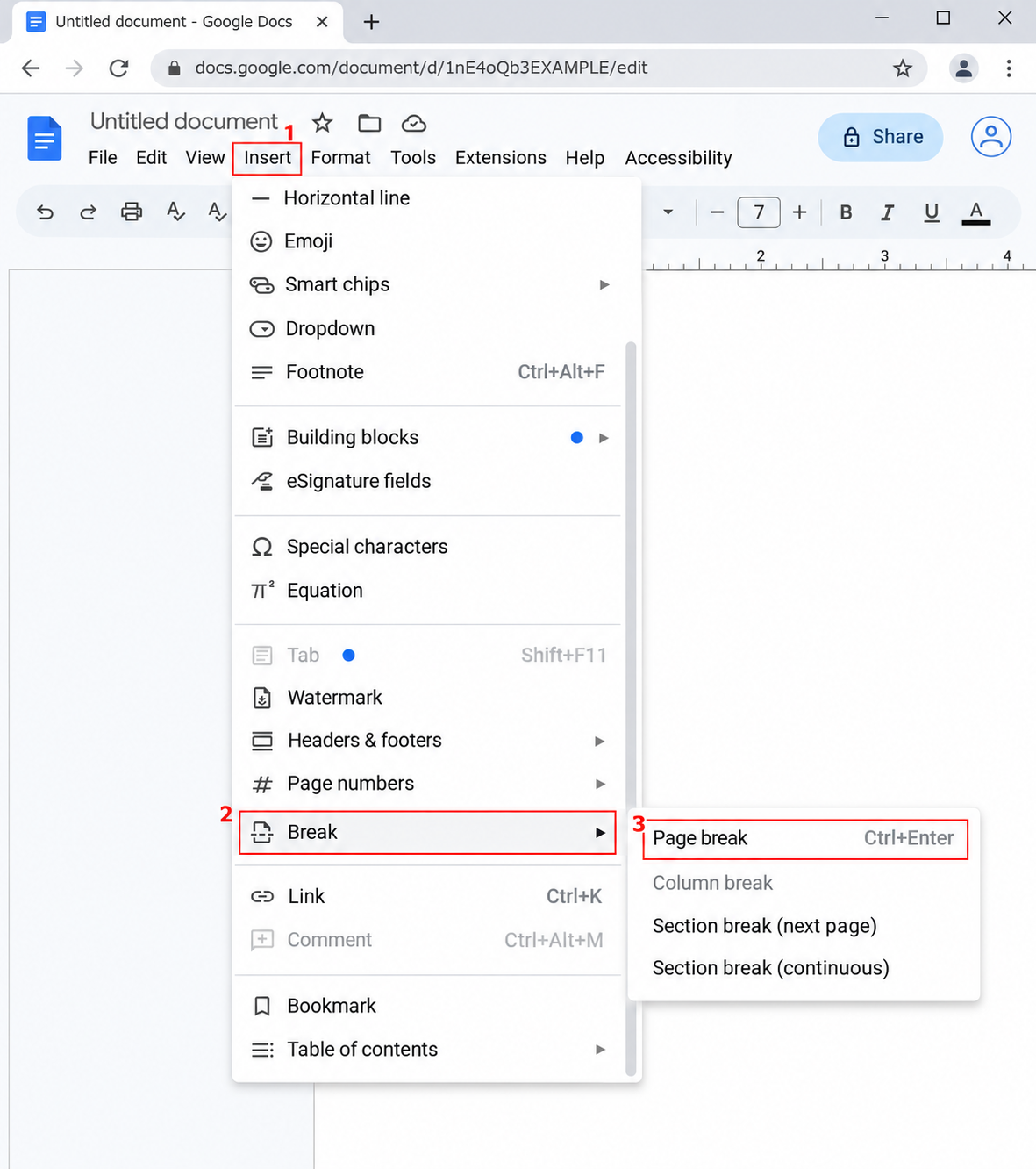
- Paste. Press Ctrl+V (Cmd+V). The copy appears on the new page.
- Repeat steps 4 and 5 for each extra copy. Tomas does it three times and ends up with four identical pages.
The page break steps are in Google’s page breaks help, and the keyboard shortcuts come from Google’s Docs shortcuts list. For more on breaks, see inserting a page break in Google Docs.
Why the right-click menu doesn’t always paste: Google says the right-click and Edit menu copy and paste options work only in Chrome, and only with the Google Docs Offline extension installed; in other browsers you need the keyboard shortcuts. Shortcuts are the safest choice everywhere.
Copy a Page Into Another Document
- Select and copy the page as above.
- Open the other document, or create one from Google Drive with New > Google Docs.
- Make sure it’s in Pages format.
- Click where the page should go. If there’s content above, add a page break first.
- Press Ctrl+V (Cmd+V).
If the other document uses different fonts or styles and you want the pasted page to match them, paste as plain text with Ctrl+Shift+V (Cmd+Shift+V). That drops the original formatting, so reapply bold, lists or headings as needed. If you change your mind, clearing formatting in Google Docs resets a selection.
Copy the Whole Document or One Tab
Make a copy of the entire file
When you want the whole document duplicated, not one page, use File > Make a copy. Per Google’s help on copying files:
- Go to File > Make a copy.
- Type a name and choose a folder.
- Optionally check Copy comments and suggestions, and then Include resolved comments and suggestions if you want those too.
- Click Ok.
You can also duplicate files from the Drive file list, as covered in making a copy of a file in Google Drive.
Duplicate a document tab
Newer documents can be split into tabs, each with its own content. If your page lives in its own tab, duplicating the tab is the closest thing Docs has to a one-click page copy. Google’s document tabs help describes it:
- Click Show tabs & outlines on the left.
- Find the tab, then open Tab options next to its name.
- Click Duplicate.
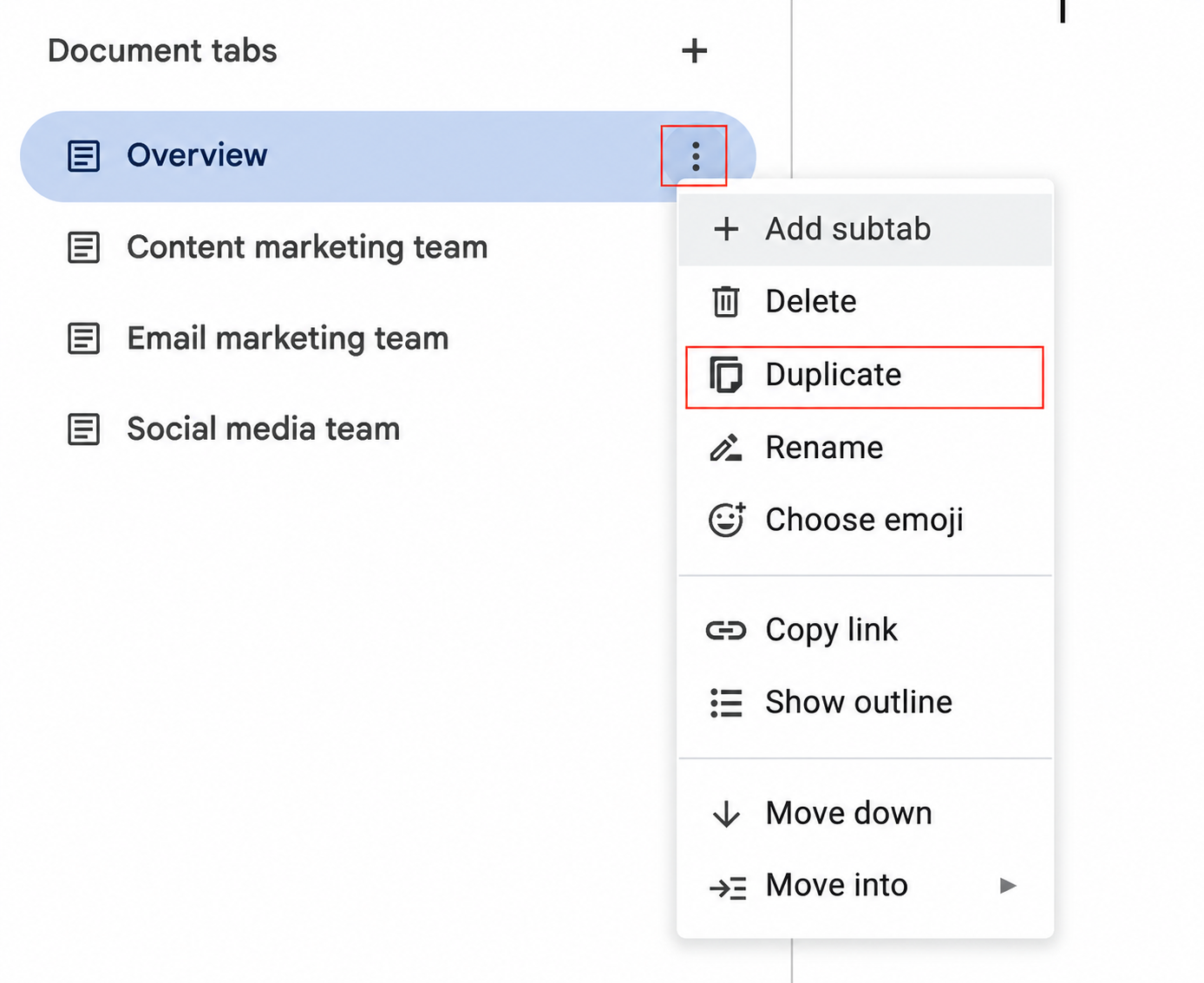
You need editor access and must be in editing mode. The duplicate keeps the styles used in that tab. A document can hold up to 100 tabs, so there’s plenty of room for a weekly template.
Copy a Page on Android, iPhone or iPad
The same idea works in the Google Docs app, though Google doesn’t publish detailed copy steps for the mobile apps, so labels may differ on your device. The usual flow is:
- Open the document and tap the edit (pencil) button.
- Long-press a word on the page and drag the selection handles to cover the whole page.
- Tap Copy.
- Tap at the end of the page, then look for Insert (the + button) and choose Page break.
- Long-press at the new spot and tap Paste.
Selecting a long page on a small screen is fiddly. If it keeps failing, do the copy on a computer, where Shift+click is far easier.
Keep the Formatting Intact
Most of the time a plain copy and paste keeps fonts, colors and tables. A few things need extra care:
- Headers and footers belong to the document (or section), not the page, so they don’t copy with the page’s body text. They already appear on every page of that section.
- Paint format copies formatting from one block of text to another: Ctrl+Alt+C to copy and Ctrl+Alt+V to apply (Cmd+Option+C and Cmd+Option+V on Mac). Use it to fix one paragraph that pasted with the wrong style.
- Floating images may shift slightly on the new page. Drag them back or set them to move with text.
- Content that should always start on a new page (like a section heading) can use Format > Line & paragraph spacing > Add page break before, so it never creeps up onto the previous page as you edit.
When the Copy Looks Wrong or Won’t Paste
- The copy runs into the previous page: there’s no page break before it, or the document is pageless. Add the break and switch to Pages format.
- An empty page appears after the copy: you probably selected the trailing page break or an empty paragraph. Delete the extra lines; deleting a blank page in Google Docs covers the stubborn cases.
- The pasted page spills onto two pages: one extra line pushed it over. Remove a blank line or reduce spacing, or check the margins in File > Page setup.
- Paste does nothing from the menu: use the keyboard shortcuts instead, especially outside Chrome.
- You can’t copy at all: you may only have view or comment access, and the owner may have turned off copying for viewers and commenters. Ask for edit access, or ask the owner to make a copy for you. A work or school administrator may also block copying.
Questions About Duplicating Google Docs Pages
Is there a shortcut that copies a page in one step?
No. The fastest route is select, Ctrl+C, Ctrl+Enter, Ctrl+V. If you duplicate the same page often, put it in its own tab and use Duplicate.
Can I copy several pages at once?
Yes. Select from the start of the first page to the end of the last one and follow the same steps. The page breaks you included in the selection come along too.
Will comments copy with the page?
Copy and paste usually leaves comments behind, so don’t count on them coming along. File > Make a copy can include comments and suggestions if you check that box.
Can I move a page instead of copying it?
Use Ctrl+X (Cmd+X) to cut instead of copy, then paste after a page break in the new spot.
Try it on a short page first: one page break and one paste, and you’ll have a reusable copy ready to fill in.

Matthew Burleigh is the founder, head writer, and editor of Solve Your Tech, which he launched in 2012. He has written technology tutorials since 2008 and worked in IT since 2003, including small-business support, IT management, and consulting. He holds Bachelor’s and Master’s degrees in Computer Science from Arizona State University.
Matthew writes practical guides for Windows, iPhone and iPad, Microsoft Office, Outlook, Google apps, and Android. Solve Your Tech’s guides are checked step by step against the device or app maker’s own documentation and tested on his own devices whenever he has the hardware or software, with clear steps, sources, and update dates.
Read more about Matthew and how Solve Your Tech writes and updates its guides, or report a correction.