Google Docs can’t play a video inside a document, so you add a video by linking to it: highlight some text, choose Insert > Link (or press Ctrl + K, Cmd + K on a Mac), paste the video’s URL, and click Apply. For a YouTube video you can also paste the link and turn it into a smart chip, or insert the video’s thumbnail as a clickable image.
These steps are for Google Docs in a web browser on a computer, with a note on the mobile app in the FAQ. Docs has no Insert > Video option; Google Slides does, and the last method below uses it. Google’s help page on adding links in Docs covers the link box used throughout.
Which Method Should You Use?
- Text link: Works for any video site and for videos in Google Drive. Best for handouts and reports.
- YouTube smart chip: A compact button showing the video’s title. Readers hover over it to see details. YouTube only.
- Clickable thumbnail: Looks most like an embedded video. Readers click the picture to open the video in a new tab.
- Google Slides: The only option with a real video player and playback settings. Use it when the video needs to play with a play button.
Whichever you pick, tell readers what they’re about to watch and how long it is, for example “Router setup demo (4:12).” A short label helps people decide whether to click and makes the link useful in a printed copy too.
Method 1: Add a Video Link
- Open the video and copy its address from the browser’s address bar. On YouTube you can also click Share and then Copy.
- In your Google Doc, type a label that tells readers what they’ll see, such as “Watch the two-minute setup demo,” and highlight it.
- Click Insert in the menu bar, then Link. A small box appears with Text and Link fields, and Text already contains your highlighted words.
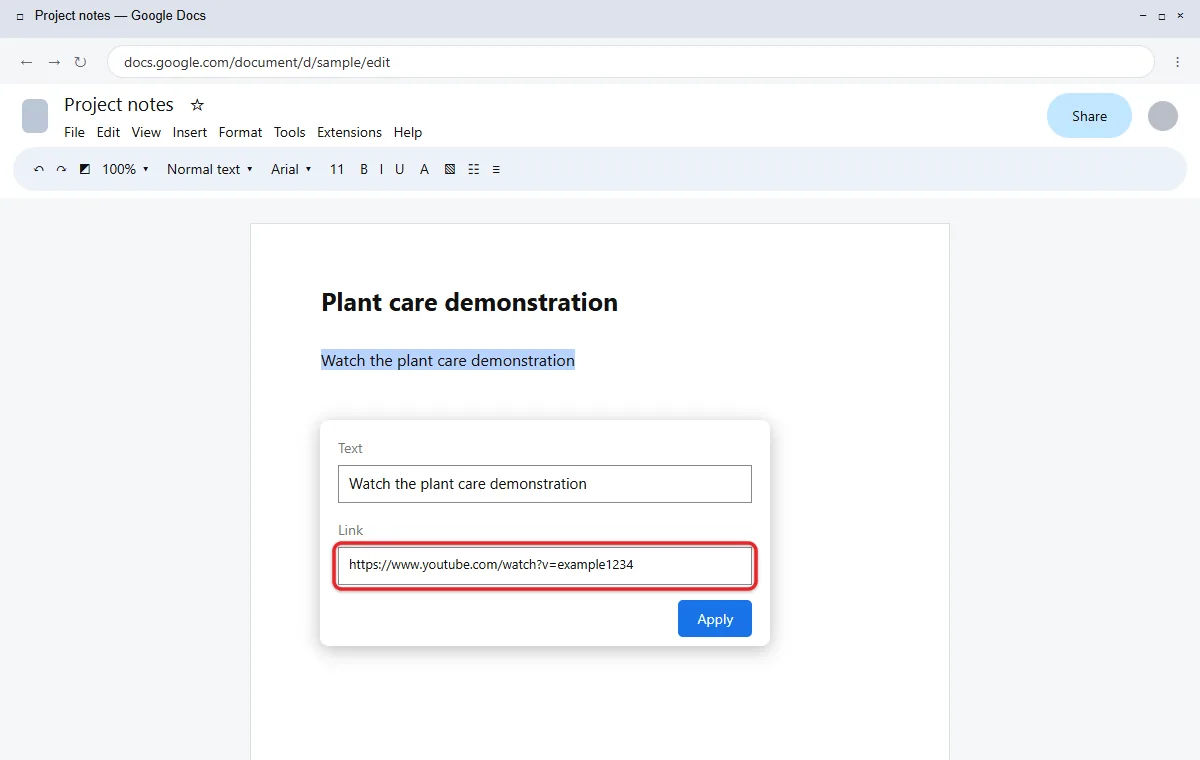
- Paste the video URL into the Link field.
- Click Apply. The words turn blue and underlined.
- Click the link and choose the URL in the box that appears to check that it opens the right video in a new tab.
To change or remove the link later, click it and choose Change (the pencil) or Remove. Adding, editing, and removing hyperlinks in Google Docs has more on the link box.
Method 2: Turn a YouTube Link Into a Smart Chip
- Copy the YouTube video’s URL.
- Click where you want it in the document and paste with Ctrl + V (Cmd + V on a Mac).
- When Docs offers to replace the URL with a chip, press Tab, or hover over the link and choose the chip option.
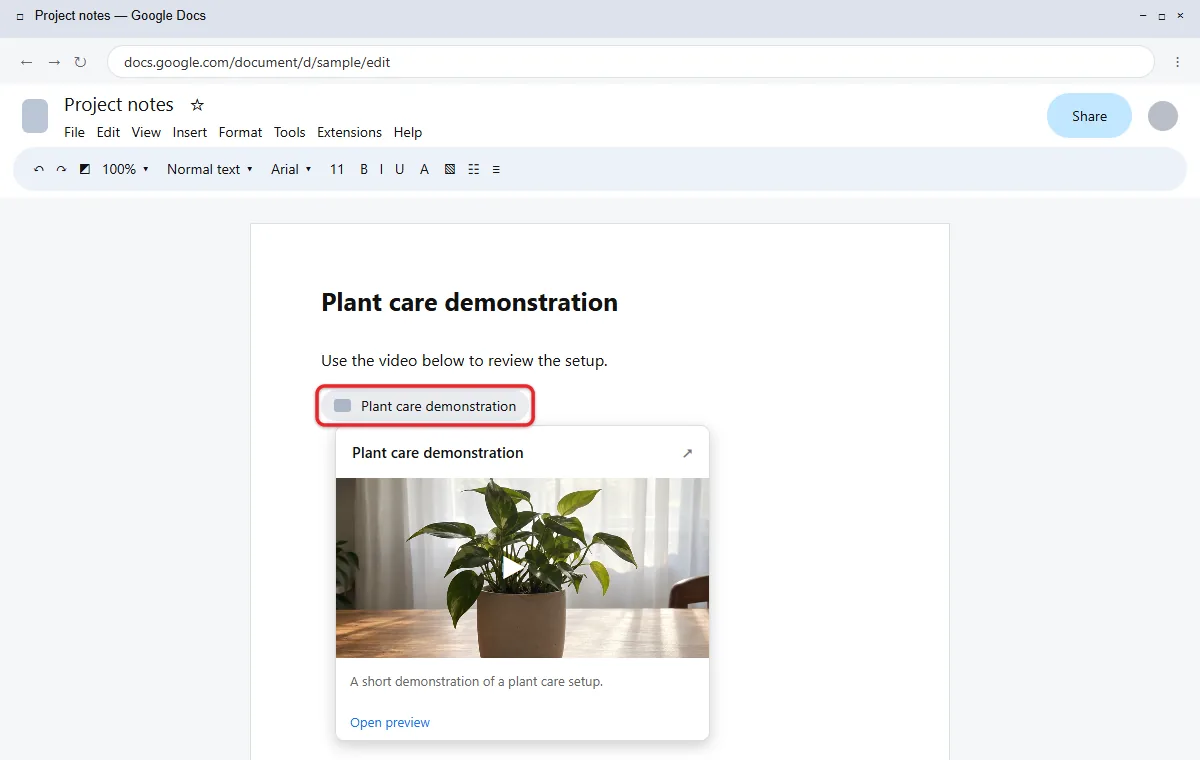
The URL becomes a chip with the YouTube logo and the video’s title. Hovering over it shows a card with the title, a description, and a preview image, and clicking the chip opens the video. If the card shows Open preview, click it to play the video in a small player in a corner of the document window, then close the player with its X when you’re done. This is the closest Docs comes to playing a video in place.
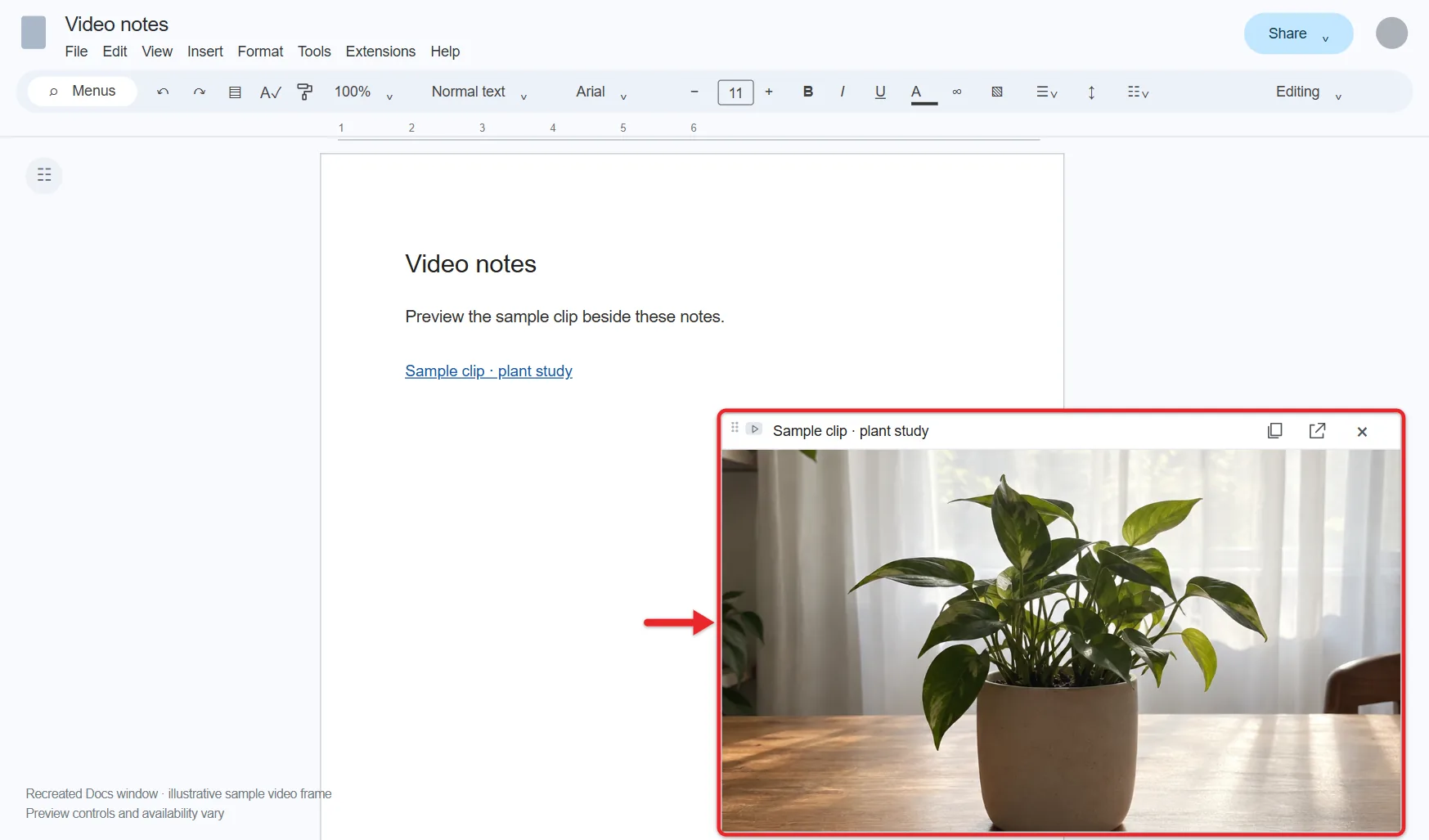
If you don’t see a chip option, the link is still a working hyperlink. Some work and school accounts limit smart chips.
Method 3: Insert a Clickable Video Thumbnail
This method makes the video look embedded. Readers see the video’s still image and click it to watch on YouTube.
- Find the video ID. It’s the part of a YouTube URL after
watch?v=(for example,aB3dE5fG7hI) or afteryoutu.be/in a short link. - In Google Docs, click Insert > Image > By URL.
- Paste
https://img.youtube.com/vi/VIDEO_ID/hqdefault.jpg, replacing VIDEO_ID with your video’s ID, and click Insert. - Click the image to select it, then press Ctrl + K (Cmd + K on a Mac) or choose Insert > Link.
- Paste the full video URL and click Apply.
- Add a caption under the image, such as “Click to play: Router setup video (4:12),” so readers know it’s a link.
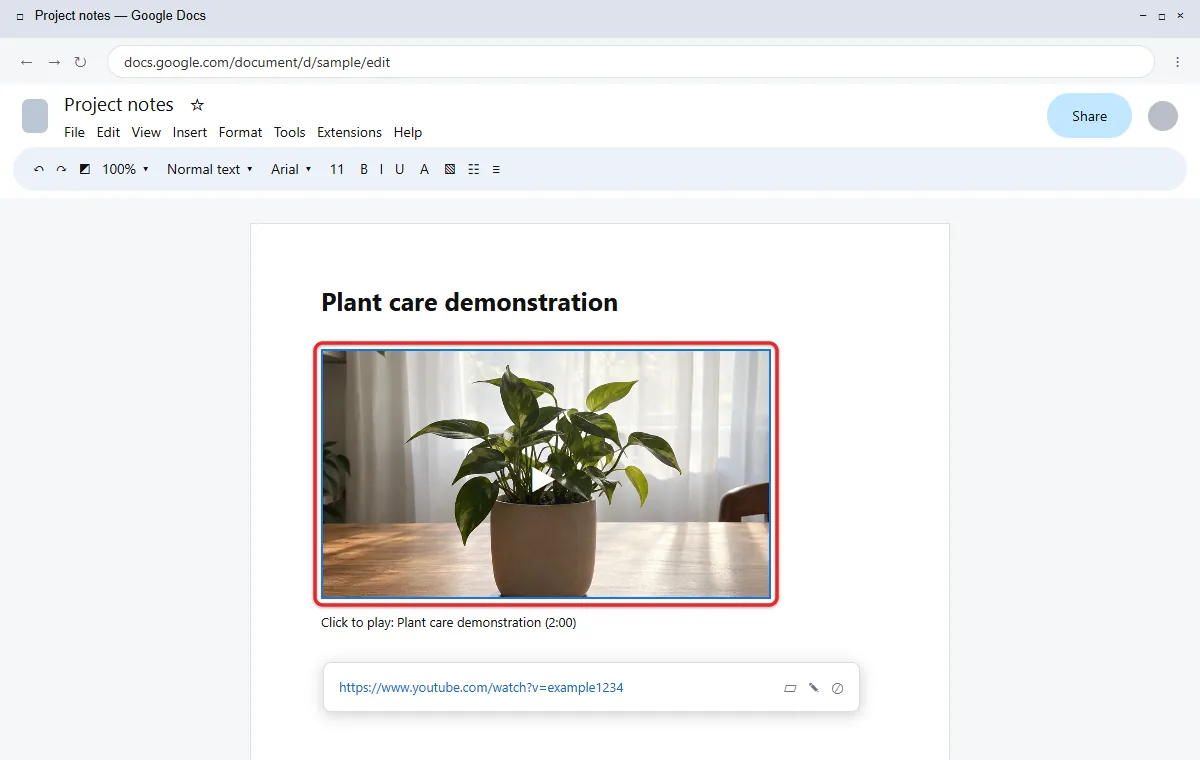
You can resize the image by dragging its corners. For videos that aren’t on YouTube, take a screenshot of the video (ideally with the play button showing), insert it with Insert > Image > Upload from computer, and link it the same way.
Link a Video Stored in Google Drive
A link to a Drive video only works for people who have permission to view that video, which is separate from permission to view the document.
- In Google Drive, select the video and click Share.
- Add the people who need it, or under General access click the down arrow, choose Anyone with the link, and keep the role set to Viewer.
- Click Copy link, then Done.
- Add the link to your document with Method 1.
Google’s Drive sharing guide explains each access level. Work and school accounts may block sharing outside the organization. A video made in Google Vids is saved in Drive, so you can share and link it the same way.
Method 4: Put the Video in Google Slides and Link It
If the video has to play with a real player, Slides is the tool for it.
- Open or create a presentation in Google Slides and select a slide.
- Click Insert > Video.
- Choose Search YouTube, By URL, or Google Drive, pick the video, and click Select.
- Click Share in Slides and give your readers at least Viewer access, or set General access to Anyone with the link.
- Copy the presentation’s link and add it to your document with Method 1.
Google’s media help page lists these video sources and says Slides now plays videos automatically when you advance to the slide, which you can change under Format options > Video playback.
A Drive video inside the presentation also needs to be shared with your readers. To use a Google Vids video, Google says to export it to Drive first and then insert it from there. For autoplay and start and end times, read about inserting a YouTube video in Google Slides.
Troubleshooting
Readers see “You need access”
Find out whether the blocked file is the document, the Drive video, or the Slides presentation, then share that file with the reader’s account. The owner of the video controls its access, even if you own the document.
The thumbnail URL shows an error
Check that you copied only the video ID, without extra characters like &t=30s from the end of the URL. Some videos don’t have a maxresdefault.jpg image, which is why this guide uses hqdefault.jpg, which nearly every video has.
The link opens the wrong video
Click the link, choose Change, and paste the correct URL. Copy it from the video page itself rather than from search results.
Link previews don’t appear
Go to Tools > Preferences and make sure Show link details is checked. Even then, Docs shows details only for some links, and a plain link without a preview still works.
Frequently Asked Questions
Can I upload a video file directly into Google Docs?
No. Docs has no option to upload or embed a video file, and it doesn’t accept HTML embed codes. Upload the video to Google Drive or YouTube first, then link to it.
Can a video play inside the document itself?
Not as an embedded player. The YouTube chip’s Open preview plays a video in a small window over the document. Some guides paste a Slides video into Insert > Drawing > New, but Google doesn’t document video playback in drawings, so test it before sharing. Add-ons from the Google Workspace Marketplace can also show videos in a sidebar; check the permissions an add-on asks for before installing it.
Will the video play when the document is printed or saved as a PDF?
No. A printed copy can’t play anything, and a PDF keeps the link but opens the video in a browser. For printed handouts, include the video’s title and a short URL so readers can type it.
Can I add a video link in the Google Docs mobile app?
Yes. In the Docs app on iPhone, iPad, or Android, tap the edit (pencil) button, select your text, and choose the link option from the menu that pops up, then paste the URL. Pasting a video URL straight into the document also creates a working link.

Matthew Burleigh is the founder, head writer, and editor of Solve Your Tech, which he launched in 2012. He has written technology tutorials since 2008 and worked in IT since 2003, including small-business support, IT management, and consulting. He holds Bachelor’s and Master’s degrees in Computer Science from Arizona State University.
Matthew writes practical guides for Windows, iPhone and iPad, Microsoft Office, Outlook, Google apps, and Android. Solve Your Tech’s guides are checked step by step against the device or app maker’s own documentation and tested on his own devices whenever he has the hardware or software, with clear steps, sources, and update dates.
Read more about Matthew and how Solve Your Tech writes and updates its guides, or report a correction.