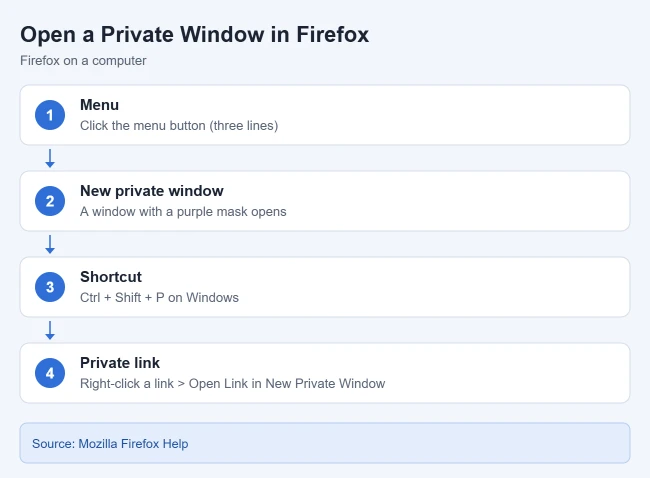
To start private browsing in Firefox, click the menu button (three lines) and choose New private window, or press Ctrl+Shift+P on Windows and Linux (Command+Shift+P on a Mac). The new window has a purple mask at the top, and Firefox forgets its history, cookies and form entries when you close it.
These steps are for Firefox on Windows, Mac and Linux computers, with menu names from Mozilla’s Private Browsing help article and keyboard shortcuts list, checked October 2026. The fire button for clearing a session needs Firefox 151 (May 2026) or later. Private browsing hides your activity from other people who use the same computer, but Mozilla says it doesn’t make you anonymous online.
What Private Browsing Does
A private window is a separate Firefox window that keeps its own temporary set of cookies and sign-ins. While it’s open, sites work normally: you can sign in, fill a shopping cart and download files. When the private session ends, Firefox throws that temporary data away. Your regular windows, bookmarks and saved passwords stay as they were. Other browsers call the same idea incognito mode.
Use it on a shared or borrowed computer, to sign in to a second account without signing out of your main one, or to check how a site looks when it doesn’t recognize you.
How to Open a Private Window in Firefox
- Click the menu button (three horizontal lines) in the top-right corner of Firefox.
- Click New private window.
A new window opens on the Private Browsing home page, with a purple mask icon at the top of the window. Everything you open in that window, including new tabs you add with +, stays private.
The keyboard shortcut does the same thing: Ctrl+Shift+P on Windows and Linux, or Command+Shift+P on a Mac. If you show Firefox’s menu bar, File > New Private Window works too.
Open a link in a private window
Right-click a link (on a Mac, you can also hold Control and click) and choose Open Link in New Private Window. The page opens in a private window and your current window stays as it was.
How to End or Clear a Private Session
Close every private window to end the session. Cookies from private windows are discarded when the last private window closes, and any accounts you signed in to there are signed out. That sign-out is intentional, not a bug.
In Firefox 151 and later, you can also start fresh without closing the window:
- Click the fire icon to the right of the address bar. Mozilla calls it the Clear Private Session button.
- Confirm when Firefox asks.
Firefox erases the private browsing data from that session and opens a new, empty private session. If you don’t see the fire icon, Firefox needs an update, so check for updates in Firefox first.
What Private Browsing Doesn’t Save
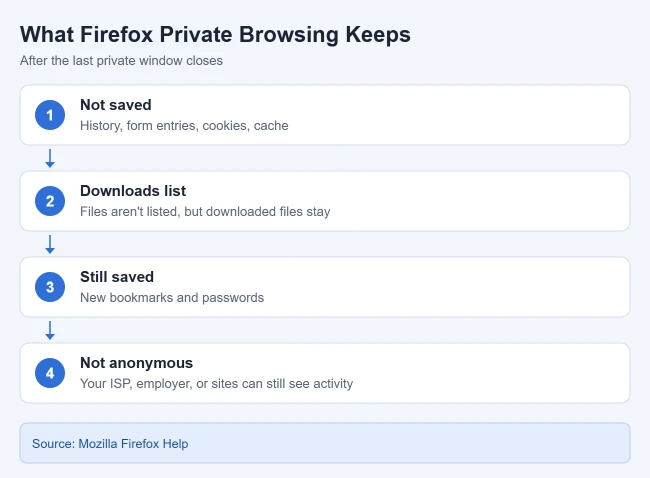
- Visited pages: they don’t appear in the History menu, the Library window or the address bar’s suggestions.
- Form and search entries: text you type into web forms or the search bar isn’t saved for autocomplete.
- Download list entries: downloads aren’t listed in the Downloads Library after you leave private browsing.
- Cookies: they’re kept in memory, separate from your regular cookies, and discarded at the end of the session.
- Cached and offline web content: temporary files and data sites store for offline use aren’t kept.
What it does save
New bookmarks and new passwords you save in a private window are kept, and files you download stay on your computer. They only drop off Firefox’s Downloads list.
Those files go to your normal download folder, and you can choose where Firefox saves downloads if you’d like a different one.
If you later want to clear those logins out, here’s how to delete saved passwords in Firefox.
What Private Browsing Doesn’t Protect Against
- Your network and the sites you visit: your internet service provider, your employer (on a work network) and the websites themselves can still see your activity. A private window doesn’t hide your IP address or general location.
- Signing in: once you sign in to a site, it knows who you are for the rest of that session, private or not.
- Malware: private browsing doesn’t protect you from keyloggers, spyware or viruses on the computer.
- Ads: Firefox blocks trackers, not ads, so you’ll still see ads in a private window.
What you do get is extra tracker blocking. Private windows block third-party cookies and content trackers by default, using Firefox’s Enhanced Tracking Protection. A shield icon in the address bar shows what was blocked on the current page.
A private window also doesn’t stop sites from asking for your location or camera. To turn those prompts off, block location requests in Firefox Settings.
How to Use Extensions in Private Windows
Extensions don’t run in private windows unless you allow them. If an ad blocker or password manager seems to vanish in a private window, that’s why. To allow one:
- Click the menu button and click Extensions and themes, then select Extensions.
- Click the extension you want.
- Next to Run in Private Windows, select Allow.
- Close the Add-ons Manager tab.
The extension now works in new private windows. Firefox also offers an Allow extension to run in private windows checkbox when you first install an extension. Mozilla’s extensions in Private Browsing article has the details. Allow only extensions you trust, since they can see the pages you visit.
How to Always Use Private Browsing
- Click the menu button and select Settings.
- Select Privacy & Security on the left and scroll to the History section.
- In the drop-down next to Firefox will, choose Use custom settings for history.
- Check Always use private browsing mode.
- Restart Firefox when it asks.
Firefox now starts in private browsing mode every time. Choosing Never remember history in the same drop-down has the same effect. Keep in mind that you’ll be signed out of sites and lose your history every time you close Firefox, so this suits a shared computer better than your own.
To undo it, uncheck Always use private browsing mode (or choose Remember history) and restart Firefox.
Troubleshooting
There’s no purple mask
If Firefox is set to always use private browsing or to never remember history, the windows don’t show the purple mask, even though you’re browsing privately. Check the History section in Settings to see which mode you’re in.
New private window is missing or won’t open
A work or school computer can be managed by an IT department that turns private browsing off. If the menu item is missing or the shortcut does nothing, ask your administrator. On a personal computer, update Firefox and try again.
A site won’t remember you
That’s expected in a private window. Sign in again, or use a regular window for sites you want to stay signed in to.
You want quicker access on Windows
Open a private window, right-click the Firefox icon with the purple mask on the taskbar, and choose Pin to taskbar. That icon then opens a private window with one click.
How to Confirm It Worked
Open a private window, visit a site, then close all private windows. In a regular window, press Ctrl+H (Command+Shift+H on a Mac) or open History from the menu. The site you visited privately isn’t listed.
Frequently Asked Questions
Does Firefox have private browsing on phones?
Yes. On Android, tap the tab counter beside the address bar, tap the mask icon at the top, then tap +. On an iPhone or iPad, tap the tabs button, tap Private, then tap +. The iPhone app has its own settings, and private browsing in Firefox on iPhone walks through them.
Is private browsing the same as incognito mode?
It’s the same idea. Chrome and Edge call it incognito or InPrivate. Firefox adds tracker blocking to private windows by default.
Can I open a private tab inside a regular window?
No. Firefox on a computer keeps private browsing in its own window. Open a private window and add tabs there.
Does closing one private tab end the session?
No. The session ends when the last private window closes, or when you use the fire button in Firefox 151 and later.
Will my employer or internet provider see private browsing?
They can. Private browsing only keeps the record off your computer. Network traffic is still visible to whoever runs the network.
Related Guides
- How to make Firefox never remember history
- How to delete cookies from one site in Firefox
- How to remove headers and footers when printing in Firefox

Matthew Burleigh is the founder, head writer, and editor of Solve Your Tech, which he launched in 2012. He has written technology tutorials since 2008 and worked in IT since 2003, including small-business support, IT management, and consulting. He holds Bachelor’s and Master’s degrees in Computer Science from Arizona State University.
Matthew writes practical guides for Windows, iPhone and iPad, Microsoft Office, Outlook, Google apps, and Android. Solve Your Tech’s guides are checked step by step against the device or app maker’s own documentation and tested on his own devices whenever he has the hardware or software, with clear steps, sources, and update dates.
Read more about Matthew and how Solve Your Tech writes and updates its guides, or report a correction.