To turn off Private Browsing on an iPhone, open Safari, tap the More button (three dots), and tap New Tab. When Private Browsing is off, the address bar is white or gray instead of dark. Your private tabs stay in the Private group until you close them (see how to close all open tabs on iPhone), and if you want Private Browsing gone for good, you can block it with Screen Time.
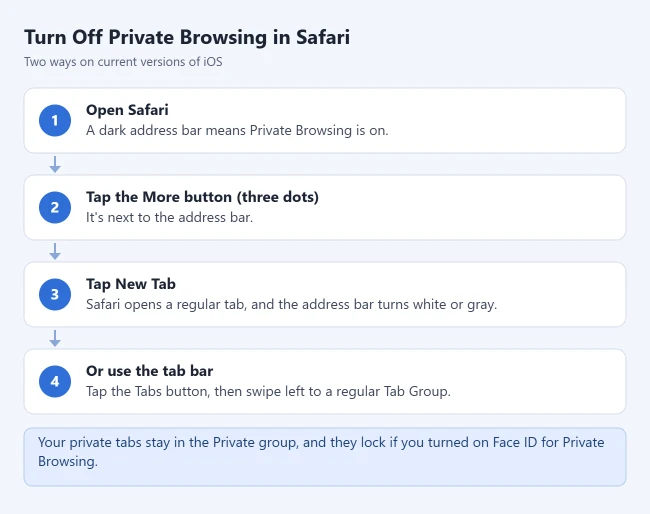
Turn Off Private Browsing in Safari
- Open Safari.
- Tap the More button (three dots).
- Tap New Tab.
- Check the address bar. White or gray means you’re back to normal browsing.
These steps come from Apple’s Private Browsing article, updated in 2026.
On iOS 17 and Earlier
- Open Safari and tap the Tabs button (two overlapping squares).
- Swipe to the tab group that shows a number, such as 3 Tabs.
- Tap the tab you want to open.
Close Your Private Tabs
Switching to a normal tab leaves your private tabs open in the background. To clear them:
- In Safari, tap the Tabs button.
- Swipe to the Private group, and unlock it with Face ID, Touch ID, or your passcode if asked.
- Tap the X on each tab, or touch and hold Done and choose the option to close all tabs. To keep regular tabs from piling up later, you can have Safari close old tabs automatically.
Safari doesn’t save history, searches, or AutoFill from private tabs, so there’s nothing else to delete.
Block Private Browsing Completely With Screen Time
Turning Private Browsing off with New Tab isn’t permanent. Anyone can tap New Private Tab again. To remove the option, for example on a child’s phone, turn on the adult website filter in Screen Time. Safari then hides Private Browsing.
- Open Settings and tap Screen Time. On a child’s device managed through Family Sharing, tap Family, then the child’s name instead.
- Tap Content & Privacy Restrictions (or Apps & Websites, then Restrictions) and turn restrictions on if needed.
- Open the web content or Filtering setting under Websites.
- Choose Limit Adult Websites.
- Set a Screen Time passcode so the setting can’t be changed without it.
Apple explains these filters in its parental controls guide. To see how the phone is being used, see how to check Screen Time on iPhone.
Turn Off Incognito in Chrome on iPhone
Chrome calls private browsing Incognito. Per Google’s Incognito help:
- Open Chrome and tap Switch tabs (the square with a number).
- Swipe left or right to move from Incognito tabs to your regular tabs.
- To end the Incognito session, close all Incognito tabs.
Want to open one on purpose? See how to open an Incognito tab in Chrome on iPhone.
Turn Private Browsing Back On
- Open Safari.
- Tap the More button (three dots).
- Tap New Private Tab.
Frequently Asked Questions
Why is Private Browsing missing?
Screen Time’s adult website filter removes it. Check Settings > Screen Time > Content & Privacy Restrictions, or ask whoever manages the phone. Our guide on why you can’t create a private tab in Safari covers this in more detail.
Can private tabs be locked?
Yes. Go to Settings > Apps > Safari and turn on Require Face ID to Unlock Private Browsing (Touch ID on older models), as Apple shows in its Locked Private Browsing guide.
Does Private Browsing hide what I do from my carrier or school?
No. It keeps history off your iPhone, but websites and whoever runs the network, such as a school or employer, may still see your activity.
How do I turn off Private Browsing on an iPad?
The steps are the same. Apple also has a separate iPad Private Browsing guide.
Why don’t my Safari extensions work in Private Browsing?
Apple turns off extensions that can access browsing data in Private Browsing automatically. You can allow them in Safari’s extension settings. See how to disable or manage a Safari extension on iPhone.
Private Browsing isn’t the only Safari privacy control on the iPhone. You can also stop websites from checking whether you have Apple Pay set up in Safari’s Advanced settings.

Matthew Burleigh is the founder, head writer, and editor of Solve Your Tech, which he launched in 2012. He has written technology tutorials since 2008 and worked in IT since 2003, including small-business support, IT management, and consulting. He holds Bachelor’s and Master’s degrees in Computer Science from Arizona State University.
Matthew writes practical guides for Windows, iPhone and iPad, Microsoft Office, Outlook, Google apps, and Android. Solve Your Tech’s guides are tested on current devices or checked against official product documentation, with clear steps, sources, and update dates.
Read more about Matthew and how Solve Your Tech writes and updates its guides, or report a correction.