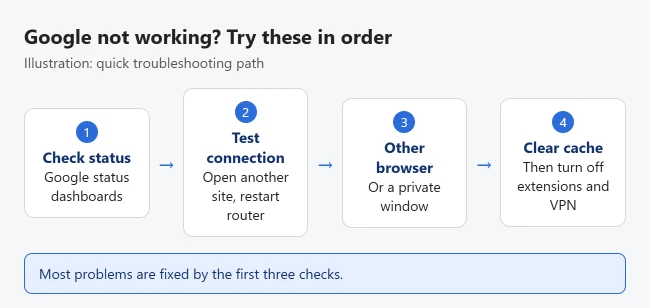
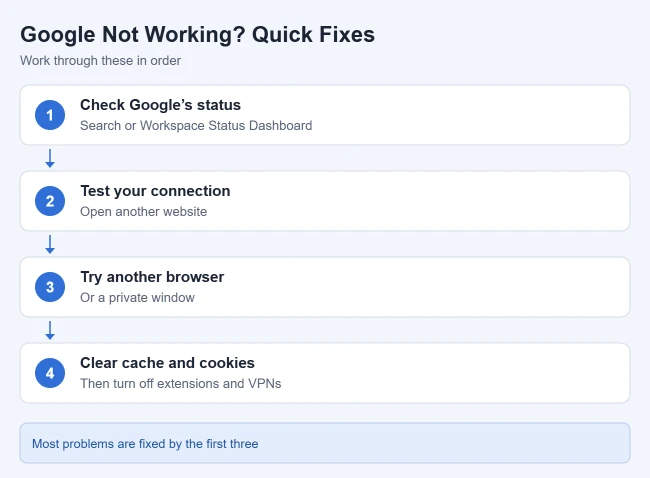
If Google isn’t working, first check whether the problem is on Google’s end with the Google Workspace Status Dashboard. If Google is up, try another browser, clear your browser’s cache and cookies, turn off extensions, and restart your router.
Work through the steps below in order. Most problems are fixed by the first three.
In this article:
- Check if Google is down
- Check your internet connection
- Try another browser
- Clear cache and cookies
- Turn off extensions and VPNs
- Clear your DNS cache
- Fix the “unusual traffic” message
- FAQs
Step 1: Check if Google Is Down
- For Gmail, Drive, Docs, Meet, and other Google apps, check the Google Workspace Status Dashboard.
- For Google Search itself, check the Google Search Status Dashboard.
If there’s an outage, you’ll need to wait for Google to fix it.
Result: If the dashboard shows an incident for the service you use, the problem is on Google’s side and the fixes below won’t help until it’s resolved.
Step 2: Check Your Internet Connection
- Open a different website, like bing.com. If nothing loads, the problem is your connection.
- Restart your modem and router, and restart your device.
- On a Windows PC that still can’t connect, see how to reset network settings in Windows 11.
Result: If other sites load normally, your connection is fine and the problem is specific to Google or your browser.
Step 3: Try Another Browser or a Private Window
Open Google in a different browser or an incognito or InPrivate window. If it works there, the problem is your main browser’s data or extensions. Also make sure your browser is up to date. Google says Search works best in a supported, up-to-date browser.
Result: If Google works in another browser or a private window, the problem is in your usual browser’s data or extensions, so continue with the next two steps.
Step 4: Clear Your Cache and Cookies
In Chrome, these steps follow Google’s cache and cookies help:
- Click the three-dot More button, then Delete browsing data.
- Choose a time range, like All time.
- Check Cookies and other site data and Cached images and files.
- Click Delete data.
You’ll need to sign back in to some sites afterward. In Edge, see how to clear the Edge cache.
Result: Google should load normally after you clear cached data, though you may need to sign in to your Google account again.
Step 5: Turn Off Extensions and VPNs
Ad blockers, privacy extensions, and VPNs can stop Google pages from loading. Turn them off one at a time and reload the page to find the one causing trouble. In Chrome, you can also reset the browser to its default settings, which turns off every extension at once.
Result: If Google loads with extensions and your VPN off, turn them back on one at a time to find the one causing trouble.
Step 6: Clear Your DNS Cache on Windows
If other sites load but Google still won’t on a Windows PC, an outdated DNS entry may be the cause. Clearing the DNS cache uses Microsoft’s ipconfig command:
- Click Start and type cmd.
- Right-click Command Prompt and choose Run as administrator.
- Type
ipconfig /flushdnsand press Enter. - Close your browser, open it again, and try Google.
If you or an app ever changed your hosts file, also make sure Google isn’t listed there. Here’s how to edit the hosts file in Windows 11.
Result: Windows fetches fresh DNS information for Google the next time you visit, which fixes problems caused by outdated entries.
How to Fix Google’s “Unusual Traffic” Message
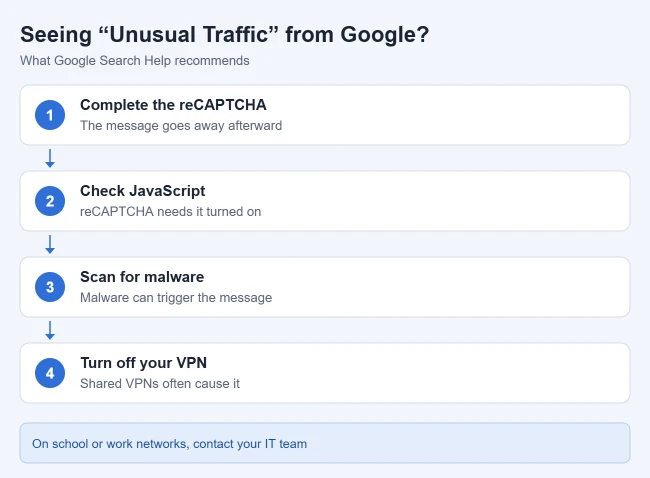
If Google shows “Our systems have detected unusual traffic from your computer network,” Google Search Help says your network, including a VPN, seems to be sending automated searches.
- Complete the reCAPTCHA on the page. Google says the message goes away once you do. If no reCAPTCHA appears, make sure your browser is supported and JavaScript is turned on.
- Check for malware. Google notes that malware on your computer can cause the message.
- Turn off or uninstall your VPN, or contact the VPN provider. Other people on a shared VPN can trigger it, and so can IPv6 tunnel services.
- On a school or work network, ask your network administrator, since other users may be sending automated searches.
Result: Once the source of the automated traffic is gone, you can search normally again. Google’s full guidance is on its unusual traffic help page.
Frequently Asked Questions
Why is Google not working on my phone?
Try switching between Wi-Fi and mobile data, update the Google app, and restart the phone. If you use the Google search bar widget, here is how to add it back to your home screen.
What if only one Google service is broken?
Check the status dashboard for that service first. If it shows no problems, clear your cache and try again.

Matthew Burleigh is the founder, head writer, and editor of Solve Your Tech, which he launched in 2012. He has written technology tutorials since 2008 and worked in IT since 2003, including small-business support, IT management, and consulting. He holds Bachelor’s and Master’s degrees in Computer Science from Arizona State University.
Matthew writes practical guides for Windows, iPhone and iPad, Microsoft Office, Outlook, Google apps, and Android. Solve Your Tech’s guides are tested on current devices or checked against official product documentation, with clear steps, sources, and update dates.
Read more about Matthew and how Solve Your Tech writes and updates its guides, or report a correction.