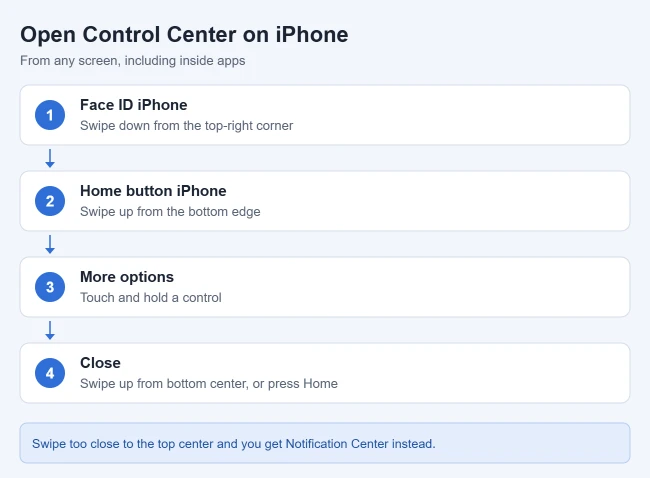
To open Control Center on iPhone, swipe down from the top-right corner of the screen (or swipe up from the bottom on an iPhone with a Home button). It works inside apps too. If it won’t open on the Lock Screen, go to Settings > Face ID & Passcode and turn on Control Center under Allow Access When Locked.
These steps follow Apple’s Use and customize Control Center on iPhone and Turn on Lock Screen features on iPhone guides, plus its Access Control Center support article.
These steps are for iPhones running iOS 18, iOS 26 and iOS 27. Control Center was redesigned in iOS 18, so an iPhone on iOS 17 or earlier shows a single page of controls and a different editing screen.
How to Open and Close Control Center on iPhone
- iPhone with Face ID (iPhone X and later): swipe down from the top-right corner. Keep swiping down to see more groups of controls.
- iPhone with a Home button (iPhone SE, iPhone 8 and earlier): swipe up from the bottom edge of any screen.
To close it, swipe up from the bottom center of the screen or tap the screen on a Face ID iPhone, or press the Home button on an iPhone with one.
Apple notes that if you swipe too close to the top center of the screen, you might open Notification Center instead. Start your swipe at the right corner, near the battery icon.
If that list of alerts is what you wanted, here is how to open Notification Center on iPhone.
On Face ID iPhones, Control Center also shows the status icons that don’t fit at the top of the screen; here’s what those iPhone status icons mean.
Control Center also shows your exact battery level as a number. To see it without opening Control Center, show the battery percentage in the status bar.
In iOS 18 and later, you can also jump between groups of controls (such as music, Home devices and connectivity) by swiping through the icons on the right edge of Control Center.
How to Use Control Center on the Lock Screen
If swiping does nothing while your iPhone is locked, Lock Screen access to Control Center is probably turned off.
- Open Settings.
- Tap Face ID & Passcode (or Touch ID & Passcode on an iPhone with a Home button), and enter your passcode if asked.
- Scroll to Allow Access When Locked.
- Turn on Control Center.

The same section lets you allow other features on the Lock Screen, such as widgets and media playback controls. To work out which feature put a particular icon there, see why an app icon appears on your iPhone Lock Screen.
There’s a trade-off. Turning off Lock Screen access keeps someone who has your iPhone from seeing personal information, but you also lose quick access yourself. For example, with Control Center allowed, anyone holding your locked phone could turn on Airplane Mode.
If you only need to take a photo, you can also open Camera directly from the Lock Screen with a left swipe. That works separately from Control Center access.
Control Center can also hold a Scan Code button, which lets you scan a QR code on your iPhone from the Lock Screen.
How to Get More Options From a Control
Many controls have extra options. Touch and hold a control to see them. Apple gives these examples:
- Touch and hold the top-left group of controls, then tap the AirDrop button to open AirDrop options.
- Touch and hold the Camera control to take a selfie, record a video or take a photo.
- Touch and hold the power button at the top right (while Control Center is open) until you feel a vibration, then drag the slider to turn off the iPhone.
Tapping the Wi-Fi or Bluetooth button only disconnects you temporarily. To turn Wi-Fi or Bluetooth fully off, go to Settings.
If brightness drops again after you raise it with the slider, learn why your iPhone screen keeps dimming.
How to Customize Control Center
- Open Control Center.
- Tap the Add button in Control Center to start editing.
- Drag a control to move it, tap the Remove button to remove one, or drag the handle at the lower right of a control to resize it.
- Tap Add a Control at the bottom to open the controls gallery, then tap a control to add it.
- Swipe up from the bottom center to finish.
For example, you can add the calculator to Control Center. The same edit mode adds the Screen Recording control, and adding the Screen Recording button on iPhone also covers what to do when it is missing or gray.
Once Calculator is open, you can switch to the scientific calculator on iPhone for powers, roots and trig, or to use parentheses on the iPhone Calculator.
How to Turn Off Control Center Inside Apps
If you keep opening Control Center by accident while playing a game or reading, you can block it inside apps.
- Open Settings.
- Tap Control Center.
- Turn off Access Within Apps.
After that, Control Center opens only from the Home Screen (and the Lock Screen, if you allowed it).
Control Center Questions
Why do I get notifications instead of Control Center?
You’re swiping from the top center. Start from the top-right corner.
Does tapping Wi-Fi in Control Center turn Wi-Fi off?
No. It disconnects from the current network. Turn Wi-Fi off in Settings > Wi-Fi.
Can I stop Control Center from opening in games?
Yes. Turn off Access Within Apps in Settings > Control Center.
More iPhone guides: how to turn on the iPhone flashlight and how to turn rotation lock on or off. If the light is stuck on, follow the steps to turn off the iPhone flashlight.
What works on the lock screen is set in your passcode settings. Here’s how to turn off, turn on, or change your iPhone passcode.

Matthew Burleigh is the founder, head writer, and editor of Solve Your Tech, which he launched in 2012. He has written technology tutorials since 2008 and worked in IT since 2003, including small-business support, IT management, and consulting. He holds Bachelor’s and Master’s degrees in Computer Science from Arizona State University.
Matthew writes practical guides for Windows, iPhone and iPad, Microsoft Office, Outlook, Google apps, and Android. Solve Your Tech’s guides are checked step by step against the device or app maker’s own documentation and tested on his own devices whenever he has the hardware or software, with clear steps, sources, and update dates.
Read more about Matthew and how Solve Your Tech writes and updates its guides, or report a correction.