An app icon on your iPhone Lock Screen is almost always one of four things: a Lock Screen control in a bottom corner, a widget near the clock, a notification from that app, or a Live Activity that is tracking something in progress. The fastest fix for most of them is to touch and hold the Lock Screen, tap Customize, and remove the item you do not want.
This guide follows Apple’s iPhone User Guide for iOS 27. Menu names can differ slightly on older versions, and those differences are called out where they matter. If your iPhone runs a very old version such as iOS 8, skip to the section on Suggested Apps near the end.
Identify the icon by where it appears
The position of the icon tells you which feature put it there, and each feature has its own off switch. Use this table to find the right section.
| Where the icon is | What it most likely is | Where to change it |
|---|---|---|
| Bottom-left or bottom-right corner | A Lock Screen control, such as the flashlight or camera | Touch and hold the Lock Screen, then Customize |
| Just above or below the clock | A Lock Screen widget | Touch and hold the Lock Screen, then Customize |
| Beside a message, or in a stack near the bottom | A notification from that app | Settings > Notifications |
| A panel that keeps updating, or playback buttons | A Live Activity or the Now Playing controls | Settings > Apps, then the app |
| Only after you swipe right | Widgets in Today View | Settings > Face ID & Passcode |
Small symbols at the very top of the screen, such as a padlock, an arrow, or a moon, are status icons and not app icons. Our guide to what the icons at the top of your iPhone screen mean covers those.

Icons in the bottom corners: Lock Screen controls
The two round buttons at the bottom of the Lock Screen are called controls. They start out as the flashlight and the camera, but Apple lets you swap them for other controls, so a button you do not recognize is usually one that was changed during customization. Apple describes this in Create a custom iPhone Lock Screen.
To change a control:
- Wake your iPhone and unlock it with Face ID, Touch ID, or your passcode, but stay on the Lock Screen.
- Touch and hold an empty part of the Lock Screen until the Customize button appears at the bottom. If nothing happens, touch and hold again and enter your passcode when asked.
- Swipe to the Lock Screen you want to edit, then tap Customize. If your iPhone asks which screen to edit, choose the Lock Screen.
- Tap the small remove button on the control you want to change.
- Tap the add button that takes its place and pick a different control from the gallery.
- Tap Done to save.
The new icon appears in that corner the next time the Lock Screen is shown. To put things back, repeat the steps and choose the original control. For more on the default buttons, see how to open the Camera from the iPhone Lock Screen and how to turn on the iPhone flashlight when it is locked.

Icons near the clock: Lock Screen widgets
A widget is a small panel that shows live information from an app, such as the weather, battery level, or your next calendar event. Widgets sit in a row below the clock, and a small one can sit beside the date above it. Some wallpapers suggest widgets when you create them, so they can appear without you deliberately adding one.
To remove a widget:
- Touch and hold the Lock Screen, swipe to the one you use, then tap Customize.
- Tap the widget row. If the row is empty, it is labeled Add Widgets.
- Tap the remove button on the widget you do not want.
- Close the widget panel, then tap Done.
Removing a widget does not delete the app or its data. You can add it back from the same panel at any time. Our walkthrough on how to change the Lock Screen on iPhone covers wallpapers and the other options on that editing screen.
An app icon beside a message: notifications
Every notification shows the icon of the app that sent it. If your iPhone is set to show notifications as a count or a stack, you may see only a small icon or number near the bottom of the screen, which is easy to mistake for a shortcut.
To stop one app from showing on the Lock Screen:
- Open Settings and tap Notifications.
- Tap the app below Notification Style.
- Under Alerts, turn off Lock Screen. The app can still use Notification Center and banners if those stay selected.
- To silence the app completely, turn off Allow Notifications instead.
To change how all notifications are laid out, go to Settings > Notifications and choose Count, Stack, or List. Apple’s page on how to change notification settings on iPhone lists every option. The red number on a Home Screen icon is a different feature; see what badges are on iPhone.
A panel that keeps updating: Live Activities
A Live Activity is a notification that stays on the Lock Screen and updates itself while something is in progress. Apple’s examples include directions from Maps, live sports scores, and food delivery updates. The playback buttons that appear while music, a podcast, or a video is playing work the same way, and they can also control media playing on another device such as an Apple TV or HomePod.
A Live Activity normally goes away when the event ends. To stop an app from showing them at all:
- Open Settings and tap Apps.
- Tap the app.
- Tap Live Activities and turn the setting off.
Not every app has a Live Activities setting. If you do not see one, that app does not offer the feature. See Apple’s overview of how to access features from the iPhone Lock Screen for the full list of what can appear there.
An app from your Mac, iPad, or Apple Watch: Handoff
Handoff lets you start a task on one Apple device and continue it on another. On older versions of iOS, a Handoff icon could appear in the bottom-left corner of the Lock Screen. On a current iPhone, Apple says the Handoff icon appears at the bottom of the App Switcher instead, so it should no longer show on the Lock Screen.
If you want to turn the feature off anyway, go to Settings > General > AirPlay & Continuity and turn off Handoff. For an Apple Watch, open the Apple Watch app on your iPhone, go to My Watch > General, and turn off Enable Handoff.
Before you turn it off: Apple notes that Universal Clipboard, which copies and pastes between your devices, works when Handoff is on. Expect to lose that as well.
Older iPhones: the Suggested Apps icon
On iOS 8, an app icon in the bottom-left corner of the Lock Screen came from a feature called Suggested Apps. It used your location to suggest an app tied to a nearby business. Tapping it opened the app, or the App Store listing if the app was not installed.
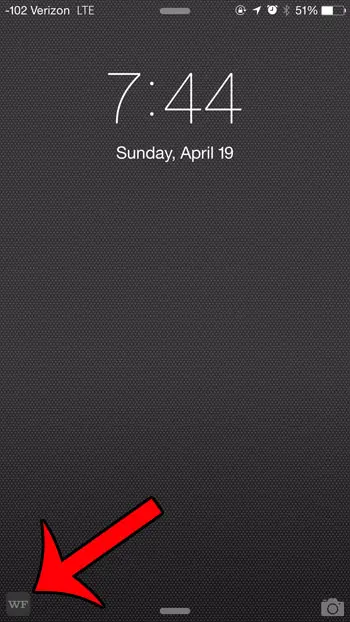
That version is no longer covered in Apple’s current documentation, so treat these steps as a reference for an old device only:
- Open Settings.
- Tap iTunes & App Store.
- Scroll to Suggested Apps and turn off My Apps, App Store, or both.
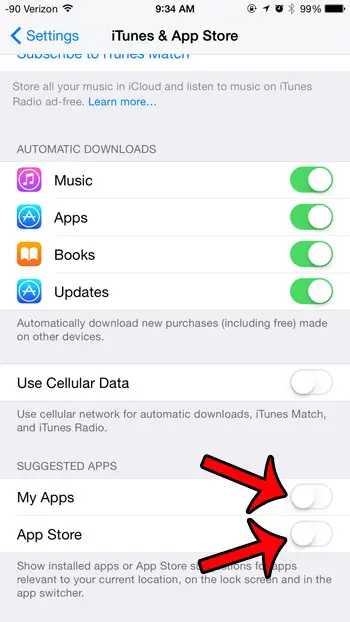
Leaving My Apps on and turning off App Store limited suggestions to apps that were already installed. Later versions of iOS moved or renamed this setting more than once, and current versions do not have a Suggested Apps section. If your iPhone can be updated, the sections above are the ones that apply.
Limit what works while the iPhone is locked
If your real concern is that someone else can see or use things without unlocking the phone, there is one screen that controls it.
Know the trade-off first: Apple points out that turning off Lock Screen access keeps other people from seeing personal information, but you also lose quick access to it yourself.
- Open Settings.
- Tap Face ID & Passcode, or Touch ID & Passcode on an iPhone with a Home button, and enter your passcode.
- Scroll to Allow Access When Locked.
- Turn off the items you do not want available, such as Today View and Search or Control Center.
The exact list depends on your model and iOS version. Related: how to use Control Center on the Lock Screen.
Check that it worked, and undo it
Press the side button to lock the iPhone, then wake it again. The control, widget, or notification you changed should be gone or replaced. Every change in this guide is a setting, not a deletion, so you can reverse it by returning to the same screen and turning the option back on or adding the item again.
Troubleshooting
- Customize does not appear. The iPhone has to be unlocked first. Touch and hold the Lock Screen again and enter your passcode if prompted.
- There is no remove button on the bottom buttons. Swapping Lock Screen controls is a newer feature. On older iOS versions the flashlight and camera buttons are fixed. Check Settings > General > Software Update.
- The icon comes back. If you use more than one Lock Screen, or a Lock Screen linked to a Focus, each one has its own widgets and controls. Edit the one that is showing.
- A setting is missing. Some options appear only when the app supports them, including Live Activities and Show Previews.
- Settings are grayed out. Screen Time restrictions or a work or school management profile can lock certain settings. Check with whoever manages the device.
Frequently asked questions
Can I remove the flashlight and camera from the Lock Screen?
On current versions of iOS you can swap either button for a different control by touching and holding the Lock Screen and tapping Customize. On older versions the two buttons cannot be changed.
Why does an icon appear only sometimes?
Notifications and Live Activities show up when an app has something to report and disappear when it is cleared or the event ends. Widgets and controls stay in place until you edit the Lock Screen.
Does an icon on the Lock Screen mean someone is using my iPhone?
No. Controls, widgets, notifications, and Live Activities are all normal iPhone features. If a Lock Screen was changed and you did not do it, review who knows your passcode.
Can people use these icons without my passcode?
Some of them. The camera and flashlight work while the phone is locked, and widgets can show information. Use Allow Access When Locked in Face ID & Passcode to restrict what is available.
How do I hide what a notification says without hiding the icon?
Go to Settings > Notifications > Show Previews and choose When Unlocked or Never. The app icon and name still appear, but the content stays hidden while the iPhone is locked.
Next step
Match the icon to its position in the table at the top, then make the one change that applies. If the app itself is the problem, turning off its Lock Screen alerts in Settings > Notifications is the least disruptive place to start.

Matthew Burleigh is the founder, head writer, and editor of Solve Your Tech, which he launched in 2012. He has written technology tutorials since 2008 and worked in IT since 2003, including small-business support, IT management, and consulting. He holds Bachelor’s and Master’s degrees in Computer Science from Arizona State University.
Matthew writes practical guides for Windows, iPhone and iPad, Microsoft Office, Outlook, Google apps, and Android. Solve Your Tech’s guides are tested on current devices or checked against official product documentation, with clear steps, sources, and update dates.
Read more about Matthew and how Solve Your Tech writes and updates its guides, or report a correction.