To switch to Easy mode on a Samsung Galaxy phone, open Settings, tap Display, tap Easy mode, and turn on the switch. Text and icons get larger, the Home screen shows fewer apps, and long presses need a slightly longer hold. Turn the same switch off to go back to the standard layout.
These steps cover current Galaxy phones running Samsung’s One UI software, including the Galaxy S, Z Fold, Z Flip and A series that Samsung lists on its Using Easy Mode on my Samsung Phone page. Older phones such as the Galaxy On5, which this guide was first written for, are covered in their own section below.
What Easy Mode Changes
Easy mode is a one-switch shortcut for several settings that would otherwise take a few minutes to find. Samsung’s display settings guide says it enlarges on-screen items, adds a high contrast keyboard, and helps prevent accidental touches. In practice you get:
| Area | Standard layout | Easy mode |
|---|---|---|
| Text and icons | Normal size | Larger and bolder |
| Home screen | Your own apps, folders and widgets | A simple grid with a small set of large app tiles |
| Long press | Standard delay | Longer delay, so a slow tap isn’t read as a long press |
| Samsung Keyboard | Normal colors | High contrast keys (black on yellow by default) |
| Extra screens | Google Discover or your other pages | A contacts page and a Magnifier shortcut |
Your apps, photos, messages and accounts are not touched. Easy mode only changes how the phone looks and responds.
Before You Turn It On
When you turn Easy mode on, some Galaxy phones show a notice that your Home screen customizations will be discarded. On many phones the old layout comes back when you turn Easy mode off, but that isn’t guaranteed on every model and software version. Take a screenshot of each Home screen page first so you can rebuild your layout if you need to.
How to Turn On Easy Mode
- Open the Settings app. It has a gray gear icon and is in the Apps screen. You can also swipe down from the top of the screen and tap the gear.
- Scroll down and tap Display. The Display settings open, with options such as Brightness and Font size and style.
- Scroll down and tap Easy mode. A screen opens with a short description and a preview.
- Tap the switch at the top so it turns on. Within a second or two, the text gets larger and the Home screen changes to the Easy mode layout.
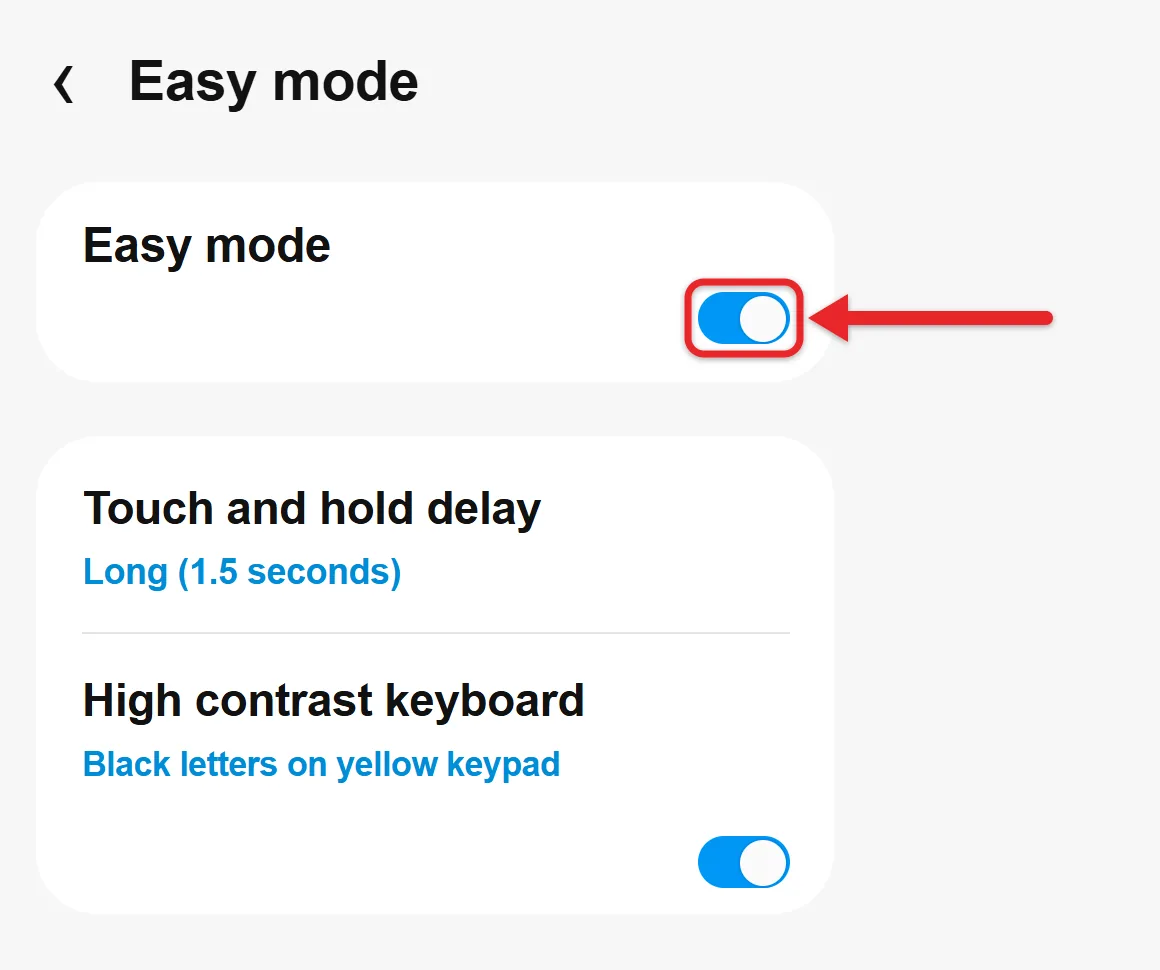
Press the Home button or swipe up from the bottom of the screen to see the new Home screen. If Easy mode isn’t under Display, tap the search icon at the top of Settings and type easy mode.
Adjust the Easy Mode Settings
The Easy mode screen in Settings > Display has two extra options once the switch is on:
- Touch and hold delay: sets how long you must press before the phone treats it as a long press. A longer delay stops menus from popping up when someone rests a finger on the screen. Pick a preset length or set a custom time. If long presses feel slow, choose a shorter one.
- High contrast keyboard: gives Samsung Keyboard bold, high contrast keys. The default theme is black keys on yellow, and you can pick another color theme or turn it off while keeping the rest of Easy mode. It only changes Samsung Keyboard, so if you use Gboard or another keyboard app, its look stays the same.
Use the Easy Mode Home Screen
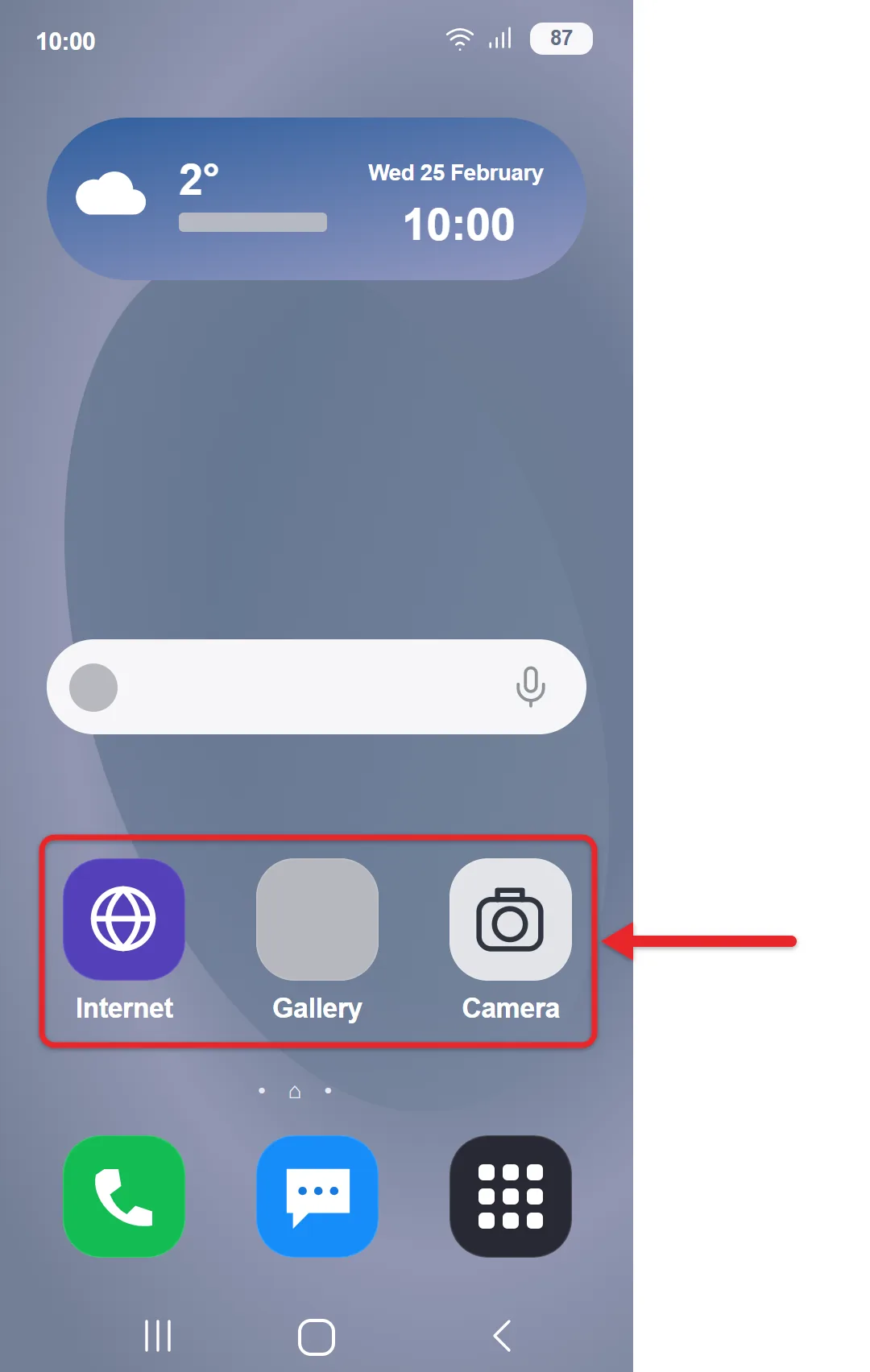
The Easy mode Home screen keeps the basics, such as Phone, Messages and Camera, as large tiles. There are two extra features:
- Magnifier: swipe left on the Home screen and tap Magnifier. Tap Allow when the phone asks for camera access, then use the zoom control to enlarge small print such as a menu or medicine label.
- Contacts page: swipe across the Home screen to reach a page of contact shortcuts. Tap the add contact icon, tap Allow, then choose Create contact or Add existing contact and pick the person. Each contact becomes a large tile you can tap to call or message. To take one off, tap Delete and select the contact.
To add an app tile, swipe up to open the Apps screen, touch and hold the app, and drag it onto the Home screen. If you’re setting up a phone for a relative, add only the apps they use every day and put their most-called people on the contacts page. A short Home screen is what makes Easy mode easy.
How to Turn Off Easy Mode
- Open Settings and tap Display.
- Tap Easy mode.
- Tap the switch so it turns off.
The phone goes back to the standard text size, keyboard colors and long-press timing, and the standard Home screen returns. If some of your old app icons or folders are missing, open the Apps screen and drag them back. For help arranging them again, read about moving apps on Android.
Easy Mode on Older Galaxy Phones Like the Galaxy On5
On older Galaxy phones from the Android 5 and 6 era, including the Galaxy On5, Easy mode was listed directly in the main Settings menu instead of under Display. Instead of a switch, that screen offered a choice between Standard mode and Easy mode.
Tap Easy mode, choose the apps you want on the Home screen, and tap Done. To go back, return to the same screen, tap Standard mode, and tap Done. If you don’t see it, use the search icon at the top of Settings.
App updates can also change how familiar apps look, so some people choose to stop apps from updating automatically and update on Wi-Fi when they are ready.
Other Ways to Make a Galaxy Phone Easier to Use
You don’t have to use Easy mode to get bigger text. These settings keep your normal Home screen:
- Bigger or bolder text: go to Settings > Display > Font size and style and drag the Font size slider, or turn on Bold font.
- Bigger everything: go to Settings > Display > Screen zoom and move the slider. On Z Fold phones this is called Screen layout and zoom.
- High contrast and other vision aids: go to Settings > Accessibility > Vision enhancements. Options include High contrast fonts, Color inversion, Reduce animations and a Display mode choice that includes Large display.
- Buttons instead of gestures: go to Settings > Display > Navigation bar and choose Buttons to get Back, Home and Recent apps keys.
- More time before the screen turns off: go to Settings > Display > Screen timeout and pick a longer time.
Choose Easy mode when you want the whole phone simplified in one step. Choose the individual settings when you only need larger text or one specific aid.
Troubleshooting
- No Easy mode option: search Settings for “easy mode.” If it still doesn’t appear, update the phone in Settings > Software update, then check again.
- Easy mode doesn’t seem to apply: restart the phone and check again. Samsung also notes that outdated software or very low storage can stop the changes from applying correctly.
- Apps disappeared from the Home screen: Easy mode shows only a few tiles. Every app is still in the Apps screen. For more fixes, read about getting apps back on the Home screen on Android.
- The Edge panel or other features are gone: Easy mode turns off some advanced extras to keep the screen simple. Turn Easy mode off to get them back.
- Keyboard colors didn’t change: the high contrast keyboard only works with Samsung Keyboard. Switch back to it, or turn on high contrast options in your other keyboard’s settings.
Frequently Asked Questions
Does Easy mode delete apps or data?
No. Apps, photos, contacts and messages stay on the phone. Easy mode only changes the layout, text size, keyboard colors and touch timing. Your Home screen arrangement may need to be rebuilt afterward, which is why a screenshot beforehand helps.
Can I still use all my apps in Easy mode?
Yes. The Home screen shows fewer apps, but every installed app is still available in the Apps screen, and you can drag any of them onto the Easy mode Home screen.
Is Easy mode the same as Senior mode or Simple mode?
People often call it that, but Samsung’s name is Easy mode. Other Android phone makers have their own versions with different names and steps.
Do other Android phones have Easy mode?
Easy mode is a Samsung feature. On a Pixel or other Android phone, you can get a similar result by raising the display size and font size in the Display or Accessibility settings and keeping only a few apps on the Home screen.
If you’re setting up the phone for someone else, do it together so they know where the switch is if they ever want to change it back.

Matthew Burleigh is the founder, head writer, and editor of Solve Your Tech, which he launched in 2012. He has written technology tutorials since 2008 and worked in IT since 2003, including small-business support, IT management, and consulting. He holds Bachelor’s and Master’s degrees in Computer Science from Arizona State University.
Matthew writes practical guides for Windows, iPhone and iPad, Microsoft Office, Outlook, Google apps, and Android. Solve Your Tech’s guides are checked step by step against the device or app maker’s own documentation and tested on his own devices whenever he has the hardware or software, with clear steps, sources, and update dates.
Read more about Matthew and how Solve Your Tech writes and updates its guides, or report a correction.