To unblock a contact on an iPhone running iOS 26 or later, open Settings > Privacy & Security > Blocked Contacts, tap Edit, tap the delete button next to the contact, and tap Unblock. Once unblocked, that person can call, text, and FaceTime you again. You can also unblock someone from the Phone, Messages, or FaceTime app.
This guide covers the Settings method, unsaved numbers, the Phone, Messages, and FaceTime shortcuts, older iOS versions, what happens after you unblock, and what to check when calls still don’t come through. The steps are the same on an iPad. On an Android phone instead? See how to unblock a number on Android.
How to Unblock a Contact in Settings
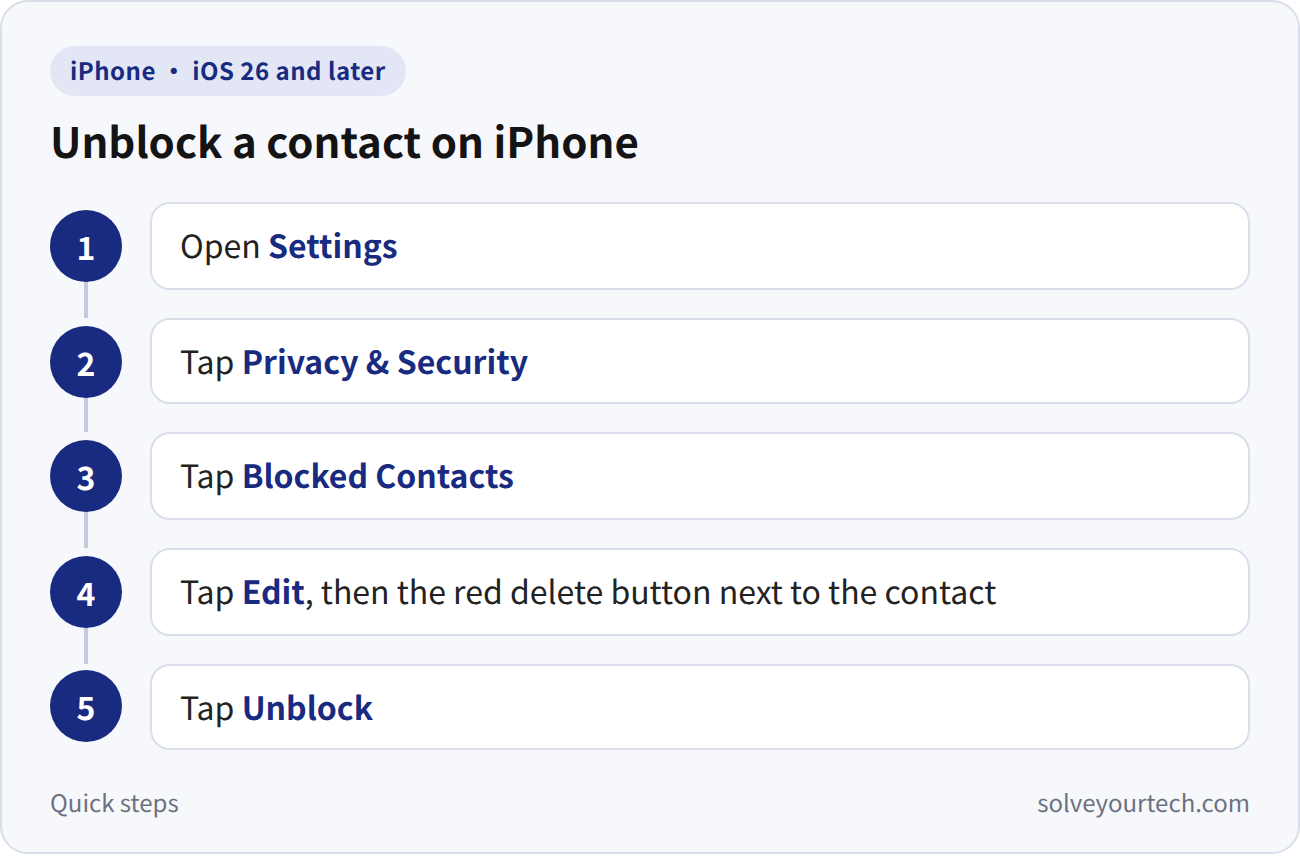
- Open the Settings app.
- Tap Privacy & Security, then Blocked Contacts. Expected result: a list of everyone you’ve blocked appears.
- Tap Edit in the top-right corner. Expected result: a red delete button appears next to each entry.
- Tap the red button next to the person, then tap Unblock. Expected result: they disappear from the list.
- Tap Done.
You can also swipe left on an entry and tap Unblock instead of using Edit. These steps come from Apple’s guide to blocking and unblocking contacts.
Unblock a number that isn’t saved as a contact
Unsaved numbers are grouped separately. In Blocked Contacts, tap the Unknown group (it shows how many numbers it holds), then tap Edit or swipe left on the number and tap Unblock. You don’t need to save the number first.
On iOS 18 and earlier
Older versions keep the list under Settings > Phone > Blocked Contacts, or Settings > Apps > Phone > Blocked Contacts on iOS 18. The same list also appears in the Messages and FaceTime settings. Tap Edit, then the red button, then Unblock. Not sure which version you have? Check Settings > General > About.
Unblock Someone From the Phone, Messages, or FaceTime App
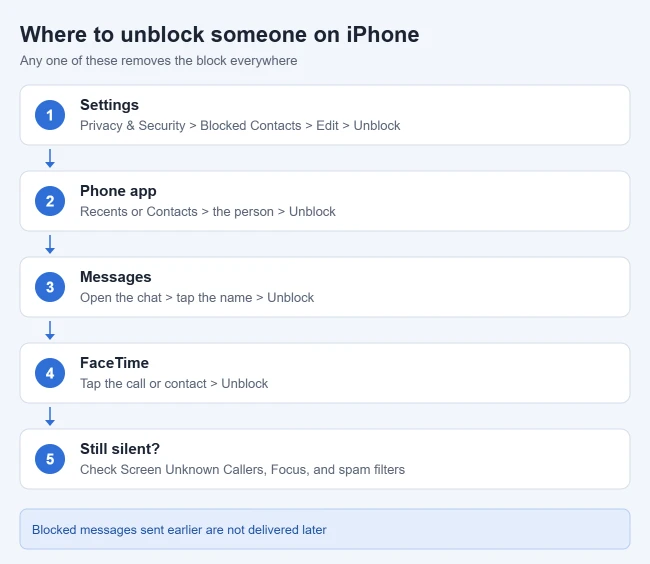
- Phone: tap Recents (or find the person in Contacts), tap the number or its Info button, scroll down, and tap Unblock Contact. Older versions call it Unblock this Caller.
- Messages: open the conversation, tap the name at the top, scroll down, and tap the unblock option.
- FaceTime: tap the call in your history or the person’s contact info, scroll down, and tap Unblock Contact.
Whichever app you use, the block is removed from all three, because they share one blocked list.
What Happens After You Unblock Someone
- New calls, texts, and FaceTime calls from them come through normally.
- Messages they sent while blocked aren’t delivered, so you won’t see them after unblocking.
- Apple says blocked callers can still leave a voicemail, but you don’t get a notification for it.
- Apple says blocked contacts aren’t notified that their call or message was blocked.
- Devices signed in to the same Apple Account share the blocked list, so unblocking on your iPhone also applies to your iPad.
To see who else is on the list, see how to see blocked numbers on iPhone.
Can’t Find the Person in Blocked Contacts?
- They were blocked by email: iMessage and FaceTime can use an email address instead of a phone number. Look for their email in the list and unblock it too.
- They have more than one number: each blocked number is listed separately, so unblock every entry that belongs to them.
- It’s saved under another name: scroll the full list, or check the Unknown group for the bare number.
Unblock an Email Sender
Apple notes that email you block in Mail goes to the trash and that email blocking works across your Apple devices. To undo it, open an email from that sender, tap their name at the top, tap View Contact Card, and tap the unblock option. See how to block an email sender on an iPhone for the reverse steps.
Unblocked but Calls Still Don’t Ring?
Other iPhone settings can silence a number even after the block is gone:
- Unknown caller screening: if the number isn’t saved, go to Settings > Apps > Phone and check Screen Unknown Callers or Silence Unknown Callers. Save the number as a contact or turn screening off. Our guide to Silence Unknown Callers shows where it is.
- FaceTime: FaceTime has its own Silence Unknown Callers switch under Settings > Apps > FaceTime.
- Focus or Do Not Disturb: an active Focus can silence calls. Add the person to the Focus’s allowed people or turn the Focus off. Our guide to turning on Do Not Disturb on iPhone covers both.
- Messages filtered as spam: in Messages, tap the filter button, open the spam or unknown senders list, and move the conversation back.
- Carrier or app blocks: blocks set through your carrier or a call-blocking app have their own lists. Remove the number there too. See how to turn off spam calls on iPhone for the related settings.
Frequently Asked Questions
How do I see who I have blocked?
Go to Settings > Privacy & Security > Blocked Contacts. Unsaved numbers are in the Unknown group.
Will they know I unblocked them?
Apple says blocked contacts aren’t notified when their calls or messages are blocked, and Apple doesn’t describe any alert for unblocking. In practice, they’ll only notice when their calls and messages start going through.
Can I get the messages they sent while blocked?
No. Messages sent while someone is blocked aren’t delivered to your iPhone, so there’s nothing to recover. Ask them to send it again.
How do I block someone again?
In Blocked Contacts, tap Add Blocked Contact and pick the person, or tap Block Caller from the Phone, Messages, or FaceTime app. To stop texts only, see how to block texts on iPhone.
Do I need to restart my iPhone after unblocking?
No. The change takes effect right away.
If a contact shows the wrong number or name because two cards were combined, learn how to unmerge contacts on an iPhone so each card is separate again.

Matthew Burleigh is the founder, head writer, and editor of Solve Your Tech, which he launched in 2012. He has written technology tutorials since 2008 and worked in IT since 2003, including small-business support, IT management, and consulting. He holds Bachelor’s and Master’s degrees in Computer Science from Arizona State University.
Matthew writes practical guides for Windows, iPhone and iPad, Microsoft Office, Outlook, Google apps, and Android. Solve Your Tech’s guides are tested on current devices or checked against official product documentation, with clear steps, sources, and update dates.
Read more about Matthew and how Solve Your Tech writes and updates its guides, or report a correction.