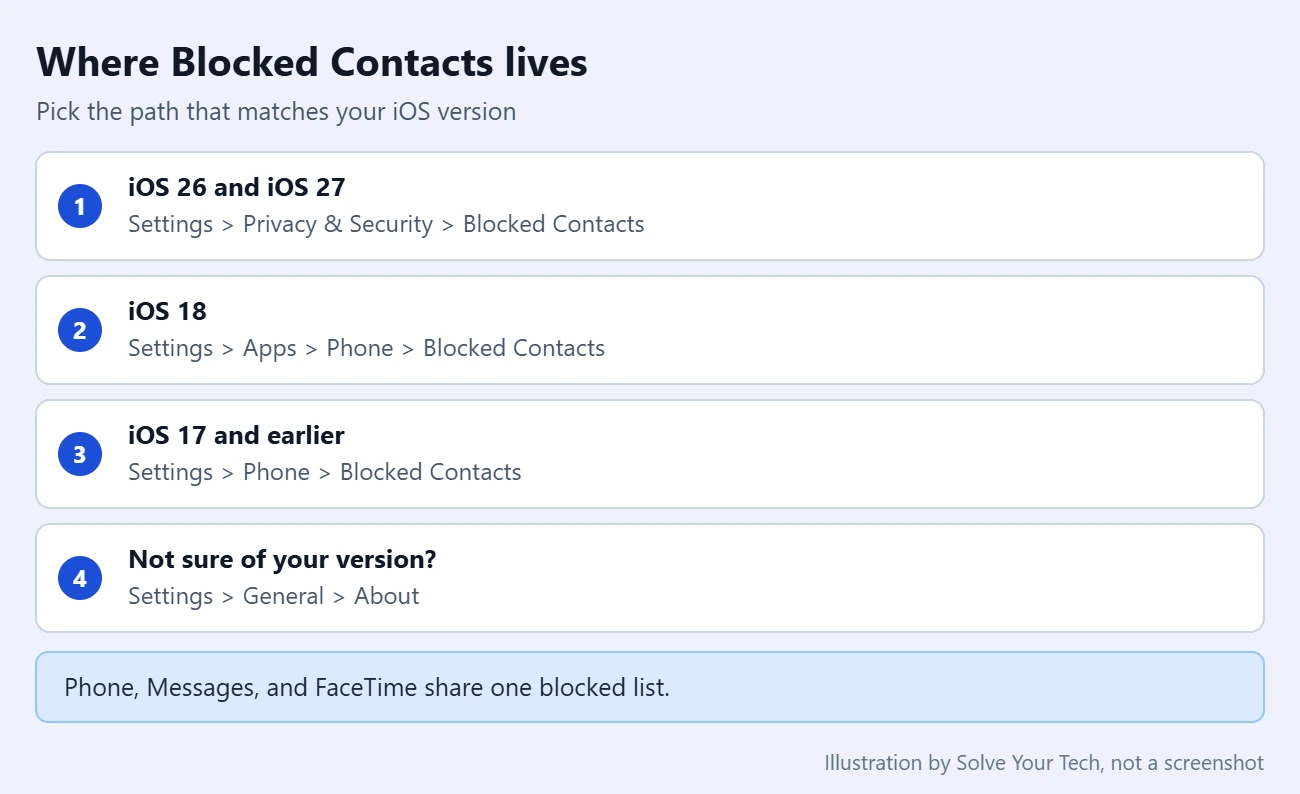
To see blocked numbers on an iPhone running iOS 26 or iOS 27, open Settings, tap Privacy & Security, and tap Blocked Contacts. The list shows the phone numbers, contacts, and email addresses you have blocked. On iOS 18, the list is in Settings > Apps > Phone > Blocked Contacts, and on iOS 17 or earlier it is in Settings > Phone > Blocked Contacts.
This guide covers each path, how to check one specific number, how to unblock or add someone from the same screen, and what to check when a number is missing from the list but its calls still do not ring.
Check Your iOS Version
- Check your iOS version. Open Settings > General > About and read the iOS Version line. The menu path changes with the version.
- You only need your own iPhone. The list is stored in your settings. There is nothing to install and no account page to visit.
- One list covers several apps. Apple says a contact you block in Messages is also blocked in Mail, Phone, FaceTime, Calendar, and other apps, so you do not have to hunt through separate lists for calls and texts.
- The list shows who is blocked, not what they sent. It is a list of names, numbers, and addresses. It is not a log of blocked calls or texts.
View Your Blocked List on iOS 26 and iOS 27
- Open the Settings app.
- Scroll down and tap Privacy & Security.
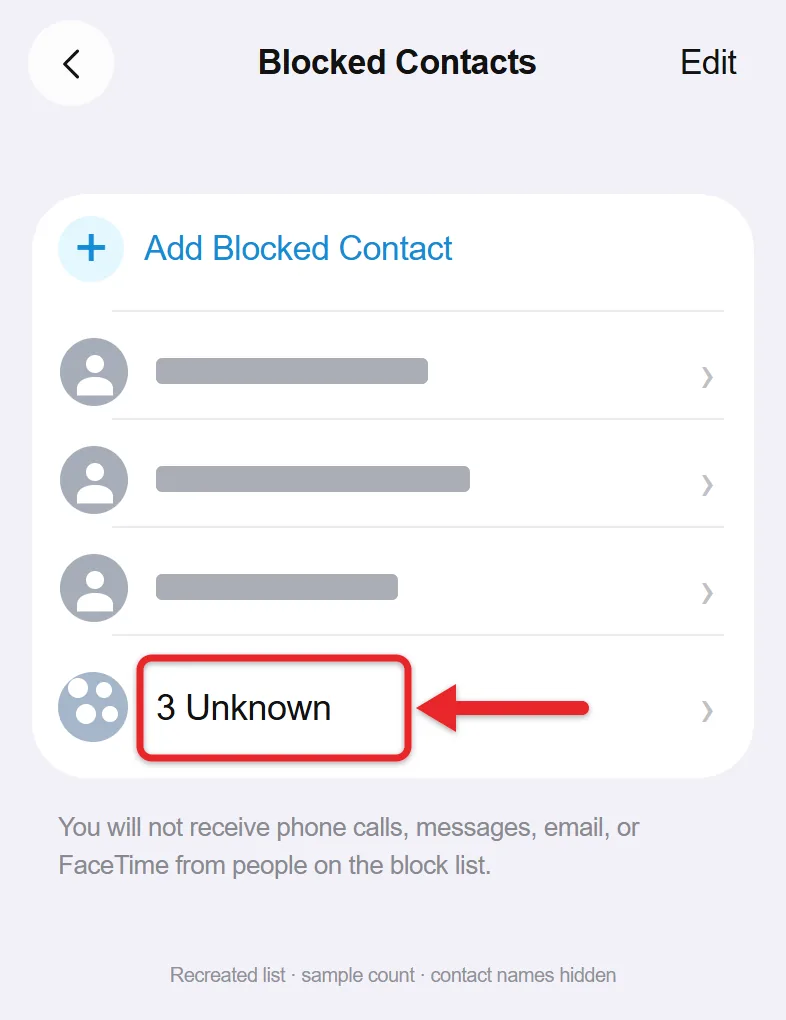
- Tap Blocked Contacts. The list opens with your blocked contacts shown by name.
- If you see a row that ends in Unknown with a number in front of it, tap it. That row holds the blocked phone numbers and addresses that are not saved in your Contacts.
- Tap any entry to open its details and see the number or email address behind it.
These steps follow Apple’s guide to blocking phone numbers, contacts, and emails and the Blocked Contacts page of the iPhone User Guide.
Other routes to the same list
Apple’s current iPhone User Guide also points to the list from individual app settings. Use whichever is closer to what you are doing:
- Phone: Settings > Apps > Phone > Blocked Contacts.
- FaceTime: Settings > Apps > FaceTime > Blocked Contacts.
- Settings search: open Settings, pull down to show the search field, and type Blocked Contacts. The result should take you to the same screen.
Every route opens one shared list, so you do not need to check more than one.
Publications you hide in the News app are not on this list. To manage those, here’s how to block a channel in Apple News.
View Your Blocked List on iOS 18
iOS 18 groups app settings inside an Apps menu, and it does not have the Privacy & Security shortcut.
- Open Settings.
- Scroll to the bottom and tap Apps.
- Tap Phone.
- Tap Blocked Contacts.
View Your Blocked List on iOS 17 and Earlier
- Open Settings.
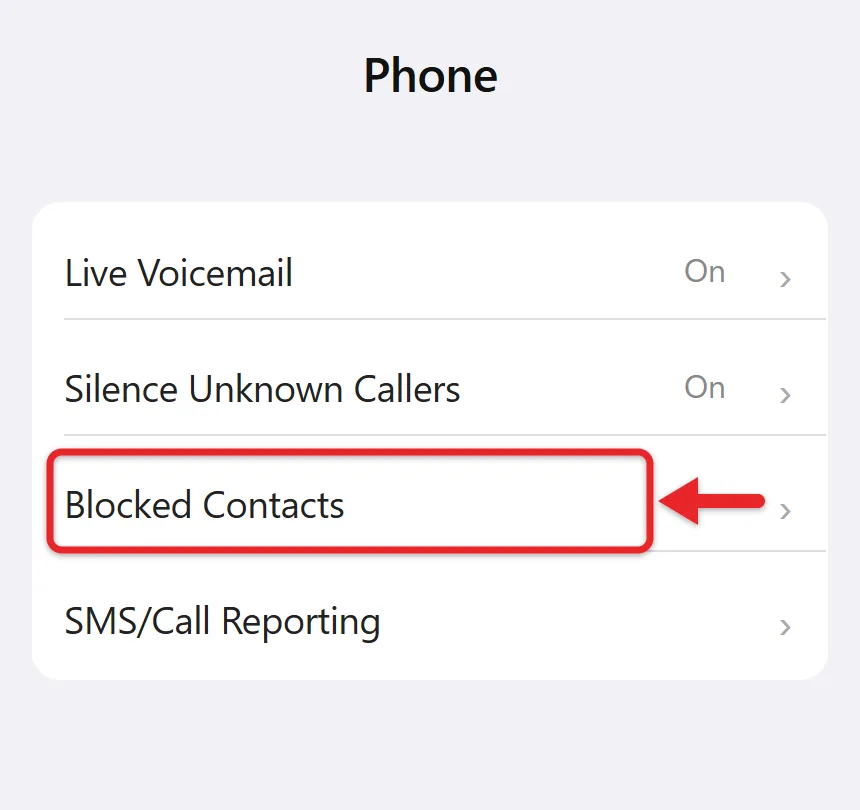
- Scroll down and tap Phone.
- Tap Blocked Contacts.
On these older versions the Phone, Messages, and FaceTime settings each have their own Blocked Contacts entry. They all show the same list.
On very old versions such as iOS 9, the entry is called Blocked instead: Settings > Phone > Blocked.
Check Whether One Specific Number Is Blocked
If you only care about one person, you can skip the full list.
- Open the Phone app and find the number in your call list. In the Classic layout that is the Recents tab, and in the Unified layout it is Calls. You can also open the person in Contacts.
- Tap the number or name, or tap the Info button next to it in the Classic layout.
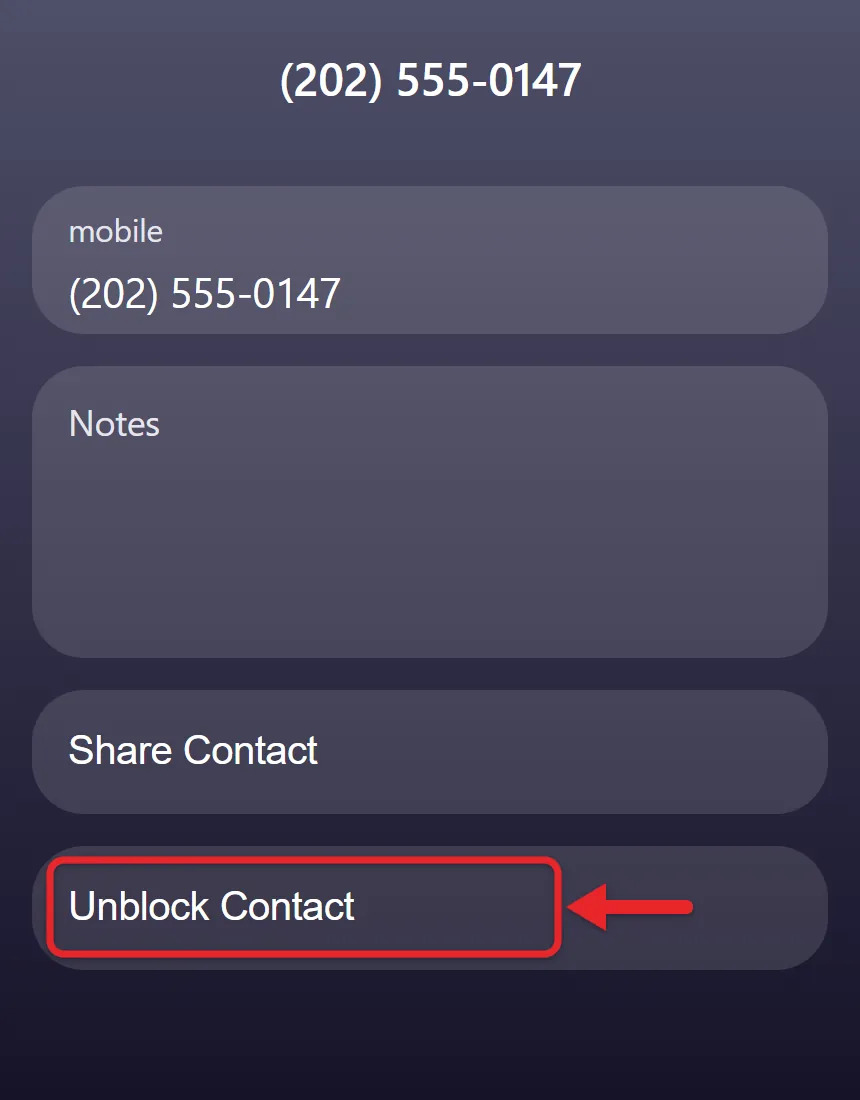
- Scroll to the bottom of the details screen.
- Read the last option. A block option, such as Block Caller or Block Contact, means the number is not blocked. An unblock option, such as Unblock Contact, means it is. The exact wording varies a little between iOS versions.
In Messages, open the conversation and tap the person’s icon at the top to reach the same details screen.
What the List Shows and What It Leaves Out
Saved contacts appear by name. Blocking a contact blocks the numbers and addresses stored for that contact. Numbers and addresses that are not in your Contacts sit behind the Unknown row on iOS 26 and later, and in one combined list on older versions.
Here is what blocking does:
- A blocked caller can still leave a voicemail, but you do not get a notification.
- Messages from a blocked contact are not delivered.
- The other person does not get a notification that the call or message was blocked.
- Email from a blocked address in Mail goes to the trash folder, and email blocking applies across your Apple devices.
Apple does not document a history of blocked calls or texts, so do not expect to find dates, times, or message contents here. Unblocking someone later does not bring back messages they sent while blocked, because those messages were never delivered.
Voicemails from blocked numbers
Blocked callers can leave voicemail, but Apple’s documentation does not say where those messages are stored. On many iPhones with Visual Voicemail (the feature that lists your voicemails in the Phone app), a Blocked Messages section appears at the bottom of the voicemail list. If you do not see it, there may be no blocked voicemails, or your carrier may not offer Visual Voicemail.
Unblock a Number From the List
Before you unblock: the change takes effect right away. That person can call, text, and FaceTime you again as soon as you remove them.
- Open the Blocked Contacts list using the path for your iOS version.
- For a number that is not saved, tap the Unknown row first.
- Swipe left on the entry and tap Unblock.
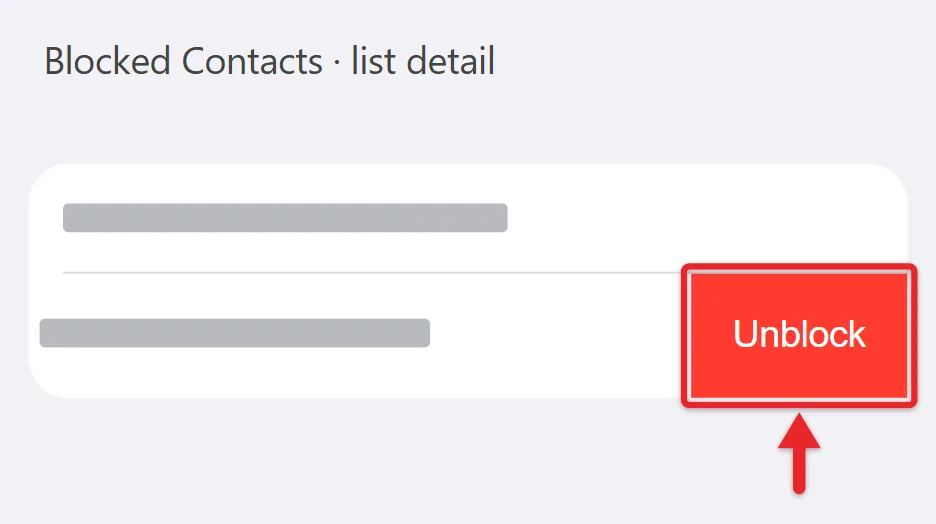
Two other methods do the same thing. You can tap Edit, tap the red delete button next to the entry, and then tap Unblock. Or you can tap a blocked contact, scroll down, and tap Unblock Contact.
To confirm it worked, check that the entry is gone from the list. To undo it, block the number again with the steps in the next section. There are also more ways to unblock a contact on iPhone from the Phone and Messages apps.
Add a Number to the List
Before you block: you will stop getting that person’s calls, texts, and FaceTime calls, and you will not be notified if they leave a voicemail. Do not block a number you rely on for appointment reminders or sign-in codes.
- Open Settings > Privacy & Security > Blocked Contacts.
- Tap Add Blocked Contact.
- Select or enter the contact you want to block.
- Tap Block Contact.
The entry appears in the list right away. To block someone straight from a call or conversation, follow the steps for blocking text messages and calls on iPhone.
A Number Is Not on the List but Still Does Not Ring
The Blocked Contacts list only shows people you blocked yourself. Several other iPhone features can keep a call or text quiet without adding anyone to that list.
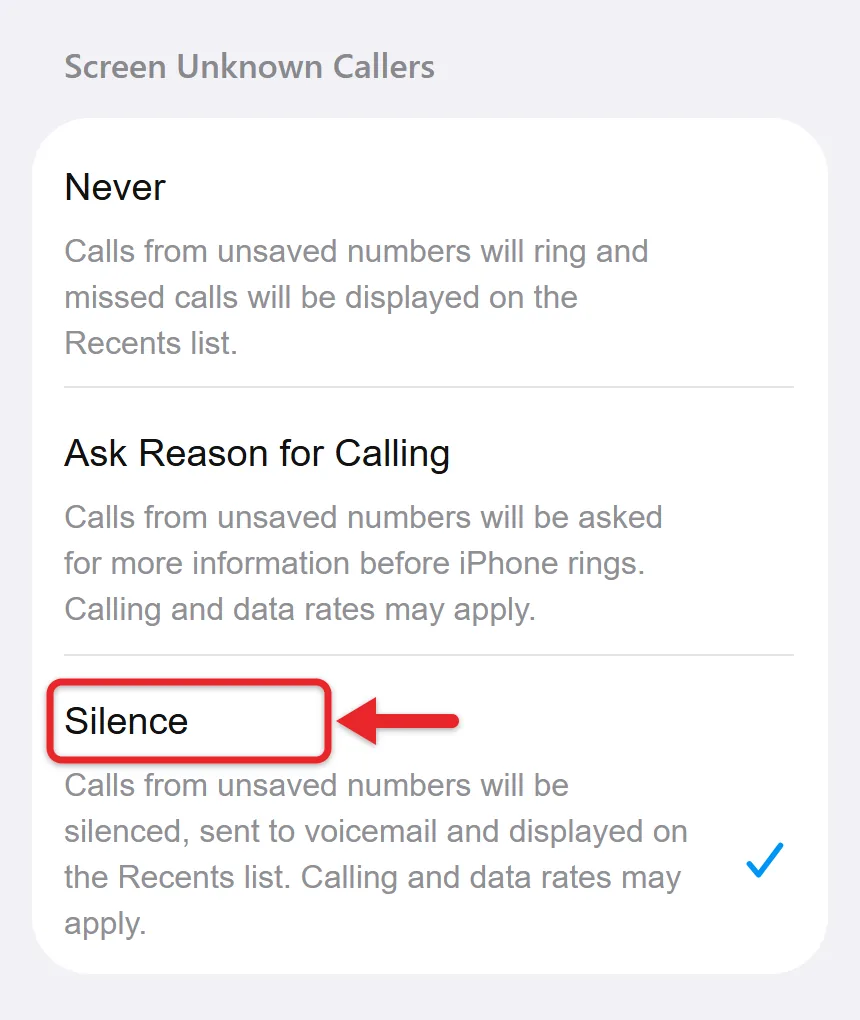

- Call screening or silencing. In Settings > Apps > Phone on iOS 26 and later, the unknown-number setting can be Never, Ask Reason for Calling, or Silence. With Silence, calls from unsaved numbers go to voicemail and still appear in your call list. On iOS 18 and earlier the setting is a single Silence Unknown Callers switch.
- Call filtering. If Unknown Callers or Spam filtering is on, those calls are moved out of your main call list. The switches for these filters are covered in turning off spam calls on iPhone. In the Phone app, open the filter menu at the top of the call list and tap Unknown Callers or Spam to see them. Tap Mark as Known next to a call so that number is no longer filtered. Apple’s Screen and block calls on iPhone page explains these settings.
- Message filtering. Texts from people who are not in your contacts can be sorted into an Unknown Senders or Spam folder in Messages. See where the Unknown Senders folder is in iPhone Messages.
- A Focus. Do Not Disturb and other Focus modes silence calls without blocking anyone. To check whether one is on, here’s how to turn Do Not Disturb on or off on iPhone.
- Screen Time. Communication limits in Settings > Screen Time can restrict who can reach the phone. They are separate from Blocked Contacts.
- Other apps and your carrier. Third-party calling and messaging apps keep their own block lists inside each app, and a block set up through your carrier is managed with the carrier, not in iPhone Settings.
If calls from one person go to voicemail and none of these apply, there are other reasons an iPhone goes straight to voicemail.
If your own calls to another country fail instead, learn how to turn off Dial Assist on iPhone and dial the full number.
When Blocked Contacts Is Missing or Empty
Blocked Contacts is not under Privacy & Security
Your iPhone is most likely on iOS 18 or earlier. Confirm the version in Settings > General > About, then use Settings > Apps > Phone on iOS 18 or Settings > Phone on iOS 17 and earlier.
The list looks empty or too short
Tap the Unknown row. On iOS 26 and later, numbers that are not saved in Contacts are tucked behind it, and spam numbers are usually unsaved. If there is no such row and no entries, nothing is blocked on this iPhone.
I cannot find a number I am sure I blocked
If the person is saved in Contacts, look for the name, not the digits. Then check whether the block was made somewhere else, such as inside a third-party app or through your carrier.
A blocked person still gets through
Blocking applies to the numbers and addresses on the list. If the person calls from a different number, or messages you from an email address that is not blocked, add that number or address with Add Blocked Contact.
Can You Tell If Someone Blocked Your Number?
You cannot reliably confirm someone else’s blocked list from your iPhone. The sender cannot find out they are blocked. Your own Blocked Contacts list shows numbers you blocked, not people who blocked you. A call going straight to voicemail, ringing once, or a missing message delivery receipt can have other causes; none is a dependable confirmation of blocking. The same goes for a carrier recording, as this look at what “person is not available” means on iPhone explains.
A green message bubble doesn’t mean you’re blocked: it means the message went as RCS or MMS/SMS instead of iMessage. A phone that’s off, a connection problem, a Focus setting or carrier behavior can also affect calls and messages. A Cancelled entry in your own call log doesn’t show you the other person’s blocked list. Don’t use these signs as a test or keep calling from other numbers to get around a possible block. If you want to check whether you blocked a contact, use the version-specific list and unblocking steps above; those are settings you can actually see.
A Delivered label is no proof either way. Here is what Delivered on iPhone does confirm.
Scroll through the list once, including the Unknown row, and remove any entry you no longer want blocked. Apple’s page on reporting spam and blocking senders in Messages has more on handling unwanted texts.
Related: on an Android phone instead? Here’s how to unblock a number on Android. Seeing Canceled Call in your Recents? Here is what a canceled call means on iPhone.
Blocked Number Questions
Where is the blocked list on iPhone in iOS 26 and iOS 27?
Open Settings > Privacy & Security > Blocked Contacts. The same list is also reachable from Settings > Apps > Phone > Blocked Contacts.
Does a blocked person know they are blocked?
The contact does not get a notification that a call or message was blocked, and a sender cannot find out whether they are blocked.
Can I see texts a blocked number sent me?
No. Messages from a blocked contact are not delivered, so there is nothing stored on your iPhone to read, and unblocking does not deliver them afterward.
Is the blocked list different for calls, texts, and FaceTime?
No. Phone, Messages, and FaceTime use one list. Blocking a contact in Messages also blocks that contact in Mail, Phone, FaceTime, Calendar, and other apps.
Can I see blocked email addresses in the same place?
Yes. The Blocked Contacts list includes email addresses along with phone numbers. To add one from the Mail app, here’s how to block an email sender on iPhone.
Is Silence Unknown Callers the same as blocking?
No. Silencing or screening unknown numbers sends those calls to voicemail or asks the caller for a reason, but it does not add anyone to Blocked Contacts. Turning it off does not unblock anyone either.
Can I see who has blocked my number?
No. Your iPhone only lists the people you blocked. Apple does not provide a way to see who has blocked you.

Matthew Burleigh is the founder, head writer, and editor of Solve Your Tech, which he launched in 2012. He has written technology tutorials since 2008 and worked in IT since 2003, including small-business support, IT management, and consulting. He holds Bachelor’s and Master’s degrees in Computer Science from Arizona State University.
Matthew writes practical guides for Windows, iPhone and iPad, Microsoft Office, Outlook, Google apps, and Android. Solve Your Tech’s guides are checked step by step against the device or app maker’s own documentation and tested on his own devices whenever he has the hardware or software, with clear steps, sources, and update dates.
Read more about Matthew and how Solve Your Tech writes and updates its guides, or report a correction.