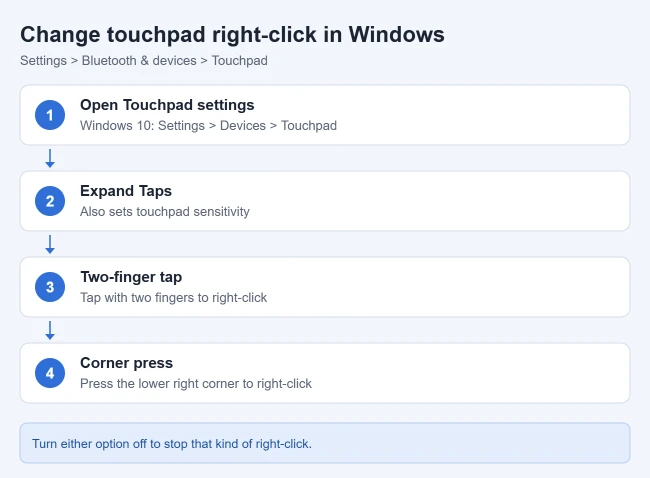
To change how right-click works on a Windows laptop touchpad, open Settings > Bluetooth & devices > Touchpad and expand Taps. Turn Tap with two fingers to right-click and Press the lower right corner of the touchpad to right-click on or off. In Windows 10, the touchpad settings are under Settings > Devices > Touchpad.
This guide covers both right-click options, touchpad sensitivity, scroll direction, gestures and other touchpad settings. The steps follow Microsoft’s touchpad gestures guide for Windows 11 and its touchpad use and settings article. Setting names can vary a little depending on your laptop’s touchpad.
In this article:
- Change the right-click setting
- How right-click works on a touchpad
- Change touchpad sensitivity
- Change scroll direction
- Three- and four-finger gestures
- Other touchpad settings
- Frequently asked questions
How to Change the Right-Click Setting on a Touchpad
- Select Start > Settings > Bluetooth & devices > Touchpad. (In Windows 10: Settings > Devices > Touchpad.)
- Expand Taps.
- Turn Tap with two fingers to right-click on or off.
- Turn Press the lower right corner of the touchpad to right-click on or off.
Result: Windows stops (or starts) treating that gesture as a right-click. If you keep accidentally opening menus with two fingers, turning off the two-finger tap usually fixes it. Microsoft says that if you don’t find the tap option you want, look in Touchpad > Advanced gestures.
How Right-Click Works on a Touchpad
Microsoft describes several ways to right-click on a touchpad, depending on your settings:
- Tap two fingers anywhere on the touchpad.
- Press the lower right corner of the touchpad.
- On touchpads with separate buttons, press the right button or the right side of the pad.
Microsoft’s Surface article explains that a right-click opens app commands in Windows apps or a context menu in desktop apps, just like the right button on a mouse. If you turn off both tap and corner right-click, you’ll need another way to right-click, such as a connected mouse.
How to Change Touchpad Sensitivity
Microsoft says the Taps section also controls touchpad sensitivity, from very responsive to needing a firmer tap. In the same section you’ll find Tap with a single finger to single-click and Tap twice and drag to multi-select.
Result: A lower sensitivity setting makes accidental taps less likely, which can help if your palm brushes the touchpad while typing.
How to Change Touchpad Scroll Direction
- Open Settings > Bluetooth & devices > Touchpad.
- Expand Scroll & zoom.
- Choose whether down motion scrolls up or down. You can also choose whether two fingers scroll and whether pinching zooms.
Result: Two-finger scrolling moves the page in the direction you picked.
Three- and Four-Finger Gestures
On the Touchpad page, Microsoft says you can choose what three-finger and four-finger swipes and taps do, such as switching apps or desktops or changing audio. For more control, go to Touchpad > Advanced gestures and pick an action for each tap and swipe direction.

Other Touchpad Settings
- Turn the touchpad fully on or off with the switch at the top of the Touchpad page.
- Change Cursor speed. To change mouse speed instead, see how to change mouse pointer speed in Windows.
- More touchpad options opens the Mouse Properties window, where you can change pointer types, schemes and button settings, according to Microsoft.
- On many laptops, the top Touchpad section also has an option to leave the touchpad on when a mouse is connected. Uncheck it if you want the touchpad to switch off whenever a mouse is plugged in or paired.
Frequently Asked Questions
Why does my touchpad right-click when I tap with two fingers?
That’s the Tap with two fingers to right-click setting. Turn it off under Touchpad > Taps.
Why can’t I find the Taps section?
Touchpad options vary by laptop, so your Touchpad page may look a little different. Microsoft notes Surface users can also customize the touchpad in the Surface app.
Do these settings affect my mouse?
No. Touchpad settings only change the built-in touchpad. Mouse settings are on the separate Mouse page.
More Windows Guides
If you’d like a pointer that’s easier to see, here’s how to change your mouse cursor in Windows 11.

Matthew Burleigh has been writing tech tutorials since 2008. His writing has appeared on dozens of different websites and been read hundreds of millions of times.
After receiving his Bachelor’s and Master’s degrees in Computer Science he spent several years working in IT management for small businesses. However, he now works full time writing content online and creating websites.
His main writing topics include iPhones, Microsoft Office, Google Apps, Android, and Photoshop, but he has also written about many other tech topics as well.