To block an artist on Spotify on your iPhone, open the artist’s page, tap the three dots under their name, and tap Don’t play this artist. Spotify then stops playing that artist’s songs for your account, including in playlists, radio and mixes.
These steps are for the current Spotify app for iPhone on iOS 27. The option is in the Spotify mobile app (iPhone, iPad and Android), but not in the desktop app or the web player.
To block just one song instead, Spotify lets you hide it in a playlist, snooze it for 30 days, keep it out of your taste profile, or turn off Autoplay. Each is covered below.
Which Spotify Control Should You Use?
Spotify has several controls that sound alike but do different jobs. Pick the one that matches what is bothering you:
| What you want | Use this | Where it works |
|---|---|---|
| Never hear one artist | Don’t play this artist | The artist’s page in the mobile app |
| Skip one song in one playlist | Hide this song | Playlists made by Spotify or other people |
| Stop a song being suggested for a while | Don’t suggest this song anywhere for 30 days | A song’s menu in a playlist |
| Stop some listening from shaping your recommendations | Exclude from your taste profile | A playlist or song menu |
| Stop Spotify adding similar songs after your music ends | Autoplay off | Settings and privacy |
| Skip songs marked explicit | Allow Explicit Content off | Settings and privacy |
How to Block an Artist on Spotify
- Open the Spotify app on your iPhone. Update it from the App Store first if you haven’t in a while, since menu labels change between versions.
- Tap Search, type the artist’s name, and tap the artist (not a song) in the results. If one of their songs is playing, you can also tap the artist’s name on the Now Playing screen.
- On the artist’s page, tap the three dots below the artist’s name, next to the Follow button. A menu opens.
- Tap Don’t play this artist. Some versions of the app shorten it to Don’t play this.
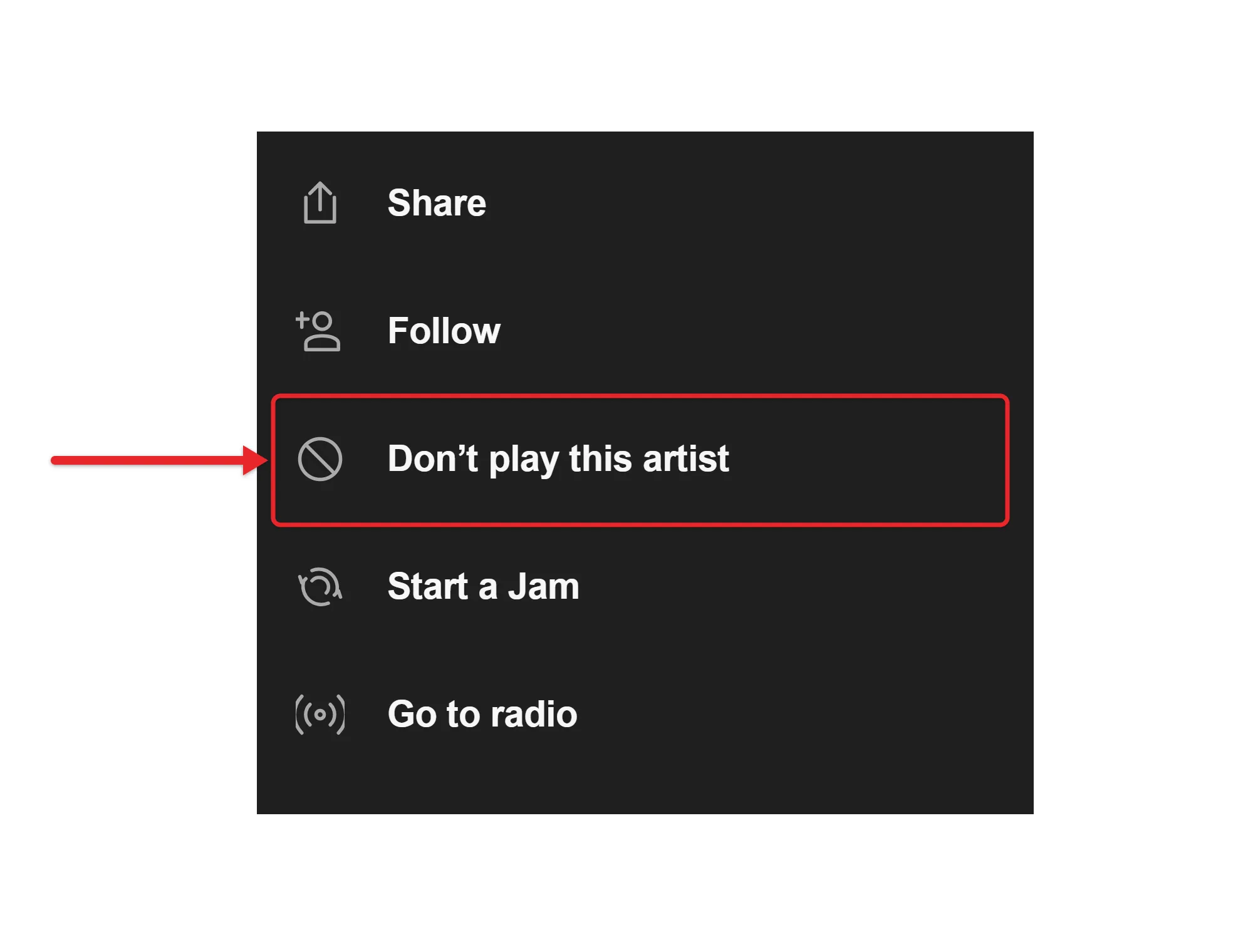
Spotify confirms the change. If one of the artist’s songs was playing, it skips to the next track. From now on, the artist’s songs are skipped in playlists, radio and recommendations, and if you try to play one, Spotify won’t play it.
The setting belongs to your Spotify account, not your phone. Spotify Community staff say it applies on all your devices, so once you set it on your iPhone, your computer, speakers and car should skip the artist too. You need the mobile app to set it, though: Spotify’s support team in the Community has said the option isn’t available in the web player, and the desktop app doesn’t show it either.
How to unblock an artist
- Search for the artist in the Spotify app on your iPhone and open their page.
- Tap the three dots below their name.
- Tap the option to allow the artist again. It appears in the same spot where Don’t play this artist was.
Their songs start playing again in playlists and mixes. If the desktop app shows the message “We can’t play this song until you allow this artist in the Spotify phone app,” this is the setting it means. Unblock the artist on your phone, then quit and reopen the desktop app.
What blocking does and doesn’t do
- It doesn’t remove the artist from Spotify. You can still find them in search, and their name still shows in album credits and on other people’s playlists.
- Featured appearances can still play. Spotify Community staff note that if the artist is featured on another artist’s song or album, that track may still play. Hide those songs one at a time if they bother you.
- It only covers that artist’s profile. A band and a solo project by the same singer are separate profiles on Spotify, so block each one you want to avoid.
How to see which artists you’ve blocked
Spotify doesn’t show a list of blocked artists in the app. A Spotify Star (a volunteer, not an employee) explained in a Spotify Community thread that the list is in your account data download.
- In a web browser, sign in to your Spotify account page and open Account privacy.
- Use Download your data to request your account data. Spotify’s data rights page describes this tool.
- When Spotify emails you the ZIP file, open it and find YourLibrary.json.
- Look for the section named bannedArtists. Those are the artists you marked with Don’t play this artist.
The Community answer says the email usually arrives within 5 days.
How to Hide One Song in a Playlist
Spotify’s guide to hiding songs says this works in playlists made by Spotify or by other people. In your own playlists, remove the song instead.
- Open the playlist.
- Tap the three dots next to the song.
- Tap Hide this song.
The song turns gray and gets skipped in that playlist. It can still play in other playlists where you haven’t hidden it. To bring it back, tap the three dots and choose Show in this playlist, or tap the remove icon next to the gray song.
How to Snooze a Song for 30 Days
Snoozing is for a song you are tired of rather than one you never want to hear again.
- Find the song in a playlist and tap the three dots next to it.
- Tap Hide in this playlist.
- Tap Don’t suggest this song anywhere for 30 days.
Spotify stops suggesting the song for 30 days. To end the snooze early, tap the remove icon next to the song.

How to Keep a Playlist Out of Your Recommendations
If someone else uses your account, or you play music for kids, workouts or sleep, you can stop that listening from shaping your recommendations. This doesn’t stop the music from playing.
- Open the playlist.
- Tap the three dots near the top of the playlist. For a single song, tap the three dots next to the song instead.
- Tap Exclude from your taste profile for a playlist, or Exclude track from your taste profile for a song.
Spotify’s taste profile article says the change takes effect within 48 hours, and Discover Weekly may not change until the following week. Excluded listening carries less weight in your recommendations, Home and Wrapped. In Wrapped, it won’t count toward your top artists or songs, but it still counts toward your total listening time.
Two limits are worth knowing. Plays of the same song from somewhere else, such as Liked Songs, still count. And hiding or snoozing a song doesn’t change your taste profile at all. To undo the exclusion, open the same menu and tap Include in your taste profile or Include track in your taste profile.
How to Turn Off Autoplay
When an album, playlist or song ends, Autoplay keeps going with similar music, which is often how an unwanted artist sneaks in. Spotify’s Autoplay article gives these steps:
- Tap your profile picture at the top of the app.
- Tap Settings and privacy.
- Under Playback, turn off Autoplay.
Music now stops when your selection ends. On the desktop app, Autoplay is under your profile picture > Settings.
The desktop app has a few settings the phone app does not, such as the switch to turn hardware acceleration on or off in Spotify.
How to Block Explicit Songs
If the problem is explicit lyrics rather than one artist, tap your profile picture > Settings and privacy, and under Content and display, turn off Allow Explicit Content. Explicit songs then turn gray and get skipped. For the full steps and the Premium Family controls, read about blocking explicit content on Spotify.
Why You Still Hear a Blocked Artist
Work through these in order:
- Check the artist’s page. Open it and tap the three dots. If you see Don’t play this artist, the block isn’t on. Tap it again.
- Check the song credits. If the artist is featured on someone else’s track, the block may not cover it. Hide that song in the playlist instead.
- Look for a different profile. Remixes, side projects and collaborations sometimes sit under a separate artist page.
- Clear the queue. Songs that were already queued before you blocked the artist can still show up. Tap the Now Playing bar, open the queue, and remove them.
- Turn off Autoplay (above) so Spotify stops adding similar music when your selection ends.
- Update and restart. Install any Spotify update from the App Store, then close and reopen the app. If the three dots are missing from the artist’s page, log out, restart your phone, log back in, and clear the cache. Here are the steps to clear the Spotify cache.
Some Community users report blocked artists still turning up in AI DJ sessions and on smart speakers. If that keeps happening, report it in the Spotify Community with your app version and the device that played the song.
Spotify Artist Blocking Questions
Can I block an artist on the Spotify desktop app or web player?
No. Set it in the Spotify mobile app on your iPhone, iPad or Android phone. Because the setting is on your account, the desktop app follows it after you set it on your phone.
Can I block several artists at once?
No. Spotify doesn’t offer a bulk block list. Open each artist’s page and tap Don’t play this artist one at a time.
Does hiding a song stop Spotify recommending it?
Not by itself. Hiding or snoozing a song doesn’t change your taste profile. To stop a song or playlist from shaping recommendations, use Exclude track from your taste profile.
Can I hide songs in my own playlist?
No. Hiding works in playlists created by Spotify or other people. In your own playlist, tap the three dots next to the song and remove it.
Next, if you share your account and want to keep your listening private, change your Spotify privacy settings.
Related Guides
- How to block explicit content on Spotify
- How to change Spotify privacy settings
- How to turn off shuffle on Spotify
- How to follow and download podcasts on Spotify

Matthew Burleigh is the founder, head writer, and editor of Solve Your Tech, which he launched in 2012. He has written technology tutorials since 2008 and worked in IT since 2003, including small-business support, IT management, and consulting. He holds Bachelor’s and Master’s degrees in Computer Science from Arizona State University.
Matthew writes practical guides for Windows, iPhone and iPad, Microsoft Office, Outlook, Google apps, and Android. Solve Your Tech’s guides are checked step by step against the device or app maker’s own documentation and tested on his own devices whenever he has the hardware or software, with clear steps, sources, and update dates.
Read more about Matthew and how Solve Your Tech writes and updates its guides, or report a correction.