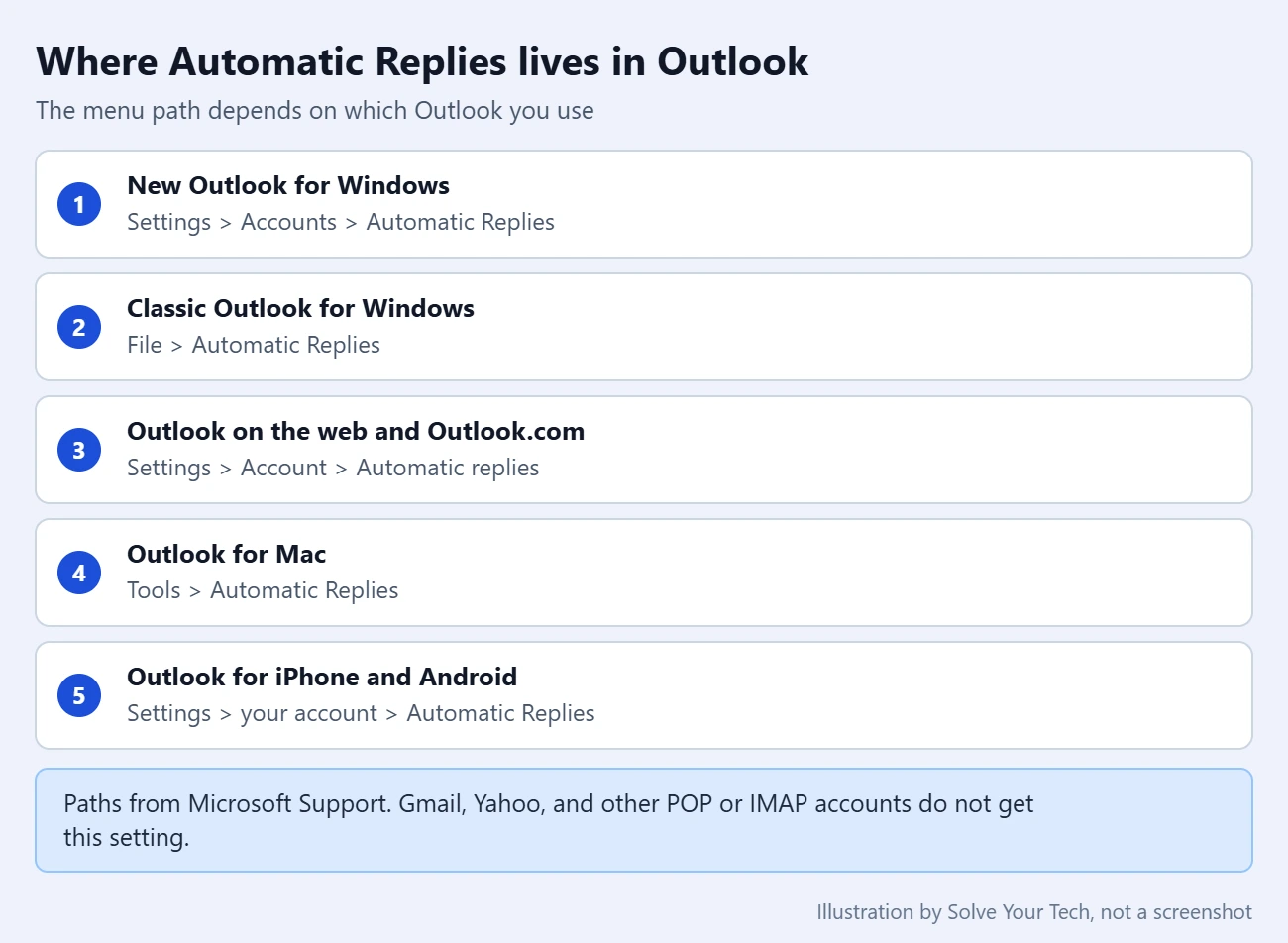
To set an out of office reply in the new Outlook for Windows, open Settings, select Accounts > Automatic Replies, turn the Automatic replies toggle on, type your message, and select Save. In classic Outlook, select File > Automatic Replies instead. Outlook calls this feature Automatic Replies, and it works with Microsoft 365, Exchange, and Outlook.com accounts.
The steps below follow Microsoft’s current out of office automatic replies guide and cover new Outlook, classic Outlook, Outlook on the web, Outlook for Mac, and the Outlook app on iPhone and Android.
Before You Start
Two things decide which steps you follow: your account type and your version of Outlook.
- Account type. Automatic Replies is available for Microsoft 365 work or school accounts, Exchange accounts, and Outlook.com accounts (including Hotmail). Microsoft says automatic replies are not supported for Gmail, Yahoo, or other POP or IMAP accounts. POP and IMAP are the standard ways a mail app connects to a mailbox from another email provider.
- Outlook version. New Outlook for Windows has a View tab with View settings and no File tab. Classic Outlook has a File tab at the left end of the ribbon. If the steps for one version do not match what you see, try the other.
- How often people get the reply. Microsoft says the automatic reply is sent once to each person who emails you while you are away, not once for every message.
- Work accounts. With a work or school account you can write one message for people inside your organization and a different one for people outside it. Your Exchange administrator can restrict replies to outside senders.
How to Set Out of Office in New Outlook for Windows
- On the View tab, select View settings. The Settings gear icon near the top-right corner of the window opens the same Settings window.
- Select Accounts, then Automatic Replies. If you have more than one account in Outlook, check that the right account is selected at the top of this page.
- Turn the Automatic replies toggle on. The rest of the options become available.
- To schedule the reply, select Send replies only during a time period and enter a start time and an end time. Outlook then starts and stops the replies for you. If you skip this, replies begin when you save and continue until you turn the toggle off.
- Type the message you want people to receive. With a work or school account, this first box is the message for people inside your organization.
- Decide who outside your organization or contacts gets a reply. Select Send replies only to contacts to limit replies to senders in your Contacts list. Work or school accounts also show Send replies outside your organization, with a separate message box.
- Select Save.
Read this before you turn on replies to everyone outside your organization: Microsoft warns that this sends your automatic reply to every email you receive, including newsletters, advertisements, and potentially junk email. Microsoft recommends choosing Send replies only to contacts instead.
How to Set Out of Office in Classic Outlook
These steps apply to classic Outlook for Microsoft 365 and to Outlook 2024, 2021, 2019, and 2016.
- Select File at the left end of the ribbon. The account information page opens.
- Select Automatic Replies. If you do not see that button, your account does not support the feature. Skip to the rule method below.
- In the Automatic Replies box, select Send automatic replies.
- Optionally, check Only send during this time range and choose a start time and an end time. Automatic replies turn off at the end time you enter. Without a time range, you need to turn them off yourself.
- Type your reply. With a work or school account, type the message for coworkers on the Inside My Organization tab.
- For outside senders, select the Outside My Organization tab, check Auto-reply to people outside my organization, and type a second message. Choose My contacts only unless you really want every outside sender to get it.
- Select OK to save your settings.
The same caution applies here. Microsoft says that replying to anyone outside your organization sends your message to every email, including newsletters, advertisements, and potentially junk email, and it recommends My contacts only.
While automatic replies are on, classic Outlook shows a message under the ribbon saying so. That bar is the quickest way to confirm the setting saved, and it has a Turn off button.
How to Set Out of Office in Outlook on the Web and Outlook.com
- Sign in to Outlook in your browser and select Settings at the top of the page.
- Select Account, then Automatic replies.
- Turn the Automatic replies toggle on.
- Check Send replies only during a time period and enter a start and end time. If you do not set a time period, the reply stays on until you turn the toggle off.
- In the box at the bottom of the window, type your message. The formatting options above the box let you change the font and text color.
- Select Send replies only to contacts if you want only senders in your Contacts list to get the reply.
- Select Save.
Automatic Replies is a setting on your account, not on one computer. Microsoft documents the same feature in every Outlook app, so a reply you turn on in the browser can be changed or turned off later from the desktop or phone app that uses the same account.
How to Set Out of Office in Outlook for Mac
Microsoft’s Outlook for Mac instructions use the Tools menu.
- In the navigation pane, select Mail.
- Select the Tools menu, then Automatic Replies.
- Pick your account from the drop-down menu and turn on the toggle next to Send Automatic Replies.
- Under Message for inside your organization, enter your reply.
- To schedule it, turn on Send replies during a specific time period and choose the start and end dates and times. Replies turn off automatically at the end time.
- To reply to outside senders, check Message for outside your organization, choose Send only to my contacts or Send to everyone, and enter that message. This option appears only if your Exchange administrator allows it.
- Close the Automatic Replies window.
Legacy Outlook for Mac has the same Tools > Automatic Replies path with checkboxes instead of toggles, and you finish by selecting OK. Microsoft says support for legacy Outlook for Mac ends in October 2026, so expect the current layout going forward.
How to Set Out of Office in the Outlook App on iPhone or Android
Microsoft’s Outlook mobile instructions cover Microsoft 365, Exchange, Exchange (Hybrid), and Outlook.com accounts.
- Open the Outlook app and go to Settings. In recent versions of the app, you typically reach it by tapping your account picture in the top corner and then the gear icon.
- Tap the account you want the reply for.
- Tap Automatic Replies and turn the switch on.
- Turn on Reply during a time period and set the start and end time if you want the reply to stop by itself.
- Choose whether to reply to everyone or only to your organization, and type your message. You can write different messages for your organization and for outside senders.
- Tap Save.
The mobile app has two extras tied to the time period. Block my calendar creates a calendar event that shows you as out of office for those dates. Clear my calendar lets you choose meetings in that period to cancel or decline. Clearing meetings affects other people, so review the list before you confirm.
If you add your work account to the iPhone’s built-in apps instead, see how to sync your Outlook calendar with iPhone.
No Automatic Replies Button? Use a Rule in Classic Outlook
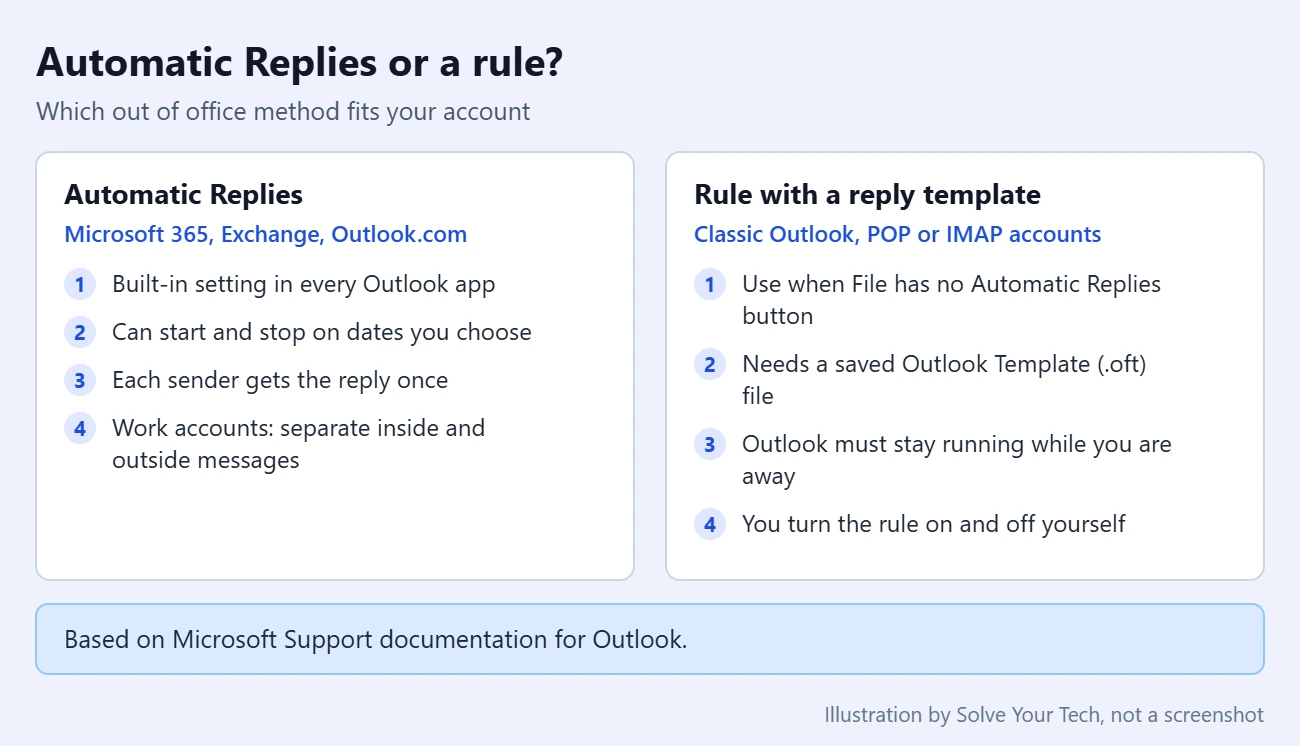
If File shows no Automatic Replies button, Microsoft says your email account does not support the feature. This is common with Gmail, Yahoo, and other POP or IMAP accounts. Classic Outlook can still answer for you with a rule, which is an instruction that tells Outlook what to do with incoming mail.
Know the limit first: Microsoft states that you must leave Outlook running for the rule to send replies while you are gone. If the computer shuts down or Outlook closes, the replies stop. For most people with a Gmail or Yahoo address, the vacation reply in that provider’s own settings is the more dependable choice.
Step 1: Create the Reply Template
- In classic Outlook, create a new email message.
- Enter a subject and the message body for your out of office reply. Leave the recipient boxes empty.
- Select File > Save As.
- Give the template a name, and in the Save as type list select Outlook Template (*.oft).
- Select Save. The default templates folder is fine.
Step 2: Create the Rule
- On the File tab, select Manage Rules & Alerts.
- On the E-mail Rules tab, select New Rule.
- Under Start from a blank rule, select Apply rule on messages I receive, then Next.
- To reply to every message, leave the condition boxes unchanged and select Next. Select Yes when Outlook asks whether to apply the rule to all messages.
- Under Step 1: Select action(s), check reply using a specific template.
- Under Step 2, select the underlined text a specific template.
- In the Look In box, select User Templates in File System, pick your template, and select Open, then Next.
- Add any exceptions you want, then select Next.
- Name the rule, for example Out of Office. Leave Turn on this rule checked to start now, or uncheck it to switch the rule on later, and select Finish.
To switch the rule on or off later, go to File > Manage Rules & Alerts, check or uncheck the box beside the rule, and select OK. A rule has no end date, so turn it off when you return. Microsoft’s full walkthrough is in its guide to out of office rules in classic Outlook. For more on rules in general, see how to create an email filter (rule) in Outlook.
How to Check That It Is On, Change It, or Turn It Off
- Confirm it: go back to the Automatic Replies page for your version. The toggle or the Send automatic replies option should still be selected, with your dates and message in place. In classic Outlook, look for the message under the ribbon.
- Change the message or dates: repeat the steps for your version, edit what you need, and save again.
- Turn it off in new Outlook or on the web: open Settings, go to Automatic replies, and turn the Automatic replies toggle off.
- Turn it off in classic Outlook: select Turn off in the message under the ribbon.
- Turn it off on a Mac: select Tools > Automatic Replies and turn off the toggle next to Send Automatic Replies.
- Turn it off on your phone: go to Settings, tap your account, tap Automatic Replies, and turn the switch off.
If you set an end time, you do not need to do anything. The replies stop at that time.
What to Put in Your Out of Office Message
- The dates you are away and the date you expect to reply.
- Who to contact for urgent issues, with that person’s permission.
- Whether you will check email at all while you are away.
- Nothing sensitive. Leave out travel plans, personal phone numbers, and internal project details, especially in the message for people outside your organization.
A short message for coworkers might read: “I am out of the office from Monday, June 8 through Friday, June 12 and will reply when I return on Monday, June 15. For anything urgent, please contact Jordan Lee at extension 204.”
A message for outside senders can say less: “Thank you for your email. I am away until June 15 and will respond after I return.”
If you include a sign-off, you can reuse the one you already have. See how to add a signature in Outlook.
Troubleshooting
- There is no Automatic Replies button in classic Outlook. Your account is probably POP or IMAP. To check, select File > Account Settings > Account Settings and look in the Type column. Use the rule method above or your email provider’s own vacation reply.
- Automatic Replies is missing in new Outlook. Microsoft says automatic replies are not supported for Gmail, Yahoo, or other POP or IMAP accounts in new Outlook, and the rule method above is for classic Outlook only. Set the reply in your email provider’s settings instead.
- The new Outlook steps do not match your screen. You may still be using classic Outlook. If you have a File tab, follow the classic steps.
- The OK button is missing in the classic Automatic Replies box. Microsoft says certain screen resolution and scaling settings can hide it. Lower the display scaling, change the resolution, or use a larger monitor, then reopen the box.
- There is no option for people outside your organization. That option is for work or school accounts, and an Exchange administrator can turn it off. Ask your IT department.
- You have several accounts. Automatic replies are set per account. Select the right account before you turn them on, and repeat the steps for each account that needs a reply.
- Someone says they got the reply only once. That is expected. Each sender receives it one time during your absence.
- Replies did not stop when you came back. You probably did not set an end time. Turn the feature off manually using the steps above.
Frequently Asked Questions
How do I turn off out of office in Outlook?
If you set an end time, automatic replies stop by themselves. Otherwise, return to the Automatic Replies setting and turn the toggle off, or in classic Outlook select Turn off in the message under the ribbon.
Will everyone who emails me get a reply?
Each sender gets your automatic reply once while it is active, not for every message. Who counts as a sender depends on your settings: with a work account you choose between your organization only, your contacts, or everyone outside your organization.
Can I set out of office in advance?
Yes. Turn on automatic replies now and use the time period option to enter a future start time and end time. Outlook begins sending the reply at the start time and stops at the end time.
Can I set an out of office reply for a Gmail or Yahoo account in Outlook?
Not with Automatic Replies. Microsoft says the feature is not supported for Gmail, Yahoo, or other POP or IMAP accounts. In classic Outlook you can use a rule with a reply template if you leave Outlook running, or you can set a vacation reply in the email provider’s own settings.
Does an out of office reply block my calendar?
Not by itself. In the Outlook app for iPhone and Android, the Block my calendar option creates an event that shows you as out of office during the time period you set. If coworkers need to see your availability, you can also share your calendar in Outlook with the right permission level.
Can I schedule emails too?
Yes. If you want a message to go out while you are away, see how to schedule an email in Outlook.
Next Step
Set the reply with an end time before you leave, then send yourself a test message from a different email address to see what people will receive. Remember that each address gets the reply only once. Need a separate address for work or personal mail? See how to create an Outlook email account.

Matthew Burleigh is the founder, head writer, and editor of Solve Your Tech, which he launched in 2012. He has written technology tutorials since 2008 and worked in IT since 2003, including small-business support, IT management, and consulting. He holds Bachelor’s and Master’s degrees in Computer Science from Arizona State University.
Matthew writes practical guides for Windows, iPhone and iPad, Microsoft Office, Outlook, Google apps, and Android. Solve Your Tech’s guides are tested on current devices or checked against official product documentation, with clear steps, sources, and update dates.
Read more about Matthew and how Solve Your Tech writes and updates its guides, or report a correction.