Google Docs saves your document automatically as you type, so there’s no Save button to click. Your work is stored in Google Drive as long as you’re online. To save a copy to your computer, go to File > Download and pick a format such as Microsoft Word (.docx) or PDF Document (.pdf). To keep saving without internet, turn on offline access before you disconnect.
The steps below use Google Docs in a desktop web browser, with a section for the Google Docs app on iPhone and Android. They follow Google’s help pages on automatic saving and downloading and working offline.
Check That Your Document Is Saved
- Open your document at docs.google.com and make your changes.
- Look at the cloud icon next to the document title at the top of the page. This is the See document status button.
- Click it. When it says the document is saved to Drive, every edit so far is stored.
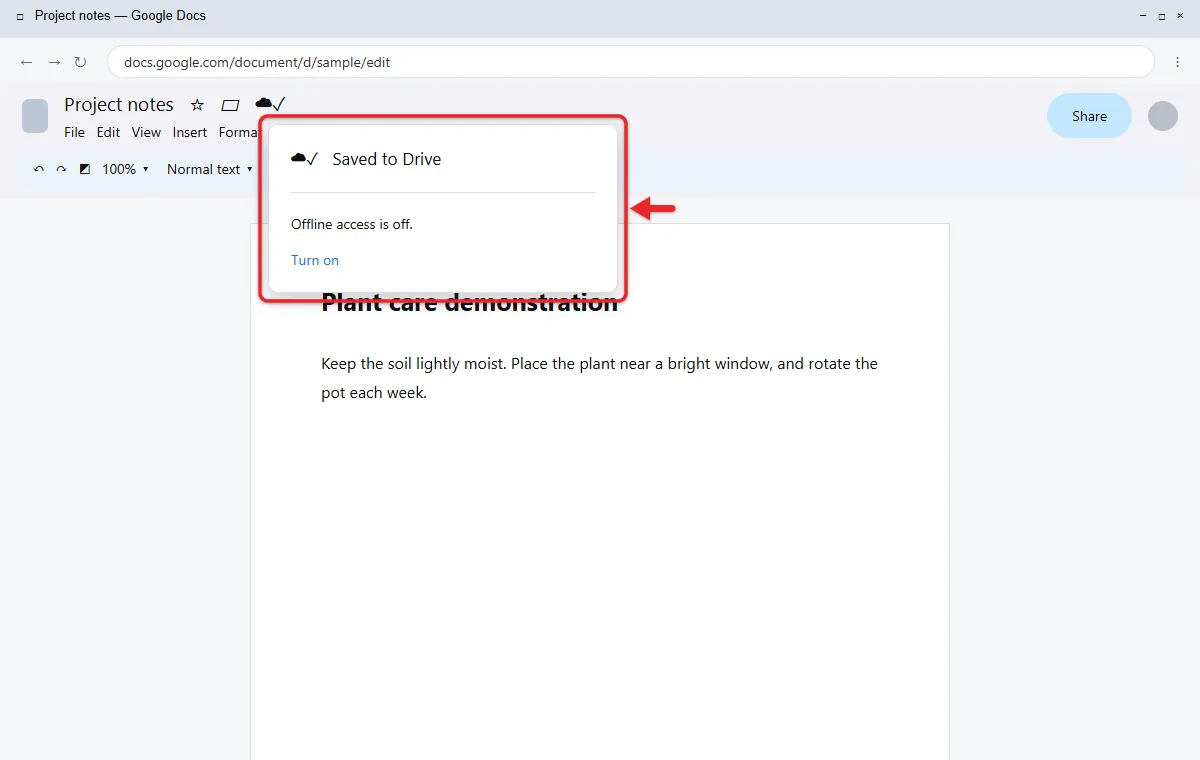
While you type, the status may briefly show that it’s saving. If it says it’s trying to connect or that changes can’t be saved, don’t close the tab yet.
A brand new document is saved as soon as you type in it, even if you never give it a name.
If you opened a Word file from Drive and you see a .DOCX label next to the title, your edits save automatically into that Word file in its original format. To turn it into a regular Google Doc, click File > Save as Google Docs. Google creates a separate Google Docs copy and leaves the Word file in Drive.
Name the Document
New documents are saved as “Untitled document,” which is hard to find later in Drive.
- Click Untitled document (or the current name) in the top-left corner.
- Type a new name and press Enter.
The new name appears in Google Drive right away. Renaming doesn’t create a second copy. On a phone, you can rename a file in the Google Docs iPhone app.
Choose Which Drive Folder It’s Saved In
New documents save to the top level of My Drive. To keep one in a specific folder:
- Click the folder icon (Move) next to the document title, or choose File > Move.
- Browse to the folder you want. To make a new one, click the new-folder icon, type a name, and confirm.
- Click Move. The document now lives in that folder, and the folder name shows when you hover over the icon.
Download a Copy to Your Computer
Downloading gives you a separate file you can email, attach, open in Word, or keep as a backup.
- With the document open, click File > Download.
- Choose a format: Microsoft Word (.docx) to keep editing in Word, PDF Document (.pdf) for a file that looks the same everywhere, or OpenDocument Format (.odt), Rich Text Format (.rtf), Plain Text (.txt), Web Page (.html, zipped) or EPUB Publication (.epub) for other uses. The file downloads to your browser’s usual download location, usually the Downloads folder.
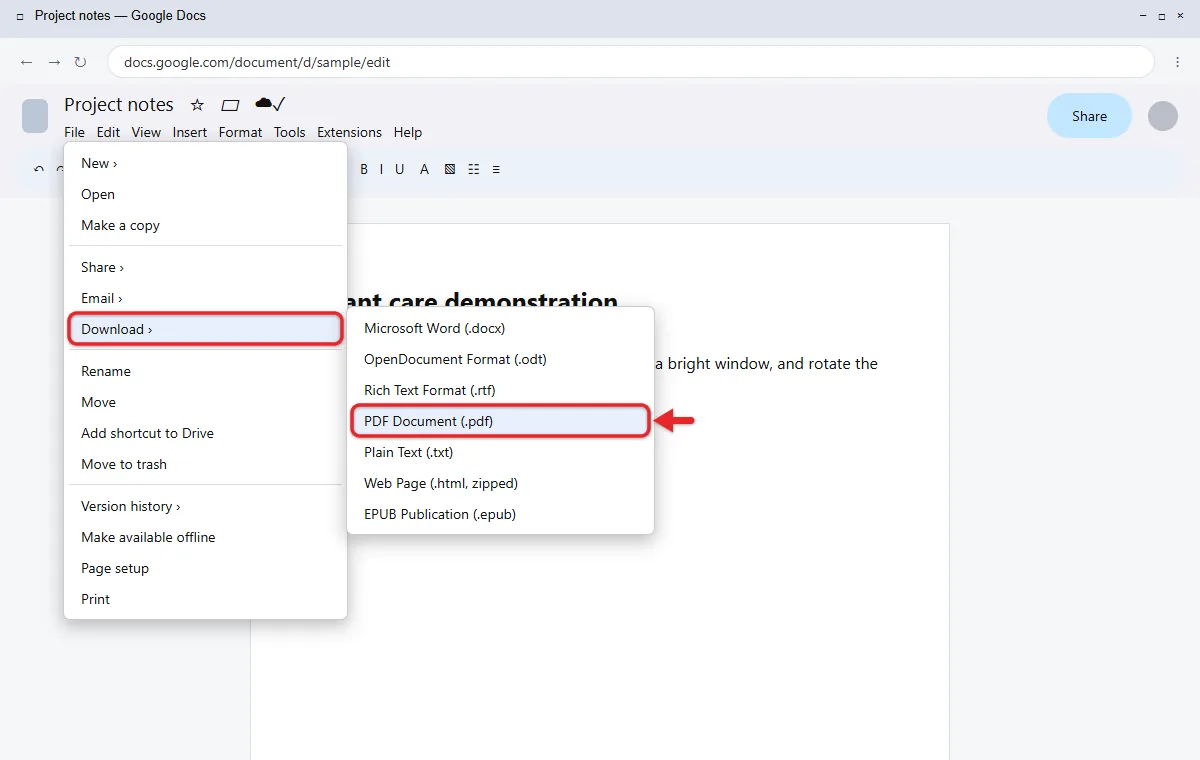
If your browser is set to ask where to save each file, a Save As window opens first. Pick a folder, such as your desktop, and click Save.
The download is a snapshot. Edits you make in Google Docs afterward don’t update the downloaded file, and edits to the downloaded file don’t go back to Google Docs. For more detail on each format, read about saving a Google Docs file as a PDF, Word, or EPUB file.
If a very large document won’t download as a PDF, Google suggests File > Print, choosing Save as PDF as the destination, and clicking Save.
For a paper copy instead, print a Google Doc from Chrome.
Saving a document someone shared with you
You can download a shared document the same way with File > Download, even if you can only view it, unless the owner has turned off downloading for viewers and commenters. Your downloaded copy belongs to you, but it won’t receive the owner’s later changes.
Save a Second Copy in Google Drive
To keep the current version before making big changes, make a copy inside Drive.
- Click File > Make a copy.
- Enter a name, such as “Report – before edits,” and pick a folder.
- To keep the comments and suggested edits, check Copy comments and suggestions.
- Click Make a copy. The copy opens in a new tab, and the original stays as it was.
You can also go back to earlier versions without making copies. Click Last edit at the top right, or File > Version history > See version history, to browse past versions. Choose File > Version history > Name current version to label an important point. You need edit access to see version history.
To restore, copy, or name those versions, learn how to see editing history in Google Docs.
To make milestones easy to find, learn how to name or rename a version in Google Docs.
Keep Saving When You’re Offline
Offline access has to be set up while you’re still connected. On a computer, you need Google Chrome or Microsoft Edge (not a private or incognito window), the Google Docs Offline extension, and enough free storage.
- Open Google Drive, click the Settings gear at the top right, and choose Settings.
- Turn on Offline. Edge users are sent to the Chrome Web Store to add the extension.
- Open the document and click File > Make available offline.
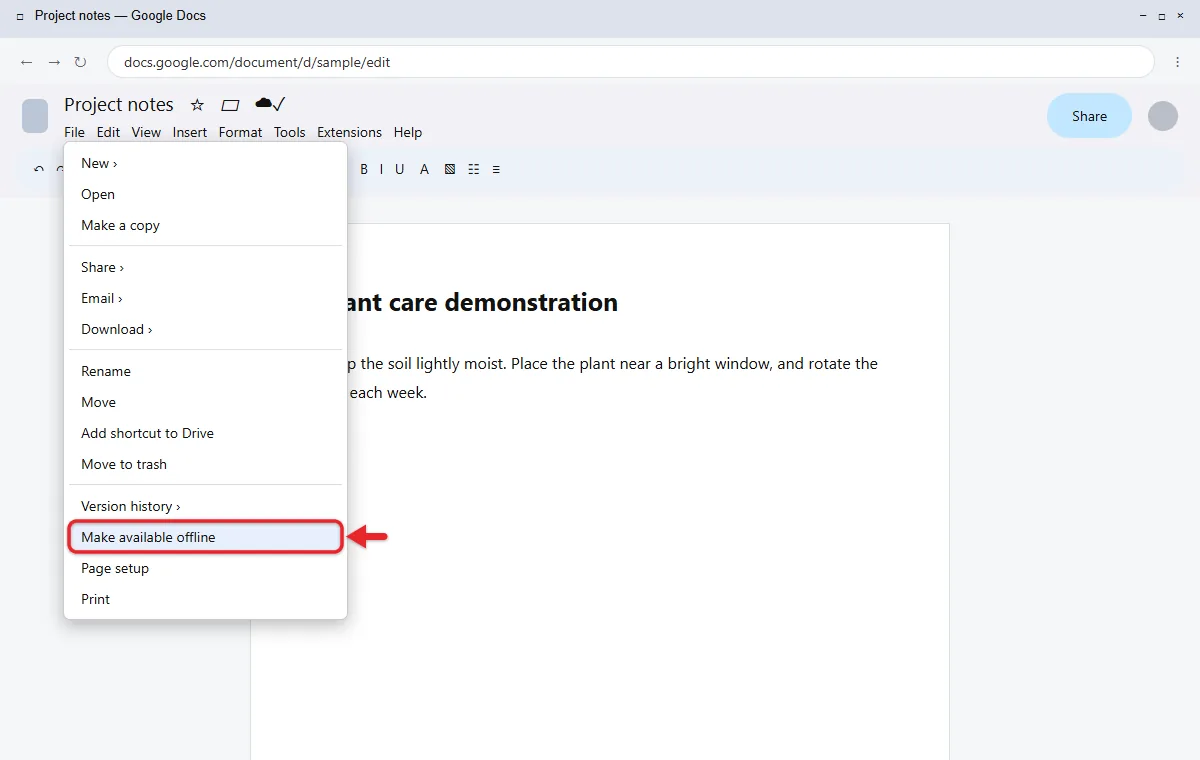
- Click the See document status icon next to the title to confirm the document is ready to use offline.
When you’re offline, your edits save to your computer. They sync to Drive automatically when you reconnect. Only one Google account per browser profile can use offline access, and work or school accounts may have it turned off by an administrator. If you later want to stop storing files on the computer, turn off Google Docs offline sync.
Save a Google Doc on iPhone or Android
The Google Docs app also saves automatically while you’re connected. Tap the check mark in the top-left corner when you finish editing, and your changes are in Drive.
To save a copy as a Word or PDF file:
- Open the document and tap the More (three dots) menu.
- Tap Share & export.
- Tap Save as Word (.docx) to create a Word version in Drive, or Send a copy and choose PDF to share or save a PDF through your phone’s share options.
On Android, you can also save a copy to the phone itself. On the Docs home screen, tap More next to the file and tap Download. A notification appears when the download finishes.
To edit without a signal, tap More > Available offline while you’re still connected.
If Google Docs Isn’t Saving
- The status says it’s trying to connect: keep the tab open. Check your Wi-Fi or network, and the document saves once the connection returns. Before you reload the page, copy any recent text you can’t afford to lose into another file.
- You see “Encountered an error”: wait about five minutes and then reload the page.
- You can view but not type: you only have view or comment access. Ask the owner for edit access, or use File > Make a copy to get your own editable version.
- You can’t download or copy the file: the owner can block downloading, printing, and copying for viewers and commenters. Ask the owner for a copy.
- Your storage is full: when your Google account is over its storage limit, you can’t create new documents, and nobody can edit or copy your affected files until you free up space or upgrade. Check your usage at one.google.com/storage.
- Errors keep appearing: try another browser or a private window to rule out an extension, clear your browser’s cache, or use Google’s editor troubleshooting guide.
Frequently Asked Questions
Where do Google Docs save?
In your Google Drive, in My Drive unless you move them to a folder. Open drive.google.com to see all your documents.
Is there a Save button in Google Docs?
No. Saving is automatic. File > Download saves a copy to your computer, and File > Make a copy saves a duplicate in Drive.
Can I save a Google Doc to my desktop?
Yes. Use File > Download and choose a format. The file goes to your Downloads folder, and you can move it to your desktop from there.
Will I lose my work if I close the tab?
Not if the document status shows it’s saved to Drive. If it shows a connection problem, wait for it to clear before closing.
Can I get back a version I saved over?
Yes, if you have edit access. Open Last edit at the top right, pick an earlier version, and click Restore this version. Newer versions stay in the history, so you can switch back.
Next step: name your document and move it into a folder now, so it’s easy to find in Drive later.

Matthew Burleigh is the founder, head writer, and editor of Solve Your Tech, which he launched in 2012. He has written technology tutorials since 2008 and worked in IT since 2003, including small-business support, IT management, and consulting. He holds Bachelor’s and Master’s degrees in Computer Science from Arizona State University.
Matthew writes practical guides for Windows, iPhone and iPad, Microsoft Office, Outlook, Google apps, and Android. Solve Your Tech’s guides are checked step by step against the device or app maker’s own documentation and tested on his own devices whenever he has the hardware or software, with clear steps, sources, and update dates.
Read more about Matthew and how Solve Your Tech writes and updates its guides, or report a correction.