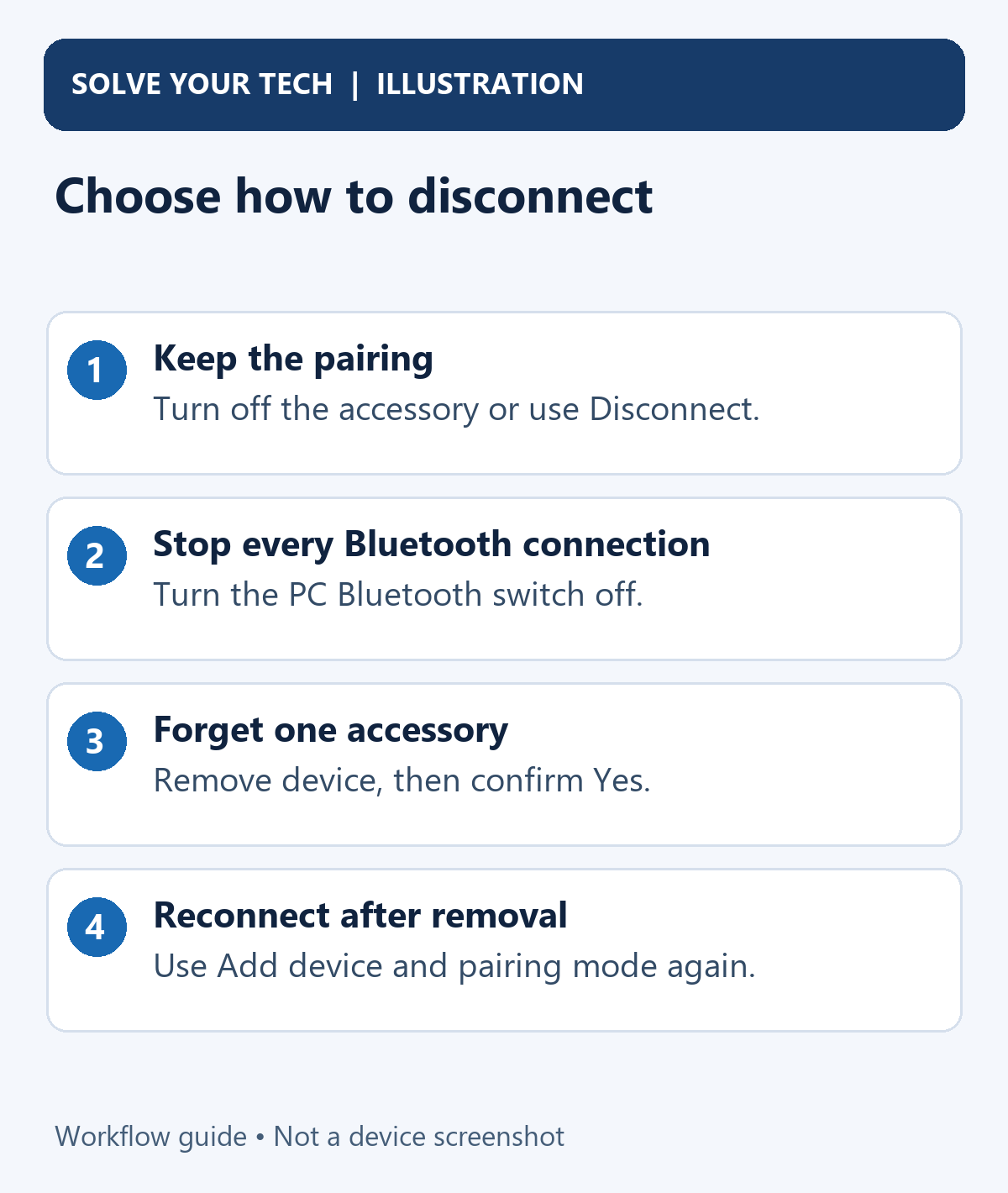
To temporarily disconnect a Bluetooth accessory from a Windows PC, turn off the accessory or use Disconnect if Windows offers that button for the device. To forget it completely, open Settings > Bluetooth & devices > Devices in Windows 11, choose the device’s More options menu, and select Remove device > Yes. In Windows 10, use Settings > Devices > Bluetooth & other devices, select the accessory, and choose Remove device > Yes.
The right choice depends on whether you want to use the accessory with this PC again. Disconnecting keeps the pairing, so you can reconnect later. Removing it clears the PC’s pairing and requires another pairing before normal Bluetooth use.
This guide covers Windows 11 and the separate Windows 10 menus. Microsoft ended general free support for Windows 10 on October 14, 2025. Its Bluetooth settings still work, but these instructions do not imply that it continues receiving general free security updates.
Choose the action that matches your goal
| What you want to do | Best starting point |
|---|---|
| Stop using one headset, speaker, controller, or other accessory for now | Turn off that accessory, or use its available Disconnect control. Its pairing stays saved. |
| Stop every Bluetooth connection on the PC | Turn off Bluetooth in Windows. This also disconnects Bluetooth keyboards and mice. |
| Stop the PC remembering an old accessory | Use Remove device, confirm the correct accessory, and pair it again only if you need it later. |
| Change where sound plays while keeping the headset connected | Change the audio output. That is a different task from disconnecting or unpairing. |
| Repair an accessory that is paired but will not connect | Try basic checks first, then remove and pair it again. Driver repair is a later troubleshooting step. |
For example, switching off headphones before putting them away usually leaves everything ready for tomorrow. Removing headphones you no longer own is useful because they no longer need to stay in the PC’s remembered list.
Before you disconnect or remove anything
Identify the accessory by its name, rather than selecting the first item under Bluetooth. Several devices can have similar names, and the list may include equipment you have not used recently.
If you are disconnecting your only Bluetooth keyboard or mouse, arrange another way to control the PC first. A laptop’s built-in keyboard and touchpad, or a wired keyboard and mouse, can help. Confirm they work before turning off Bluetooth or removing the accessory. Otherwise, you may lose the input device you need to finish the task or turn Bluetooth on again.
Stop playback or leave a call before disconnecting an audio device. Windows or the app may move sound to another available output, such as the laptop speakers. Disconnecting the headset does not necessarily stop the app itself.
Removing a device from this PC does not erase its remembered connections to other computers or phones. If you also want to clear the accessory’s own pairing list, consult its manufacturer’s instructions. A factory reset can have broader effects and is unnecessary for an ordinary temporary disconnection.
Temporarily disconnect one Bluetooth device
The simplest option is often the accessory’s own power control. This avoids changing the pairing list or disturbing your other Bluetooth equipment.
- Stop using the accessory. Pause playback, finish a call, or save the activity that depends on it.
- Turn off the accessory using its documented power button or switch. For earbuds, follow the maker’s instructions for storing them in their charging case.
- Open the PC’s Bluetooth device list if you want to check the result. In Windows 11, use Start > Settings > Bluetooth & devices > Devices. In Windows 10, use Start > Settings > Devices > Bluetooth & other devices.
- Find the same accessory and check that it is no longer shown as connected. It can remain listed as paired, which means Windows remembers it for later.
Some devices also offer Disconnect in Windows or in their manufacturer’s app. If that control is present, select it for the intended accessory and check the connection status afterward. Its placement and availability vary by accessory, driver, and Windows version.
A Disconnect button is not available for every Bluetooth device. If the device’s menu only offers Remove device, that action will forget the pairing. Use the accessory’s power control when you want to keep the pairing, or use the PC-wide Bluetooth switch if disconnecting all accessories is acceptable.
Windows can reconnect to a remembered accessory when Bluetooth is on and the accessory becomes available again. If it immediately reconnects, keep it switched off, disconnect through the accessory’s documented connection controls, or remove the pairing if you no longer want this PC to connect to it.
Remove a Bluetooth device in Windows 11
Use this method to unpair an accessory you no longer need, or to prepare for pairing it again as part of troubleshooting. Check your alternate input method first if the accessory is a keyboard or mouse.
- Select Start, then Settings. You can also press Windows key + I to open Settings.
- Select Bluetooth & devices, then Devices. Find the saved accessory in the device list.
- Select More options, the three-dot button beside that accessory. Match the name before selecting a removal command.
- Select Remove device. When Windows asks you to confirm, select Yes.
- Wait for removal to finish, then check that the accessory has disappeared from the saved device list. If a removal error appears or the entry remains, use the troubleshooting section below.
You may also see device cards near the top of the Bluetooth & devices page. The fuller Devices list is useful when the accessory is not visible among those cards. Right-clicking a device name is not a substitute for opening its three-dot menu in this Settings route.
Microsoft documents this Remove device > Yes route in its Bluetooth troubleshooting guide. Removing and then pairing again is one of its suggested fixes for connection problems.
Remove a Bluetooth device in Windows 10
Windows 10 uses a different Settings category. Follow these steps instead of looking for the Windows 11 Bluetooth & devices sidebar.
- Select Start > Settings, or press Windows key + I.
- Select Devices, then Bluetooth & other devices.
- Find the accessory you want to forget and select its entry. This reveals the controls available for that device.
- Select Remove device, then select Yes in the confirmation prompt.
- Wait for the entry to disappear. To use the accessory again, put it in pairing mode and add it as a new Bluetooth device.
Removing one accessory does not require turning off the PC’s entire Bluetooth radio. Your other paired devices can remain available. If the control fails, avoid repeatedly removing unrelated devices in the hope of clearing the problem.
Turn off all Bluetooth connections
This is useful when you want a temporary break from every Bluetooth accessory. It keeps the saved pairings, but all current Bluetooth connections on that PC are interrupted.
Before continuing, make sure you can control the PC without its Bluetooth keyboard or mouse. Turning Bluetooth off affects those accessories along with headphones, speakers, and controllers.
Windows 11
- Open Start > Settings > Bluetooth & devices.
- Set the Bluetooth switch to Off. Connected Bluetooth accessories stop communicating with the PC.
- When you want to use them again, return to the same page and set Bluetooth to On.
For a quicker route, select the grouped network, sound, or battery icons beside the taskbar clock, then select the Bluetooth tile to switch it off. A chevron beside that tile opens device management on supported versions. Selecting the tile itself changes the PC-wide Bluetooth state.
Windows 10
- Open Start > Settings > Devices > Bluetooth & other devices.
- Set Bluetooth to Off.
- Return to that page and switch it On when you are ready to reconnect.
You can also open Action center beside the taskbar clock and select its Bluetooth tile. Select Expand if the tile is not visible among the collapsed quick actions.
Use the Bluetooth switch for this task. Airplane mode can affect other wireless connections, so it is a broader change than stopping Bluetooth accessories. A mouse with its own USB wireless receiver may continue working because that connection is not necessarily Bluetooth.
Reconnect the accessory afterward
If you only disconnected it, turn on Bluetooth on the PC and turn the accessory on. Windows may connect automatically when a remembered accessory is in range. If it does not, find the accessory in the Bluetooth list and use Connect if offered. Also check that the accessory is charged and available to this PC.
If you selected Remove device, you need to pair it again:
- Turn on the accessory and put it in pairing mode. This makes it discoverable to another device. The button sequence or indicator light depends on the manufacturer.
- In Windows 11, open Settings > Bluetooth & devices and select Add device > Bluetooth. In Windows 10, open Settings > Devices > Bluetooth & other devices and select Add Bluetooth or other device > Bluetooth.
- Select the correct accessory when it appears. Follow any displayed confirmation or PIN instructions, then select Done when pairing finishes.
- Test the function you need, such as audio playback or pointer movement. Being listed as paired does not by itself confirm that every app or accessory feature works.
Microsoft’s pairing instructions for Windows cover both versions. For device-specific pairing controls, see our guides to connecting AirPods Pro to a Windows laptop or connecting an Xbox controller to a Windows PC.
What to do if Windows will not remove the device
An entry that stays in the list, a Remove failed message, and an accessory that reconnects after an ordinary disconnection are different problems. First check which one you have.
The removal control is missing
Check that you are in the correct Settings page for your Windows version. In Windows 11, open Devices and the accessory’s More options menu. In Windows 10, select the accessory itself to reveal its controls.
If the accessory is not in the saved list at all, confirm that you are looking at the PC that originally paired with it. A device remembered by your phone is not automatically a saved device on this computer. Also distinguish a Bluetooth accessory from equipment connected through USB, a dedicated wireless receiver, or another network connection.
Removal is stuck or shows an error
Try the basic checks before changing drivers:
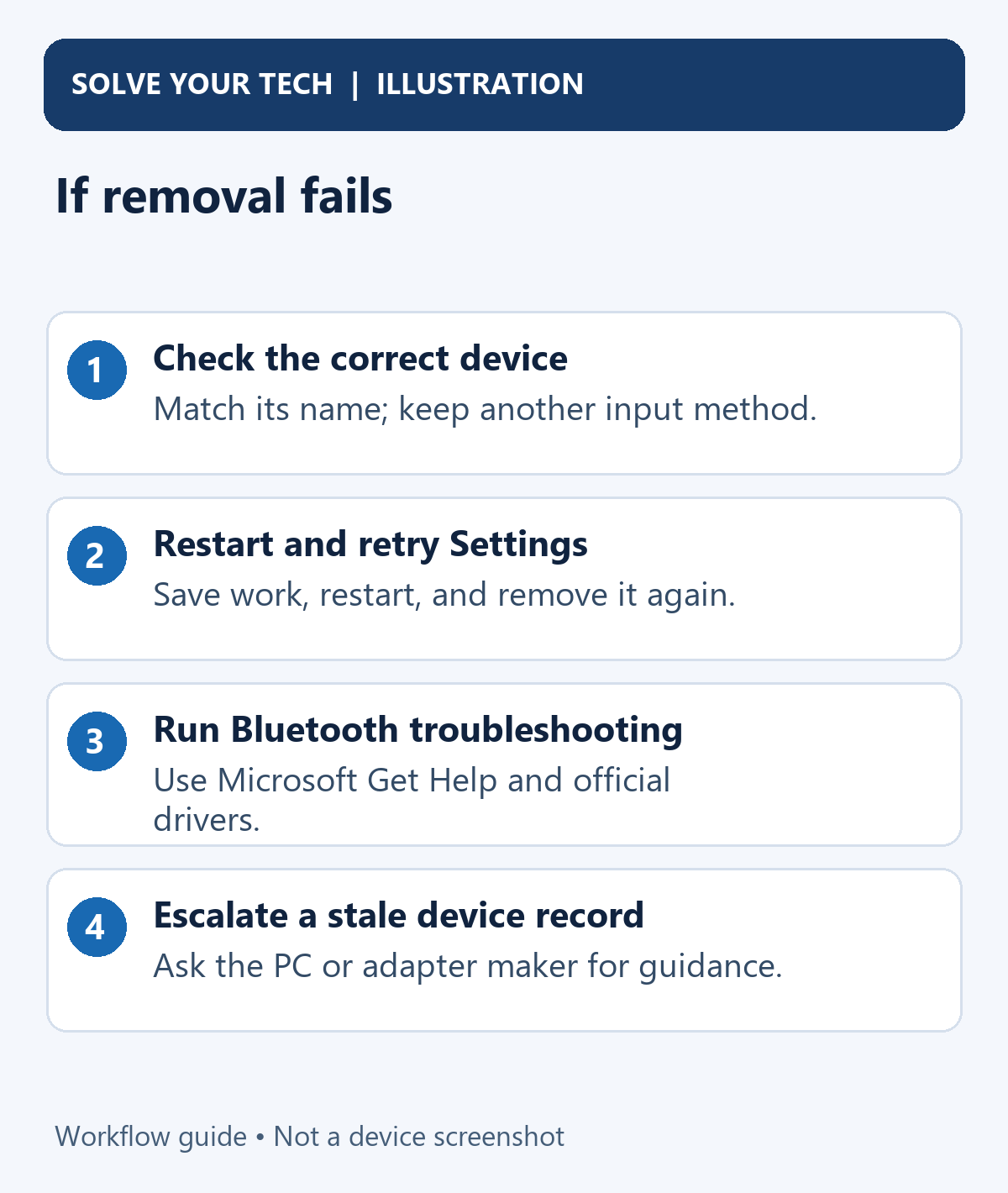
- Confirm the device name and try the correct Settings removal route with the PC’s Bluetooth switched on. If you turn Bluetooth back on for this check, remembered accessories may reconnect.
- Turn off the accessory, save your work, and restart the PC. After signing in, reopen Settings and try removing that same entry again.
- If your PC uses a removable USB Bluetooth adapter, confirm that it is connected properly. Reconnecting the existing adapter can help with an unresponsive connection, but do not unplug the only adapter supporting your current keyboard or mouse without another input method.
- Run Microsoft’s Bluetooth troubleshooter through Get Help, following the current link in its Bluetooth troubleshooting guide. The tool checks the Bluetooth system; it does not guarantee that every stale pairing record can be removed.
Record the exact error, accessory model, Bluetooth adapter model, and Windows version if the problem continues. Those details help the PC or adapter manufacturer identify the relevant driver and explain the appropriate repair.
Several devices fail, or Bluetooth is missing
If every Bluetooth accessory stops working, the PC’s adapter or driver deserves attention. Follow Microsoft’s driver guidance or get the correct Bluetooth driver directly from the PC or adapter manufacturer. Avoid choosing a driver for a similarly named model.
Microsoft also describes uninstalling and reinstalling the Bluetooth adapter for a specific missing-icon problem. That is a repair procedure affecting the Bluetooth system, with different consequences from removing one saved accessory. Prepare another input method and follow the documented procedure for your actual fault.
On a work or school PC, some repair operations may require administrator permission. Contact its IT support if the relevant controls are restricted rather than trying to bypass the restriction.
An old pairing remains after replacing an adapter
An old USB adapter or driver can complicate device records. Device Manager can display device entries, including hidden ones, but deleting an entry there is not a universal substitute for unpairing in Settings. It also does not guarantee that every associated driver package or pairing record is removed.
Ask the PC or adapter manufacturer about the specific stale entry if ordinary removal and the documented troubleshooting steps fail. Registry edits, bulk unpairing tools, and administrator device-removal commands require careful identification of the record being changed. Deleting every Bluetooth entry can disrupt other accessories, so those are not appropriate first steps for disconnecting one device.
Frequently asked questions
Why does the accessory still say Paired?
Paired means Windows remembers the relationship. Connected means it currently has an active connection. An accessory can remain paired while it is switched off or disconnected. Use Remove device when you want to clear the remembered relationship.
Why does it connect again when I turn it on?
Windows can reconnect to remembered devices when they are available. Keeping the accessory powered off prevents that immediate connection. Removing it from the PC’s Bluetooth list is appropriate when you want to stop using the saved pairing entirely.
Does changing the speaker output disconnect my headphones?
Not necessarily. Choosing another audio output changes where sound is sent. The headphones can remain connected for another function, such as their microphone. Check their Bluetooth status or switch them off if you want to disconnect them.
Will removing a device erase files or uninstall every driver?
Removing a saved Bluetooth accessory clears its relationship with this PC. It is not a file-deletion procedure, a factory reset of the accessory, or a guarantee that every related driver package is uninstalled. Driver cleanup is a separate repair task.
Will removing it from Windows also remove it from my phone?
No. Each host has its own saved pairing. You may need to forget it separately on another computer or phone, or clear the accessory’s remembered connections using its manufacturer’s instructions.
Is a wireless display a Bluetooth device?
Not simply because it connects wirelessly. Windows wireless display projection uses a separate workflow. If that is your goal, follow connecting to a wireless display in Windows rather than removing unrelated Bluetooth accessories.
Start with the least disruptive action that achieves your goal: switch off one accessory for a temporary break, switch off Bluetooth for all accessories, or remove the pairing when you want Windows to forget a specific device. Check the result before moving on to driver troubleshooting.

Matthew Burleigh is the founder, head writer, and editor of Solve Your Tech, which he launched in 2012. He has written technology tutorials since 2008 and worked in IT since 2003, including small-business support, IT management, and consulting. He holds Bachelor’s and Master’s degrees in Computer Science from Arizona State University.
Matthew writes practical guides for Windows, iPhone and iPad, Microsoft Office, Outlook, Google apps, and Android. Solve Your Tech’s guides are tested on current devices or checked against official product documentation, with clear steps, sources, and update dates.
Read more about Matthew and how Solve Your Tech writes and updates its guides, or report a correction.