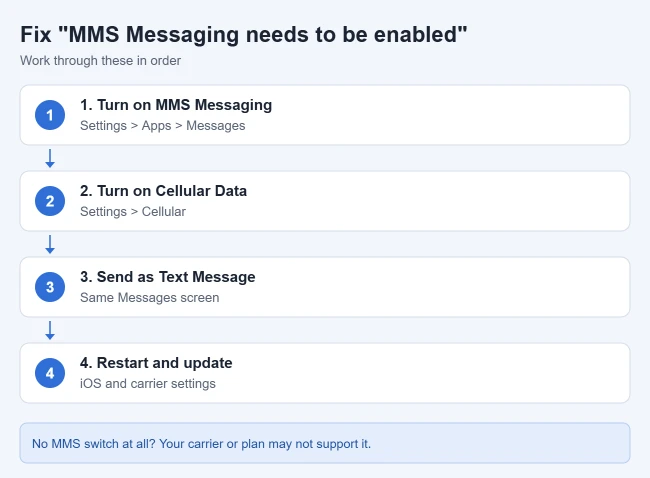
To fix “MMS Messaging needs to be enabled to send this message,” open Settings > Apps > Messages (Settings > Messages on older iOS) and turn on MMS Messaging. Also make sure Cellular Data is on, because picture and group texts sent as MMS go through your carrier.
These steps cover iPhones on iOS 18 through iOS 27, the current version, with notes for iOS 17 and earlier. They follow Apple’s If you can’t send or receive messages on your iPhone or iPad, checked October 19, 2026.
Why This Alert Appears
MMS (Multimedia Messaging Service) is the carrier service that sends photos, videos and group texts outside iMessage. The alert shows up when you try to send one of those as a green-bubble message and MMS is turned off or unavailable on your line.
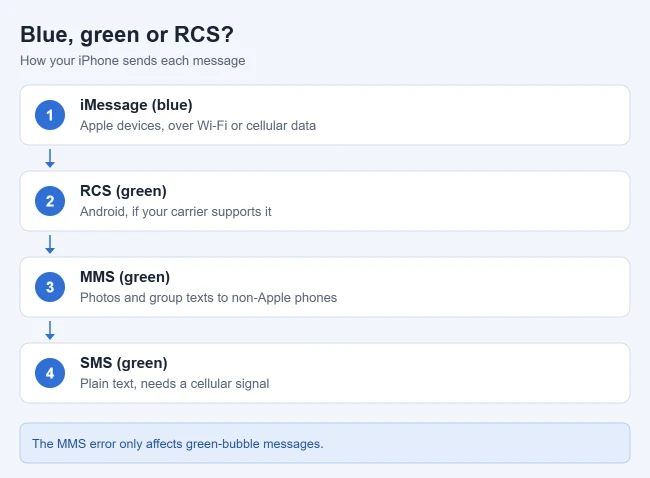
Apple explains that iMessages to other Apple devices are blue and travel over Wi-Fi or cellular data, while all other texts use RCS, SMS or MMS and need a text-messaging plan. RCS is the newer carrier standard that iPhones on iOS 18 and later can use when the carrier supports it. Because RCS, SMS and MMS all show green, a green bubble alone doesn’t tell you which one was used. For the full comparison, see Apple’s difference between iMessage, RCS and SMS/MMS.
Turn On MMS Messaging
- Open Settings.
- Tap Apps, then Messages. On iOS 17 and earlier, tap Messages directly. The Messages settings open.
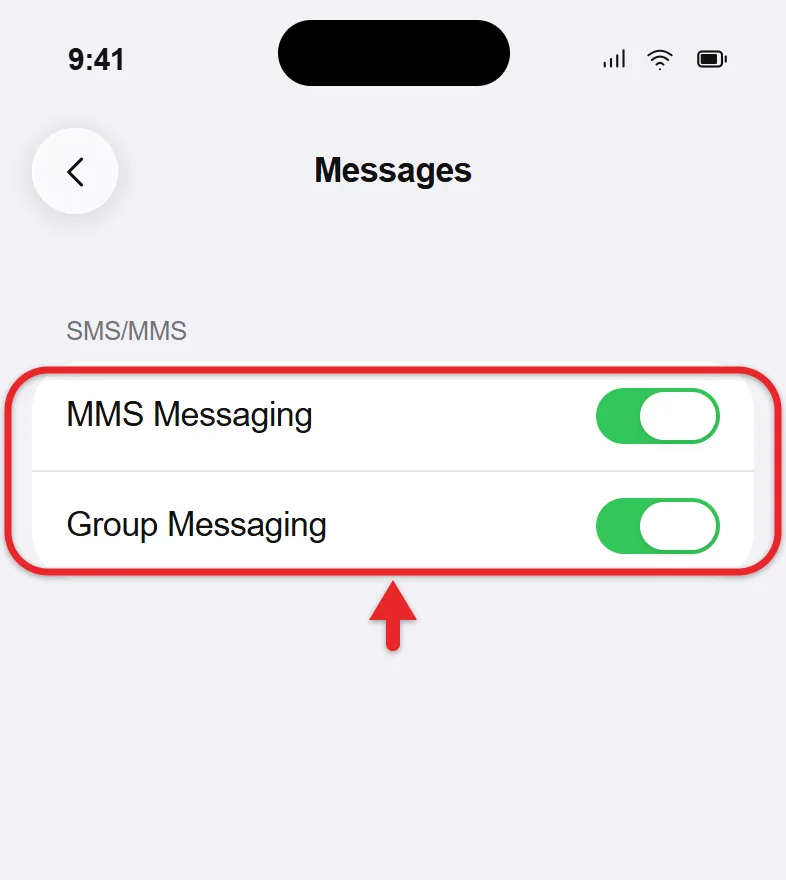
- Scroll down to the section that contains MMS Messaging. Depending on your iOS version, it’s labeled SMS/MMS or Text Messaging.
- Turn on MMS Messaging. The switch turns green.
- Turn on Group Messaging if you text groups that include Android users. Without it, replies in a group can arrive as separate one-on-one texts.
- Go back to the conversation and send the message again. If MMS works on your line, the photo or group text sends and appears as a green bubble.
If you don’t see MMS Messaging or Group Messaging, your carrier might not support the feature. Skip to the section on a missing MMS switch below.
Once group MMS works, you can manage a group text on iPhone to name it, add people, or mute it.
Other Fixes to Try
Work through these in order and resend the message after each one.
Turn on Cellular Data
- Open Settings > Cellular (Mobile Data in some regions).
- Turn on Cellular Data. If you have more than one line, check that the line you text from is turned on.
- Scroll down to the list of apps that can use cellular data and make sure Messages is on.
iMessage, RCS and MMS need a cellular data or Wi-Fi connection, but many carriers send MMS only over cellular data, so leave it on even when you’re on Wi-Fi. Worried about your data plan? See how much data text messaging uses on iPhone.
Turn on Send as Text Message
In Settings > Apps > Messages, turn on Send as Text Message (called Send as SMS on older iOS). This lets Messages send a text when iMessage isn’t available, and it’s required for group MMS messages.
Restart and update
- Restart the iPhone.
- Install iOS updates in Settings > General > Software Update.
- Check for a carrier settings update in Settings > General > About, with Wi-Fi or cellular on. If one is available, a prompt appears after a few seconds; follow it to install the update. More detail is in Manually update carrier settings on your iPhone or iPad.
Turn on iMessage again
In Settings > Apps > Messages, turn iMessage off, wait a few seconds, and turn it back on. It may show “Waiting for activation” for a short time. This refreshes how Messages registers your phone number.
Try Wi-Fi Calling off
Some carriers don’t support MMS while Wi-Fi Calling is active. Turn it off in Settings > Cellular > Wi-Fi Calling (tap your line first if you have more than one), resend the message, then turn it back on.
Reset network settings
Go to Settings > General > Transfer or Reset iPhone > Reset > Reset Network Settings and enter your passcode. The iPhone restarts with default network settings. This also forgets saved Wi-Fi networks and passwords, Bluetooth pairings and VPN settings, so use it last. Resetting network settings on iPhone lists what to set up again afterward.
If Photos or Videos Still Won’t Send
- Check storage. Your iPhone needs enough space to send and receive images and videos. Look in Settings > General > iPhone Storage.
- Send smaller files. Carriers can limit MMS attachment size, and large videos often fail. In Settings > Apps > Messages, turn on Low Quality Image Mode (or Send Photo Previews, depending on your iOS version) to send lighter photos, or share a long video as a link instead.
- Check the number. Make sure the contact’s phone number is correct.
- Check your signal. MMS needs more bandwidth than a plain text. With only one bar, move somewhere with better reception and try again.
- Check RCS. If your carrier supports RCS, it appears as RCS Messaging in Messages settings. RCS sends higher-quality photos to Android phones than MMS.
- Tap the red exclamation point. If a message shows Not Delivered, tap the icon, then tap Try Again.
If your photos send but arrive looking soft, see why your iPhone sends blurry pictures.
If This Started After You Set Up a New iPhone
New devices can show separate threads or green bubbles until Messages is set up again. To fix it:
- Update to the latest iOS.
- In Settings > Cellular, make sure your phone line is turned on. With more than one SIM, select the number you want to use.
- In Settings > Apps > Messages, turn iMessage off and back on. If it does not activate, follow the steps to turn on iMessage on iPhone.
- Tap Send & Receive and choose your phone number. Messages uses your number again for iMessage, SMS and MMS.
If the MMS Switch Is Missing
A missing MMS Messaging switch usually means your carrier hasn’t set up MMS for your line. It can also happen on data-only plans or right after you switch carriers or move to a new eSIM.
- Update carrier settings in Settings > General > About and restart the iPhone.
- Contact your carrier and ask them to turn on MMS or picture messaging for your number. Prepaid and budget plans sometimes leave it off.
- If the carrier tells you to check your APN (Access Point Name, the settings your iPhone uses to reach the carrier’s data and MMS servers), open Settings > Cellular > Cellular Data Network and compare the MMS fields with the values the carrier gives you.
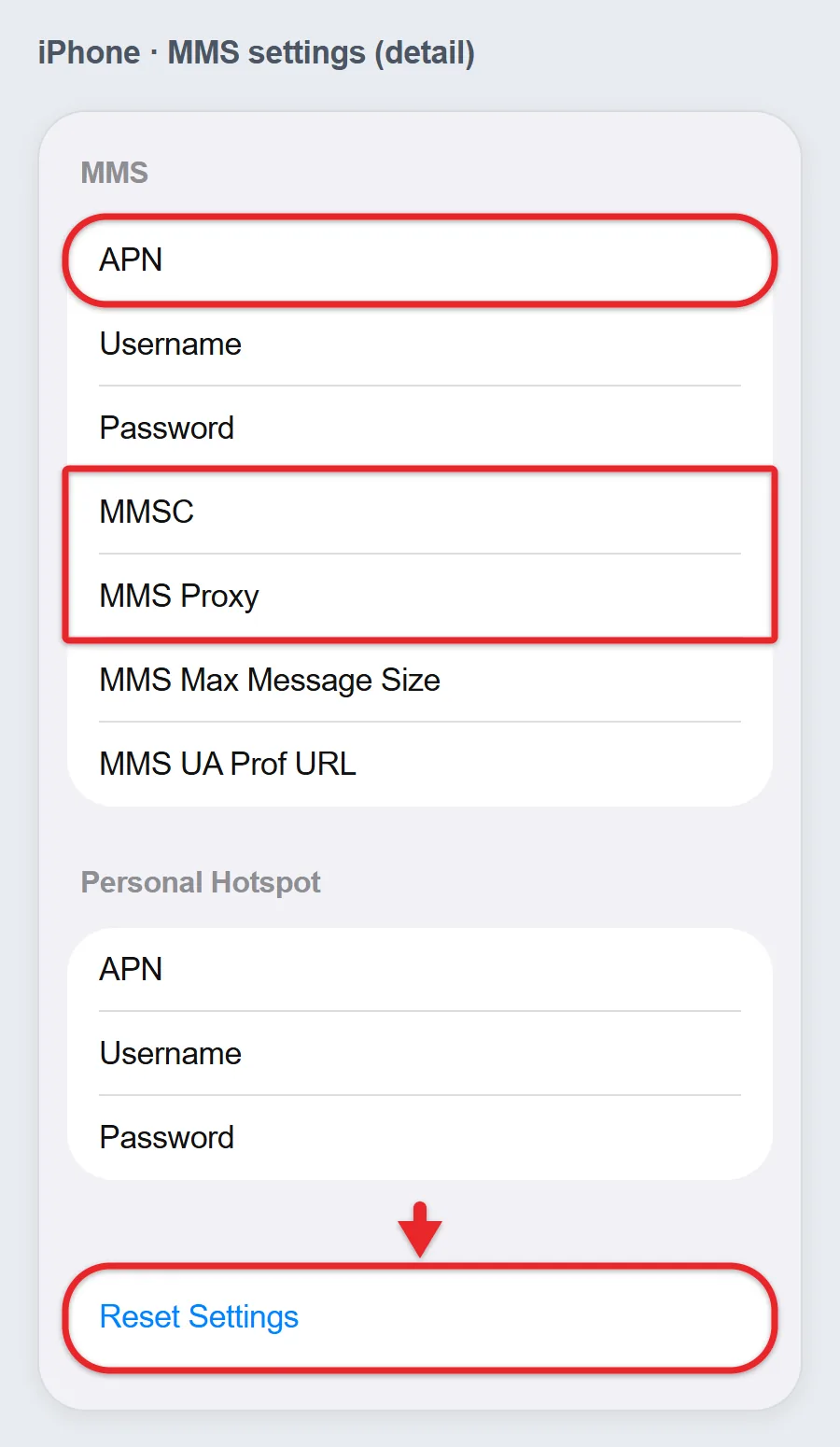
Wrong APN settings can cut off cellular data or cause extra charges, so only change them when your carrier tells you to. If Cellular Data Network isn’t there, your carrier doesn’t allow edits and has to send the settings itself. To undo changes, tap Reset Settings at the bottom of that screen. Apple’s guide to viewing and editing your APN has the details.
How to Confirm It’s Fixed
Send a photo to a contact who uses an Android phone, or to an iPhone user with iMessage turned off. If it arrives as a green bubble without the alert, MMS is working. For a group test, start a new group text that includes at least one Android number and check that replies land in the same thread.
Frequently Asked Questions
Why do only some messages fail?
iMessages to other Apple users go over the internet. Texts to Android phones, especially pictures and group chats, use SMS/MMS or RCS through your carrier, so only those are affected.
To tell which kind of message you’re sending, read about blue vs. green text messages on iPhone.
Does Wi-Fi work for MMS?
MMS can technically use cellular data or Wi-Fi, but in practice many carriers require cellular data for MMS. Keep Cellular Data on.
Will this fix group texts with Android users?
Turning on MMS, Group Messaging and Send as Text Message usually does. If your carrier supports RCS, newer iPhones can use it for group chats with Android users.
These settings don’t let you add an Android user to an existing group, though. Start a new group instead; adding someone to a group text walks through it.
Does MMS cost extra?
It depends on your plan. Messaging rates may apply to texts that aren’t iMessages, and some prepaid or international plans charge per picture message.
Does MMS work with an eSIM?
Yes, if the plan on that eSIM includes MMS. The settings are the same. With two lines, choose the right number in Settings > Cellular and in the conversation before you send.
Related: The Complete Guide to Text Messaging on iPhone.

Matthew Burleigh is the founder, head writer, and editor of Solve Your Tech, which he launched in 2012. He has written technology tutorials since 2008 and worked in IT since 2003, including small-business support, IT management, and consulting. He holds Bachelor’s and Master’s degrees in Computer Science from Arizona State University.
Matthew writes practical guides for Windows, iPhone and iPad, Microsoft Office, Outlook, Google apps, and Android. Solve Your Tech’s guides are checked step by step against the device or app maker’s own documentation and tested on his own devices whenever he has the hardware or software, with clear steps, sources, and update dates.
Read more about Matthew and how Solve Your Tech writes and updates its guides, or report a correction.