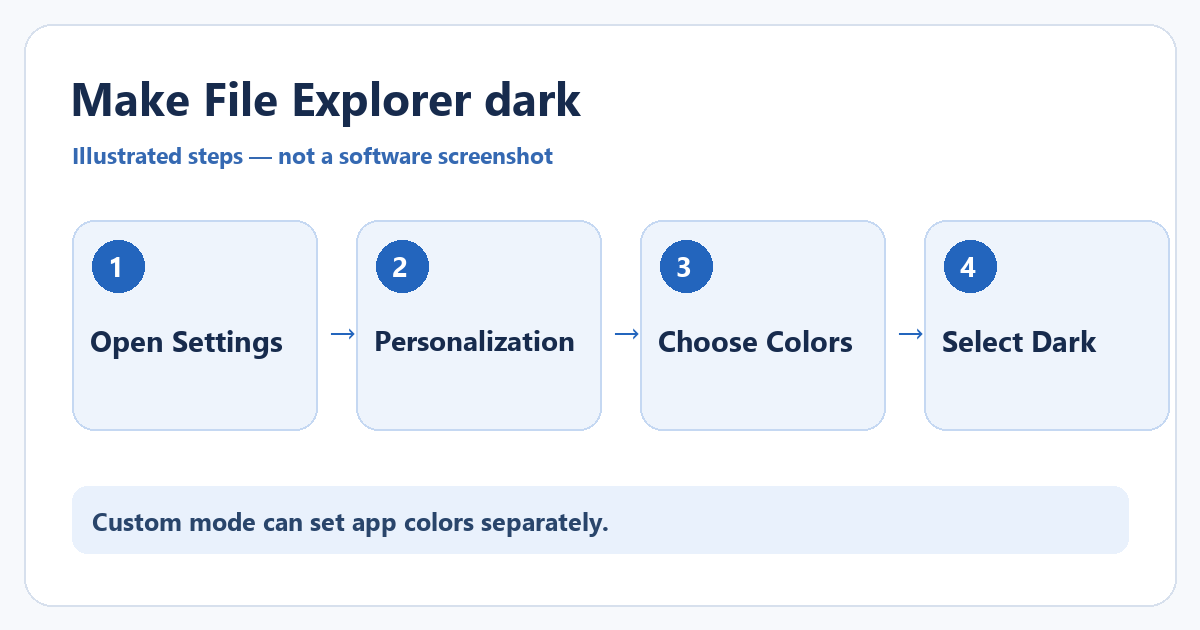
To make File Explorer dark, open Start > Settings > Personalization > Colors and choose Dark under Choose your mode. Windows applies the dark app setting to File Explorer and other apps that support it. The exact wording and appearance can differ slightly between Windows 10 and Windows 11.
Turn on dark mode
- Select Start and open Settings.
- Choose Personalization, then Colors.
- Under Choose your mode, select Dark.
- Open a new File Explorer window to see the result.
The mode also changes other supported Windows surfaces. If you were looking for a File Explorer-only switch, Windows does not offer a separate universal theme control for that app. Individual apps can still have their own appearance choices.
Keep Windows light while apps are dark
Choose Custom in Choose your mode. Set Choose your default app mode to Dark, and choose the Windows mode you prefer for Start and the taskbar. This can keep those Windows surfaces light while File Explorer uses dark colors. Reverse the two choices if you want a dark taskbar with light apps.
If File Explorer stays light
Confirm that you changed the app mode when using Custom. Close and reopen File Explorer. Some dialogs, older programs, and third-party apps may still use light colors because they do not follow the Windows app theme. Check the app's own appearance setting if only one app remains light. If the Colors page looks different, check your Windows version and available updates before following an older Windows 10 screenshot.
Choose the right mode for the result you want
The Dark choice sets both the Windows interface and supported apps to dark colors. Choose this when you want a consistent look across File Explorer, Settings, Start, and the taskbar. Custom is more precise: it separates the Windows mode, which affects areas such as Start and the taskbar, from the app mode, which affects File Explorer and other compatible apps. If File Explorer is the only part you care about, set the app mode to Dark and choose either Windows mode according to your preference.
The two controls are easy to mix up. If you choose Custom and only change Choose your default Windows mode, File Explorer may remain light because the app mode is still Light. Return to Colors and check the app control specifically. Microsoft notes that some apps manage their own appearance and that not every app supports dark mode, so a single bright window does not necessarily mean the Windows setting failed.
Windows 11 and Windows 10 wording
On Windows 11, Microsoft labels the main control Choose your mode. The path is Settings > Personalization > Colors. On Windows 10, the path is also through Personalization and Colors, but the main control may read Choose your color. Choose Dark or Custom there, then look for Choose your default app mode if you need to separate app and Windows colors. Avoid following a Windows 10 screenshot word for word on a Windows 11 PC: the labels and arrangement differ, while the underlying choice is similar.
If you are unsure which version you have, press Windows logo key + I to open Settings and look at the left navigation. Windows 11 has a persistent Settings sidebar; Windows 10 commonly shows category tiles on its Settings home page. You can also check Settings > System > About for the Windows edition. This matters when a guide describes a control that appears in a different place on your screen.
Check the result and undo it
Open File Explorer with Windows logo key + E. Its navigation pane and file list should use dark colors, although thumbnails, document previews, and individual files can still be bright. Open the Colors page again if you want to compare the result. To reverse the change, choose Light under Choose your mode, or keep Custom and change Choose your default app mode to Light. The change is a display preference; switching back does not alter your files.
Common questions
Can File Explorer alone be dark while every other app stays light? Windows does not provide a separate universal File Explorer theme switch. Custom mode changes the default for supported apps as a group. An app with its own setting may be adjusted separately, but that does not create a File Explorer-only Windows setting.
Why are a few menus or windows still white? Older dialogs and third-party programs do not always follow the system theme. A website viewed inside a browser also has its own page colors. Check whether File Explorer itself changed before troubleshooting unrelated windows.
Is dark mode the same as a contrast theme? No. Dark mode changes the general color scheme. A contrast theme is an accessibility setting designed to make interface elements easier to distinguish. If the real problem is insufficient contrast rather than brightness, review Windows contrast settings instead of relying on dark mode alone.
Dark mode changes colors; it does not enlarge text or increase contrast for every control. For a separate display adjustment, see how to use Windows Magnifier or turn on dark mode in Windows 11.
Microsoft's Windows color settings guide explains Dark and Custom modes.
To finish the look, you can also pick a new picture for your desktop. Here’s how to change the desktop background in Windows 11.

Matthew Burleigh is the founder, head writer, and editor of Solve Your Tech, which he launched in 2012. He has written technology tutorials since 2008 and worked in IT since 2003, including small-business support, IT management, and consulting. He holds Bachelor’s and Master’s degrees in Computer Science from Arizona State University.
Matthew writes practical guides for Windows, iPhone and iPad, Microsoft Office, Outlook, Google apps, and Android. Solve Your Tech’s guides are tested on current devices or checked against official product documentation, with clear steps, sources, and update dates.
Read more about Matthew and how Solve Your Tech writes and updates its guides, or report a correction.