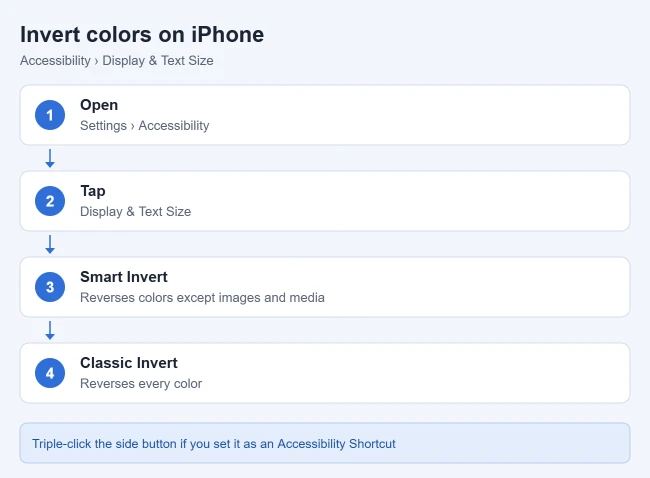
To invert colors on iPhone, open Settings, tap Accessibility › Display & Text Size, and turn on Smart Invert or Classic Invert. Smart Invert reverses colors everywhere except images, media, and some apps that already use dark styles. Classic Invert reverses every color on the screen.
These steps follow Apple’s Change display colors on iPhone guide and its Use display and text size preferences article for current versions of iOS. Below you will find both invert options, a one-tap shortcut, the other display settings on the same screen, and how to fix colors that look wrong.
How to invert colors on iPhone
- Open the Settings app.
- Tap Accessibility, then tap Display & Text Size.
- Turn on Smart Invert or Classic Invert.
Result: the screen switches to a dark background with light text right away. Apple notes this can be especially useful in apps and websites that don’t support Dark Mode. To go back, turn the same switch off.
Smart Invert vs. Classic Invert
- Smart Invert: reverses the colors on the display except for images, media, and some apps that use dark color styles, so photos still look normal.
- Classic Invert: reverses all colors, including photos and videos.
Only one can be on at a time; you need to turn one off before the other becomes available.
How to turn invert on and off with a shortcut
- Go to Settings › Accessibility › Accessibility Shortcut.
- Select Smart Invert or Classic Invert.
- Triple-click the side button (or the Home button on older iPhones) whenever you want to turn it on or off.
Result: you can toggle inverted colors in a second. Apple says Invert Colors and Color Filters can both be turned on or off with the Accessibility Shortcut; see Use accessibility shortcuts on iPhone.
If your colors suddenly look strange or gray, check this screen. Smart Invert, Classic Invert, or Color Filters may be turned on. If the screen looks orange or yellow instead, see why there is an orange hue on your iPhone.
Other display accessibility settings
The same Display & Text Size screen has more options:
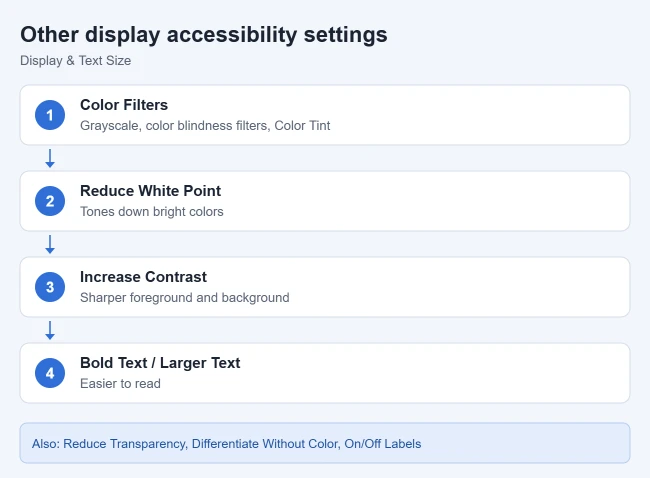
- Color Filters: choose Grayscale, Red/Green (Protanopia), Green/Red (Deuteranopia), Blue/Yellow (Tritanopia), or Color Tint, then adjust the intensity.
- Reduce White Point: tones down the intensity of bright colors.
- Increase Contrast: improves contrast between foreground and background colors.
- Reduce Transparency: makes blurred or see-through backgrounds solid.
- Differentiate Without Color: replaces items that rely only on color with shapes or text.
- Bold Text and Larger Text: make text easier to read.
How to show On/Off labels on switches
- Open Settings › Accessibility › Display & Text Size.
- Turn on On/Off Labels.
Result: switches show a vertical line when on and a circle when off, in addition to turning green.
- Open Settings › Accessibility › Display & Text Size.
- Turn on Show Borders (called Button Shapes on some versions).
Result: controls and buttons get a visible outline so they’re easier to spot. Apple covers this in Make onscreen elements easier to see on iPhone.
Change Brightness, True Tone, and Auto-Brightness
On iPhone or iPad, open Settings > Display & Brightness and drag the brightness slider. On older software, the page can be called Wallpapers & Brightness or Brightness & Wallpaper. Check the screen at a comfortable level. On supported models, switch True Tone off or on in Display & Brightness to change automatic color adaptation. iPhone 5 and 7 do not have True Tone.
For automatic brightness, open Settings > Accessibility > Display & Text Size, scroll down, and switch Auto-Brightness off or on. Older pre-iOS 11 layouts put it with the display’s brightness settings. Apple’s brightness and color guide explains both controls. Inversion, True Tone, and automatic brightness affect different aspects of the display. Temperature management can still dim a hot device even when Auto-Brightness is off.
Choose and Adjust an iPhone Color Filter
Open Settings > Accessibility > Display & Text Size > Color Filters, turn Color Filters on and select the filter suited to your needs. Adjust Intensity; Color Tint also offers a Hue control. Check text, photos and colored controls in the apps you use. To restore normal colors, turn Color Filters off on the same screen. Apple’s color-filter instructions explain the preview samples and available filters. A filter changes the display’s color rendering; it does not rewrite the original photo or change a wallpaper.
Change the iPhone Too Close Screen Distance Alert
The iPhone Too Close alert belongs to Screen Distance, rather than VoiceOver. On a supported iPhone or iPad, open Settings > Screen Time > Screen Distance and set its switch on or off. Apple’s Screen Distance guide requires a TrueDepth camera and iOS/iPadOS 17 or later. To dismiss an alert while keeping the feature enabled, move the device more than 12 inches from your face and tap Continue when available. If Screen Time is managed by a parent or organization, ask that manager about its controls instead of bypassing them. Check the switch again to confirm the preference; changing display colors, text size or VoiceOver does not change this setting.
Troubleshooting
- Colors flip back at night: Apple notes that Night Shift automatically removes inverted colors and color filter effects (except grayscale). Our guide shows how to schedule Night Shift on an iPhone.
- Night Shift or True Tone stopped working: Apple says Invert Colors, Grayscale, and Increase Contrast might turn off Night Shift or True Tone. The same warning applies when you use Night Shift on an iPad.
- Photos look like negatives: you’re using Classic Invert. Switch to Smart Invert to keep images normal.
Use Grayscale on an iPhone 5 With iOS 8
For the historical iPhone 5 running iOS 8 layout, open Settings > General > Accessibility and turn Grayscale on. The switch becomes green and the display appears in shades of gray. Return to the same switch and turn it off to restore color. This older setting differs from the newer Accessibility > Display & Text Size > Color Filters > Grayscale controls described above. It changes the screen’s appearance rather than converting the original photos into black-and-white files.
Frequently asked questions
Is Smart Invert the same as Dark Mode?
No. Dark Mode is a design that apps support. Smart Invert reverses colors in any app, which helps when an app has no dark option.
Which iPhones have these settings?
Apple lists display accessibility features on iPhone 5s and later.
Related: How to turn on Reduce Motion on iPhone, How to make text bigger on iPhone, and How to turn off the black and white screen on Apple Watch.
Choose the Right Display-Color Setting on iPad
For an iPad’s light or dark interface, open Settings > Display & Brightness and select Light or Dark. For warmer colors, open Night Shift there, review its Scheduled times and adjust Color Temperature; use its available manual switch for an immediate check. Apple documents iPad brightness and color settings. These change display appearance, not the original photo’s pixels. If the appearance changes later, review the relevant automatic schedule.
For inversion or a color filter, use Settings > Accessibility > Display & Text Size. Enable Smart Invert or Classic Invert as needed, or open Color Filters, enable it and select the intended filter; adjust any offered intensity or hue slider. Apple’s iPad color-accessibility guide distinguishes Smart Invert’s image exceptions from Classic Invert and notes that filters can affect images and video. Check a page and photo, then return to the same control to reverse an unwanted effect. These settings are not under Display & Brightness, and Night Shift can override inversion or color-filter effects except grayscale.

Matthew Burleigh is the founder, head writer, and editor of Solve Your Tech, which he launched in 2012. He has written technology tutorials since 2008 and worked in IT since 2003, including small-business support, IT management, and consulting. He holds Bachelor’s and Master’s degrees in Computer Science from Arizona State University.
Matthew writes practical guides for Windows, iPhone and iPad, Microsoft Office, Outlook, Google apps, and Android. Solve Your Tech’s guides are tested on current devices or checked against official product documentation, with clear steps, sources, and update dates.
Read more about Matthew and how Solve Your Tech writes and updates its guides, or report a correction.